
A founder is preparing next year’s budget. The sales team expects several large contracts to close, so the forecast shows rapid hiring, a bigger office, and new software investments. The finance lead is less certain: a few contracts are still in negotiation, and customer payment timing has been uneven.
Neither person is necessarily being careless. One is trying to seize an opportunity; the other is trying to make sure the business can survive delays, surprises, and ordinary volatility.
This tension appears far beyond startups. Households deciding how much mortgage they can afford, project managers staffing a major engagement, and public organizations funding new programs all face a version of the same question.
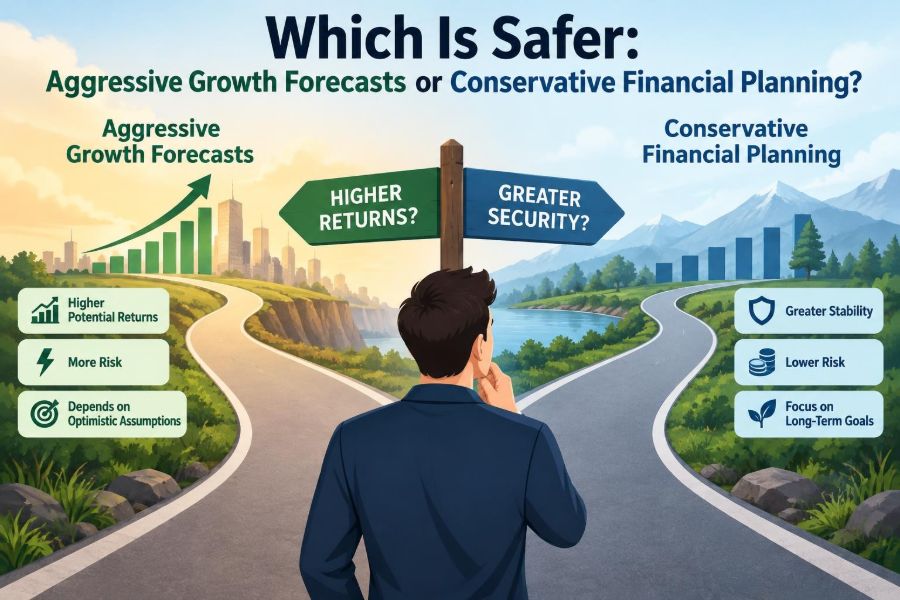
Growth forecasts and conservative financial planning are not opposing moral choices. They are different tools for making decisions under uncertainty. The safer approach depends on what is being forecast, what commitments follow from it, and how much room exists to recover if reality falls short.
🧭 Start With What “Safer” Actually Means
Safety in financial planning does not simply mean ending every year with the largest possible cash balance. It means reducing the chance that a reasonable setback creates a crisis: missed payroll, broken loan terms, cancelled projects, forced asset sales, or damaging cuts.
A plan can be safe in one dimension and risky in another. Holding too much cash may protect liquidity, for example, but consistently underinvesting can leave a company unable to serve demand or compete effectively.
The practical question is usually: which planning approach preserves choices when assumptions prove wrong?
📈 What an Aggressive Growth Forecast Assumes
An aggressive growth forecast projects revenue, customers, production, or market share rising quickly. It may rely on a strong sales pipeline, a product launch, extra capacity, a favorable market trend, or expected funding.
A forecast is not automatically reckless because it is ambitious. It becomes risky when decision-makers treat uncertain future outcomes as if they were already secured cash.
For example, a company may reasonably expect a major client to sign. Hiring ten permanent employees before the contract is executed and funded is a separate decision, with a separate risk profile.
🛡️ What Conservative Financial Planning Means
Conservative planning uses cautious assumptions about revenue, expenses, timing, and access to funding. It often includes cash reserves, contingency amounts, slower hiring, and a preference for commitments that can be adjusted if conditions change.
It does not require assuming disaster is inevitable. Rather, it recognizes that forecasts contain error and that the timing of cash receipts can matter as much as the total amount expected.
A conservative plan asks, “What can we safely commit to if the good outcome arrives later than expected?”
⚖️ Forecasts Are Estimates, Not Promises
Every forecast converts assumptions into numbers. A revenue forecast may assume a certain number of leads, a conversion rate, an average selling price, renewal behavior, and payment collection timing.
Small errors can compound. If lead volume is lower, sales cycles are longer, and customers pay later than expected, the cash effect may be far larger than any single variance suggests.
Strong planning therefore separates forecast confidence from enthusiasm. A forecast can be useful without being dependable enough to support irreversible spending.
💵 Profit Does Not Pay Bills Until Cash Arrives
Accounting profit and cash flow are related but different. A business can record revenue when it earns it under its accounting policies while waiting weeks or months to collect from customers.
It can also pay suppliers, rent, wages, taxes, and debt obligations before customer invoices are settled. This timing gap is known broadly as working-capital pressure.
That is why a growth forecast that looks profitable on an income statement can still be dangerous if it consumes cash faster than the organization can finance it.
⏳ Timing Risk Often Hides Inside Good News
Growth commonly requires spending before revenue arrives. Inventory may be purchased before it is sold. New staff may need training before they become productive. Marketing costs may be paid before leads convert.
Consider a hypothetical consulting firm that wins more work than expected. If it adds employees immediately but clients pay on extended terms, its payroll may rise months before collections do.
The opportunity may be real, yet the funding schedule may still be unsafe. Conservative planning pays close attention to the gap between the cash outflow and the cash inflow.
🔍 Revenue Quality Matters More Than a Headline Number
Not all projected revenue deserves the same level of confidence. Signed contracts, recurring renewals with reliable payers, late-stage proposals, verbal commitments, and early sales leads should not be treated as identical.
A useful forecast distinguishes the evidence behind each expected sale. This prevents a large but uncertain pipeline from being mistaken for cash that is available to spend.
📋 A practical confidence ladder
- Collected cash: available, though it may be reserved for other obligations.
- Contracted and billable revenue: relatively strong, subject to delivery and collection risk.
- Advanced opportunities: plausible but still uncertain.
- Early pipeline and market potential: valuable for strategy, weak support for fixed commitments.
🧱 Fixed Costs Make Optimism Harder to Reverse
The risk of an aggressive plan depends heavily on the costs it creates. Fixed costs continue even when revenue drops: permanent salaries, long leases, debt payments, and certain software or service contracts.
Variable costs move more closely with activity. Freelance help, usage-based services, and purchase orders can often be reduced more quickly, although not always without consequences.
Forecast-based commitments are safer when they are reversible. A business can test demand with phased hiring before taking on a large permanent cost base.
🏦 Liquidity Is the Ability to Keep Moving
Liquidity is the ability to meet near-term obligations with available cash or assets that can be converted to cash without serious disruption. It is different from long-term solvency, which concerns whether total assets and future earnings can support total obligations.
An organization may own valuable equipment, property, or inventory and still face a liquidity problem if it cannot pay wages on Friday.
Conservative planning usually prioritizes liquidity because short-term distress can force poor long-term decisions, such as accepting unfavorable financing or selling assets under pressure.
🪜 Cash Reserves Buy Decision Time
A cash reserve is not idle money by definition. It is a buffer that gives management time to investigate a missed target, adjust spending, negotiate with suppliers, or wait for receivables to arrive.
The appropriate reserve depends on cost volatility, debt terms, customer concentration, seasonality, insurance coverage, and access to reliable funding. There is no universal reserve amount that fits every organization.
The key is to define which shocks the reserve is intended to absorb. A vague “emergency fund” is less useful than a buffer designed around realistic operating risks.
🎯 Growth Can Be Risky to Reject
Conservatism also has a cost. Turning down profitable work, delaying capacity that customers clearly need, or failing to invest in a proven opportunity can reduce future earnings and weaken relationships.
For example, a manufacturer that refuses all equipment investment despite sustained, profitable demand may lose orders to competitors. In that case, the risk is not overspending but becoming unable to deliver.
Safety is therefore not achieved by minimizing activity. It is achieved by matching the scale and permanence of investment to the strength of the evidence.
📊 Use Base, Downside, and Upside Cases
A single forecast implies more certainty than planners actually possess. Scenario planning makes uncertainty visible by calculating several plausible paths rather than defending one “correct” number.
| Scenario | Typical assumptions | Planning use |
|---|---|---|
| Downside | Slower sales, delayed collections, higher costs | Tests survival and required safeguards |
| Base case | Most reasonable operating assumptions | Sets the normal budget and targets |
| Upside | Stronger demand or faster execution | Prepares capacity and investment triggers |
Scenario planning is not prediction. Its value is in exposing which decisions remain sensible across several outcomes.
🧮 Stress-Test the Plan Before Committing
A stress test asks what happens when important assumptions deteriorate together. It may model a delayed customer payment, a decline in sales conversion, a cost increase, or the loss of a major account.
The goal is not to create the bleakest imaginable story. It is to identify conditions that are plausible enough to warrant preparation.
Useful questions include:
- Can payroll and essential suppliers still be paid?
- When would available cash reach an unacceptable level?
- Which costs can be reduced quickly, and what would that damage?
- Would loan covenants or other contractual obligations be at risk?
🔢 Sensitivity Analysis Finds the Real Drivers
Sensitivity analysis changes one assumption at a time to show which variables most influence results. A small change in gross margin, customer churn, payment days, or labor utilization can sometimes matter more than a large change in top-line sales.
This is especially useful when management debates broad narratives instead of measurable drivers. It directs attention toward the assumptions worth monitoring every month.
If a plan fails when collections are modestly slower, the solution may be credit-control improvements or working-capital funding—not simply a more optimistic sales target.
📉 Break-Even Analysis Adds a Floor
Break-even analysis estimates the activity level required for revenue to cover fixed and variable costs. It does not replace a full cash forecast, but it gives decision-makers a clear operating threshold.
For a simple business, the calculation is often expressed as fixed costs divided by contribution per unit. Contribution is the selling price less the variable cost associated with that unit.
Knowing the break-even point helps leaders see whether projected growth creates a comfortable cushion or merely keeps the organization near the edge.
🧾 Budget for Contingencies, Not Perfection
A budget without any allowance for rework, price changes, delays, or minor failures is usually a wish list. Contingency planning recognizes that complex work has uncertainty even when everyone performs competently.
Contingency should be purposeful rather than a hidden pool of spending. It can be assigned to identified risks, governed by approval rules, and reviewed as risks change.
This discipline protects a plan without making every manager inflate estimates defensively.
🚦 Tie Expansion to Observable Triggers
Instead of approving all anticipated growth spending at the beginning of the year, organizations can create decision triggers. A trigger is a measurable condition that must occur before the next commitment is released.
A retailer might add staff after sales remain above a defined operating threshold for a sustained period. A software business might expand customer support after paid accounts and renewal behavior reach planned levels.
Triggers make planning more adaptive. They retain the ability to capture upside while limiting exposure to forecasts that have not yet materialized.
🧑💼 Hiring Requires Special Caution
Hiring is often the most consequential forecast-based decision because compensation carries both cash costs and human consequences. An employee is not a line item that can be adjusted without disruption.
Before permanent hiring, assess workload durability, onboarding time, productivity ramp-up, management capacity, and the consequence if demand softens. Temporary staffing, contractors, overtime, or phased offers may provide flexibility in some situations.
These options are not always cheaper or better. Their value is that they can match uncertain demand more closely while evidence develops.
🏗️ Capital Spending Needs a Different Lens
Capital expenditure, or capex, is spending on long-lived assets such as equipment, facilities, or major systems. These decisions should be evaluated not only by expected return but also by maintenance costs, implementation risk, financing terms, and resale or exit options.
A growth forecast may justify capacity investment, yet the timing matters. Leasing, pilot equipment, modular capacity, or staged implementation can sometimes reduce the cost of being wrong.
Conversely, delaying a genuinely constrained asset can be expensive if it prevents profitable production. The right choice depends on utilization evidence and alternatives, not optimism alone.
🔗 Debt Can Amplify Forecast Error
Borrowing can fund valuable investments, but debt creates scheduled obligations that do not automatically shrink when revenue disappoints. Interest, principal payments, security requirements, and covenant conditions can narrow a business’s flexibility.
Before relying on debt to fund a growth plan, model a slower revenue path and a delayed collection cycle. Understand the terms, including what happens if financial ratios or reporting requirements are not met.
Debt is not inherently unsafe. It is safer when repayment capacity remains credible under more than the upside case.
👥 Customer Concentration Changes the Risk
A forecast built on a few large customers carries a different risk from one built on many independent buyers. A single delayed renewal, procurement freeze, or operational problem can materially alter results.
Customer concentration should influence reserve levels, contract review, sales priorities, and the willingness to add fixed costs. The issue is not distrust of major customers; it is avoiding dependence that the financial structure cannot tolerate.
Revenue diversification can be slow to build, so it should be treated as a strategic resilience objective rather than an emergency fix.
🗓️ Build a Rolling Cash Forecast
An annual budget is useful, but it can become stale quickly. A rolling cash forecast is updated regularly by adding a new future period as the latest period closes.
It should focus on when cash is expected to enter and leave, including payroll, tax payments, debt service, supplier commitments, and customer collections. The aim is not false daily precision; it is early visibility of potential cash gaps.
Frequent updates turn financial planning from an annual document into an operating management tool.
🔄 Compare Actual Results With Assumptions
Variance analysis compares actual performance with budget or forecast. The most useful version goes beyond noting that a number is different: it asks why it differs and whether the underlying assumption has changed.
If sales are below forecast because one customer’s approval moved to next month, the response differs from a situation where win rates have deteriorated across the market. Good explanations lead to better revisions.
A forecast should be updated when evidence changes, not protected because it was approved earlier.
🧠 Watch for Behavioral Biases
Planning is affected by incentives and emotions. Sales teams may focus on opportunities they can see; operational teams may overestimate the pain of capacity limits; finance teams may emphasize worst-case outcomes after a difficult period.
Common biases include optimism bias, where favorable outcomes receive too much weight, and anchoring, where an old target continues to shape judgment despite new evidence.
Structured assumptions, independent review, and scenario discussion help—not because they eliminate bias, but because they make it easier to challenge.
🚫 Avoid Sandbagging as Much as Overstatement
Deliberately low forecasts can look safe, but they create their own problems. They may suppress investment, distort performance evaluation, and encourage managers to manage targets rather than improve the business.
Conservative planning should mean realistic assumptions plus safeguards. It should not mean intentionally obscuring likely demand or setting goals that fail to inform resource decisions.
The best forecast is candid about uncertainty, including both downside exposure and credible upside potential.
🗣️ Separate the Forecast From the Target
A target expresses what an organization wants to achieve. A forecast estimates what is currently likely to happen based on evidence. Treating them as the same number encourages people to report optimism rather than information.
A team can maintain an ambitious growth target while using a more cautious forecast for cash, hiring, and financing decisions. This distinction allows aspiration and prudence to coexist.
Clear language matters: ask whether a number is a goal, a commitment, a probability-weighted estimate, or a cash expectation.
🤝 Align Finance, Operations, and Sales
Finance cannot create a reliable plan from spreadsheets alone. Sales understands pipeline quality, operations understands delivery constraints, and procurement understands supplier commitments and lead times.
Cross-functional planning surfaces conflicts early. A sales forecast may require implementation staff that are not available; an operations plan may require inventory that arrives after the sales window.
Regular conversations should focus on assumptions and actions, not blame for variances. That produces information decision-makers can use.
🧪 Pilot Before You Scale
When uncertainty is high, a small test can be more informative than a large forecast debate. A pilot launch, limited geography, short-term campaign, or controlled production run can reveal demand, margin, delivery difficulty, and collection behavior.
Pilots have costs and may not perfectly represent full-scale operations. Still, they can replace an untested assumption with direct evidence.
The learning value is greatest when success criteria, spending limits, and the next decision are defined before the pilot begins.
🏠 The Same Logic Applies to Personal Finances
A household may expect a promotion, bonus, commission, or investment return. Using that expectation to take on a fixed monthly obligation can create stress if the income arrives late or does not materialize.
Conservative personal planning often bases recurring commitments on dependable income and treats uncertain income as a source of saving, debt reduction, or optional investment.
This does not prohibit thoughtful risk-taking. It recognizes that rent, food, insurance, and loan payments have dates regardless of optimism.
🧭 When Aggressive Growth Is Reasonable
A more aggressive plan can be justified when evidence is strong, margins support the expansion, cash resources are sufficient, commitments can be scaled, and management has clear visibility into execution risks.
Examples may include contracted demand exceeding current capacity, repeatable unit economics, a verified funding source, or a bottleneck that is already causing profitable sales to be lost.
Even then, a disciplined plan defines warning signs and fallback actions. Confidence should change the pace of investment, not remove the need for control.
🛟 When Conservative Planning Should Dominate
Caution deserves more weight when cash is tight, revenue is highly uncertain, fixed costs are large, debt obligations are material, or a small group of customers drives most income.
It is also sensible during major operational change, when historical data no longer reflects the new business model. Old trends may offer less reassurance than they appear to provide.
In these settings, preserve liquidity, phase commitments, and treat upside as an option to prepare for rather than income already earned.
✅ The Core Principle: Match Commitment to Certainty
The safest answer is rarely “always forecast aggressively” or “always plan conservatively.” A business needs an honest view of growth to allocate resources well, but it needs financial guardrails to remain resilient when reality varies from the model.
Use ambitious forecasts to identify opportunities, capacity needs, and strategic choices. Use conservative cash planning, scenarios, reserves, triggers, and stress tests to decide what can be committed today.
The more irreversible a commitment is, the stronger the evidence and financial buffer supporting it should be. This principle works for hiring, debt, inventory, capital projects, and household decisions alike.
Plan for growth with open eyes, but fund commitments with evidence, liquidity, and room to adapt. That balance is not timid; it is the foundation of durable financial decision-making. 💰📈🛡️