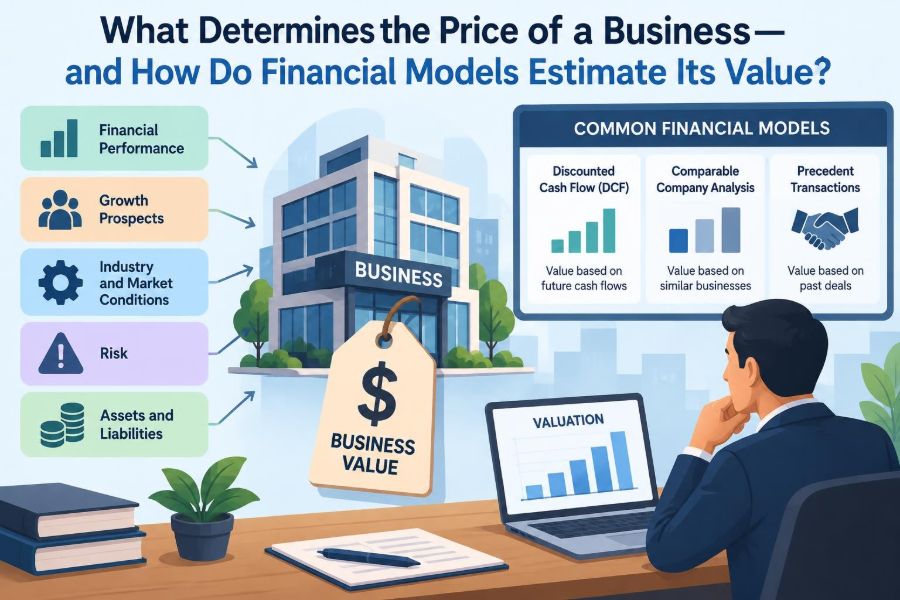

Imagine two owners considering the sale of their companies. One runs a stable plumbing contractor with recurring maintenance contracts. The other owns a fast-growing software business that has not yet produced much cash. Both ask the same question: “What is my business worth?”
The tempting answer is to look at last year’s profit, multiply it by a familiar number, and call that the price. In practice, a buyer is purchasing a claim on the business’s future cash flows, along with its assets, risks, opportunities, and obligations.
That is why a thriving business can receive a disappointing offer, while a company with modest current earnings can command a high valuation. Value is not simply an accounting total; it is a forward-looking judgment formed under uncertainty.
Financial models give that judgment structure. They do not uncover one universally “correct” price, but they help owners, investors, lenders, and students test assumptions and explain what must be true for a proposed value to make sense.
🧭 Value, Price, and Worth Are Not Quite the Same
Business value is an estimate of what an informed buyer might pay under stated assumptions. Price is the amount actually agreed in a transaction. The two can differ because a particular buyer may have special reasons to pay more or less.
For example, a national distributor may value a small regional distributor highly because it can combine warehouses, eliminate duplicate overhead, or cross-sell products. Those benefits are called synergies, and they may not be available to a stand-alone buyer.
A seller may also accept a lower price for speed, certainty, or a cash-only deal. Valuation provides a reasoned range; negotiation determines where, if anywhere, a final price lands.
🏢 What a Buyer Is Actually Acquiring
A business sale can transfer far more than equipment and inventory. A buyer may be acquiring customer relationships, trained employees, contracts, a brand, operating systems, licenses, data, and a place in a market.
Some of these resources appear on the balance sheet. Many do not. A loyal customer base built over years, for instance, may be economically valuable even though internally developed customer relationships are usually not recorded as an asset at their estimated market value.
The buyer is also taking on exposure to problems: expiring contracts, obsolete stock, product claims, weak controls, environmental obligations, or a founder whose departure could disrupt sales.
🔮 Future Cash Flow Sits at the Center
Most valuation methods ultimately focus on the cash a business can generate for its capital providers. Accounting profit matters because it helps describe performance, but profit is not automatically cash.
A company can report a profit while consuming cash by extending credit to customers, building inventory, or buying equipment. Conversely, a temporary accounting loss does not necessarily mean a company lacks future value if it is investing in a credible, cash-generating opportunity.
A useful question is: after paying operating costs, taxes, and the investment needed to keep the business functioning and growing, how much cash can reasonably be distributed or used to reduce debt?
📚 Accounting Statements Supply the Raw Material
Valuation models begin with financial statements, management accounts, tax records, and operating data. The income statement shows revenue and expenses; the balance sheet shows resources and obligations; the cash flow statement helps reconcile profit with changes in cash.
These records are starting points, not final answers. A model often adjusts historical figures to separate recurring operations from unusual events and to estimate what performance would look like for a typical owner.
Reliable, consistent accounting makes this work faster and more credible. Poor records do not always destroy value, but they create uncertainty—and buyers generally demand protection for uncertainty.
🧹 Normalizing Earnings Makes History Comparable
Normalized earnings are historical earnings adjusted to represent ongoing operating performance. The goal is not to make results look better. It is to remove items that distort a buyer’s view of repeatable cash generation.
Common adjustments may include a one-time legal settlement, a temporary shutdown, a non-recurring gain on asset sales, or owner expenses that would not continue after a sale. Each adjustment needs evidence and a clear explanation.
Suppose an owner’s travel includes personal holidays. A buyer may add back the personal portion when estimating normalized earnings. But a buyer should not add back ordinary sales travel merely because it feels discretionary; it may be necessary to maintain revenue.
🧾 Revenue Quality Matters as Much as Revenue Size
Two businesses with identical sales can deserve very different valuations. The key distinction is whether revenue is durable, predictable, and profitable.
- Long-term contracts and subscriptions can improve predictability.
- A diverse customer base reduces dependence on one account.
- High renewal rates may indicate customer loyalty, but should be examined alongside pricing and service quality.
- Revenue driven by a one-off project or a short-lived trend is usually less dependable.
Buyers look beyond the top line: they ask who pays, why they stay, whether contracts can be assigned, and whether margins survive after the transaction.
📈 Growth Has Value Only When It Is Credible
Expected growth can increase valuation because it creates the prospect of larger future cash flows. Yet forecasts deserve scrutiny. A plan to double sales is not a valuation input simply because management wrote it in a budget.
Credible growth has operational support: capacity, a realistic sales pipeline, adequate working capital, capable staff, customer demand, and a path to preserve margins. Growth funded by steep discounts or excessive spending may add revenue while reducing cash.
Financial models commonly show a base case, an upside case, and a downside case. This makes uncertainty visible rather than hiding it inside one optimistic forecast.
⚙️ Margins Reveal Economic Strength
Revenue is only the first layer. Gross margin shows the amount left after direct costs; operating margin reflects the cash-generating potential after broader operating expenses. Strong margins can indicate pricing power, efficient operations, or a differentiated offering.
Margins should be compared over time and understood in context. A retailer with lower margins may turn inventory quickly and earn attractive returns. A consultancy may have high margins but depend heavily on a few individuals.
A model should ask what will happen to margins as the company grows. New hires, capacity constraints, supplier pricing, and customer concentration can all change the answer.
🏗️ Capital Intensity Changes the Cash Story
Some businesses need substantial ongoing investment in machinery, vehicles, stores, technology, or inventory. Others can grow with comparatively little capital. This difference affects the cash available to investors.
Capital expenditure, often called capex, is spending on long-lived operating assets. Maintenance capex keeps current operations running; growth capex supports expansion. A model should not assume all capex can be eliminated without consequences.
A business with modest accounting profit but low reinvestment needs may produce more distributable cash than a higher-profit competitor that constantly needs new equipment.
🔄 Working Capital Can Absorb Cash Quietly
Working capital is commonly measured as current operating assets minus current operating liabilities. In practical terms, it captures cash tied up in receivables and inventory, partly offset by supplier credit and other short-term operating obligations.
Fast growth can consume cash when receivables and stock rise before customers pay. A manufacturer may report increasing profits while needing more borrowing just to fund larger orders.
Valuation forecasts therefore model likely changes in working capital. Ignoring them can overstate cash flow, especially in businesses with seasonal sales, long collection periods, or inventory-heavy operations.
💳 Debt Changes Who Receives the Value
Business value is often discussed using two related concepts. Enterprise value represents the value of the operating business available to both lenders and shareholders. Equity value is what remains for owners after considering debt and debt-like claims.
A simplified bridge is enterprise value less interest-bearing debt, plus excess cash, subject to careful treatment of leases, pension obligations, preferred instruments, and transaction-specific items. The exact bridge depends on the deal and the valuation purpose.
Two companies may have identical operations and enterprise values, yet very different equity values if one has much more debt. Confusing these terms is a common source of misunderstanding.
🧮 Free Cash Flow Is a Practical Valuation Measure
Free cash flow generally means cash generated by operations after taxes and the investment required to sustain the business. The precise definition varies by model, especially depending on whether it is measured before or after interest payments.
A simplified unlevered cash flow approach begins with operating profit after tax, then adds non-cash charges such as depreciation, subtracts capital expenditure, and subtracts increases in working capital. It measures cash available to debt and equity providers.
Because definitions differ, analysts should label their cash flow clearly. Mixing a cash flow before interest with a discount rate intended for equity holders produces an internally inconsistent valuation.
🏷️ The Income Approach Values Cash Flows Directly
The income approach estimates value from expected future economic benefits. Its best-known form is the discounted cash flow, or DCF, model.
A DCF forecasts free cash flow over an explicit period, often several years, then estimates a continuing value for cash flows beyond that period. Those amounts are discounted back to today because a dollar received later is less certain and cannot be invested today.
DCF analysis is especially useful when historical results do not fully represent future operations, such as after a turnaround, major investment program, or planned expansion. It is only as sound as its assumptions.
⏳ Discounting Reflects Time and Risk
A discount rate converts future cash flows into present value. It reflects the time value of money and the return investors require for bearing risk. Higher perceived risk generally means a higher rate and a lower present value.
Risk can arise from customer concentration, volatile demand, leverage, dependence on key people, regulatory exposure, weak data, or simply uncertainty in the forecast. It should not be counted twice without thought—for example, once through very pessimistic cash flows and again through an excessively high discount rate.
Discount rates are not magic percentages selected to force a desired answer. They should fit the type of cash flow, the business’s financing assumptions, and the market evidence available.
♾️ Terminal Value Often Drives the Result
Most businesses are expected to operate beyond the final year of a detailed forecast. Terminal value estimates the value of those later cash flows. It can be calculated using a long-term growth assumption or an exit multiple.
Because terminal value may represent a large share of a DCF result, small changes in its assumptions can have a large effect. A perpetual growth rate should be economically plausible and consistent with the company’s maturity, market, and reinvestment needs.
A model that produces a striking valuation mainly because of an aggressive terminal assumption deserves careful challenge. The detailed forecast should connect logically to the steady state that follows.
📊 The Market Approach Uses Comparable Evidence
The market approach estimates value by observing what investors pay for similar businesses. Public-company multiples and completed transaction multiples are common sources of reference.
A multiple might compare enterprise value with revenue, EBITDA, or operating profit. EBITDA—earnings before interest, taxes, depreciation, and amortization—is widely used because it can help compare operating performance across capital structures, but it is not a substitute for cash flow.
Comparable evidence is useful only when the comparables are genuinely comparable. Industry labels alone are not enough; growth, margins, scale, geography, risk, and business model all matter.
🔍 Choosing a Multiple Requires Judgment
A high-growth subscription business and a project-based contractor may both be described as “technology services,” but their revenue visibility and reinvestment demands can differ sharply. Applying one company’s multiple to the other without adjustment is misleading.
When selecting comparables, analysts consider factors such as:
- Size, market position, and geographic reach
- Growth rate and margin profile
- Customer concentration and contract duration
- Capital intensity and working-capital needs
- Whether the reference transaction included control or synergies
Multiples are shorthand for market expectations. They are not universal rules that automatically determine a company’s worth.
🧱 The Asset Approach Starts With What the Business Owns
The asset approach estimates value from the fair value of identifiable assets less liabilities. It is often relevant for asset-heavy companies, investment holding entities, real estate businesses, or companies whose earnings do not yet support an income-based valuation.
A book-value balance sheet may require significant adjustment. Land, equipment, inventory, receivables, and liabilities may have values different from their recorded amounts. Obsolete inventory or doubtful receivables can reduce value; under-recorded obligations can do the same.
For a profitable operating business, asset value may set a useful floor or cross-check, but it can understate the value of profitable relationships and intangible advantages.
🧠 Intangible Assets Can Explain the Gap
When a buyer pays more than the fair value of identifiable net assets, the difference may reflect goodwill: expected benefits from a combined set of assets, such as reputation, assembled workforce, customer relationships, and operating know-how.
Some identifiable intangibles can be valued separately in a transaction, including trademarks, patents, software, licenses, or contractual customer relationships. Their treatment depends on the purpose of the valuation and applicable accounting or legal requirements.
The practical lesson is simple: the absence of an asset from a historical balance sheet does not mean it lacks value. It does mean the buyer needs evidence that the advantage is real and transferable.
👥 Management Depth Reduces Key-Person Risk
A company that depends on one owner for sales, technical judgment, supplier relationships, or customer trust presents a transition risk. If that person leaves, revenue or operational continuity may suffer.
Buyers assess whether knowledge is documented, whether managers can operate independently, and whether customers deal with the company rather than only with the founder. Employment agreements or transition support can help, but cannot fully replace a durable team.
For owners preparing to sell, building management depth can improve both business resilience and valuation credibility.
⚖️ Control, Minority Stakes, and Liquidity Affect Value
A controlling interest usually gives the holder authority over strategy, distributions, leadership, and a potential sale. A minority interest may lack those rights. The same percentage of a company can therefore have different value depending on what it allows its holder to do.
Interests in private companies can also be difficult to sell quickly. This lack of marketability may influence value in certain appraisal contexts, though the appropriate treatment depends on the specific facts and standard of value.
These issues show why valuation begins by defining exactly what is being valued: the whole business, a controlling block, a minority stake, or a particular class of shares.
🤝 Deal Terms Can Change the Economic Price
Headline price alone does not tell the full story. Payment timing, earn-outs, seller financing, working-capital targets, retained liabilities, indemnities, and escrow arrangements can change both risk and economic value.
An earn-out pays part of the consideration later if agreed performance targets are achieved. It can bridge a disagreement about future performance, but it also creates measurement and control questions after closing.
A lower all-cash offer with limited conditions may be preferable to a higher offer dependent on future targets or financing. Comparing proposals requires translating their terms into expected cash, timing, and risk.
🧪 Sensitivity Analysis Shows What Really Matters
A point estimate can create false confidence. Sensitivity analysis changes important assumptions—such as revenue growth, operating margin, discount rate, capex, or terminal growth—to see how the valuation moves.
A simple sensitivity table can reveal whether value depends mainly on an ambitious forecast or remains reasonable under several plausible scenarios. It also directs attention to the assumptions that deserve the most diligence.
| Assumption | If it changes | Likely valuation effect |
|---|---|---|
| Revenue growth | Lower customer demand or slower sales execution | Future cash flows decline |
| Operating margin | Higher costs or weaker pricing | Cash generation declines |
| Discount rate | Greater perceived risk | Present value declines |
| Working capital need | More cash tied up in receivables or inventory | Free cash flow declines |
🧱 Scenario Planning Tests the Business Narrative
Sensitivity analysis changes one variable at a time. Scenario planning changes a connected set of assumptions to reflect a coherent future: for example, a recessionary case, a steady base case, and an expansion case.
A downside scenario might combine lower sales, slower collections, and reduced margins rather than assuming every negative event occurs independently. An upside scenario should also include the investment needed to support success.
Scenarios are not predictions. Their purpose is to test resilience and show how much of the proposed value relies on favorable conditions.
🔎 Due Diligence Turns a Model Into a Decision
Financial models rely on information that must be verified. Due diligence is the process of investigating financial, commercial, legal, tax, operational, and other matters before a transaction.
Typical work includes reconciling management accounts to source records, reviewing major contracts, testing customer concentration, examining aged receivables and inventory, understanding tax exposures, and confirming ownership of key assets or intellectual property.
Diligence may validate a forecast, require a price adjustment, or change the deal structure. It is not merely a final checklist; it is the evidence-gathering process that makes valuation assumptions more reliable.
🚩 Common Modeling Mistakes to Avoid
Many weak valuations fail through avoidable inconsistencies rather than advanced mathematical errors. A polished spreadsheet cannot compensate for unsupported inputs.
- Using EBITDA as if it were cash flow while ignoring capex and working capital
- Applying a public-company multiple without adjusting for size, liquidity, or risk
- Counting a benefit twice through both forecast improvements and a lower discount rate
- Forgetting debt, surplus cash, or liabilities when moving from enterprise to equity value
- Using a terminal growth assumption that is disconnected from the business’s long-term economics
- Treating one valuation method as proof rather than comparing several perspectives
Good modeling is transparent enough that another informed person can trace the logic, challenge assumptions, and reproduce the calculations.
🛠️ A Disciplined Valuation Workflow
A reliable process is usually more valuable than a clever formula. Start by defining the valuation date, the interest being valued, the purpose, and the relevant standard of value. Then gather records and understand how the business actually makes money.
- Analyze historical results and normalize unusual items.
- Build operating forecasts tied to real business drivers.
- Convert forecast performance into cash flow, including reinvestment needs.
- Apply appropriate income, market, and, where relevant, asset approaches.
- Reconcile results, test sensitivities, and document judgment calls.
The final output should explain not only the indicated value, but also the assumptions, risks, and conditions that support it.
🎯 The Core Principle: Value Is a Defensible View of the Future
The price of a business is shaped by its expected cash generation, the durability of its revenue, the investment needed to grow, the risks a buyer must bear, its capital structure, and the specific terms of a deal. Financial models organize these factors into a disciplined estimate.
No spreadsheet can remove uncertainty. What it can do is make uncertainty explicit: which assumptions drive value, what evidence supports them, and how the conclusion changes when conditions differ.
That is the real purpose of business valuation. It is not to produce a precise-looking number on demand, but to support a better-informed decision about an inherently uncertain future.
A business is worth what its future benefits are reasonably expected to deliver to the right buyer, after accounting for the cash, risk, and investment required to earn them. 💰📊🤝