
It is the third working day of the month, and the finance team is already chasing numbers. Sales has sent a revised pipeline file, operations has updated staffing assumptions, procurement has flagged a supplier increase, and the latest actuals do not match the management dashboard.
Someone still has to decide which version is current, why gross margin moved, and whether the annual budget remains credible. The spreadsheet may calculate correctly, yet the work of collecting, reconciling, interpreting, and explaining can consume far more time than the calculation itself.
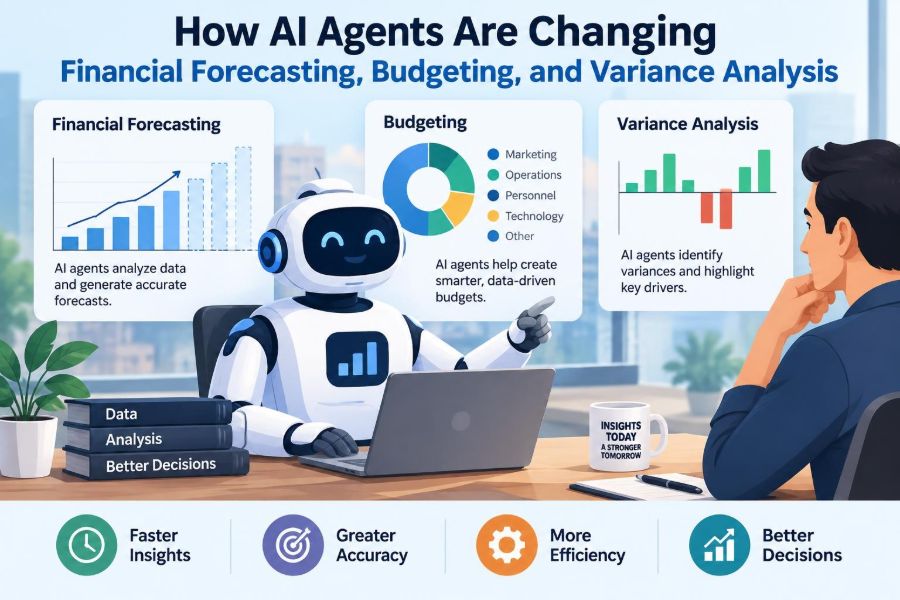
This is where AI agents are beginning to change financial planning and analysis. They do not replace accounting judgment or management accountability. Instead, they can take on parts of the recurring workflow: gathering approved data, testing assumptions, generating scenarios, investigating variances, and preparing a traceable first draft of the story behind the numbers.
For students, this shift changes the skills worth developing. For working professionals, it raises a more immediate question: which forecasting and budgeting tasks can be safely redesigned, and which must remain firmly under human control?
🧭 What an AI Agent Means in Finance
An AI agent is software that can pursue a defined goal through several steps. It can receive an instruction, retrieve information from permitted systems, apply rules or analytical methods, produce an output, and sometimes trigger a workflow for human review.
That is different from a basic chatbot that answers a single question. It is also different from a fixed automation that follows the same prescribed path every time. An agent may decide that it needs actual revenue, open orders, and pricing changes before it can investigate a sales variance.
In finance, the word “agent” should not imply independence without limits. A well-designed agent operates within permissions, policies, approval thresholds, and documented source data.
🧩 Why Forecasting Work Is a Natural Starting Point
Forecasting contains repeatable activities but rarely follows one perfectly fixed script. Teams regularly refresh actuals, compare results with plan, collect operational drivers, update assumptions, and explain what changed.
Those activities are suitable for assistance because they combine structured data with recurring judgment prompts. An agent can perform the clerical and analytical preparation, then route uncertain or material issues to a finance professional.
The opportunity is not simply to finish the forecast faster. It is to give analysts more time to test commercial assumptions, challenge optimistic inputs, and discuss decisions with operating leaders.
📚 The Difference Between Automation, Analytics, and Agents
These terms are often used as though they mean the same thing. They do not, and the distinction matters when selecting controls.
| Approach | Typical behavior | Example in FP&A | Main control need |
|---|---|---|---|
| Automation | Runs a fixed sequence | Loads a monthly trial balance | Exception handling and access control |
| Analytics or model | Calculates, predicts, or classifies | Projects demand from historical patterns | Model validation and monitoring |
| AI agent | Combines tools and steps toward a goal | Finds drivers of a margin variance and drafts questions | Permissions, evidence, review, and action limits |
A mature finance process may use all three. Automation provides reliable movement of data, predictive models estimate outcomes, and an agent coordinates analysis around a defined business question.
🏗️ The Data Foundation Comes First
An agent cannot repair a weak chart of accounts, inconsistent customer identifiers, or an undocumented allocation rule by itself. It may make a fragmented process appear smoother while preserving the same underlying errors.
Useful foundations include a governed general ledger, clear master data, reliable operational systems, defined planning dimensions, and a record of how metrics are calculated. Finance should know which source is authoritative for revenue, headcount, inventory, and cash.
Before introducing an agent, ask a basic question: if two analysts use the approved data today, should they reach the same starting number? If the answer is no, data governance is the first project.
🔐 Permissions Shape What an Agent Can Safely Do
Financial data often includes payroll, customer pricing, supplier terms, and strategic plans. An agent should receive only the access needed for its role, following the principle of least privilege.
Read access to a planning model is not the same as permission to change a forecast. Permission to draft a budget commentary is not permission to send it externally or post a journal entry.
- Separate access to sensitive data from access to general planning data.
- Use approved service identities rather than shared personal credentials.
- Maintain logs of data retrieved, calculations performed, and outputs produced.
- Require approval before changes are committed to core finance systems.
These are not obstacles to innovation. They are the conditions that make experimentation defensible in an audited environment.
📥 Bringing Actuals into the Forecast Cycle
A rolling forecast needs a dependable actuals refresh. An agent can check whether the period is closed, retrieve approved actuals, map them to planning categories, identify missing values, and prepare a reconciliation between ledger balances and the planning tool.
Consider a hypothetical retailer. At month-end, the agent imports sales, returns, payroll, and inventory movements only after the relevant close-status checks pass. If returns are still being adjusted, it labels the revenue input as provisional instead of quietly treating it as final.
This status awareness is essential. A fast forecast based on incomplete actuals can create more confusion than a later forecast based on approved numbers.
🔄 Rolling Forecasts Become More Responsive
A rolling forecast extends the planning horizon as each period closes. Rather than treating the annual budget as the only view, management receives an updated outlook based on current conditions.
AI agents can help maintain this rhythm by refreshing actuals, carrying forward approved assumptions, identifying expired inputs, and prompting owners to revisit drivers. A sales forecast might require an update when win rates, deal timing, or average contract value moves beyond a preset range.
The agent should not automatically convert every short-term fluctuation into a new long-term expectation. Finance still needs to distinguish noise from a meaningful change in business conditions.
🧮 Driver-Based Forecasting Gives Agents Something Useful to Work With
Forecasts are stronger when they are linked to operating drivers rather than only to prior-year amounts. Revenue may depend on units, price, customer retention, and sales capacity. Labor cost may depend on headcount, wage rates, hiring dates, and overtime.
Agents can retrieve these drivers, test whether they reconcile with financial outputs, and flag assumptions that conflict with available evidence. For example, planned revenue growth may require a sales volume that exceeds manufacturing capacity.
Driver-based models also make explanations clearer. Instead of saying that revenue is “up,” finance can describe whether the movement comes from volume, price, mix, timing, or foreign exchange.
🔮 Predictive Models Are Inputs, Not Decisions
Machine-learning models can estimate future values from historical patterns and available signals. Demand forecasts, payment timing estimates, and expense projections are common examples.
But a prediction is not a business decision. A model trained on stable history may perform poorly after a product launch, pricing change, acquisition, supply disruption, or regulatory shift. Historical data does not automatically contain a reliable answer for a new event.
An agent can compare a model estimate with management assumptions and show the difference. The finance team must decide which view is appropriate, document the rationale, and revisit the choice when new evidence arrives.
🌦️ Scenario Planning Moves Beyond One Number
Management rarely needs only a base-case forecast. It needs to understand the range of plausible outcomes and the assumptions that create them.
An agent can prepare scenarios by changing controlled assumptions: a delayed product launch, lower conversion rates, a currency movement, or a hiring freeze. It can calculate the resulting effects on revenue, margin, cash, and covenant headroom where relevant.
Three questions a useful scenario should answer
- What assumption changed?
- Which financial lines and operational constraints are affected?
- What action would management consider if that case begins to occur?
A scenario is not a prediction. It is a structured way to prepare for uncertainty and identify leading indicators worth watching.
🎯 Budgeting Shifts from Collection to Challenge
Traditional budgeting often becomes an exercise in collecting templates, following up with owners, fixing broken formulas, and consolidating submissions. Agents can reduce this administrative load by checking completeness, validating formats, comparing submissions with approved baselines, and issuing targeted reminders.
That allows finance to focus more on the quality of the budget. Is the growth target supported by capacity? Does the cost plan reflect signed contracts? Has a department assumed savings that another department has already counted?
The goal is not to make budgeting effortless. A useful budget should still involve constructive challenge because it allocates limited resources and establishes accountability.
🗂️ Assumption Libraries Reduce Hidden Logic
Many planning models contain critical assumptions buried in formulas, emails, or one analyst’s notes. An assumption library places key inputs in a governed location with an owner, effective date, status, and explanation.
An agent can retrieve approved assumptions from that library and warn when a model uses an outdated rate. It can also summarize which assumptions changed since the previous forecast cycle.
This improves traceability. When management asks why a forecast changed, finance can show whether the cause was an updated price, hiring plan, volume outlook, exchange rate, or allocation method.
🧹 Data Reconciliation Is a High-Value Agent Task
Before analysis begins, finance often needs to reconcile totals across the general ledger, subledgers, planning system, and management reports. This is tedious work, but it is central to trust.
An agent can compare balances, identify unmatched records, group differences by likely source, and create an exception list. It may detect, for example, that a newly created cost center exists in the ledger but has not yet been mapped into the planning hierarchy.
It should not conceal a difference merely because it can find a plausible mapping. Material or ambiguous exceptions need an owner, a documented resolution, and sometimes an accounting review.
🔍 Variance Analysis Becomes a Search for Drivers
Variance analysis compares actual results with a benchmark such as budget, forecast, prior period, or prior year. The numerical difference is only the start. Decision-makers need to understand what caused it and whether it is likely to continue.
Agents can decompose a variance across dimensions such as entity, product, customer group, region, account, and month. They can rank the largest contributors and identify combinations that explain a meaningful share of the movement.
For example, a gross-margin shortfall may be linked to a sales mix change, freight costs, a supplier price increase, and an inventory adjustment. The agent can organize this evidence; the controller must determine whether the explanation is complete and accounting-consistent.
📏 Materiality Prevents Analysis from Becoming Noise
A system that comments on every small movement will quickly lose credibility. Finance needs rules for materiality: the size, nature, and context that make a variance worth escalating.
Materiality is not only a percentage threshold. A small expense can matter if it signals a control failure, compliance concern, or developing operational issue. Conversely, a large planned seasonal movement may require little investigation.
Agents can prioritize exceptions using approved thresholds and context, but those thresholds should be reviewed. A rule appropriate for a large revenue account may be unhelpful for a small but sensitive legal or payroll account.
🧠 Natural-Language Narratives Need Evidence
One visible feature of generative AI is its ability to draft commentary in plain language. A finance agent might produce a first-pass monthly narrative: revenue exceeded forecast because of higher volume in one region, while margin declined because lower-margin products made up a larger share of sales.
This can save time, but fluent wording can create false confidence. Every significant sentence should be traceable to a number, a documented assumption, or a verified operational explanation.
A practical standard is simple: a reviewer should be able to ask “how do we know this?” and locate the supporting evidence without reconstructing the analysis from scratch.
🧾 Explainability Matters More Than Polished Output
In finance, an answer that cannot be explained is difficult to approve. Explainability means the organization can understand the source data, transformations, calculation logic, assumptions, and reasoning path behind an output.
For an agent-generated variance explanation, retain the relevant period, data extracts, mapping rules, prompts or instructions, calculation outputs, and reviewer decisions. The exact technical record will depend on the organization and system design, but the principle is consistent.
Explainability also helps learning. When an analyst can inspect why the agent reached a conclusion, they can challenge it, refine the process, and improve their own business understanding.
🧑⚖️ Human Review Is a Design Choice, Not a Fallback
Human-in-the-loop review should be deliberately placed where judgment, accountability, or risk is highest. It is not an admission that the technology has failed.
Good candidates for mandatory review include changes to published forecasts, material assumptions, unusual journals, external communication, sensitive employee data, and explanations that could influence investment or lending decisions.
Lower-risk tasks may be more automated, such as preparing a refresh checklist or identifying a missing departmental submission. The degree of autonomy should match the consequence of being wrong.
⚠️ Hallucinations and False Explanations Remain Real Risks
Generative systems can sometimes produce statements that sound plausible but are unsupported, incomplete, or wrong. In finance, an invented explanation for a variance can distract management from the actual issue.
Risk increases when the agent lacks access to authoritative data, receives vague instructions, or is asked to infer operational facts that were never recorded. It can also arise when a system merges data from different periods or definitions.
Controls include constrained data retrieval, approved calculation tools, evidence citations inside internal workflows, exception flags, and reviewer sign-off. Never treat a well-written narrative as proof.
🧪 Testing an Agent Requires More Than Checking One Good Example
An agent should be tested against realistic cases before it is used in a live close or forecast process. Include routine cases, missing data, conflicting sources, unusual transactions, late adjustments, and intentionally misleading prompts.
Testing should assess more than whether the final number looks reasonable. Does the agent use the correct period? Does it respect access restrictions? Does it escalate uncertainty? Does it preserve an audit trail? Does it refuse actions outside its authority?
Finance teams should also re-test after material changes to source systems, model logic, accounting structures, or the agent’s instructions.
📊 Measuring Value Means Looking Beyond Hours Saved
Time savings matter, especially in a compressed close cycle, but they are not the only measure of value. A process can be faster while becoming harder to control.
Useful measures may include forecast refresh time, reconciliation exceptions resolved, percentage of commentary supported by evidence, number of late inputs detected, forecasting error over appropriate periods, and user satisfaction with the quality of insights.
Choose measures carefully. Lower forecast error is not always the sole goal: a forecast can be statistically accurate yet operationally unhelpful if it does not reveal risks early enough to support action.
🧱 Start with a Narrow, Repeatable Use Case
The most practical implementations usually begin with one contained problem. Examples include a monthly expense-variance briefing, headcount forecast reconciliation, cash-collections follow-up list, or budget-submission quality check.
A narrow use case makes it easier to define inputs, outputs, ownership, and success criteria. It also exposes issues in data definitions and approval design before the organization gives an agent a broader role.
- Map the current process and identify the recurring bottleneck.
- Define the approved data sources and decisions the agent may not make.
- Build review points and evidence requirements into the workflow.
- Pilot with parallel human work, compare results, then refine.
Scale should follow demonstrated reliability, not enthusiasm alone.
👥 Finance and Operations Must Share the Workflow
Forecasting fails when finance owns the model while operations owns the facts but neither owns the connection between them. AI agents can surface gaps faster, but they cannot resolve conflicting incentives.
Sales leaders may understand pipeline quality; operations may know capacity constraints; procurement may know contract timing; finance understands the financial consequences and control requirements. The workflow should make each contribution visible.
Clear ownership helps: operational teams provide and validate drivers, finance governs definitions and consolidates the financial view, and senior management makes decisions using documented alternatives.
🎓 Skills That Become More Valuable
Spreadsheet proficiency remains useful, but the professional advantage shifts toward skills that help people supervise and improve intelligent workflows. That includes data literacy, accounting knowledge, business partnering, scenario design, control awareness, and the ability to ask precise questions.
Students should practice translating an operational event into financial drivers. For example, how would a longer supplier lead time affect inventory, working capital, production, revenue timing, and cash?
Working professionals can strengthen their role by learning how systems connect, documenting key calculations, and reviewing AI outputs critically. The valuable skill is not merely using a prompt; it is recognizing when an answer does not make economic or accounting sense.
🪜 A Practical Maturity Path
Organizations do not need to leap from manual spreadsheets to fully autonomous planning. A staged approach lowers risk and builds confidence.
Stage 1: Assist
The agent retrieves data, prepares reconciliations, drafts questions, and generates commentary for review. Humans make all material decisions and changes.
Stage 2: Recommend
The agent suggests forecast updates or investigation paths based on rules and evidence. Finance reviews and approves the recommendation before it affects official plans.
Stage 3: Act within guardrails
The agent performs low-risk, pre-approved actions such as sending reminders or updating a nonfinancial status field. Higher-risk actions remain subject to approval.
This maturity path recognizes that trust is earned through reliable operation, not claimed at launch.
🚫 Common Implementation Mistakes
One mistake is beginning with a broad promise to “use AI in finance” instead of a measurable workflow. Another is treating the agent as an analytics solution when the true problem is poor master data or unclear ownership.
Teams also underestimate change management. If users do not understand why an output changed, how to challenge it, or who approves it, they may ignore the tool or rely on it inappropriately.
- Do not let an agent overwrite approved plans without defined authority.
- Do not mix provisional and final actuals without visible labels.
- Do not use unverified narrative as a substitute for a reconciliation.
- Do not judge success only by the quality of a demonstration.
📌 A Hypothetical Monthly Variance Workflow
Imagine a manufacturing company reviewing an unfavorable materials-cost variance. After close status is confirmed, an agent retrieves approved purchase data, production volumes, standard-cost assumptions, and inventory adjustment records.
It finds that the variance is concentrated in two plants and separates the movement into purchase-price changes, usage differences, and inventory-related adjustments. It then compares the supplier-price component with contract data and flags one unmatched supplier code for review.
The agent drafts a briefing that identifies supported drivers, labels the unmatched item as unresolved, and asks whether a change in product mix contributed to the usage variance. The plant controller and procurement lead validate the explanation before management receives it. This is assistance with accountability preserved.
⚖️ Governance Connects Innovation to Trust
Governance is the set of roles, policies, controls, and evidence that guide responsible use. In financial processes, it should cover data access, model ownership, change approval, monitoring, records retention, and escalation.
Governance should be proportionate. A low-risk assistant that summarizes publicly available economic commentary needs different controls from an agent that accesses payroll data or influences an official earnings forecast.
Clear governance gives capable teams room to innovate safely. Without it, pilots can multiply into inconsistent tools that produce conflicting numbers and unclear accountability.
🌱 The Core Principle: Better Decisions, Not Just Faster Outputs
AI agents can reduce the friction around forecasting, budgeting, and variance analysis. They can bring information together, enforce routine checks, expose exceptions, run controlled scenarios, and turn numerical movements into questions that deserve attention.
Yet the quality of the result still depends on sound data, transparent assumptions, meaningful controls, and informed human judgment. Finance is not only a reporting function; it is a decision-support and stewardship function.
The strongest design treats the agent as a disciplined colleague: quick with preparation, explicit about evidence, constrained by authority, and always open to challenge.
AI agents create lasting value in finance when they make planning more traceable, analysis more timely, and human judgment more effective—not when they merely make reports sound more polished. 📊🧠✅