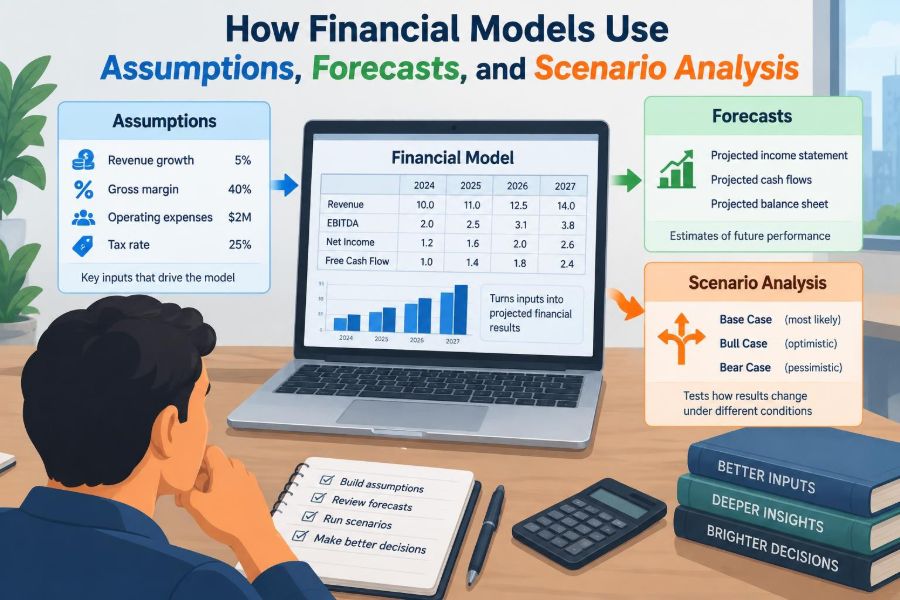

A finance team is deciding whether to open a new location, acquire a smaller competitor, or invest in automation. The spreadsheet on the screen appears to offer a clear answer: projected revenue rises, cash remains positive, and the investment seems worthwhile.
But every result in that spreadsheet depends on choices made before the formulas run. How quickly will customers be added? Can prices increase? Will suppliers charge more? When will the company actually collect cash?
Those choices are assumptions. They turn a spreadsheet from a record of the past into a model of possible futures.
Financial models are valuable not because they predict one exact outcome, but because they make uncertainty visible, testable, and easier to discuss. 📊
🧭 1. What a Financial Model Actually Does
A financial model is a structured representation of how a business, project, transaction, or decision may perform financially. It connects operational drivers to accounting outcomes and cash consequences.
For example, expected customer growth may drive units sold, units sold may drive revenue, revenue may drive receivables, and receivables may affect operating cash flow.
A good model does not merely calculate totals. It explains the logic connecting inputs, activities, and financial statements.
🧱 2. Assumptions Are the Model’s Building Blocks
An assumption is an input that represents an expected condition when the outcome is not yet known. It can be based on history, contracts, management plans, market research, operational capacity, or professional judgment.
Examples include sales volume growth, average selling price, wage increases, payment terms, interest rates, tax rates, and inventory days.
Assumptions should be explicit. If a reader cannot identify what the model assumes, they cannot properly evaluate its conclusion.
🔎 3. Separate Facts From Assumptions
Some model inputs are known facts, while others are estimates. Confusing the two can create false confidence.
- Facts may include signed lease payments, current debt balances, contractual interest rates, and historical sales already recorded.
- Assumptions may include renewal rates, future hiring needs, commodity prices, future borrowing rates, and customer adoption.
- Decisions may include a planned price increase, launch date, capital expenditure, or financing mix.
Labeling these categories helps reviewers challenge the right items without reopening settled information.
🗂️ 4. Build an Assumptions Register
An assumptions register is a central list of key inputs used in the model. It improves transparency and prevents values from being buried inside formulas or scattered across worksheets.
For each assumption, record its value, unit, timing, source, owner, rationale, and update date. A note such as “monthly churn based on recent cohorts” is more useful than an unexplained percentage.
It also creates accountability: someone should be able to explain why each material assumption belongs in the model.
🎯 5. Start With the Decision, Not the Spreadsheet
Before choosing assumptions, define the decision the model is intended to support. A model for annual budgeting needs different detail from a model for a loan application, valuation, or plant expansion.
Ask what the decision-maker needs to know: affordability, profitability, liquidity, valuation, covenant headroom, payback period, or downside exposure.
A clear purpose keeps the model proportionate. More rows and formulas do not automatically create a better answer.
📅 6. Choose a Time Horizon That Fits the Question
The forecast period should reflect the economic life of the decision and the reliability of available information. A short working-capital model may focus on weeks or months, while a long-lived investment may require several years.
Near-term periods can often be modeled monthly because timing matters. Longer periods are frequently grouped into quarters or years because precision naturally declines over time.
Forecast detail should decrease as uncertainty rises, rather than pretending that distant periods are known precisely.
⚙️ 7. Use Drivers Instead of Arbitrary Totals
Driver-based forecasting calculates results from the activities that create them. It is generally more informative than typing a final revenue or expense total directly into a forecast line.
Common driver relationships
- Revenue = customers × purchase frequency × average order value.
- Payroll = headcount × compensation per employee.
- Cost of goods sold = units sold × unit cost.
- Receivables = revenue × collection days ÷ days in the period.
Driver-based models reveal where a change originates and make scenario analysis much easier. ⚙️
📈 8. Forecast Revenue With Operational Logic
Revenue forecasts should reflect the commercial mechanics of the business. A subscription business may use subscribers, additions, cancellations, pricing, and usage; a manufacturer may use units, capacity, and realized price.
Growth should not be entered simply because it looks reasonable. The model should consider sales pipeline, distribution capacity, customer behavior, market conditions, and the timing of new initiatives.
It is also important to distinguish booked sales, delivered sales, recognized revenue, and cash collected. They may occur in different periods.
🧾 9. Match Costs to Their Real Drivers
Costs behave differently. Some move closely with sales volume, some are fixed for a range of activity, and some increase in steps when capacity must expand.
| Cost pattern | Typical driver | Modeling consideration |
|---|---|---|
| Variable cost | Units, usage, transactions | Use a rate per unit or activity. |
| Fixed cost | Time or contractual commitment | Model separately from volume. |
| Step cost | Capacity threshold | Add cost when a threshold is crossed. |
| Semi-variable cost | Base amount plus activity | Separate fixed and variable elements. |
Using one blanket percentage for all costs can conceal important operating leverage and capacity constraints.
👥 10. Model Headcount Before Payroll
Payroll is often a major cost and a major source of forecasting error. A better approach starts with roles, start dates, salaries, bonuses, benefits, and expected turnover rather than a single annual payroll growth rate.
Timing matters. Hiring someone in the final month of a quarter has a different cash and expense effect from hiring them on the first day.
Headcount planning can also reveal whether a revenue plan is operationally feasible.
🏭 11. Include Capacity and Constraints
A model should not assume unlimited production, service capacity, warehouse space, staff time, or funding. Growth frequently requires additional investment before the related revenue arrives.
Capacity constraints can be modeled through utilization rates, maximum units, staffing ratios, lead times, or capital investment triggers.
Without these checks, a forecast can show attractive growth that the business cannot deliver.
💰 12. Forecast the Income Statement, Balance Sheet, and Cash Flow Together
Three-statement modeling links the income statement, balance sheet, and cash flow statement. This matters because accounting profit is not the same as cash generation.
A revenue increase may improve profit but consume cash if customers pay later. Inventory growth, prepaid expenses, capital expenditure, debt repayments, and tax payments can all affect liquidity without appearing as simple operating expenses.
The basic accounting relationship must remain true: assets = liabilities + equity.
🔄 13. Working Capital Often Changes the Answer
Working capital represents operating assets and liabilities such as receivables, inventory, payables, and accrued expenses. It is central to understanding the cash effect of growth.
A company can report increasing sales and still face a cash shortage when receivables or inventory rise faster than payables. Conversely, improved collections or inventory management can release cash.
Use realistic assumptions for collection days, inventory turns, payment terms, and seasonality rather than treating all cash movements as immediate.
🏗️ 14. Distinguish Operating Expense From Capital Expenditure
Operating expenses are generally recognized as costs of the current period, while capital expenditure creates or improves longer-lived assets that are then depreciated or amortized according to applicable accounting policies.
For modeling, this distinction affects profit, assets, depreciation, and cash flow differently. The cash payment for an asset may occur before its expense is recognized in profit.
A model for an investment decision should show both the initial funding requirement and the later accounting effects.
🏦 15. Model Financing as a Real Constraint
Debt and equity financing should be incorporated when they are material to the decision. Borrowing affects interest expense, repayment schedules, cash balances, leverage, and sometimes compliance with contractual conditions.
Interest may depend on opening debt, average debt, or a more detailed drawdown schedule. The appropriate method depends on the purpose and required accuracy of the model.
Do not use financing as an unexplained plug merely to force a positive ending cash balance.
🧮 16. Treat Taxes With Appropriate Care
Tax forecasting can be complex because taxable income and accounting profit may differ, tax losses may be available, and payment timing may not match book expense timing. A simple effective-rate assumption can be acceptable for an early estimate, but its limits should be clear.
As decisions become more material, tax assumptions should be reviewed by people with relevant expertise. The model should distinguish a simplified planning estimate from a formal tax calculation.
Precision should be earned by evidence, not implied by formatting.
🕰️ 17. Timing Is a Financial Assumption
Many model errors come from getting timing wrong rather than getting the annual total wrong. A delayed product launch, late customer payment, or earlier equipment purchase can materially change short-term cash needs.
Use a consistent calendar and clearly identify whether figures represent a period flow, an end-of-period balance, or an average balance.
Monthly modeling is especially useful when cash availability, debt drawdowns, or seasonal sales are important.
🔗 18. Link Formulas, Do Not Re-Key Outputs
Where possible, calculate an item once and reference it elsewhere. Re-entering the same revenue, depreciation, or debt figure in multiple locations creates reconciliation risks.
A clear model often separates inputs, calculations, outputs, and checks. The layout can vary, but the flow should be understandable to someone who did not build it.
Hardcoded values inside long formulas are difficult to review and easy to overlook.
🧪 19. Sensitivity Analysis Tests One Variable at a Time
Sensitivity analysis changes one key assumption while holding other assumptions constant. It shows how exposed an output is to a specific driver.
For example, a model might test the effect of changes in selling price, sales volume, gross margin, collection days, or interest rate on cash flow or valuation.
This approach is useful for identifying assumptions that deserve the most management attention.
🌦️ 20. Scenario Analysis Tests Coherent Futures
Scenario analysis changes several related assumptions together to represent a plausible future state. It is not simply a collection of random high and low inputs.
Typical scenario set
- Base case: the central planning view based on current evidence.
- Upside case: favorable conditions such as stronger demand, better pricing, or faster execution.
- Downside case: adverse conditions such as slower sales, margin pressure, delays, or tighter collections.
A coherent downside may include both lower sales and slower customer payments, because difficult trading conditions can affect several drivers at once.
🎲 21. Avoid Calling a Scenario a Prediction
A base case is not a promise, and an upside case is not a target disguised as certainty. Each scenario is a structured way to examine what could happen if a defined set of conditions occurs.
Good communication states the scenario logic in plain language. Readers should understand why demand, pricing, cost, and cash assumptions move together.
This is especially important when model outputs are presented to leaders who may focus on one headline number.
📍 22. Use Cases That Matter to the Decision
Not every assumption deserves a scenario. Focus on uncertainties that could change the decision, alter financing needs, threaten liquidity, or affect key performance thresholds.
For a new product, adoption and unit economics may matter most. For an acquisition, revenue retention, integration costs, financing terms, and working capital may be more significant.
Scenario design is a judgment exercise, not a requirement to create every imaginable combination.
🚨 23. Find the Break-Even or Breach Point
Decision-makers often need to know more than the expected result. They need to know what must be true for the decision to remain acceptable.
A model can test the sales level required to cover fixed costs, the price decline that eliminates a target margin, or the collection delay that causes a cash shortfall.
These threshold questions turn a forecast into a practical risk-management tool.
✅ 24. Build Checks Into the Model
Model checks identify errors early and protect reliability as assumptions change. They should be visible, simple, and designed to flag exceptions clearly.
- Balance sheet balances.
- Opening cash plus cash movements equals closing cash.
- Debt closing balances agree with drawdowns, interest, and repayments.
- Forecast periods align with the stated timeline.
- Percentages and ratios use the intended denominators.
Checks do not prove every assumption is sensible, but they help confirm that the mechanics work as intended.
🧹 25. Watch for Common Modeling Mistakes
Common mistakes include double-counting growth, using inconsistent signs, mixing monthly and annual units, omitting working capital, and allowing circular references to remain unexplained.
Another frequent issue is false precision: displaying many decimal places or detailed long-range monthly forecasts can imply knowledge that does not exist.
Use simple formulas where possible, document complexity where necessary, and review unusual movements period by period.
🗣️ 26. Make Assumptions Reviewable
Financial modeling is collaborative. Finance may own the model structure, but sales, operations, HR, procurement, treasury, and leadership often own important inputs.
Review assumptions with the people closest to the underlying activity. Ask what evidence supports the number, what could change it, and what early indicators would show that the forecast is drifting.
A challenge process improves the model without turning every estimate into a negotiation.
📊 27. Present Outputs for Decisions, Not Just Calculation
Decision-ready output usually highlights a limited set of measures: revenue, gross margin, operating profit, operating cash flow, ending cash, funding requirement, and selected risk thresholds.
Show the differences between scenarios, not merely three separate columns of numbers. Explain the drivers of the change and identify the assumptions that management can influence.
A model succeeds when it helps people decide what to do, what to monitor, and what contingency plan to prepare.
🔁 28. Update Forecasts as Evidence Arrives
Forecasting is a process, not a one-time event. Actual results provide evidence about demand, pricing, cost behavior, collections, and execution timing.
When actual performance differs from forecast, investigate the driver rather than simply replacing the old number. Was the original assumption wrong, did timing shift, or did a one-off event occur?
This feedback loop makes future assumptions more disciplined and turns the model into a learning tool.
🛡️ 29. Use Judgment and Governance Alongside Formulas
A model can calculate the consequences of an input, but it cannot independently establish whether that input is credible. Professional judgment remains essential.
Material models benefit from version control, documented changes, independent review, access controls, and approval of key assumptions. These practices are especially important when a model supports significant investment, financing, reporting, or strategic decisions.
Good governance makes the model more trustworthy without making it unnecessarily complicated.
🏁 30. The Core Principle: Make Uncertainty Useful
The core principle of financial modeling is to convert uncertain future conditions into transparent, logical, and testable financial implications. Assumptions supply the starting point, forecasts connect those inputs through business and accounting mechanics, and scenario analysis shows how the answer changes when conditions change.
The objective is not to eliminate uncertainty or produce a perfect forecast. It is to understand the drivers, expose the risks, and make better decisions before real money, time, and reputation are committed.
The best financial model is not the one that looks most certain; it is the one that makes uncertainty clear enough to manage. 📈🧭✅