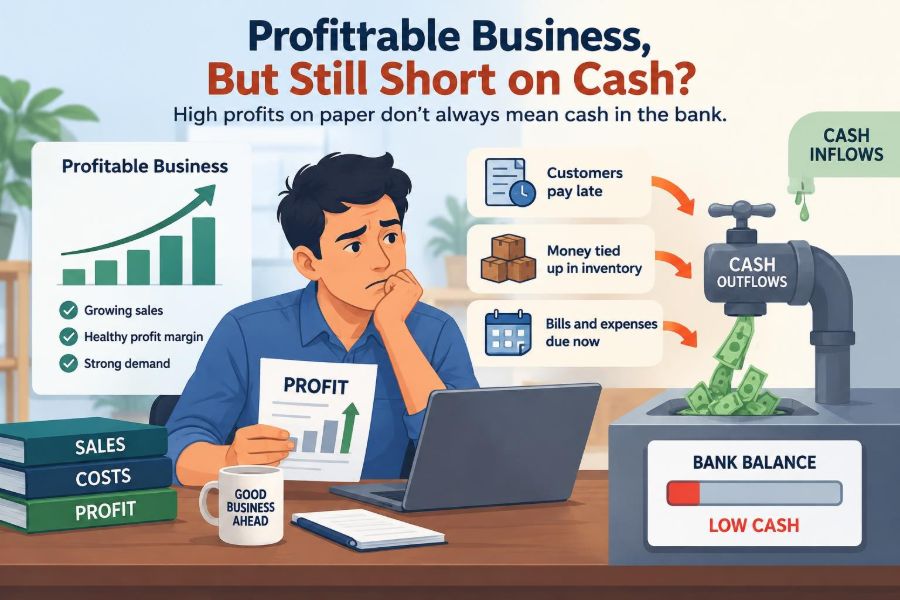

A business owner looks at the monthly income statement and sees a healthy profit. Sales are rising, costs appear controlled, and the company is technically making money. Yet payroll is due on Friday, a supplier is demanding payment, and the bank balance is uncomfortably low.
This situation is more common than it first appears because profit and cash are related but not identical. Profit measures whether revenue exceeded expenses over a period. Cash measures whether the business has money available to pay its obligations at a particular moment.
A profitable business can fail to pay its bills if its cash is tied up in customer invoices, inventory, equipment, or other commitments. Conversely, a business can temporarily have cash in the bank while losing money, perhaps because it borrowed funds or delayed payments.
Understanding the gap between reported profit and available cash helps managers make better decisions before a routine cash squeeze becomes a crisis. The issue is usually not one mysterious leak; it is a pattern of timing, growth, financing, and operating choices.
💡 Profit Is an Accounting Measure, Not a Bank Balance
Profit is generally calculated by subtracting expenses from revenue under the accounting method used by the business. Under accrual accounting, revenue is often recorded when it is earned and expenses when they are incurred, rather than when cash changes hands.
Cash flow follows actual receipts and payments. A sale on credit may create revenue and profit today, but the related cash may not arrive for weeks or months. That time gap is the starting point for most profitable-but-cash-poor situations.
🏦 Cash Pays Obligations When They Fall Due
Businesses do not pay wages, rent, taxes, loan instalments, or suppliers with accounting profit. They pay them with cash available in the right account at the right time.
This is why timing matters. A company may expect a large customer payment next month, but that expectation does not solve an invoice due this week. Liquidity—the ability to meet short-term obligations—can be weak even when profitability looks strong.
📄 Accrual Accounting Creates a Timing Difference
Accrual accounting gives a more useful picture of performance than simply recording cash movements. It matches revenue with the costs incurred to generate it, helping readers evaluate whether normal operations are economically sustainable.
But it also creates items that affect profit without immediately affecting cash. Accounts receivable, unpaid expenses, depreciation, and prepaid costs are common examples. A manager who reads only the profit and loss statement can miss these movements.
🧾 Credit Sales Can Produce Paper Profit
Consider a hypothetical consulting firm that completes a project in March and invoices the client for $40,000. If the work cost $25,000 in salaries and contractors, the firm may report a $15,000 profit from that project in March.
If the customer pays in June, the cash has not supported March payroll, rent, or contractor payments. The business is profitable on the project, but it must finance the period between delivering the work and collecting the invoice.
⏳ Slow Collections Lock Cash in Receivables
Accounts receivable are amounts customers owe the business. They are an asset, but they are not spendable cash until collected. A growing receivables balance can therefore consume substantial cash, especially in companies that sell to other businesses on credit.
The problem becomes persistent when invoicing is late, invoice details are disputed, collection follow-up is inconsistent, or customers routinely pay beyond agreed terms. A profitable sales increase can then deepen the shortage instead of relieving it.
🔍 The Age of Receivables Matters More Than the Total
A single receivables total hides useful information. An aging schedule groups invoices by how long they have been outstanding, such as current, 30 days overdue, or substantially overdue.
Older invoices carry more uncertainty. They may need repeated collection effort, may be subject to a dispute, or may ultimately be uncollectible. Reviewing aging regularly helps separate a temporary delay from a genuine collection and credit-risk problem.
- Invoice promptly after goods or services are delivered.
- Confirm purchase-order and billing requirements before work begins.
- Assign clear responsibility for following up overdue balances.
- Escalate disputes early rather than allowing them to age silently.
📦 Inventory Consumes Cash Before It Creates Revenue
A retailer or manufacturer often pays for inventory long before it sells it. Cash leaves when materials or finished goods are purchased, while profit is recognized only after the inventory is sold.
Inventory is necessary for many operating models, but excess stock is cash sitting on shelves. It also brings storage costs, damage risk, obsolescence, and markdown risk. Fast-growing product ranges can make this drain easy to overlook.
🛒 Stockouts and Overstocking Are Different Cash Problems
Too little inventory can cause missed sales and damage customer relationships. Too much inventory may protect availability but strain liquidity. The goal is not simply to minimize stock; it is to hold the right items, in the right quantities, at a reasonable cost.
Forecasting, reorder points, supplier lead times, and slow-moving-item reports should be connected to cash planning. A purchasing decision that seems sensible operationally can still be dangerous if it absorbs funds needed for payroll or debt service.
🌱 Rapid Growth Often Requires More Cash, Not Less
Growth sounds like a solution to financial pressure, but it often increases the amount of cash tied up in operations. More sales may require more staff, materials, marketing, inventory, delivery capacity, and receivables before the new customers pay.
This is sometimes called the growth cash gap. A business may be increasingly profitable per sale while needing more external funding to support the larger volume of activity. Growth without a funding plan can therefore create repeated cash shortages.
🔄 Working Capital Is the Operating Cash Cycle
Working capital usually refers to current assets less current liabilities. In practical terms, managers often focus on the operating components: receivables, inventory, and payables.
A simplified cash cycle begins when the business pays suppliers, continues while it holds or transforms inventory, and ends when it collects from customers. The longer that cycle, the more money operations require.
| Component | When it increases | Typical cash effect |
|---|---|---|
| Accounts receivable | Customers take longer to pay | Cash is delayed |
| Inventory | More stock is purchased or held | Cash is tied up |
| Accounts payable | Suppliers are paid later, within agreed terms | Cash is retained temporarily |
🤝 Supplier Terms Can Be Shorter Than Customer Terms
A business may need to pay suppliers in 15 or 30 days while allowing customers 60 or 90 days to pay. Even if every customer eventually pays and each sale earns a margin, the company must bridge that difference.
This mismatch is especially demanding when suppliers require deposits, payment before delivery, or immediate payment on smaller orders. The commercial terms on both sides of a transaction are therefore as important as the selling price.
📉 Low Margins Leave Little Room for Delays
Profitability is not just a yes-or-no condition. A company may make a positive margin that is too thin to absorb late payments, price increases, rework, returns, or an unexpected expense.
For example, a distributor can report profit on a high volume of sales while continually needing cash to fund purchases. If gross margins are narrow, a modest disruption in collections or costs can erase the available cash cushion quickly.
🏗️ Capital Expenditure Uses Cash but Is Not an Immediate Expense
When a business buys a vehicle, machine, computer system, or building improvement, cash may leave immediately. Accounting commonly spreads the cost over the asset’s useful life through depreciation rather than recording the full purchase as an expense at once.
As a result, the cash outflow can be much larger than the depreciation expense shown in that period’s profit calculation. The asset may be a sound investment, but it still requires a financing decision and a cash forecast.
📉 Depreciation Reduces Profit Without Using Current Cash
Depreciation is the opposite timing pattern. It lowers accounting profit over time, but it does not normally require a new cash payment in the period it is recorded because the asset was paid for earlier.
This is one reason net profit alone cannot describe operating cash flow. Depreciation should not be mistaken for free cash, however: equipment eventually needs replacement, and that future outlay must be planned for.
💳 Loan Principal Payments Do Not Reduce Profit
Interest expense usually appears in the profit statement because it is the cost of borrowing. Repayment of the loan principal, however, generally reduces the debt balance rather than being recorded as an operating expense.
A business can therefore show profit yet face heavy cash commitments from principal repayments. Lease payments, tax instalments, owner distributions, and settlement of old liabilities can create similar pressure depending on their accounting treatment.
🧮 Tax Timing Can Create an Unwelcome Surprise
Tax expense in accounts may not equal cash tax paid during the same month. Payment schedules, prior-period adjustments, estimated instalments, and differences between accounting profit and taxable income can all affect timing.
Businesses should treat expected tax payments as planned cash outflows, not as distant accounting entries. Tax rules vary by jurisdiction and business structure, so professional advice is appropriate when obligations are uncertain or complex.
🧑💼 Owner Withdrawals Can Drain Operating Funds
In owner-managed businesses, personal drawings, distributions, or dividends may be taken from cash without appearing as an operating expense. They can be perfectly legitimate, yet still weaken the cash available for the business.
The risk is highest when owners use the bank balance as a guide to what can be withdrawn. A balance may include money needed for upcoming wages, taxes, supplier invoices, or loan commitments.
🎯 Revenue Recognition Can Be Misread
Some businesses receive cash before earning revenue, such as subscriptions, retainers, deposits, or advance bookings. Others earn revenue before collecting cash. These models produce very different relationships between profit and cash.
Advance customer payments can strengthen near-term liquidity, but they also create an obligation to deliver later. Managers should avoid treating all incoming cash as available profit, particularly when future service costs remain to be paid.
↩️ Returns, Warranties, and Rework Arrive After the Sale
A sale may be recorded before the business knows the full cost of returns, warranty claims, credits, or corrective work. Accounting estimates may recognize some expected costs, but estimates are not perfect.
High return rates or repeated rework can turn apparently successful sales into cash-consuming transactions. Operational quality, contract clarity, and customer onboarding are therefore cash-flow controls as well as service concerns.
📊 Profit Reports Can Hide Monthly Volatility
An annual profit does not mean every month produced cash. Seasonal businesses may build inventory, hire staff, or spend on marketing for months before their busy period generates collections.
Even a profitable year can contain several dangerous weeks. Monthly, weekly, or even daily forecasts may be necessary for businesses with tight balances, volatile sales, or concentrated payment dates.
⚠️ Customer Concentration Raises Collection Risk
If one or two customers account for a large share of sales, a delayed payment from one customer can disrupt the whole business. The income statement may still look excellent because revenue was recognized, but cash dependence is concentrated.
Monitoring customer concentration does not mean refusing large customers. It means setting credit limits, checking payment behavior, negotiating deposits where practical, and having a contingency plan for delay or dispute.
🏦 A Bank Facility Is Not the Same as Cash Generation
Overdrafts, revolving credit facilities, and short-term loans can bridge ordinary timing gaps. They are useful tools when matched to predictable working-capital needs and when repayment is realistic.
They are less effective when used to cover a structural issue, such as unprofitable pricing, permanently slow collections, or recurring losses hidden by borrowing. Financing buys time; it does not automatically fix the operating cause.
📈 The Cash Flow Statement Connects the Story
The cash flow statement organizes cash movements into operating, investing, and financing activities. It helps explain why profit did not become cash and where cash actually went.
Operating cash flow reflects the cash consequences of normal trading. Investing cash flow includes items such as asset purchases. Financing cash flow includes borrowing, repayments, and owner-related funding movements. Reading all three together is more informative than treating a single statement as complete.
🗓️ A Rolling Cash Forecast Makes Timing Visible
A rolling cash forecast lists expected opening cash, customer receipts, supplier payments, wages, taxes, debt payments, capital spending, and closing cash over future periods. It is updated as actual information replaces assumptions.
A simple forecast is often more valuable than a sophisticated one that nobody maintains. The essential discipline is to use realistic collection dates, known payment dates, and cautious assumptions about uncertain sales.
🧭 Build Scenarios Instead of Trusting One Forecast
Forecasts are estimates, not promises. A useful approach is to consider a base case, a delayed-collections case, and a lower-sales or higher-cost case.
Scenario planning identifies the point at which a cash gap appears and gives managers time to respond. Possible actions include slowing discretionary spending, accelerating invoicing, renegotiating payment terms, arranging funding, or delaying nonessential capital purchases.
🧾 Improve Billing Before Chasing Customers Harder
Collection problems often begin before an invoice is issued. Missing purchase-order numbers, unclear scope, incorrect legal entity names, and incomplete delivery evidence give customers reasons to delay approval.
Good cash discipline starts with clean commercial processes: documented terms, timely invoices, clear milestones, and someone accountable for resolving billing questions. Firm collection is more effective when the underlying documentation is accurate.
🧱 Match Funding to the Life of the Need
Short-term working-capital needs are often better matched with short-term facilities, while long-lived assets may be better financed over a longer period. Using a short-term facility to fund a major long-term asset can create unnecessary repayment pressure.
The right arrangement depends on risk, cost, asset life, and lender terms. There is no universal funding formula, but the matching principle helps prevent routine cash demands from becoming unmanageable.
🚫 Common Reactions That Make the Problem Worse
When cash is tight, managers may accept every sale regardless of payment terms, order excess inventory to secure a discount, or postpone supplier communication. These choices can feel practical in the moment but may extend the cash cycle.
- Do not treat an unpaid invoice as if it were available cash.
- Do not use delayed supplier payments as a permanent financing strategy.
- Do not cut revenue-producing activity without checking its cash timing.
- Do not borrow repeatedly without identifying the underlying cash driver.
🩺 Diagnose the Specific Cause, Not Just the Symptom
“We need more cash” is a symptom, not a diagnosis. The relevant question is whether the gap comes from receivables, inventory, weak margins, capital spending, debt service, tax timing, withdrawals, or a combination.
Comparing several periods helps. If receivables rise faster than sales, collections deserve attention. If cash fell when equipment was purchased, the issue may be investment financing. If operating cash is consistently weak despite stable working capital, profitability or cost control may need review.
✅ The Core Principle: Manage Conversion, Not Only Profit
A profitable business creates value, but it survives day to day by converting that value into cash soon enough to meet commitments. Sales, margins, credit terms, inventory decisions, investment, and financing all influence that conversion.
The practical discipline is to review profit, balance-sheet movements, and cash forecasts together. None of these reports is sufficient alone; together they reveal whether the business is earning money, where funds are tied up, and whether obligations can be met.
Persistent cash shortages in a profitable business usually mean that cash is arriving too late, being committed too early, or being used for needs that profit reporting does not fully show. Once that distinction is clear, managers can address the actual driver rather than waiting for higher sales to solve a timing problem. 💰📊🧭