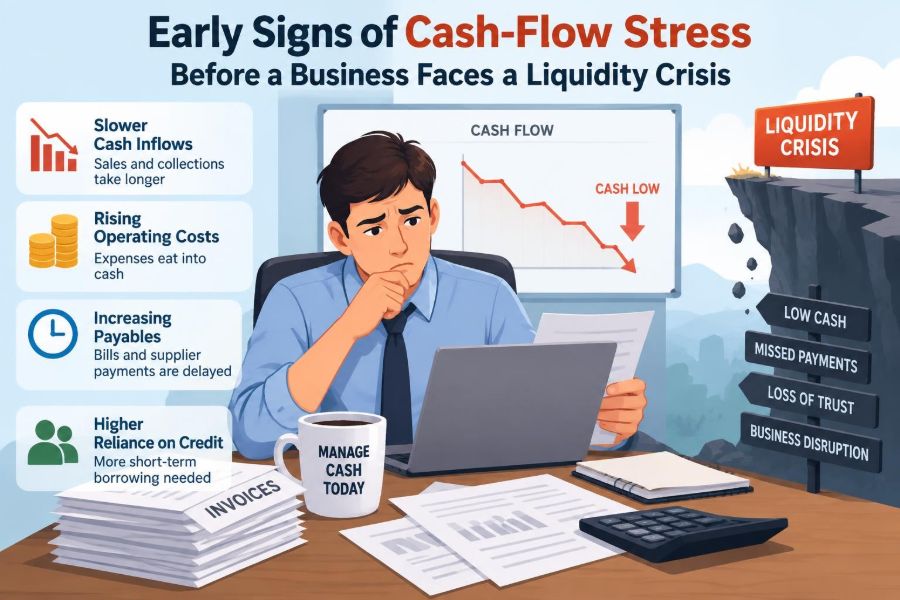

A business can look healthy on paper and still be short of cash on Friday. Sales may be growing, the income statement may show a profit, and customers may appear busy—yet payroll, rent, suppliers, and loan payments are all due before the next meaningful cash receipt arrives.
This is how cash-flow stress often begins: not with one dramatic failure, but with a series of small workarounds. An owner delays paying a supplier, asks a customer to pay early, stretches a credit card balance, or transfers money from another account “just for this month.”
None of those actions automatically means a business is failing. Seasonal businesses, fast-growing firms, and project-based companies can all face temporary timing gaps. The danger is missing the pattern until the timing gap becomes a liquidity crisis—a point at which the business cannot meet obligations as they fall due.
Early detection gives management choices. It may create time to collect receivables, revise purchasing, negotiate payment terms, arrange financing, or reduce commitments before decisions become urgent and expensive.
💧 Cash Flow Is Not the Same as Profit
Profit measures whether revenue exceeds expenses over an accounting period. Cash flow tracks actual money entering and leaving the bank account. These measures are related, but they are not interchangeable.
A company can record a sale today, recognize revenue under its accounting method, and wait 30, 60, or 90 days to receive payment. During that wait, it may need cash for wages, inventory, tax, and operating costs.
Conversely, a business may receive a customer deposit before it has delivered the related product or service. Cash rises immediately, while revenue may be recognized later. Looking at only profit can therefore hide a developing cash shortage.
🏦 What a Liquidity Crisis Actually Means
Liquidity is a business’s ability to pay obligations when they are due using available cash or assets that can be converted to cash quickly without serious loss. A liquidity crisis occurs when that ability breaks down.
The immediate symptoms are practical: missed payroll, rejected supplier orders, overdue debt payments, or an inability to pay tax liabilities. The underlying cause is often a mismatch between the timing of cash inflows and cash outflows.
A liquidity crisis does not necessarily mean the business has no valuable assets. It may own inventory, equipment, property, or substantial receivables. But assets that cannot be turned into usable cash quickly do not solve this week’s payment problem.
🧭 Why Early Signals Matter More Than One Bank Balance
A low bank balance deserves attention, but it is not the only warning sign. A retailer may carry little cash immediately before a predictable inventory sale, while a consulting firm with a large bank balance may still be exposed if payroll and debt payments will exceed expected receipts next month.
The better question is: what will cash look like after known inflows and outflows over the next several weeks? That forward-looking view turns a bank balance into a management tool.
Cash-flow stress is usually visible first in trends: collections slow slightly, inventory stays longer, vendors become less flexible, or managers increasingly need manual interventions to make payments work.
📅 Forecasts That Start Showing a Shortfall
A rolling cash forecast is one of the clearest early-warning tools. It estimates opening cash, expected receipts, and expected payments over a near-term period—often weekly for the next several weeks and monthly further out.
A forecast is useful only if its assumptions are realistic. Expected customer receipts should reflect actual payment behavior, not invoice due dates alone. Expected payments should include payroll, taxes, debt, recurring subscriptions, supplier commitments, and known one-off costs.
Repeatedly forecasting a low point, even if it has not occurred yet, is a signal to act. Waiting until the account is overdrawn reduces negotiating power.
📉 Sales Growth That Consumes Cash
Growth can create a cash squeeze. A distributor that wins a large order may need to buy stock, hire labor, or pay freight before the customer pays. The more rapidly sales rise, the more working capital may be required.
Working capital is the short-term funding tied up in day-to-day operations, especially receivables and inventory, less short-term operating liabilities such as payables. When it expands faster than available financing, growth can drain cash.
This does not make growth undesirable. It means growth plans should include a funding plan. A profitable order can still be cash-negative for a period.
🧾 Receivables That Age Beyond Normal Terms
Accounts receivable aging groups unpaid invoices by how long they have been outstanding. When balances move into older categories, the business is not simply waiting longer; it may be facing a rising risk of dispute, customer distress, or eventual nonpayment.
Compare the aging report with the company’s normal terms and past collection pattern. If customers who usually pay within 30 days are increasingly paying after 45 or 60 days, cash conversion is deteriorating.
One late invoice may be ordinary. A broad shift across customers, or a large late balance from one major customer, deserves prompt investigation.
🗂️ Rising Invoice Disputes and Collection Friction
Late payment is not always caused by a customer’s lack of money. Invoices may be missing purchase-order numbers, contain pricing errors, go to the wrong contact, or lack proof of delivery. These operational issues can quietly trap cash.
A rise in credit notes, disputed invoices, incomplete billing files, or customer requests for revised documentation is an early sign because it delays collection even where demand remains strong.
Track dispute reasons rather than treating all overdue invoices alike. If errors cluster around a product line, sales team, or billing process, fixing the source may release cash faster than intensifying collection calls.
🎯 Too Much Dependence on One Customer
Customer concentration turns a normal late payment into a liquidity event. If one customer represents a large share of expected receipts, a delayed approval or a temporary dispute can disrupt the entire cash plan.
Concentration risk is especially important when the customer has long payment terms, negotiates aggressively, or places uneven project-based orders. Revenue may look strong while cash timing remains fragile.
Monitor the portion of receivables and upcoming cash receipts linked to the largest customers. Diversifying customers helps over time; in the near term, the forecast should show what happens if a major receipt arrives late.
📦 Inventory Growing Faster Than Sales
Inventory is necessary for many businesses, but it is cash sitting on shelves, in warehouses, or in transit. When inventory purchases rise faster than sales, cash can become tied up in goods that are not yet producing receipts.
Some increases are planned, such as preparation for a seasonal peak or a new product launch. The warning sign is inventory growth without a credible sales, replenishment, or margin rationale.
Review slow-moving, obsolete, and excess stock separately. Their book value may appear substantial, but their practical ability to generate prompt cash may be limited.
⏳ Longer Inventory Days
Inventory days estimate how long goods remain in stock before sale. Rising inventory days can indicate weaker demand, over-ordering, production bottlenecks, or a product mix that no longer matches customer needs.
A manufacturer might be busy producing goods while cash deteriorates because finished products are not shipping. A retailer may have full shelves but lack enough of the items customers actually want.
The metric should be interpreted by category. A single overall number can hide a fast-selling core range and a growing accumulation of unsellable items.
🚚 Suppliers Becoming Less Willing to Extend Credit
Supplier behavior can reveal stress before it appears in formal reports. A vendor may shorten payment terms, require deposits, place an account on credit hold, reduce delivery frequency, or insist on cash on delivery.
These changes may reflect the supplier’s own policies rather than your company’s condition. Still, when several vendors tighten terms at once, operating cash requirements rise quickly.
Strong supplier relationships are not a substitute for cash management, but they can provide early conversations. Ask whether suppliers see recurring administrative issues, late remittance patterns, or concerns that need to be addressed.
🧱 Payables Being Stretched as a Routine
Accounts payable is a source of short-term operating credit, but deliberately paying every supplier late is not a sustainable financing strategy. It can trigger fees, supply interruptions, lost early-payment discounts, and damaged trust.
Watch whether the business is paying invoices later than agreed, not just whether the total payable balance has increased. A rising payable aging report often signals that cash is being preserved by postponing obligations.
Prioritizing payments temporarily may be necessary in a genuine shortfall. It should be managed transparently and legally, with a plan—not allowed to become the default process.
💳 Reliance on Expensive Short-Term Funding
Using overdrafts, credit cards, merchant cash advances, or emergency borrowing can bridge a temporary timing gap. The warning sign is not the existence of these tools; it is repeated dependence on them for ordinary, recurring expenses.
High-cost short-term funding can create a feedback loop. Repayments consume future cash, leaving less room for payroll, inventory, and tax obligations, which then creates a need for more borrowing.
Separate a planned seasonal facility from improvised financing. If the business cannot explain when and how the balance will be repaid from operating cash, the funding structure needs review.
📊 Falling Cash Conversion Efficiency
The cash conversion cycle links the time inventory is held, the time customers take to pay, and the time the business takes to pay suppliers. In simple terms, it shows how long cash is tied up in operations before it returns through collections.
| Component | What a rise often means | Potential cash effect |
|---|---|---|
| Inventory days | Goods are held longer before sale | More cash locked in stock |
| Receivable days | Customers are paying more slowly | Cash arrives later |
| Payable days | Suppliers are paid more slowly | Temporary cash relief, but relationship risk |
A lengthening cycle does not diagnose the cause by itself. It prompts useful questions: Is demand slowing? Are credit terms too loose? Has purchasing outpaced sales? Are suppliers being paid late because cash is tight?
🧮 Gross Margin Pressure That Reaches Cash Later
Margin pressure may not cause an immediate bank shortage, but it reduces the cash generated by each sale over time. Discounts, higher material costs, freight increases, returns, and unpriced labor can all weaken the conversion of revenue into cash.
A company may report growing sales while its gross margin—the amount left after direct costs—shrinks. If operating expenses and debt payments do not decline as well, future cash headroom narrows.
Review margin by product, customer, and contract where practical. A large customer with attractive revenue but thin margins and slow payment terms may strain cash more than a smaller, faster-paying customer.
🧾 Tax Payments Treated as an Afterthought
Payroll taxes, sales taxes, value-added taxes, income taxes, and other statutory payments can produce sharp cash demands. The exact obligations depend on jurisdiction and business structure, so companies should obtain appropriate local accounting or legal advice.
The early warning sign is using tax funds for general operating needs. Cash collected or reserved for tax may not truly be available for inventory, rent, or discretionary spending.
Maintain a calendar of due dates and a separate forecast line for tax obligations. A business can appear current with suppliers while accumulating a significant obligation to authorities.
👥 Payroll Becoming a Monthly Emergency
Payroll is usually one of the least flexible cash outflows. When management starts checking the bank balance immediately before each payroll run, delaying owner compensation unpredictably, or moving funds between entities to cover wages, the business has lost useful cash headroom.
This signal deserves special attention because employees depend on timely payment and because payroll disruption can affect morale and operations rapidly.
Forecast payroll net of all related taxes and benefits. Looking only at net wage payments understates the true cash commitment.
🔁 Frequent Transfers Between Accounts or Entities
Moving cash between bank accounts can be ordinary treasury management. It becomes a warning sign when transfers repeatedly patch gaps created by normal operations.
For example, an owner may use cash from a profitable division to pay the bills of another division, then reverse the transfer after a customer payment arrives. This can obscure which activity is generating cash and which is consuming it.
Record intercompany and owner-related movements clearly. Without that visibility, a consolidated bank balance can make a fragile operation appear more stable than it is.
🧑💼 Owner Drawings and Discretionary Spending Outpacing Capacity
In owner-managed businesses, personal withdrawals, dividends, bonuses, and discretionary purchases can compete directly with operating needs. The issue is not that owners should never be paid; it is that distributions should reflect realistic cash capacity.
Cash available after a profitable month may still be needed for taxes, inventory replenishment, debt service, or delayed customer payments. A forecast should distinguish between cash that is present and cash that is genuinely free to distribute.
Clear policies reduce emotionally driven decisions, particularly during periods of uneven sales.
📈 Budget Variances That Keep Being Explained Away
A variance is the difference between planned and actual results. One adverse variance may have a clear explanation, but a series of optimistic explanations can mask an emerging pattern.
Common examples include collections assumed too early, costs labelled “one-off” several months in a row, or sales budgets that do not account for delayed delivery and billing. The problem is often less the variance itself than the failure to update the plan.
Reforecast when new information appears. A budget is a benchmark; a cash forecast is a current decision tool.
🔍 Reconciliation Delays and Unreliable Cash Data
Management cannot respond early if it does not know the actual cash position. Delayed bank reconciliations, unposted invoices, missing purchase orders, and unrecorded expenses make cash reports misleading.
A bank reconciliation compares accounting records with bank activity and explains differences, such as deposits in transit or payments not yet cleared. It is a basic control, but it also supports practical forecasting.
Close the books promptly enough to inform action. Perfect detail delivered too late is less valuable than reliable, timely information with clearly stated uncertainties.
🚨 Covenant Headroom Getting Smaller
Loan agreements may include financial covenants: conditions such as maintaining specified ratios, minimum liquidity, or limits on additional borrowing. The terms vary widely, so management should read the actual agreement and obtain professional advice when needed.
The key early signal is shrinking headroom—the distance between the current position and a covenant threshold. A company can still be compliant while becoming vulnerable to a modest decline in earnings, collections, or available cash.
Monitor covenant calculations using the definitions in the agreement, not informal approximations. Speak with lenders early if a breach appears possible; surprises rarely improve the available options.
🧪 Scenario Testing Reveals Fragility
A single forecast can create false confidence because it reflects one set of assumptions. Scenario testing asks what happens if a major customer pays late, sales fall below plan, a shipment is delayed, or a key expense rises.
Consider at least a base case, a downside case, and a severe-but-plausible case. The goal is not to predict every event. It is to identify the conditions that make cash negative and the actions available before that point.
For a hypothetical construction contractor, a 30-day delay in one project payment may be manageable if supplier terms are flexible. It may be critical if payroll, equipment leases, and subcontractor bills all fall due first.
🛠️ A Practical Weekly Cash Review
Cash management works best as a recurring operating discipline rather than a crisis meeting. A short weekly review can bring finance, sales, purchasing, and operations into the same picture.
- Confirm the reconciled opening bank position.
- Review customer receipts expected in the next one to two weeks, including risks and disputes.
- List required payments: payroll, taxes, debt, suppliers, rent, and contractual commitments.
- Compare actual movements with the prior forecast and explain material differences.
- Assign actions, owners, and dates for collections, purchasing changes, or financing discussions.
This process is especially valuable because different teams often hold different pieces of the cash story. Sales knows customer intentions; operations knows delivery timing; purchasing knows upcoming commitments; finance connects them to cash.
🤝 Collection Practices That Protect Customer Relationships
Better collections do not require aggressive or impersonal communication. They require clear terms, accurate invoicing, prompt follow-up, and early resolution of questions.
Before extending credit, confirm who approves invoices, what documentation is required, and where invoices should be sent. Once an invoice is overdue, contact the customer while the issue is still small and specific.
For strategically important customers, collection conversations should be coordinated with the account manager. The objective is to protect both cash and the commercial relationship, rather than allowing silence to turn a routine delay into a dispute.
🛒 Purchasing Controls Without Damaging Operations
When cash is tight, cutting all spending can create new problems: missed sales, production stoppages, safety risks, or higher emergency costs. Better controls distinguish essential spending from spending that can be delayed, reduced, or renegotiated.
Review purchase commitments before orders are placed, particularly for non-core inventory, capital purchases, subscriptions, and projects with uncertain payback. Match ordering quantities and timing to credible demand where possible.
Purchasing teams should not be judged only on unit price. A bulk discount may be costly if it creates months of excess stock and absorbs cash needed elsewhere.
🏗️ Financing Should Match the Underlying Need
Different cash needs call for different funding structures. A predictable seasonal inventory build may suit a planned short-term facility. Equipment used for years may be better aligned with longer-term financing. Permanent operating losses cannot be solved sustainably by repeated short-term borrowing.
Financing can provide time, but it does not fix weak pricing, poor collections, excessive overhead, or unprofitable contracts. Treat borrowing as part of a wider cash plan with a credible repayment path.
Terms, fees, security requirements, and personal guarantees can be significant. Business owners should understand these consequences and seek qualified financial and legal guidance before committing.
⚖️ Avoid the Two Common Overreactions
The first overreaction is denial: assuming that a future sale, delayed invoice, or refinancing discussion will solve the problem without changing the plan. Optimism is useful, but forecasts should use evidence and show uncertainty.
The second is indiscriminate cutting. Stopping all marketing, maintenance, training, or purchasing may preserve cash briefly while weakening the business’s ability to earn and serve customers.
Good decisions rank expenditures by urgency, contractual obligation, customer impact, safety, return, and reversibility. The goal is to preserve viable operations while correcting the source of the pressure.
🧠 Build a Culture That Escalates Bad News Early
Cash problems become more dangerous when staff fear reporting them. A salesperson may avoid admitting a customer has paused payment; a project manager may delay reporting a cost overrun; a buyer may conceal an unavoidable supplier increase.
Leaders can reduce this risk by rewarding timely, factual escalation. A forecast should be allowed to worsen when new evidence warrants it. A more accurate bad forecast is more useful than a comforting wrong one.
Clear ownership also matters. Someone should be accountable for the forecast, but every function that affects cash should contribute dependable information.
🧩 The Core Principle: Protect Cash Before Choices Disappear
Most early signs of cash-flow stress point to the same underlying issue: the business is losing flexibility. Customer cash arrives later, stock stays longer, costs become less predictable, creditors become less patient, and emergency funding becomes more attractive.
The practical response is not to obsess over one ratio or one bank balance. It is to combine timely records, a realistic rolling forecast, working-capital discipline, scenario testing, and early conversations with customers, suppliers, lenders, and advisers.
Cash flow is not merely a finance department concern. Pricing, sales terms, billing accuracy, purchasing, staffing, project management, and owner decisions all affect whether a business can meet tomorrow’s commitments.
The earlier a business recognizes shrinking cash headroom, the more choices it retains to protect operations and recover stability.
Liquidity crises rarely become visible all at once. Build the habit of looking forward, challenging assumptions, and acting while there is still room to choose wisely. 💰📊🤝