
A café owner sees sales rise every month, yet the bank balance keeps feeling tight. A department manager is asked to cut costs but worries that reducing the wrong expense will damage service. A founder receives a large customer order and wonders whether accepting it will create profit or a cash crisis.
These are not just accounting problems. They are decision problems, and accounting provides a language for seeing them more clearly.
Financial thinking means looking beyond a number on a report and asking what created it, what will change it, what trade-off is involved, and what action makes sense next. It turns financial information from a record of the past into a tool for shaping the future.
For students, this approach connects classroom concepts to real business choices. For working professionals, it makes budgets, performance conversations, and investment proposals more useful. The goal is not to turn everyone into an accountant; it is to help people make better decisions with the resources they control.
🧭 Financial Thinking Is a Decision Discipline
Financial thinking starts with a simple question: What decision are we trying to improve? A profit figure by itself does not tell a manager whether to hire, discount, outsource, expand, or wait. It becomes useful when connected to a specific choice.
This discipline combines accounting data with operational reality. It considers revenue, cost, timing, risk, capacity, and customer value rather than treating any one measure as the complete answer.
🔍 Numbers Are Clues, Not Conclusions
A drop in gross margin can signal higher supplier prices, excessive discounting, product mix changes, waste, or inaccurate inventory records. The number identifies where to investigate; it does not automatically explain why the change occurred.
Good analysis moves from result to driver. Instead of saying, “Costs are too high,” ask which costs changed, whether volume changed, whether the change is temporary, and who can influence it.
🎯 Begin With the Business Question
Clear questions prevent analysis from becoming a spreadsheet exercise. “Should we add a delivery service?” is better than “Can we review delivery costs?” because it requires an answer tied to a decision.
- What outcome are we seeking?
- What alternatives are genuinely available?
- Which costs, revenues, and risks differ between those alternatives?
- What information would change our choice?
When the question is precise, the relevant numbers become easier to identify.
🗺️ Understand How the Business Creates Value
Before analyzing financial statements, understand the business model. How does the organization attract customers, deliver its product or service, collect cash, and earn enough to cover its resources?
A software firm may incur development costs before sales arrive. A retailer may tie up cash in inventory months before a customer pays. A consulting practice may have few physical assets but depend heavily on staff utilization. The same financial ratio can mean different things in each setting.
💵 Separate Profit From Cash
Profit measures whether revenues exceed expenses over a period under accounting rules. Cash flow tracks money entering and leaving the bank. They are connected, but they are not interchangeable.
A business can report a profit after making credit sales it has not yet collected. It can also have cash after borrowing money even while its underlying operations are unprofitable. This distinction is essential when assessing whether growth is sustainable.
🌊 Follow the Cash Conversion Cycle
The cash conversion cycle describes the path from paying for inputs to receiving cash from customers. It is especially useful for businesses that buy inventory, produce goods, and sell on credit.
Consider a hypothetical furniture retailer. It pays suppliers, holds stock in a warehouse, sells a table, and then waits for the customer or finance provider to pay. Faster inventory movement and timely collection can relieve pressure without increasing sales.
However, aggressively reducing stock or tightening customer terms can create service problems. Financial thinking weighs the cash benefit against lost sales, stockouts, and customer relationships.
📈 Revenue Is Not the Same as Economic Value
Revenue growth is often celebrated because it is visible and easy to communicate. But a sale creates value only if the contribution from that sale helps cover fixed costs and supports an acceptable return for the risk involved.
Low-margin revenue can be sensible when it uses spare capacity, introduces a strategically valuable customer, or supports a broader offering. It can also be harmful when it consumes scarce staff time, requires costly support, or trains customers to expect permanent discounts.
🧮 Use Contribution Margin for Short-Term Choices
Contribution margin is sales revenue less variable costs: costs that generally change with volume, such as direct materials, sales commissions, or transaction fees. The remaining amount contributes toward fixed costs and profit.
Suppose a business has unused production capacity and receives a one-time order at a price below its usual price. The decision should consider the additional revenue and additional costs, not automatically allocate every fixed overhead cost to the order.
That reasoning changes when capacity is constrained. If accepting the order displaces a more profitable customer, the lost contribution becomes a relevant cost.
🏗️ Know the Difference Between Fixed and Variable Costs
Fixed costs do not usually change immediately with small changes in activity: rent, core salaries, or annual software subscriptions are common examples. Variable costs move more directly with output or sales volume.
The distinction helps managers forecast consequences. A business with high fixed costs may experience strong profit improvement after passing its break-even point, but it may also be exposed when demand falls because those costs remain.
⚖️ Recognize Step Costs and Capacity Limits
Real cost behavior is rarely perfectly fixed or variable. A customer support team may handle additional demand without hiring, until workload reaches a threshold and another employee is needed. This is a step cost.
Capacity limits create another important trade-off. When machines, staff hours, storage, or management attention are scarce, the relevant question becomes: which use produces the best return from the constrained resource?
🚪 Treat Opportunity Cost as a Real Cost
An opportunity cost is the benefit sacrificed by choosing one option over another. It may not appear as an invoice, but it still affects the quality of a decision.
For example, using a design team on a custom project may prevent it from improving a standard product line. The custom project’s reported profit is incomplete if the forgone contribution from the other work is ignored.
🧱 Break-Even Analysis Clarifies the Minimum
Break-even analysis estimates the sales volume or revenue needed for total contribution to cover fixed costs. It offers a practical way to test whether a new product, event, location, or service has a plausible path to viability.
The output is only as reliable as its assumptions. Selling price, variable cost, customer mix, and fixed costs can all change. Treat break-even as a structured scenario, not a prediction carved in stone.
🔭 Build Scenarios Instead of One Forecast
A single forecast often hides uncertainty behind a precise-looking total. Scenario planning makes assumptions visible by considering a base case alongside credible upside and downside cases.
| Scenario | Key assumption | Useful management response |
|---|---|---|
| Base case | Expected demand and normal costs | Set the operating plan and budget |
| Downside case | Slower sales, delayed collections, or higher input costs | Protect cash and identify costs that can be adjusted |
| Upside case | Demand exceeds plan | Prepare capacity, inventory, and working capital plans |
The purpose is not to guess every outcome. It is to know which assumptions matter most and what action will be taken if they change.
📊 Turn a Budget Into an Operating Plan
A budget is most useful when it describes how the organization intends to operate: sales activity, staffing, purchasing, projects, and cash needs. It should connect financial targets to people who can influence the underlying drivers.
A weak budget simply distributes last year’s amounts with a small adjustment. A stronger one asks what volume is expected, what resources are required, and what must happen operationally for the plan to work.
🚦 Use Variances to Learn, Not to Blame
A variance is the difference between actual results and a budget, forecast, standard, or prior period. It is a signal for investigation, not a verdict on an individual’s performance.
For example, a labor cost variance may result from higher wage rates, overtime, lower productivity, a changed product mix, or incorrect scheduling. Separating price and usage effects helps reveal which response is appropriate.
🧠 Distinguish Leading and Lagging Indicators
Financial outcomes such as profit and cash flow are usually lagging indicators: they tell us what has already happened. Leading indicators provide earlier evidence of possible future outcomes, such as qualified sales opportunities, delivery backlog, customer retention signals, or production defects.
No leading indicator is universally useful. The right measures depend on the business model and must have a believable connection to a later financial outcome.
🪜 Create a Driver Tree
A driver tree breaks a broad result into components that can be understood and managed. Revenue, for instance, may be separated into customer count, purchase frequency, average order value, and retention.
This structure makes conversations more practical. Rather than demanding “more revenue,” a manager can ask whether the immediate priority is attracting new customers, improving conversion, increasing repeat purchases, or protecting price.
🧾 Understand Cost Allocation Without Being Misled
Cost allocation assigns shared costs, such as building rent, IT support, or finance staff, to products, departments, or customers. It can support pricing, accountability, and long-term planning.
But allocated costs are not always relevant to a short-term decision. If closing a product line would not actually eliminate a share of head-office rent, treating that allocation as an avoidable saving can lead to a mistaken conclusion.
🔄 Separate Relevant Costs From Sunk Costs
A relevant cost changes because of the decision being considered. A sunk cost has already been incurred and cannot be recovered through the current choice.
Imagine a company has spent money developing a product that is now performing poorly. Continuing solely because “we have already invested so much” can compound the loss. The better question is whether future benefits justify future costs and risks.
🏷️ Price With More Than Cost in Mind
Cost information creates a floor for many decisions, but price also depends on customer value, alternatives in the market, brand position, demand, and strategic intent. A price that merely adds a standard markup may ignore what customers will accept or what the business must deliver to justify it.
Discounts deserve the same discipline. A small percentage discount may require a much larger increase in volume to preserve total contribution, particularly when margins are already thin.
🤝 Evaluate Customers and Products Carefully
Not every customer or product contributes equally after considering service requirements, returns, delivery complexity, payment behavior, and support time. Profitability analysis can reveal where a growing workload is not producing a matching financial return.
Still, avoid an overly mechanical response. A low-profit customer may have strategic value, provide learning, stabilize demand, or lead to higher-value work. The analysis should inform a commercial judgment, not replace it.
📦 Manage Working Capital Deliberately
Working capital is commonly understood as the short-term resources used in daily operations, including receivables, inventory, and payables. It is one of the clearest places where accounting and operational choices meet.
Collection discipline, sensible purchasing, accurate demand planning, and timely supplier communication can all improve cash availability. The goal is not simply to minimize every balance; it is to hold the level needed to operate reliably.
🛡️ Build Risk Into Financial Decisions
Two options with the same expected profit can carry very different risks. One may depend on a single customer, volatile input prices, complex implementation, or a large upfront cash commitment.
Useful questions include: What could go wrong? How quickly would we notice? What is the financial exposure? Can we reduce, share, insure, stage, or exit the risk? A financially attractive plan should survive more than its most optimistic assumptions.
🧩 Consider Qualitative Effects Alongside the Model
Some consequences resist simple measurement: employee morale, safety, reputation, supplier trust, regulatory obligations, and environmental effects. Excluding them because they are difficult to quantify does not make them disappear.
State these effects explicitly alongside the financial case. This is particularly important when a cost-saving action could shift costs elsewhere, weaken controls, or damage a relationship that took years to build.
🧪 Test Assumptions Before Committing Fully
When uncertainty is high, a pilot, phased rollout, limited contract, or small experiment can be more informative than a large irreversible commitment. The financial model should include the cost of learning as well as the possible payoff.
Define what the test is meant to prove, what evidence will be collected, and what threshold would support expansion, revision, or termination. This prevents a pilot from becoming an unfocused project that never informs a decision.
🗣️ Communicate the Story Behind the Numbers
Decision makers rarely need every ledger detail. They need a clear explanation of the issue, the major drivers, the alternatives, the recommendation, and the uncertainty surrounding it.
A useful finance conversation can follow a simple sequence:
- What happened or what opportunity exists?
- Why did it happen?
- What are the realistic options?
- What is the financial and operational impact of each?
- What decision, owner, and next review point are proposed?
Clear communication is not simplification at the expense of truth. It is selecting the detail needed to make a sound choice.
🔐 Maintain Data Quality and Control
Even sophisticated analysis fails when source data are incomplete, late, inconsistent, or poorly understood. Basic controls over approvals, reconciliations, coding, inventory counts, and access rights protect both decision quality and organizational trust.
Automation can speed reporting, but it can also repeat errors at scale. Someone still needs to understand the process, challenge unusual results, and confirm that the measure means what users think it means.
⚠️ Avoid Common Financial Thinking Traps
Several habits repeatedly weaken otherwise capable decisions:
- Using last year’s result as the only benchmark despite changed conditions.
- Confusing a favorable accounting result with immediate cash availability.
- Cutting visible costs while ignoring lost revenue, quality, or risk.
- Using averages that hide large differences among customers, products, or locations.
- Assuming an allocation is a cash saving without checking whether the cost is avoidable.
- Presenting a forecast as certainty rather than as an assumption-based view.
The remedy is not more reports. It is more disciplined questions about cause, timing, alternatives, and consequences.
👥 Make Financial Thinking a Shared Capability
Finance teams bring rigor in measurement, reporting, controls, and analysis. Operations, sales, technical, and customer-facing teams bring knowledge of what actually happens on the ground. Better decisions emerge when these perspectives work together.
Non-finance managers do not need to master every accounting standard. They do need confidence with margins, cash, capacity, drivers, and trade-offs. Finance professionals, in turn, need to understand the operational choices behind the figures.
🛠️ Use a Repeatable Decision Routine
A repeatable routine reduces rushed judgments while leaving room for professional judgment. For a meaningful decision, document the objective, assumptions, relevant cash flows, non-financial effects, risks, recommendation, and how results will be reviewed.
After implementation, compare actual outcomes with the case that supported the decision. This is not merely an audit exercise. It improves future estimates and reveals whether the original logic was sound.
🌱 Turn Constraints Into Better Questions
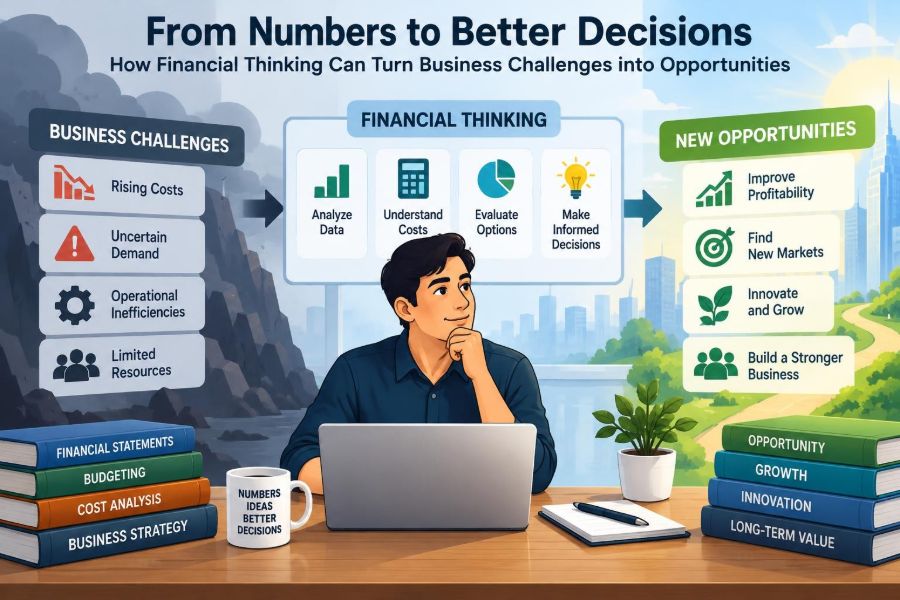
A tight budget can force prioritization. Slow collections can expose weaknesses in billing and customer terms. Low margins can reveal a pricing, process, or product-mix problem. Constraints become opportunities when they prompt investigation rather than reflexive cuts.
The most useful question is often not “How do we spend less?” but “How can we create more value with the resources we have, while protecting the organization’s ability to operate?”
🏁 The Core Principle: Connect Numbers to Choices
Financial thinking is valuable because it connects accounting information to action. It asks what drives performance, which costs and benefits will truly change, when cash will move, what risk is being accepted, and whether an option supports the organization’s wider purpose.
Reports remain necessary, but their greatest value appears when they lead to better questions and more deliberate choices. A number becomes powerful when someone understands its context and uses it to decide what to do next.
Better decisions come from treating financial information not as a scorecard alone, but as a practical map of trade-offs, resources, and opportunities. With curiosity, sound assumptions, and regular review, challenges that once looked like isolated problems can become starting points for stronger business decisions. 💡📊💰