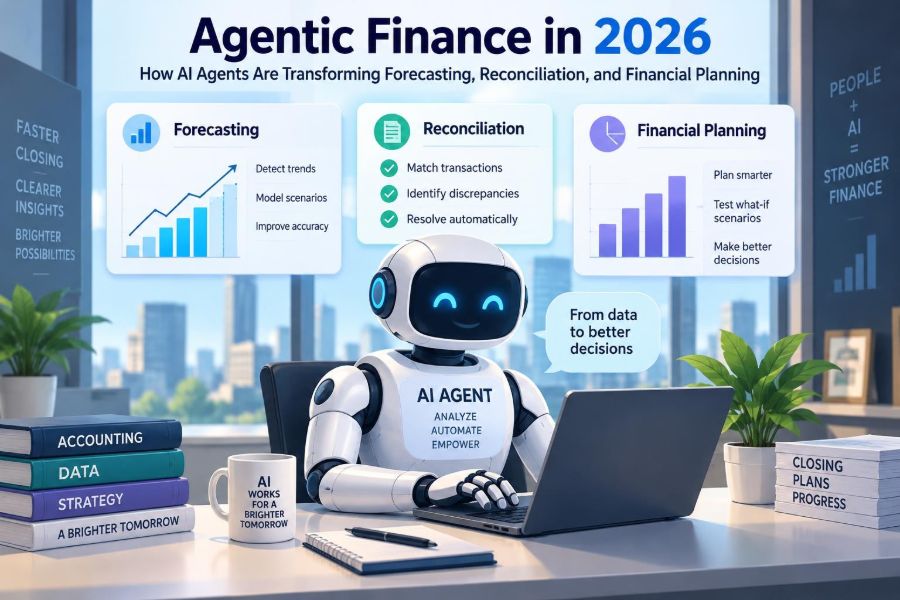

It is the third business day after month-end. A controller is still waiting for bank files, an analyst is rebuilding a forecast because sales changed its assumptions, and the finance team has a growing list of unexplained reconciliation items. Everyone has spreadsheets open, but no one has a complete view of what has changed.
For years, finance automation has helped with pieces of this work: importing transactions, routing invoices, refreshing reports, and flagging unusual values. Yet people have remained responsible for deciding what to do next, gathering evidence across systems, and escalating the exceptions that matter.
That boundary is beginning to move. AI agents are designed not simply to answer questions or generate text, but to pursue a defined objective through a sequence of supervised actions: retrieve information, compare records, apply rules, prepare a recommendation, and request approval when needed.
In 2026, the practical question is not whether an agent can “do finance.” It is whether finance teams can redesign processes so agents handle repeatable investigative work while people retain judgment, accountability, and control. That distinction shapes how agentic finance can improve forecasting, reconciliation, and financial planning without weakening governance.
🧭 What Agentic Finance Actually Means
Agentic finance describes finance workflows in which an AI-based software agent can plan and execute multiple connected steps toward a goal within defined boundaries. An agent might investigate a forecast variance, match transactions to source documents, or assemble a planning package for review.
This is different from a conventional chatbot. A chatbot may explain why revenue fell after a user provides the data. An agent can be configured to collect approved data, test possible drivers, document its reasoning, create a draft analysis, and send an exception to the appropriate reviewer.
The word “agentic” should not imply autonomy without limits. In a well-designed finance environment, autonomy is graduated: the system may read widely, propose confidently, and post narrowly—or not post at all.
🧩 The Difference Between AI, Automation, and Agents
These terms are often blended together, but they solve different problems. Clear terminology prevents teams from buying a tool for one purpose and expecting another.
| Approach | Primary strength | Example in finance |
|---|---|---|
| Rules-based automation | Repeats fixed instructions reliably | Routes an invoice when amount and vendor conditions are met |
| AI model | Recognizes patterns or generates language | Classifies an expense or drafts a variance explanation |
| AI agent | Coordinates tools and steps toward an objective | Investigates unmatched cash and prepares a review queue |
Agents usually combine all three. They use business rules for controls, statistical or language models for ambiguous inputs, and workflow logic to decide the next permitted step.
⚙️ The Building Blocks Behind an Agent
A useful finance agent needs more than a capable language model. It needs access to trusted data, approved tools, clear instructions, a way to keep track of the task, and a method for recording every material action.
Its operating loop often looks simple: receive a trigger, gather context, perform permitted checks, select the next action, produce an output, and either complete the task or escalate it. The complexity lies in the guardrails around each stage.
- Instructions define the objective, accounting policies, and prohibited actions.
- Tools let the agent query ledgers, planning systems, document stores, or workflow queues.
- Memory or task state preserves what has been checked during a specific case.
- Controls limit access, require approvals, and create an audit trail.
🔐 Why Finance Is a Special Case for Agents
Finance operates on structured records, repeatable calendars, and documented policies—conditions that make many tasks suitable for automation. But it also carries reporting, tax, contractual, and fiduciary consequences. A plausible explanation is not sufficient when an accounting conclusion requires support.
An agent therefore needs to distinguish between facts, assumptions, estimates, and recommendations. It should never silently convert an uncertain inference into an accounting entry or a management commitment.
The safest design principle is straightforward: the greater the financial impact or judgment involved, the stronger the evidence, approval, and segregation of duties should be.
📊 Why Forecasting Is a Natural Starting Point
Forecasting involves frequent data refreshes, many contributing drivers, and recurring questions about deviations from plan. Much of the preparation is mechanical even when the final judgment is not.
An agent can collect actuals, compare them with the latest forecast, identify material movements, and assemble a first explanation from approved operational data. Finance professionals can then challenge the logic: Is the effect temporary? Does the sales pipeline support the assumption? Is the cost movement a timing issue or a run-rate change?
That division of labor reduces time spent locating evidence and preserves time for interpreting it.
🔎 How an Agent Investigates a Forecast Variance
Consider a hypothetical company whose monthly gross margin falls below plan. A variance agent could begin by confirming the reporting period and entity, then compare actual revenue, volume, price, standard cost, freight, returns, and inventory adjustments against the forecast.
It might find that a product mix shift explains part of the decline, while expedited shipping explains another part. It can link the calculation to source data and label unresolved items rather than inventing a complete explanation.
The output should be a reviewable workpaper, not a confident paragraph with hidden calculations. A strong draft separates:
- observed facts from source systems;
- calculated contributors to the variance;
- management commentary or operating assumptions; and
- open questions requiring owner confirmation.
🧮 Driver-Based Forecasting Gets More Usable
Driver-based forecasting models outcomes through operational inputs such as units sold, conversion rates, headcount, utilization, customer churn, or payment terms. Their value depends on keeping drivers current and understanding which assumptions have changed.
Agents can monitor designated drivers, detect when inputs are stale or inconsistent, and propose updates based on authorized data. For example, an agent may notice that planned hiring dates no longer match approved requisitions and flag the payroll forecast for review.
It should not treat every observed pattern as a causal law. A recent trend may be seasonal, affected by a one-off event, or based on incomplete data. Forecasting remains an exercise in reasoned assumptions, not pattern matching alone.
🧠 Scenario Planning Becomes Less Laborious
Finance teams often avoid testing useful scenarios because each version requires manual data preparation. Agents can make scenario planning more accessible by maintaining a library of assumptions and calculating the effect of a defined change across connected models.
A planner could ask for a downside case involving lower volume, slower collections, and delayed hiring. The agent can apply those inputs to the approved model structure, identify affected statements, and document the assumptions used.
The crucial word is defined. Scenario outputs are conditional projections, not predictions. They are only as credible as their assumptions, formulas, and data lineage.
💵 Cash Forecasting Benefits From Continuous Attention
Cash forecasting is particularly sensitive to timing. A business may report healthy revenue while facing pressure from late collections, inventory purchases, tax payments, debt service, or uneven payroll cycles.
An agent can monitor receivables aging, expected billing dates, open purchase orders, bank activity, and known payment schedules. It can then highlight changes that could affect a short-term liquidity view, such as a major customer payment moving beyond its expected date.
That does not replace treasury judgment. Payment behavior can change abruptly, and bank balances may be subject to restrictions, sweeps, or pending transactions. The agent improves visibility; it does not eliminate uncertainty.
🧾 Reconciliation Is More Than Matching Numbers
A reconciliation establishes that two records or balances agree, or explains why they do not. Bank reconciliations, subledger-to-general-ledger reconciliations, intercompany reconciliations, and balance sheet account reconciliations each involve different evidence and risks.
Simple matching is often deterministic: amount, date, reference, and counterparty align. The harder work begins when data is incomplete, timing differs, references are inconsistent, or a match would hide a meaningful error.
This is where agents can help most: not by forcing every item into a match, but by organizing ambiguity for human review.
🧷 Matching Logic Needs a Confidence Threshold
An agent can use exact rules first, then permitted fuzzy matching for items that are close but not identical. Fuzzy matching may consider normalized vendor names, date windows, split payments, invoice references, and expected fees.
Each proposed match should carry an explanation and a confidence category. High-confidence, low-risk matches may be eligible for streamlined review; low-confidence items should remain unmatched and be assigned to an owner.
Organizations should set thresholds based on risk, not convenience. A small recurring bank fee and a large unusual payment should not receive the same treatment simply because both appear mathematically matchable.
🕵️ Exception Handling Is the Real Reconciliation Work
Exceptions tell finance where the process, data, or control may be weak. An unmatched item could be a timing difference, a missing document, a duplicate posting, a wrong entity, fraud risk, or a legitimate transaction that requires classification.
Agents can enrich an exception with transaction history, related documents, prior resolution patterns, and the responsible business owner. They can draft a proposed disposition, but the workflow should require evidence appropriate to the account and materiality.
A useful exception queue is prioritized by factors such as age, amount, account risk, unusual counterparties, and whether the item has recurred. A queue sorted only by dollar amount can overlook persistent control failures.
📚 Audit Trails Must Be Designed, Not Assumed
Finance teams need to be able to answer basic questions later: What data did the agent use? Which rule or model version applied? What did it recommend? Who approved the result? What changed after approval?
An audit trail should preserve source references, timestamps, tool actions, approval decisions, and final outcomes. It should also distinguish the agent’s generated narrative from verified system data.
Do not assume a chat transcript is enough. A transcript may be incomplete, difficult to search, or unable to reproduce a calculation if source data and model versions have changed.
🏗️ Financial Planning Needs Connected Data, Not Just Clever Prompts
Financial planning and analysis depends on consistent dimensions: entity, cost center, account, product, customer, period, currency, and scenario. If these definitions conflict across systems, an agent can accelerate confusion rather than insight.
Before deploying agents broadly, teams should identify the governed source for key metrics and establish common master data. “Revenue,” “active customer,” and “headcount” may each have several operational meanings; planning requires an approved finance definition.
Data integration remains unglamorous but foundational. An intelligent workflow built on unreliable inputs is still unreliable.
🗂️ The Close Process Can Be Orchestrated Better
Month-end close is a chain of dependencies: transactions must be captured, accounts reconciled, estimates reviewed, entries approved, consolidations completed, and reporting checked. Delays often occur because nobody has a clear view of blockers across the chain.
An orchestration agent can monitor task status, identify missing prerequisites, send targeted reminders, and summarize unresolved high-risk items for the close leader. It can also compare current progress with the organization’s close calendar.
It should not use schedule pressure as a reason to bypass controls. A faster close is valuable only if balances remain supportable.
✍️ Journal Entries Require Tight Boundaries
Agents may help prepare recurring or well-supported journal entries by gathering documentation, calculating amounts according to an approved template, and routing the entry to the right approver. This can reduce copy-and-paste mistakes.
However, preparing an entry is different from posting it. Posting rights should be limited, especially where the same agent or user can influence source data, create the entry, and approve it. That combination defeats segregation of duties.
High-judgment entries—such as reserves, impairments, complex revenue matters, or unusual transactions—need explicit professional review even when an agent assists with research and documentation.
🧑⚖️ Human-in-the-Loop Is a Control Design Choice
“Human in the loop” is sometimes used as a vague reassurance. In practice, teams must decide which human reviews which decision, using which evidence, and before or after which action.
A sensible model has tiers. Low-risk informational tasks can be automated. Medium-risk recommendations can require review. High-risk actions, policy interpretations, and material entries can require named approval and documented support.
Reviewers also need enough time and authority to challenge the output. Clicking approve on dozens of unexplained agent recommendations is not meaningful oversight.
🧱 Segregation of Duties Still Applies
Segregation of duties prevents one person or system from controlling incompatible parts of a transaction. Agentic workflows can blur this separation if permissions are granted too broadly for the sake of convenience.
For example, a reconciliation agent may read bank data and propose matches, while a different controlled workflow posts adjustments after human approval. The agent that drafts a forecast should not silently alter approved assumptions or publish management reports without review.
Access should be role-based, narrowly scoped, and periodically reviewed. Service accounts deserve the same scrutiny as human accounts.
🛡️ Data Privacy and Security Cannot Be an Afterthought
Finance data may include payroll, bank information, customer terms, acquisition plans, and performance results. Before connecting an agent to any source, organizations need to understand where data is processed, retained, and logged.
Useful safeguards include data classification, least-privilege access, encryption, environment separation, approval for connectors, and restrictions on copying sensitive information into unapproved tools. Prompts and attachments can themselves become records requiring protection.
Teams should also test for prompt injection: malicious or irrelevant instructions hidden in documents or messages that try to redirect an agent from its assigned task. The agent should treat retrieved content as data, not as authority.
⚠️ Hallucinations and Calculation Errors Need Different Defenses
A generative model may produce a statement that sounds credible but is unsupported. This is commonly called a hallucination. A separate risk arises when calculations use the wrong period, entity, currency, or formula despite the narrative being accurate.
The defenses differ. Hallucinations require source grounding, citations to internal records where appropriate, and rules that permit the agent to say “insufficient evidence.” Calculation errors require reconciled data, deterministic calculation engines, validation checks, and reproducible workpapers.
Never use fluent prose as evidence that the underlying analysis is correct.
📏 Measuring Value Beyond Headcount Reduction
Agentic finance is often evaluated too narrowly as a labor-saving initiative. Time savings matter, but the more durable benefits may be earlier visibility, more complete exception coverage, faster scenario turnaround, and better documented decisions.
Metrics should reflect both efficiency and quality. Examples include unresolved reconciliation aging, forecast refresh cycle time, exception rework, late close tasks, review turnaround, and the rate at which recommendations are overridden.
An increasing override rate may reveal that assumptions, data, or instructions need attention. It is not automatically evidence that reviewers are resisting change.
🧪 Start With a Bounded Pilot
The strongest pilots focus on a process that is frequent, measurable, and narrow enough to control. A recurring bank reconciliation exception queue or a standard forecast variance package may be more suitable than attempting an end-to-end autonomous close.
Define the baseline first: current cycle time, error patterns, exception types, review effort, and control requirements. Then run the agent alongside the existing process until the team understands its behavior across normal and unusual cases.
A pilot succeeds when it produces evidence for a scaling decision—not simply when it creates an impressive demonstration.
📝 Write Instructions Like Operating Procedures
Good agent instructions resemble concise accounting procedures. They define the goal, scope, data sources, decision rules, required calculations, escalation triggers, output format, and forbidden actions.
Vague instructions such as “reconcile this account” invite inconsistent behavior. Better instructions specify, for example, which matching criteria are acceptable, how to handle aged reconciling items, and when the agent must stop and request review.
Policies change, so instruction ownership matters. Finance, controllership, internal audit, security, and technology teams may each need a role in approving changes.
🧹 Clean Inputs Before Seeking Sophisticated Outputs
Many apparent AI problems are actually data-quality problems: duplicate vendor records, missing identifiers, delayed feeds, inconsistent entity codes, or undocumented manual spreadsheets. An agent can expose these issues quickly, but it cannot resolve them reliably without governance.
Start by profiling the data used in the proposed workflow. Which fields are often blank? Which systems disagree? What transformations occur before a balance reaches a report? These answers identify where controls and ownership are needed.
Improving master data and interface reliability may produce more benefit than adding another model feature.
👥 Finance Roles Will Shift Toward Review and Design
Routine preparation work is likely to change first, not disappear uniformly. Analysts may spend less time downloading files and more time testing assumptions. Accountants may spend less time ticking and tying routine matches and more time resolving exceptions and strengthening account support.
This raises the value of skills that connect accounting knowledge with systems thinking: data literacy, control design, process mapping, model review, and clear written judgment. Professionals do not need to become software engineers, but they do need to understand how automated decisions are made and governed.
Teams should make this shift deliberately through training, job redesign, and realistic workload planning. Automation that merely adds a new review layer without removing old tasks creates frustration rather than capacity.
🚫 Common Implementation Mistakes
Several mistakes recur when organizations move quickly. The first is giving an agent broad access before defining its job. The second is automating a broken process without clarifying ownership or evidence standards.
- Deploying on ungoverned spreadsheets with no reliable source of truth.
- Allowing production posting before testing edge cases and approval paths.
- Measuring only speed while ignoring error detection and auditability.
- Using a single generic agent for tasks with very different risk profiles.
- Failing to retain enough documentation for reviewers and auditors.
The remedy is rarely a better prompt alone. It is a stronger combination of process design, data discipline, permissions, and accountability.
🗺️ A Practical Adoption Roadmap
A phased approach gives finance teams room to learn without putting core reporting at unnecessary risk.
- Map the workflow. Identify inputs, decisions, outputs, owners, systems, and control points.
- Select one bounded use case. Prefer high-volume, evidence-based work with a clear review path.
- Set success and risk measures. Include quality, timeliness, exceptions, and control performance.
- Run in parallel. Compare agent outputs with established work before relying on them.
- Expand permissions carefully. Move from read-only support to limited actions only after evidence supports it.
- Review continuously. Monitor drift, policy changes, data changes, and user feedback.
🔮 What 2026 Is Likely to Look Like in Practice
For most organizations, 2026 will not mean a fully autonomous finance function. It is more likely to mean a growing set of specialized agents embedded in planning, close, reconciliation, treasury support, and management reporting workflows.
The mature implementations will be quiet rather than theatrical. They will produce cleaner work queues, better-supported explanations, earlier warnings, and more consistent documentation. Their users will know where automation ends and professional judgment begins.
Technology will continue to change quickly, while accounting obligations and management accountability will remain. That makes adaptable controls more valuable than rigid assumptions about any one tool.
🎯 The Core Principle: Augment Judgment, Do Not Outsource It
Agentic finance can remove substantial friction from repetitive investigative work. It can connect information that is currently scattered, surface exceptions sooner, and give finance professionals a stronger starting point for analysis.
But an agent does not own the forecast, certify the reconciliation, or bear responsibility for a financial statement. Those duties remain with people and the organizations that establish the controls around the work.
The best question to ask is not “Can an agent do this task?” Ask: “What evidence, permissions, review, and accountability would make this task safer and more useful with an agent involved?” That question leads to better workflows—and better finance decisions.
Agentic finance delivers its real value when disciplined systems handle repeatable work and finance professionals apply informed judgment to the decisions that follow. 💰📊🤝