
You build a model for a class project, a budgeting cycle, or an internal investment decision. The formulas work, the assumptions are traceable, and the outputs make sense. Then the project ends, and the spreadsheet sits in a folder.
Meanwhile, a small business owner is trying to decide whether to hire, raise prices, open a second location, or seek funding. They may have accounting records and plenty of opinions, but no structured way to see how one decision changes cash, profit, and risk.
That gap creates an opportunity. Financial modeling is not merely an Excel skill; it is a way to turn messy operating information into a decision tool. When used responsibly, it can become the foundation for freelance projects, consulting engagements, and longer-term advisory work.
The shift is not automatic. Clients do not pay for a discounted cash flow formula simply because it is technically correct. They pay for clearer decisions, reliable analysis, and a process they can understand well enough to use after you leave.
🧭 Start with the difference between a skill and a service
A financial model is a structured representation of a business or financial decision. A service is the practical result a client receives from that model: a budget, a cash forecast, a funding plan, an acquisition analysis, or a decision memo.
This distinction changes how you describe your work. “I build three-statement models” is a capability. “I help owner-managed businesses understand whether they can afford a new hire without creating a cash shortfall” is a client-facing service.
Clients usually buy an outcome, not a spreadsheet feature. Your technical ability matters because it makes the outcome credible and repeatable.
🎯 Identify the decisions that models can improve
The best modeling opportunities arise where a client must commit money, time, or resources under uncertainty. A useful model makes the trade-offs visible before the decision becomes expensive to reverse.
- Can the company fund growth from operating cash flow?
- What sales level is needed to cover fixed costs?
- Which pricing option improves margin without reducing demand too sharply?
- How much debt can the business service under different scenarios?
- Is a proposed project likely to create value after taxes, financing, and working-capital needs?
Notice that these are management questions. The model is the method used to answer them, not the question itself.
🧩 Choose a client problem before choosing a model type
It is tempting to begin with a favorite template: a valuation model, a forecast workbook, or a dashboard. That can lead to unnecessary complexity. Instead, begin by asking what the client needs to decide, who will use the analysis, and what information is actually available.
A restaurant considering a new site may need unit economics and monthly cash flow. A software company discussing outside investment may need a revenue forecast, hiring plan, and financing runway. The structure should follow the decision.
This approach also prevents “model theater”: elaborate schedules that look sophisticated but do not change what management does next.
🛠️ Build a marketable set of core modeling capabilities
You do not need to offer every kind of analysis. A focused toolkit is more credible than broad claims that are hard to support. For many early freelance engagements, the most transferable capabilities are practical rather than exotic.
- Integrated income statement, balance sheet, and cash flow forecasting
- Monthly budgets and rolling forecasts
- Scenario and sensitivity analysis
- Break-even, pricing, and unit-economics analysis
- Working-capital and cash conversion analysis
- Capital expenditure and project appraisal models
- Simple valuation or transaction support, where appropriate
Strong spreadsheet hygiene belongs in this toolkit too: clear inputs, consistent formulas, checks, version control, and readable outputs.
📊 Understand the three-statement model as a business map
An integrated three-statement model connects the income statement, balance sheet, and cash flow statement. It shows why a profitable business can still run short of cash, or why rapid growth can create financing needs.
For example, higher sales may increase profit, but they can also increase inventory and receivables. If customers pay slowly, cash may leave the business before it arrives. That is a valuable insight for a client planning growth.
You do not need to force every client into a full three-statement build. But understanding the links helps you recognize when a simple profit forecast would give a misleading answer.
💵 Make cash flow a practical entry-level offer
Cash forecasting is often one of the clearest ways to demonstrate value, especially for smaller businesses. It addresses an immediate operating concern: whether the business can meet payroll, suppliers, tax obligations, debt payments, and planned investment.
A short-term forecast may use weekly receipts and payments. A longer planning model may use monthly assumptions about sales, gross margin, operating costs, receivable collection, inventory, and capital spending.
Its limitation matters: a forecast is only as reliable as its assumptions and source data. Present it as a planning tool with ranges and scenarios, not as a promise of future cash.
🔍 Turn historical accounting data into useful drivers
Financial statements tell you what happened. Modeling requires you to identify what drives what happens next. Revenue may be driven by volume and price, labor by staffing levels and wages, and inventory by sales volume and reorder policies.
A practical first step is to reconcile historical data to the accounting records, then group it in a way that supports decisions. This may mean separating recurring revenue from one-off revenue, direct costs from overhead, or discretionary spending from contractual spending.
Do not treat every historical line as a forecast assumption. Find the operational driver behind the line item and test whether it is likely to continue.
📈 Use scenarios to explain uncertainty without pretending to predict it
Most clients do not need a single “correct” forecast. They need to understand what changes if sales arrive later, costs rise, collection periods lengthen, or hiring happens earlier than planned.
A simple base, downside, and upside case can be more useful than dozens of sensitivity tables. Each case should have a clear narrative. A downside case might assume slower customer conversion, lower average order values, and delayed collections rather than mechanically reducing every line by the same percentage.
Scenario analysis creates a conversation about contingency actions: reduce discretionary spending, delay a capital purchase, secure a credit facility, or revise hiring timing.
🧮 Add sensitivity analysis where one assumption matters most
Sensitivity analysis changes one or two key inputs and shows the effect on an output such as cash balance, project return, or valuation. It is particularly useful when a decision turns on a small number of uncertain variables.
For a proposed equipment purchase, the critical variables may be utilization, selling price, maintenance cost, and financing terms. For a subscription business, they may be customer acquisition cost, monthly churn, and gross margin.
Keep the output readable. A decision-maker should be able to see which assumption deserves more research, negotiation, or caution.
🏷️ Package pricing and profitability analysis as a service
Many businesses set prices by looking at competitors, using an informal markup, or relying on what customers have historically accepted. A model can connect price to unit cost, capacity, commissions, delivery costs, discounts, and target margin.
Suppose a service company is considering a lower-priced package. A useful analysis would estimate the contribution margin: revenue remaining after variable costs. It would then consider whether the additional volume can be delivered without adding fixed resources.
This is more valuable than simply stating that a lower price reduces margin. It shows the sales volume required to offset that reduction and whether the capacity assumption is realistic.
🏗️ Evaluate investments through capital budgeting
Capital budgeting assesses whether a long-term investment is worth pursuing. This may include machinery, a new location, a software implementation, an energy-efficiency project, or a product launch.
Common tools include payback period, net present value, and internal rate of return. Net present value discounts expected future cash flows to reflect the fact that cash available now is generally worth more than the same nominal amount received later.
These methods depend on estimates. Clearly state the forecast period, discount-rate rationale, terminal assumptions if used, and material excluded costs. A polished output cannot compensate for weak commercial assumptions.
🏦 Support funding decisions without crossing professional boundaries
Entrepreneurs often need forecasts for lenders, investors, grant applications, or internal financing discussions. You can help organize historical performance, explain assumptions, build projections, and prepare management-ready materials.
Be precise about your role. Preparing a forecast is not the same as guaranteeing finance, valuing securities for a regulated purpose, providing investment advice, or giving legal or tax advice. Requirements vary by location, transaction type, and professional status.
When a matter requires a licensed accountant, lawyer, tax professional, valuation specialist, or regulated adviser, collaborate or refer the client. Clear boundaries protect both the client and your reputation.
🤝 Separate freelance work, consulting, and advisory relationships
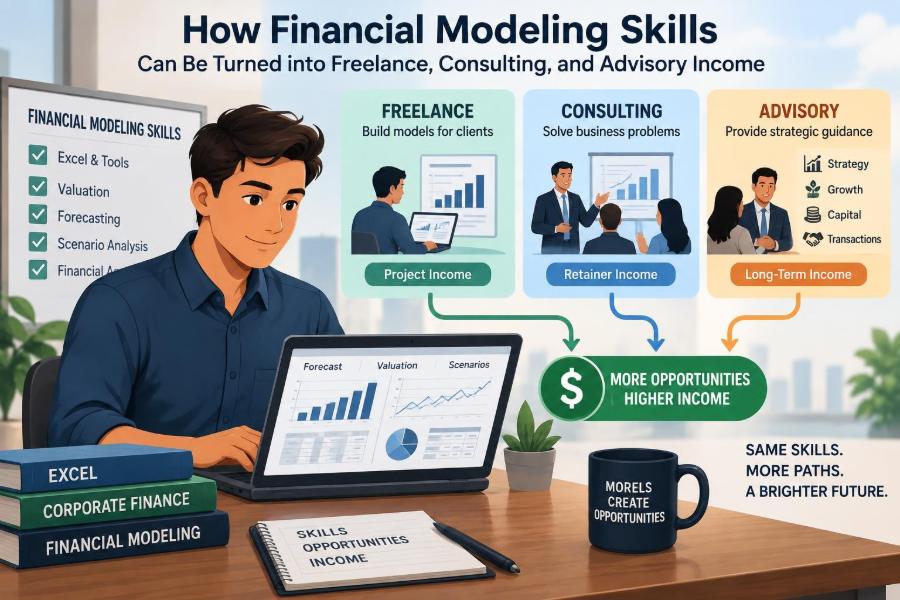
These terms overlap, but they usually imply different scopes. Freelance work often involves a defined deliverable. Consulting focuses on diagnosing a problem and recommending a solution. Advisory work is typically ongoing and centered on decision support.
| Type of work | Typical client need | Typical deliverable |
|---|---|---|
| Freelance modeling | A specific analysis or workbook | Model, dashboard, instructions |
| Consulting | A decision or performance problem | Analysis, recommendations, implementation plan |
| Advisory | Recurring planning and oversight | Forecast updates, management meetings, decision support |
A defined freelance project can lead to consulting when the findings reveal broader issues. Advisory should be earned through reliable delivery, not assumed at the start.
📦 Design offers around concrete deliverables
A vague promise to “provide financial insight” is difficult to price and easy to misunderstand. Create offers with a defined starting point, process, deliverables, exclusions, and client responsibilities.
A cash-planning package, for example, might include a review of available records, a 13-week cash forecast, two scenarios, a dashboard of key assumptions, and a handover meeting. It might exclude bookkeeping cleanup, tax filing, audit work, and lender negotiations unless separately agreed.
Defined offers reduce scope creep and help prospective clients compare your service with the problem they are trying to solve.
🗣️ Lead client conversations with questions, not formulas
Discovery is where much of the value begins. Ask what decision is pending, what happens if it is delayed, what has already been tried, and which number the owner watches most closely.
Also ask operational questions. How are sales recorded? When do customers pay? Who approves spending? Is inventory counted? Are owner withdrawals mixed with business expenses? A model built on misunderstood processes will produce confident-looking but unreliable outputs.
Listening carefully often reveals that the stated request is only a symptom. “I need a forecast” may really mean “I do not know why cash keeps falling.”
🧾 Define the scope in writing before you open Excel
A short engagement letter or statement of work should identify the objective, deliverables, timeline, fee arrangement, information required, review points, confidentiality expectations, and assumptions about client cooperation.
It should also state what the work is not. If you are using management-provided data without audit procedures, say so. If forecasts rely on assumptions supplied by management, make that explicit.
This is not unnecessary administration. It is part of professional risk management and gives both parties a reference point when priorities change mid-project.
🧱 Build models that another person can actually use
A client-ready model should be understandable by someone other than its creator. Separate inputs, calculations, and outputs. Use consistent time periods, clear labels, and a visible assumptions area. Avoid hiding critical logic in hard-coded formulas.
Add checks that flag common problems: balance sheet imbalance, cash below a stated threshold, formulas overwritten by values, or totals that do not reconcile to source data. Document key conventions, such as whether figures are before or after tax.
Elegance is not the objective. A useful model is transparent enough to be reviewed, updated, and challenged.
✅ Create a disciplined model review process
Before delivery, review both mechanics and logic. Check formulas, period alignment, signs, units, and links between schedules. Then step back and ask whether the outcome makes commercial sense.
- Does revenue growth require a plausible increase in customers, capacity, or price?
- Do margins behave consistently with the stated cost assumptions?
- Does the cash flow reconcile with profit and working-capital movements?
- Are scenario changes flowing through every relevant schedule?
- Can a reader identify the assumptions behind the main conclusion?
Where possible, have another competent person review important work. Fresh eyes are especially valuable before a model supports financing, an acquisition, or a major investment.
🔐 Protect confidential financial information
Client data may include payroll, bank activity, customer pricing, supplier terms, and strategic plans. Treat it as confidential whether or not the client is large enough to have formal policies.
Use appropriate access controls, reputable storage methods, strong passwords, and careful file-sharing practices. Limit data collection to what the engagement requires, and agree on retention or deletion practices when the work ends.
Do not use client information in a portfolio without explicit permission and meaningful anonymization. Even a model with names removed may reveal commercially sensitive details.
💲 Price the work using scope, risk, and value
Hourly pricing can be suitable when the scope is uncertain or when you are supporting an existing team. Fixed fees work better when deliverables and inputs are clear. A recurring monthly fee can suit ongoing forecast updates and advisory meetings.
Do not price only by the number of spreadsheet tabs. Consider the quality of the records, urgency, decision stakes, revision expectations, and specialist knowledge required. A model for an internal planning meeting carries a different risk profile from one used in a transaction.
For fixed-fee work, define what constitutes a revision. Otherwise, “one more scenario” can quietly become a new project.
🧪 Use a portfolio to demonstrate judgment, not just formatting
Prospective clients need evidence that you can solve problems. If you cannot share past work, create hypothetical case studies clearly labeled as hypothetical. Use realistic but invented facts and explain the decision, assumptions, analysis, and recommended next steps.
A strong case study might show how a fictional retailer used a rolling cash forecast to identify a seasonal cash gap, compare responses, and choose a combination of purchasing changes and financing timing.
Show selected screenshots or simplified outputs, not every schedule. The aim is to demonstrate reasoning and communication, not overwhelm the reader with formulas.
🌐 Find clients where financial decisions are already happening
Good prospects are often businesses experiencing change: growth, a new product, expansion, tighter liquidity, a financing conversation, a leadership transition, or a need for better reporting.
Potential channels include professional networks, former colleagues, accountants and bookkeepers who do not provide modeling services, industry groups, specialist freelance platforms, and direct relationships with business owners. Referrals tend to work best when people can describe exactly what you do.
A focused message is easier to refer: “I build cash and growth-planning models for service businesses” is clearer than “I do finance.”
🤝 Build referral relationships without creating conflicts
Bookkeepers, accountants, fractional finance leaders, bankers, lawyers, and operational consultants may encounter clients who need planning analysis. A productive referral relationship depends on trust, clear roles, and respect for existing client relationships.
Explain where your work begins and ends. You might build the forecast while the bookkeeper maintains the records and the tax adviser handles tax consequences. Avoid implying that you will replace another professional unless the client explicitly requests a change.
Be cautious with referral fees and disclosure obligations. Professional rules and local requirements can apply, so transparency is the safer default.
🧑💼 Communicate conclusions in management language
Decision-makers rarely need a walkthrough of every formula. They need to know what the model says, what assumptions drive the answer, what could change it, and what action is sensible now.
A delivery meeting might begin with three points: the expected result under the base case, the main downside risk, and the decision required. Then use the model to answer questions rather than presenting every worksheet sequentially.
For example: “The expansion appears fundable in the base case, but only if collection days stay near current levels. If collections slow materially, cash falls below the working buffer before the busy season.” That is analysis with operational meaning.
🔄 Convert a one-time model into recurring advisory value
A model becomes more valuable when it is updated against actual results. Comparing actual performance with forecast assumptions reveals whether the issue is sales volume, price, margin, collections, spending, or timing.
Recurring advisory may include a monthly forecast refresh, a variance review, a quarterly scenario update, and a meeting focused on decisions for the next period. This helps clients develop a planning rhythm rather than treating forecasting as an emergency exercise.
Do not force recurring work where the client only needs a one-off decision tool. The right advisory relationship solves an ongoing need, not a revenue target.
⚠️ Avoid the common mistake of overbuilding
Overbuilding happens when the model contains far more detail than the decision requires. It raises development time, increases error risk, makes updates harder, and can distract the client from the few assumptions that matter.
A small company may gain more from a clear 12-month forecast with a handful of drivers than from a complex model with granular schedules it cannot maintain. Start with the minimum viable model: enough structure to answer the question reliably.
You can add detail later when it improves a real decision or control process. Complexity should be earned.
🚩 Recognize unreliable data and state its limits
Some engagements begin with incomplete records, inconsistent chart-of-account categories, unexplained balances, or sales reports that do not tie to the accounting system. These are not reasons to invent precision.
Reconcile what you can, flag unresolved items, and consider a data-cleanup phase before relying on the forecast. If management estimates are necessary, label them as estimates and test their effect through scenarios.
Sometimes the best advice is to postpone a major modeling conclusion until the underlying information improves. That honesty may feel less dramatic, but it is professionally sound.
⚖️ Know when technical work becomes regulated or specialized
Financial modeling can support many business decisions, but some assignments carry legal, regulatory, accounting, or valuation requirements beyond general planning analysis. Examples may include statutory reporting, audit opinions, formal fairness opinions, tax positions, securities recommendations, and litigation-related calculations.
The precise boundary depends on jurisdiction and context. Do not represent your work as an assurance engagement or formal valuation if it does not meet the relevant standards and qualifications.
Maintain professional indemnity coverage where appropriate, use engagement terms, and seek specialist input when the work could materially affect a transaction, dispute, compliance obligation, or investment decision.
🧠 Develop commercial judgment alongside technical skill
Clients may provide a requested assumption, but part of your role is to ask whether it is coherent. Can revenue double without additional staff? Does a lower price account for delivery costs? Does a loan repayment schedule fit the seasonal cash pattern?
Commercial judgment does not mean replacing management’s knowledge of its own market. It means translating that knowledge into assumptions, identifying tensions between assumptions, and showing the consequences of different choices.
Over time, this judgment is what differentiates a spreadsheet operator from a trusted finance partner.
📚 Build expertise through repeatable learning loops
Each project can strengthen your process. After delivery, note which inputs were hardest to obtain, which assumptions were most uncertain, where the client had questions, and which outputs influenced a decision.
Improve your templates, checklists, discovery questions, and documentation from those observations. Keep learning in the industries you serve: their revenue models, cost structures, payment terms, operating constraints, and common performance measures.
Specialization is not required at the beginning, but it often improves speed and insight. Familiarity with one business model helps you ask better questions earlier.
🚀 Create a practical path from first project to trusted adviser
A realistic progression starts small. Take a tightly scoped project where the decision and deliverable are clear. Deliver a transparent model, explain the result well, and ask for feedback on what was most useful.
- Choose one client problem you can solve competently.
- Create a simple offer and a hypothetical case study.
- Use a written scope and a repeatable review checklist.
- Deliver an action-oriented explanation, not just a workbook.
- Offer an update process only if the client has a continuing planning need.
Reputation grows from dependable work, honest limits, and useful communication. It does not require pretending to have every answer on day one.
🌟 The core principle: make better decisions easier
The economic value of financial modeling comes from reducing avoidable uncertainty. A model can show the cash consequences of growth, expose a weak pricing assumption, test whether an investment clears a sensible hurdle, or turn scattered records into a plan.
To earn income from that capability, combine technical accuracy with a clearly defined problem, trustworthy process, and plain-language communication. Be cautious about data quality, scope, confidentiality, and professional boundaries.
The most durable opportunities are not created by selling complexity. They come from helping people see their options, understand the consequences, and act with more discipline.
Financial modeling becomes a sustainable freelance, consulting, or advisory service when it turns business uncertainty into clear, usable decisions. Start with a real problem, build only what the decision needs, and let reliable judgment earn the next conversation. 💰📊🤝