
A finance team closes the month. Sales data arrives from a storefront, payments arrive through a processor, employees submit expenses, and suppliers send invoices. By morning, executives want to know one thing: what happened, and what happens next?
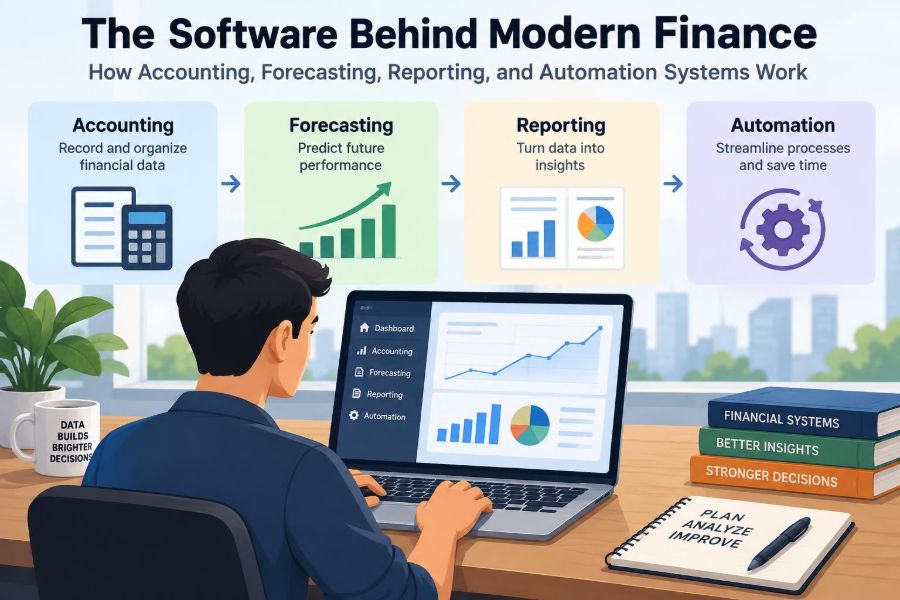
That answer does not come from a single spreadsheet. It comes from a connected set of systems that record transactions, check them, organize them into reports, forecast future outcomes, and route repetitive work to the right people.
When those systems work well, finance can explain results with confidence and help the business make decisions sooner. When they work poorly, teams spend their time finding files, correcting duplicate entries, and debating whose number is correct.
Modern finance software is therefore not just an administrative tool. It is the operational machinery that turns everyday business activity into reliable financial information.
🧭 Finance Software Is a System, Not a Single Product
People often refer to “the accounting system” as if one application does everything. In practice, a finance technology environment usually contains several connected tools, each with a different responsibility.
An enterprise resource planning system, or ERP, may hold the general ledger and supplier records. A customer billing platform may create invoices, a payroll tool may calculate wages, and a planning application may produce forecasts. Reporting tools then combine selected data into dashboards and formal statements.
The goal is not to own the most software. It is to create a dependable flow from business activity to financial decision-making.
📚 The General Ledger Is the Financial Core
The general ledger is the central record of an organization’s financial transactions. It groups entries into accounts such as cash, revenue, rent expense, inventory, accounts receivable, and accounts payable.
Every transaction eventually affects the ledger, whether it begins as a card sale, a supplier invoice, a payroll run, or a depreciation calculation. The ledger provides the underlying balances used to prepare the income statement, balance sheet, and cash flow statement.
Think of it as a structured financial database rather than a report. Reports summarize it; the ledger preserves the detailed accounting record behind those summaries.
⚖️ Double-Entry Accounting Gives Software Its Logic
Most accounting systems are built around double-entry bookkeeping. Each event is recorded with at least one debit and one credit, and total debits must equal total credits.
If a business buys equipment for cash, equipment increases while cash decreases. The accounting software records both sides of that event. This structure helps keep the accounting equation in balance: assets equal liabilities plus equity.
Software can enforce this logic automatically, but it cannot determine whether a user selected the correct account, date, entity, or tax treatment. System controls reduce errors; professional judgment still matters.
🏷️ The Chart of Accounts Creates a Shared Language
A chart of accounts is the organized list of ledger accounts available for recording transactions. Its design determines how clearly a business can later understand its results.
For example, separating shipping expense from advertising expense may help management see which costs are changing. Adding too many narrowly defined accounts, however, can make coding difficult and reporting cluttered.
Well-designed charts often use dimensions in addition to account codes. A transaction may be tagged by department, location, product line, customer type, project, or legal entity. Those tags make analysis more useful without endlessly expanding the account list.
🔌 Integrations Move Data Between Business Systems
Finance systems rarely create all their own data. They receive information from sales platforms, banks, procurement tools, inventory systems, customer relationship management software, timekeeping applications, and more.
An integration is the mechanism that moves or synchronizes data between systems. It may use an application programming interface, commonly called an API, a scheduled file transfer, or a manual import.
Each method involves trade-offs. Real-time APIs can provide timely information but require careful monitoring. Scheduled uploads may be simpler but can leave reports temporarily out of date. A reliable integration also needs clear rules for handling rejected or incomplete records.
🧾 Source Data Determines the Quality of the Result
Finance reporting is only as dependable as its source data. If a sales system marks a canceled order as completed, or an employee chooses the wrong cost center, that error can travel through several downstream reports.
This is why strong processes identify the system of record for each type of information. A payroll application may be the source for gross wages, while a bank feed may be the source for cleared cash transactions.
Teams should avoid silently overwriting information in multiple places. When two systems both claim to hold the “real” customer balance, reconciliation becomes harder and confidence declines.
🧹 Data Mapping Turns Different Formats Into Comparable Records
Different systems use different labels, identifiers, dates, and levels of detail. Data mapping defines how information from one system should be translated for another.
For instance, a sales platform’s “online promotional discount” might map to a particular revenue reduction account in the ledger. A mapping table can also translate department names, currency codes, tax categories, or supplier identifiers.
Mapping is not glamorous, but it is foundational. An incorrect mapping may produce reports that look complete while classifying activity incorrectly. Changes to products, departments, or account structures should trigger a review of relevant mappings.
🛡️ Validation Rules Catch Problems Early
Good finance software does not merely store information. It checks whether information meets defined rules before or after it enters the system.
Common validations include:
- requiring a supplier invoice number before payment processing;
- preventing entries in a closed accounting period;
- checking that debits equal credits;
- flagging duplicate invoice numbers for the same supplier; and
- requiring an approval when a transaction exceeds a policy threshold.
Validation rules cannot catch every business error. They are strongest when based on known, meaningful risks rather than a long list of arbitrary restrictions that users learn to work around.
🏦 Bank Feeds Make Cash Activity Easier to See
Bank feeds import transaction data from bank accounts into accounting or treasury software. They reduce manual data entry and give finance teams a more current view of deposits, payments, fees, and transfers.
Imported bank activity is not automatically correct accounting. A payment may need to be matched to an existing supplier invoice, classified as a transfer, or investigated as an unexpected charge.
Bank feeds are especially useful when paired with disciplined reconciliation. They show what cleared the bank; the ledger explains how that activity should be accounted for.
🧩 Reconciliation Tests Whether Records Agree
Reconciliation is the process of comparing two records that should agree and investigating differences. Bank reconciliations compare the cash ledger to bank activity. Accounts receivable reconciliations compare customer subledger balances to the general ledger.
Differences may be timing-related, such as an outstanding check. They may also reveal duplicate postings, missed entries, incorrect dates, or integration failures.
Reconciliation is not simply a month-end ritual. Frequent reconciliation can uncover issues while supporting documents, employee knowledge, and system logs are still available.
📦 Subledgers Handle Detailed Operational Activity
A subledger stores detailed transactions for a specific area, then posts summarized or individual entries to the general ledger. Common examples include accounts payable, accounts receivable, fixed assets, inventory, and payroll.
Consider accounts payable: the subledger may contain every supplier invoice, payment status, due date, and approval trail. The general ledger holds the corresponding liability balance and expense or asset postings.
This design preserves detail without forcing the core ledger to become an unwieldy operational database. It also creates a reconciliation requirement: subledger totals should tie to their related general ledger accounts.
📥 Invoice Processing Converts Documents Into Payables
Accounts payable software helps teams receive, capture, approve, and pay supplier invoices. Some systems extract information from scanned documents or electronic invoices, while others receive structured invoice data directly.
A typical workflow records the supplier, invoice number, date, amount, tax, payment terms, and coding. The invoice is then matched to evidence that the business ordered and received the goods or services.
Automation can speed extraction, but document quality varies. A human review remains valuable when a document is unclear, an amount is unusual, or coding requires context about the purchase.
🔍 Three-Way Matching Reduces Payment Risk
Three-way matching compares a purchase order, a receiving record, and a supplier invoice. In simple terms, it asks: did the business authorize the purchase, receive the item or service, and receive a bill consistent with both?
For example, an invoice for 100 units may be held if the receiving record shows only 80 units delivered. The difference could be a legitimate partial delivery, a data-entry problem, or an invoice error.
Three-way matching is useful for controlled purchasing environments, but it may be impractical for every expense. Professional services, utilities, and recurring subscriptions often require different approval evidence.
💳 Expense Systems Apply Policy at the Point of Spending
Expense management systems collect employee claims, receipts, card transactions, mileage records, and approval decisions. Their purpose is not merely faster reimbursement; it is consistent policy application and better visibility over spending.
Rules can flag missing receipts, restricted merchant categories, duplicate claims, or expenses submitted outside a stated period. Managers can review business purpose and budget context before payment.
Rigid rules can create friction when employees face legitimate exceptions. A well-designed process makes exceptions visible and reviewable rather than forcing people to hide them in vague descriptions or incorrect categories.
👥 Payroll Connects People Data and Financial Records
Payroll systems calculate compensation, deductions, employer costs, and net pay using employee data, time records, pay rules, and applicable requirements. They then produce accounting entries for wages, taxes, benefits, and related liabilities.
Payroll is sensitive because errors directly affect people and can create compliance obligations. Access should be limited, changes should be logged, and payroll outputs should be reviewed before release.
Accounting teams also need to understand timing. Pay earned in one reporting period may be paid in the next, requiring an accrual so financial statements reflect the cost in the appropriate period.
📅 The Close Process Turns Activity Into a Reporting Period
The financial close is the structured process of completing accounting work for a period, reviewing balances, posting adjustments, and preparing reports. It creates a controlled point at which results can be communicated.
A close checklist often includes bank reconciliations, revenue reviews, accruals, prepaid expense updates, fixed asset depreciation, intercompany entries, variance analysis, and management review.
Speed matters, but a fast close that relies on unreviewed data is not a strong close. The practical objective is a repeatable process that balances timeliness with evidence, review, and correction.
🧮 Accruals Match Costs and Revenue to the Right Period
Accrual accounting records economic activity when it is earned or incurred, rather than only when cash changes hands. This helps financial statements describe a period’s performance more meaningfully.
Suppose a consulting firm receives work in December but invoices in January. A hypothetical year-end close may record revenue in December if the relevant recognition conditions are met. Similarly, a business may accrue a utility cost used in December but billed later.
Accruals often depend on estimates, contracts, usage data, and management judgment. They should be documented, reviewed, and reversed or updated when actual invoices or outcomes become known.
📊 Financial Reporting Summarizes What Happened
Financial reporting transforms ledger data into understandable statements and management views. External-style statements usually focus on financial position, performance, and cash flows. Internal reports may focus on margin, operating costs, customer trends, or departmental performance.
The same ledger balance can be presented differently for different audiences. A controller may need account-level detail; a business leader may need a concise explanation of why actual spending differed from plan.
A report is useful when its definitions, reporting period, source data, and filters are clear. Attractive charts cannot compensate for ambiguous metrics.
📈 Management Dashboards Need Metric Definitions
Dashboards provide a fast view of selected measures, but speed can create false certainty. Terms such as “revenue,” “active customer,” “operating margin,” and “cash available” may have different meanings across teams.
A good dashboard includes a metric definition: what is included, what is excluded, when the data refreshes, and which system supplies it. For example, cash may mean bank balance, available cash after restrictions, or forecast cash after expected payments.
Dashboards work best as a starting point for questions. They should allow users to drill into transactions or supporting schedules when a figure needs explanation.
🔎 Variance Analysis Explains the Difference From Plan
Variance analysis compares actual results with a budget, forecast, prior period, or another relevant benchmark. The useful question is not just “What changed?” but “What operational event caused the change?”
A payroll expense variance might result from additional hires, overtime, a bonus accrual, a coding change, or a timing difference. Those causes require different actions and should not be treated as interchangeable.
Strong variance commentary distinguishes fact from interpretation. It identifies the amount and driver, notes whether the effect is recurring, and explains what decision or follow-up is appropriate.
🔮 Forecasting Uses Assumptions to Look Forward
A forecast estimates future financial outcomes based on current information, historical patterns, planned actions, and explicit assumptions. It is not a promise. Its value lies in making the assumptions visible so they can be tested and revised.
A simple revenue forecast might combine expected unit volume, average selling price, renewal expectations, and timing. A cash forecast may add collections timing, payroll dates, supplier payments, taxes, borrowing, and planned capital spending.
Forecast quality depends less on complex mathematics than on whether key drivers reflect how the organization actually operates.
🌦️ Scenario Planning Makes Uncertainty Discussable
Scenario planning creates alternative views of the future, such as a base case, an upside case, and a downside case. Each case changes selected assumptions rather than pretending that one projection is certain.
For a hypothetical retailer, the downside case may assume lower sales volume and slower customer collections, while the upside case may assume stronger demand with additional inventory purchases. Finance can then estimate effects on profit, cash, and staffing needs.
Useful scenarios are plausible and decision-focused. They should help leaders identify triggers, prepare responses, and understand what could change—not manufacture a large number of speculative possibilities.
🧠 Driver-Based Planning Links Finance to Operations
Driver-based planning builds forecasts from operational inputs that cause financial outcomes. Examples include headcount, production volume, store traffic, customer churn, utilization, average order value, and payment terms.
Instead of entering a single travel expense number, a team might forecast trips per employee, average cost per trip, and expected hiring. That approach makes the forecast easier to challenge and update when staffing plans change.
Not every account needs a detailed driver model. Teams should focus modeling effort on material, uncertain, or decision-relevant areas rather than creating complexity that no one can maintain.
🤖 Automation Handles Repetition, Not Accountability
Finance automation uses rules, workflows, integrations, and sometimes machine-learning features to perform repeatable tasks. Examples include routing invoices for approval, matching bank transactions, sending payment reminders, creating recurring journal entries, and refreshing reports.
Automation is most effective when the process is stable and the expected outcome can be described clearly. A poorly understood process does not become reliable merely because software performs it faster.
Human accountability remains necessary for exceptions, estimates, unusual transactions, control design, and decisions that require business context. The aim is to remove low-value manual handling, not eliminate informed review.
🧾 Rules Engines and Workflows Encode Decisions
A rules engine applies predefined logic, such as sending an invoice over a certain amount to a specific approver or coding a recurring charge to a known account. A workflow defines the sequence of steps, people, and status changes around that rule.
Clear workflows make responsibilities visible. They can show who submitted an item, who approved it, when a decision was made, and why an exception occurred.
Rules should be documented in business language, not only buried in system configuration. Otherwise, a policy change can leave outdated logic running unnoticed.
🪪 Access Controls Protect Data and Decisions
Finance systems hold sensitive information: payroll data, bank details, supplier records, pricing, budgets, and financial results. Access controls determine who can view, change, approve, or export that information.
Good access design follows the principle of least privilege: users receive the access needed for their role, not broad access “just in case.” Permissions should be reviewed when roles change or people leave.
Security is also an operational issue. A person who can create a supplier, approve an invoice, and release payment may bypass the checks intended to detect error or fraud.
🧱 Segregation of Duties Builds Internal Control
Segregation of duties separates incompatible responsibilities so that one individual cannot complete a risky transaction from beginning to end without oversight. It is a core concept in internal control.
A practical separation might involve one person entering a supplier, another approving the invoice, and a third releasing the payment. Smaller organizations may not have enough staff for a perfect split, so they may use compensating reviews by an owner or manager.
Controls should be proportionate to risk. Excessive approval layers can delay routine work; insufficient separation can leave material activity unchecked.
🧾 Audit Trails Preserve the Story Behind a Number
An audit trail records what happened in a system: who created or changed a transaction, what changed, when it changed, and sometimes the reason or supporting document.
Audit trails help teams investigate unexpected balances, explain journal entries, support reviews, and demonstrate that a process operated as intended. They are particularly valuable when a transaction moves through several systems before reaching the ledger.
Keeping logs is not enough. Organizations need retention practices, access to historical records, and a process for reviewing unusual changes. A trail is useful only if someone can follow it.
🧪 Testing Prevents Quiet System Failures
Changes to finance systems can affect account mappings, calculations, approval routes, integrations, reports, and controls. Testing checks whether a change works as intended before it affects live financial data.
A useful test includes normal cases, exceptions, boundary conditions, and failed inputs. For example, an invoice workflow should be tested not only for a standard invoice, but also for a duplicate number, a missing purchase order, and an amount requiring extra approval.
Teams should document expected results and retain evidence of testing. This is especially important when a configuration change affects reporting or automated journal entries.
🚨 Exception Management Is Where Human Judgment Adds Value
Exceptions are transactions that do not fit normal rules: an unusual payment, a late invoice, a disputed customer balance, a missing receipt, or an integration error. They are often where financial risk and business context meet.
Strong systems make exceptions visible, assign ownership, track resolution, and prevent issues from disappearing into email threads. A queue without clear priorities can become another hidden backlog.
Reviewers should ask whether an exception is genuinely unusual or whether it exposes a recurring process weakness. Repeated “exceptions” may signal a rule, policy, data, or workflow that needs redesign.
🧰 Spreadsheet Work Still Has a Place
Spreadsheets remain valuable for analysis, modeling, small-scale reconciliations, and flexible one-time questions. They allow finance professionals to explore data quickly and communicate a calculation transparently.
Problems arise when a critical recurring process depends on a file with unclear ownership, hidden formulas, copied data, and no review. That is not a reason to ban spreadsheets; it is a reason to apply controls appropriate to their importance.
For material workbooks, use clear inputs, protected formulas where appropriate, version control, documented logic, independent review, and a plan to move stable recurring processes into managed systems.
🧭 Choosing Software Starts With Process Design
Software selection should begin with questions about the business process: What data is needed? Who performs each step? Which controls are required? What decisions must reporting support? What will change as the organization grows?
A feature list alone can be misleading. A system may offer powerful capabilities that the organization cannot configure, govern, or maintain. Conversely, a simpler tool may work well if processes are straightforward and data volumes are manageable.
Evaluate integration options, data ownership, implementation effort, user skills, reporting needs, security, support, and total operating complexity. The best fit is rarely the product with the longest list of features.
🚀 Implementation Requires Ownership and Change Management
Implementing finance software means changing routines, data structures, responsibilities, and sometimes management expectations. Technical configuration matters, but adoption depends on people understanding why the process is changing and what they must do differently.
Define owners for master data, mappings, approvals, reporting definitions, and system administration. Clean historical data where practical, but avoid treating migration as an opportunity to copy every obsolete record into a new environment.
Training should use realistic tasks: entering an invoice, resolving an exception, reviewing a dashboard, or closing a period. Clear support channels during early use can prevent informal workarounds from becoming permanent.
🎯 The Core Principle: Reliable Decisions Need Reliable Flows
Modern finance systems connect events, records, controls, reports, and forecasts. Their real value is not that they produce more data. It is that they create a traceable path from a business event to a decision.
That path depends on sound accounting design, clean source data, sensible automation, tested integrations, meaningful controls, and people who understand the operations behind the numbers. Each element reinforces the others.
For students, the lesson is that accounting knowledge increasingly includes systems thinking. For professionals, the lesson is practical: improve the flow of information before demanding faster answers from finance.
The strongest finance technology does not replace accounting judgment; it gives that judgment timely, organized, and trustworthy evidence. When the flow works, finance can spend less time repairing records and more time helping the organization act wisely. 💰📊⚙️