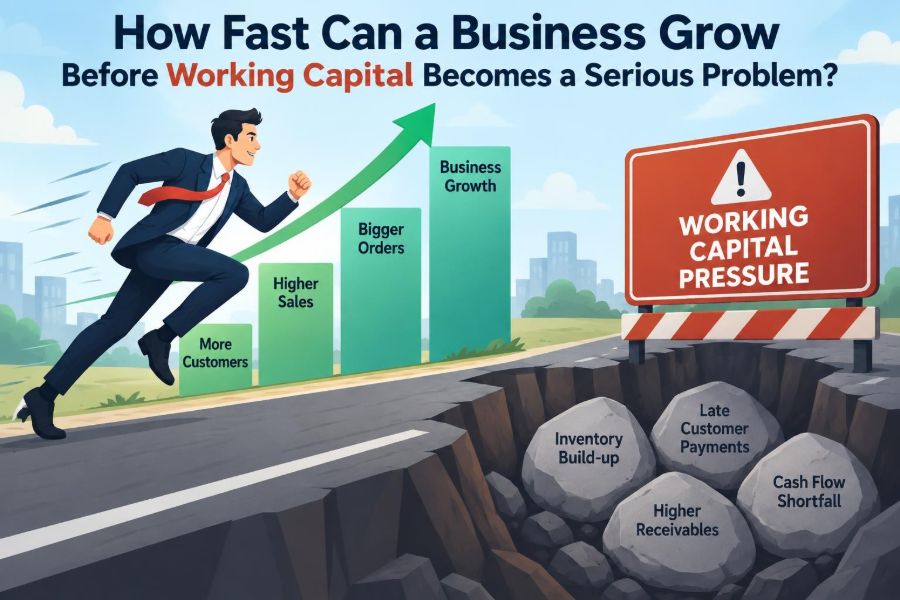

A business can look successful on paper and still struggle to make payroll on Friday. Sales are rising, new customers are signing contracts, and the owner is celebrating the busiest month yet. Then a large supplier invoice arrives before the customer payment does.
This is one of the most uncomfortable patterns in business finance: growth creates more activity, but activity often consumes cash before it produces cash. The faster the company grows, the more inventory, labor, deposits, and unpaid invoices it may need to carry.
That does not mean growth is dangerous or that a profitable business should slow down automatically. It means leaders need to understand the timing difference between earning revenue and collecting money.
Working capital is where that timing difference becomes visible. It can show when growth is being funded safely, when it is stretching the business, and when an apparently strong sales trend is becoming a liquidity problem.
🧭 Growth Is Not the Same as Cash Generation
Revenue records the value of goods or services delivered. Cash records money actually available to pay obligations. Those measures may move together over time, but they can diverge sharply in any given month.
A consulting firm might invoice a client for a completed project and recognize revenue immediately. If the contract allows the client 60 days to pay, however, the firm must fund salaries and subcontractors during that gap.
A growing business can be profitable but cash-poor. This is especially common when sales growth requires upfront spending.
💧 What Working Capital Actually Means
Working capital is usually calculated as current assets minus current liabilities. Current assets include cash, accounts receivable, and inventory expected to turn into cash within a relatively short period. Current liabilities include obligations due within that same period, such as supplier bills, payroll taxes, and short-term debt.
The calculation is useful, but it is only a starting point. A dollar of cash is immediately available; a dollar of aging inventory or a disputed customer invoice is not equally useful.
For day-to-day management, working capital asks a practical question: can the business pay near-term commitments while waiting for customers and inventory to convert into cash?
📈 Why Fast Growth Pulls Cash Forward
When sales increase, a company often needs to buy more inputs before making the extra sales. A retailer purchases more stock. A manufacturer orders materials and schedules labor. A services company hires staff, pays travel costs, or brings in contractors.
Those costs generally occur before collection. If the company doubles monthly sales while collection terms remain unchanged, the dollar amount tied up in unpaid invoices can also rise substantially.
Growth therefore creates a funding requirement. The business is financing the period between paying for operations and receiving cash from customers.
⏱️ The Operating Cycle Explains the Pressure
The operating cycle is the time from spending cash to obtain goods or deliver services until collecting cash from the customer. For a retailer, it may run from buying inventory to selling it and then receiving card or invoice payments.
For a project business, it may begin with mobilization, labor, and materials, then continue through invoicing, client approval, and payment. Longer cycles generally require more working capital at a given level of sales.
Fast growth becomes harder to fund when the operating cycle is long, unpredictable, or both.
🔄 Cash Conversion Cycle: A More Specific Lens
The cash conversion cycle refines the operating cycle by considering supplier credit. It is commonly described as inventory days plus receivable days minus payable days.
In plain language, it estimates how long the company’s cash is tied up after allowing for the time suppliers give it to pay. A shorter cycle usually reduces the amount of cash needed to support operations.
| Component | What it measures | Why it affects cash |
|---|---|---|
| Inventory days | How long stock is held before sale | Cash remains tied up in unsold goods |
| Receivable days | How long customers take to pay | Revenue has been earned but not collected |
| Payable days | How long the business takes to pay suppliers | Supplier credit can preserve cash temporarily |
No single target fits every industry. The useful comparison is against the company’s own history, contract terms, seasonality, and operating model.
🧮 A Simple Hypothetical Growth Example
Imagine a wholesaler selling goods with a gross margin that covers operating costs and eventually produces profit. To support an additional month of sales, it must purchase inventory in advance and give customers 45-day payment terms.
If monthly sales rise quickly, the company may need to make larger supplier payments now while waiting for a larger pool of invoices to be collected later. Even if every sale is profitable, the cash gap grows with the sales base.
The key insight is not a universal percentage. It is that each extra unit of growth can require an extra investment in working capital.
🚦 When Growth Starts Becoming a Serious Problem
There is no sales-growth rate that automatically becomes unsafe. A software company collecting subscriptions in advance can often grow much faster with less working-capital strain than a distributor that prepays for stock and collects 60 days after delivery.
The warning point arrives when the additional cash required by growth exceeds cash generated internally and dependable funding available to the business. At that point, the company may delay payments, draw down emergency credit, or reject profitable orders because it cannot finance delivery.
The problem is driven by the relationship between growth speed, cash timing, margins, and access to funding—not by growth percentage alone.
🧱 Inventory Can Absorb Cash Quietly
Inventory is necessary for many businesses, but it is cash in a less liquid form. Excess stock may result from optimistic forecasts, minimum-order quantities, supply-chain caution, slow-moving product lines, or weak purchasing controls.
During growth, managers sometimes increase inventory “just in case.” That can protect service levels, but it also multiplies carrying costs and the risk of obsolescence.
Review stock by product movement and margin, not only by total value. A full warehouse can hide both a cash problem and a forecasting problem.
📬 Receivables Turn Sales into a Credit Decision
Every invoice issued on terms is, in effect, short-term credit extended to a customer. Sales teams may see a large contract; finance teams must also ask whether the customer will pay in full and on time.
A rise in accounts receivable is not automatically bad. It may simply reflect healthy growth. Concern rises when receivables grow faster than sales, invoices age beyond terms, or disputes prevent collection.
Clear contracts, prompt invoicing, proof of delivery, and disciplined follow-up help turn recorded revenue into usable cash.
🤝 Supplier Terms Are Useful but Not Free Cash
Payables represent bills the business has not paid yet. Reasonable supplier terms can align cash outflows with customer collections and reduce working-capital pressure.
But treating suppliers as an unlimited bank is risky. Consistently paying late can damage supply reliability, remove early-payment discounts, trigger credit holds, or weaken relationships when flexibility is most needed.
Negotiate terms openly before a crisis. A sustainable agreement is better than silently stretching payments.
🏗️ Different Business Models Need Different Answers
Working-capital needs vary widely. A restaurant receives much of its cash quickly but may face frequent payroll and food purchases. A construction contractor may incur major costs long before a milestone is approved and billed.
Subscription businesses that bill in advance can have customer cash before delivering service, while e-commerce sellers may pay for inventory months before a sale. Manufacturers often face both inventory and receivable exposure.
Benchmarking can be informative, but operating details matter more than broad labels. Two firms in the same industry can have very different cash cycles.
📊 The Current Ratio Has Limits
The current ratio divides current assets by current liabilities. It is a familiar indication of short-term coverage, but it should never be read in isolation.
A company can report a seemingly comfortable ratio because it holds inventory that cannot be sold quickly or receivables that are overdue. Conversely, a business with rapid cash collections may operate safely with a lower ratio.
Ask what is inside the numerator and when each asset is likely to become cash. Quality and timing matter as much as the total.
⚡ The Quick Ratio Adds a Useful Stress Test
The quick ratio generally excludes inventory from current assets before comparing the remainder with current liabilities. It is often useful where inventory could be slow to sell or heavily discounted.
It does not declare a business safe or unsafe by itself. Its value is in prompting a more demanding question: if inventory could not be converted promptly, could the business still meet near-term obligations?
Use ratios as signals for investigation, not as substitutes for a detailed cash forecast.
🗓️ A Cash Forecast Sees Trouble Earlier
An income statement may show profit while a cash forecast shows a funding gap several weeks ahead. A rolling forecast lists expected customer receipts, payroll, tax payments, supplier payments, debt service, rent, and planned capital spending by week or month.
The best forecasts are updated frequently with actual collections and revised assumptions. They are not predictions carved in stone; they are management tools for seeing choices before they become emergencies.
For a rapidly growing firm, weekly visibility is often more useful than waiting for month-end reports.
🔍 Forecast Collections, Not Just Invoices
A common forecasting error is to assume that every invoice will be paid on its contractual due date. Actual collections may depend on customer approval processes, missing purchase-order references, disputes, payment runs, or simple delay.
Group receivables by expected collection date and risk. Separate invoices that are confirmed, due soon, disputed, or materially overdue.
Conservative collection assumptions do not mean pessimism. They prevent management from spending cash that exists only in a spreadsheet.
🧾 Gross Margin Does Not Pay Bills by Itself
Higher gross margin can improve a company’s ability to self-fund growth, but it does not eliminate timing issues. A high-margin project may still consume cash if it requires substantial labor and materials before the first billing milestone.
Low-margin businesses are more sensitive because a small pricing error, discount, return, or cost increase can remove the cash cushion needed to carry working capital.
Assess growth by contribution and cash timing together. A sale that looks attractive on margin may be unattractive once financing needs and collection risk are considered.
🎯 Pricing Should Reflect the Cash Burden
Pricing discussions often focus on competitor prices and desired margins. They should also consider payment terms, customization, delivery commitments, warranty exposure, and the capital tied up before payment.
A customer asking for extended terms is asking the supplier to provide more financing. That may be worthwhile for a strategic relationship, but the cost and risk should be visible in the commercial decision.
Options include deposits, progress billing, shorter terms, credit limits, or a price that reflects the additional financing burden.
🧾 Deposits and Milestones Can Change the Equation
For custom products, long projects, and professional services, deposits and milestone billing can align cash receipts with work performed. They reduce the amount the supplier must finance before the customer contributes cash.
Milestones should correspond to tangible progress, such as design approval, delivery of materials, completion of an installation stage, or an accepted project output. Vague milestones invite disputes and delay.
Advance payment is not suitable for every market, but where it is commercially acceptable, it can materially improve growth capacity.
🏦 Debt Can Fund a Gap, Not Fix a Broken Model
A working-capital facility, line of credit, overdraft, or receivables-based financing can help bridge the period between cash outflows and collections. These tools may be appropriate when growth is profitable, forecasts are credible, and repayment comes from normal cash conversion.
Borrowing is less helpful when the underlying issue is persistent losses, obsolete stock, chronic customer nonpayment, or pricing below sustainable cost. In those cases, debt can postpone rather than solve the decision.
Match financing duration to the asset or gap being financed. Short-cycle needs are generally better matched with short-term liquidity tools than with improvised long-term commitments.
💳 Factoring and Invoice Finance Require Care
Invoice finance can provide cash against eligible receivables before customers pay. Depending on the arrangement, the lender may advance funds while the business retains some collection and bad-debt risk.
It may be useful for firms with strong invoices and long customer terms, but costs, eligibility rules, customer concentration limits, and administrative requirements matter. Not every receivable qualifies.
Read the agreement carefully and model the economics. Faster cash is valuable only if the margin supports the financing cost and the arrangement fits customer relationships.
🧠 Credit Control Is Part of Operations
Collections should not begin only after an invoice becomes overdue. Credit control starts before the sale: verify the customer entity, set an appropriate credit limit, agree billing requirements, and document who approves invoices.
Operational teams matter too. An accurate invoice sent promptly with the required evidence is easier to pay than one submitted late with errors.
- Confirm terms before accepting the order.
- Invoice immediately when the contractual trigger occurs.
- Follow up before, on, and after the due date.
- Escalate disputes quickly to the people who can resolve them.
🛑 Sales Incentives Can Accidentally Create Cash Risk
When sales incentives reward booked revenue alone, employees may be encouraged to offer long terms, accept weak-credit customers, or pursue deals with costly customization. The accounting revenue may look strong while the cash profile deteriorates.
This does not mean salespeople should manage the entire balance sheet. It means commercial incentives should include sensible guardrails, such as approved credit terms, contribution margin, collection quality, or cash-aware deal approval.
Fast growth needs coordination between sales, operations, and finance rather than isolated targets.
📦 Operations Can Release Working Capital
Many working-capital improvements come from better execution rather than financial engineering. More accurate demand planning can reduce excess inventory. Faster fulfillment can allow earlier invoicing. Fewer billing errors can shorten collection time.
Small improvements across the process can compound. Reducing unnecessary stock, accelerating invoice approval, and aligning purchase orders with confirmed demand may free cash without reducing customer service.
The goal is not to minimize every balance. It is to remove avoidable cash lockups while maintaining resilient operations.
🌦️ Seasonality Makes Annual Profit Misleading
Some businesses build inventory or hire staff months before their sales season. An annual profit forecast may look healthy while the pre-season cash trough is severe.
Seasonal companies should forecast their lowest expected cash point, not just year-end cash. They may need committed funding before the build period begins, when lenders and suppliers are more willing to negotiate.
Plan downside cases too: later demand, slower collections, higher purchase costs, or a customer cancellation can all deepen the trough.
🚨 Early Warning Signs Deserve Attention
Working-capital stress often appears in operational behavior before it appears in a formal default. Leaders should watch for patterns, not just one unusual week.
- Receivables aging faster than revenue growth.
- Repeated reliance on last-minute borrowing.
- Supplier calls, credit holds, or requests for overdue payment.
- Inventory rising faster than demand or containing slow-moving items.
- Payroll, tax, or debt payments becoming difficult to schedule.
- Profitable orders being delayed because materials cannot be funded.
These signals call for diagnosis, not panic. The correct response depends on whether the cause is timing, poor controls, weak margins, or a structural funding mismatch.
🧯 What to Do When the Gap Is Already Here
Start by building a short-term cash forecast based on realistic receipt dates and unavoidable payments. Rank obligations by legal priority, operational impact, and relationship importance, while obtaining professional advice where needed for tax, legal, or insolvency concerns.
Then act on the main drivers: accelerate undisputed collections, pause nonessential spending, reduce or defer discretionary inventory purchases, negotiate transparently with key suppliers, and reassess unprofitable or cash-intensive orders.
A rushed attempt to grow out of a cash crisis can worsen it. New sales help only when their cash profile improves rather than expands the gap.
🧪 Stress-Test the Growth Plan Before Committing
Before taking a major order, launching a new product, or expanding into a new region, model the cash path. Include deposits, inventory lead times, labor, payment terms, likely collection delays, taxes, returns, and financing availability.
Run at least a base case and a slower-collection case. If a modest delay makes the plan unaffordable, the business may need revised terms, staged rollout, more capital, or a smaller initial commitment.
Stress testing is not a prediction of failure. It is a way to learn which assumptions require protection.
🧑🤝🧑 Owners, Managers, and Finance Need Shared Visibility
Finance teams can calculate cash needs, but they cannot manage them alone. Sales knows upcoming contracts. Operations knows supplier lead times and production constraints. Account managers know which customers may delay approval.
A regular cross-functional review can connect those facts before they collide. Discuss expected orders, large invoices, stock commitments, collections, and exceptions to standard terms.
Working capital improves when people treat cash timing as an operating responsibility, not merely an accounting report.
🧰 A Practical Monthly Review Routine
A disciplined monthly review does not need to be complicated. It should compare planned and actual cash movement, explain significant variances, and identify actions with named owners.
- Review cash collected versus invoices issued.
- Examine aged receivables and disputed balances.
- Review inventory movement, purchase commitments, and obsolete stock risk.
- Check supplier terms, upcoming payment concentrations, and credit availability.
- Update the rolling cash forecast and test key assumptions.
As growth accelerates, supplement this monthly rhythm with a shorter weekly cash review.
🪜 There Is No Single Safe Growth Rate
A business that collects cash upfront may be able to scale rapidly with comparatively little external working capital. A business that must build inventory, pay labor, and wait for customer acceptance may need substantial funding even at modest growth rates.
The better question is: how much incremental cash does each additional dollar of sales require, and when will that cash return? Once management can answer that, it can judge whether planned growth is fundable.
That answer should be revisited whenever customer terms, supplier terms, product mix, delivery lead times, or financing conditions change.
✅ The Core Principle: Fund the Cash Cycle, Not the Headline
Sales growth is valuable when it produces sustainable cash over time. But revenue growth alone is not evidence that a company can safely meet its commitments next week or next month.
Track the path from cash spent to cash collected. Protect margin, control inventory, invoice accurately, collect deliberately, negotiate terms thoughtfully, and use financing for temporary timing gaps rather than recurring economic weakness.
The sustainable speed of growth is the speed a business can finance through its real cash cycle.
When leaders measure growth alongside cash timing, they can pursue opportunity without confusing a fuller order book for a fuller bank account. 💰📈🧭