
A business can report a healthy profit and still struggle to pay its staff, suppliers, or loan instalments. That sounds contradictory until you separate the accounting result from the money in the bank.
Imagine a small design agency that completes a large project in December and sends the client an invoice. Revenue appears in December’s income statement. If the client pays in February, however, the cash arrives much later. Meanwhile, payroll, software subscriptions, and rent still need to be paid.
This is why owners, lenders, investors, and managers look beyond profit. They need to know whether the business can generate cash through normal operations, where it is investing money, and how it is funding itself.
The cash flow statement answers those questions. Once you can read it, financial statements stop looking like separate reports and start telling one connected story.
🧭 What a Cash Flow Statement Shows
A cash flow statement explains the change in a company’s cash and cash equivalents during an accounting period. Cash equivalents are highly liquid, short-term investments that can be converted to a known amount of cash quickly and carry little risk of value changes.
Unlike an income statement, which records revenue when earned and expenses when incurred, the cash flow statement focuses on actual inflows and outflows of cash. Its central question is simple: where did the cash come from, and where did it go?
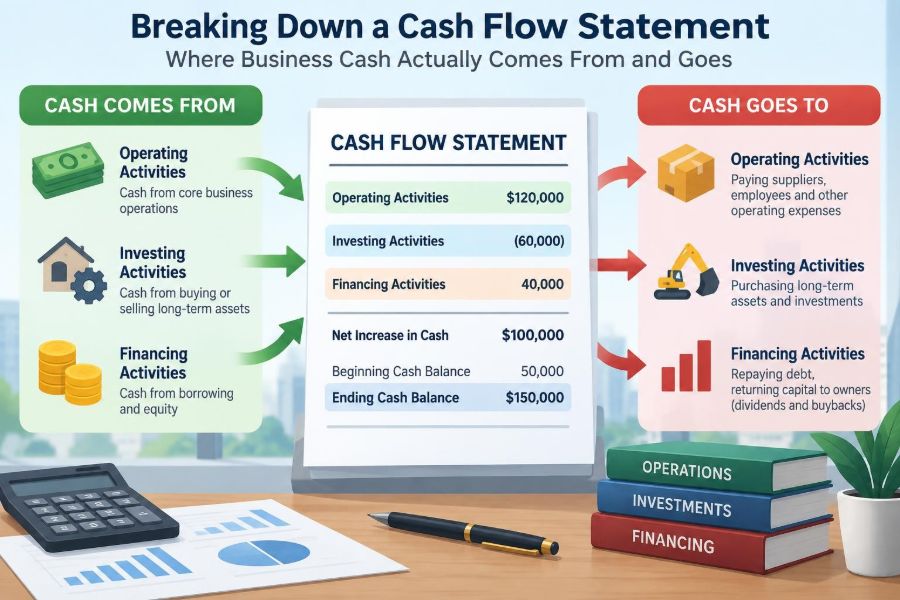
The statement divides cash movements into three categories: operating activities, investing activities, and financing activities. Together, these categories reconcile beginning cash to ending cash.
💡 Why Profit Is Not the Same as Cash
Profit is calculated under accrual accounting. A company records a sale when it has delivered goods or services and has earned the revenue, not necessarily when its customer pays.
Similarly, an expense may reduce profit before any cash leaves the business. Depreciation is the familiar example: it allocates the cost of a long-lived asset over time, but it is not a current-period cash payment.
A profitable business can therefore have weak cash flow if customers pay slowly, inventory absorbs cash, or it makes large capital purchases. A loss-making business can temporarily show positive cash flow if it collects old receivables, delays supplier payments, or borrows heavily. Neither pattern tells the full story alone.
🧱 The Three Activity Categories
The three sections are designed to separate ordinary trading activity from long-term investment decisions and funding decisions. That separation makes the statement much more informative than one total cash number.
| Section | Core question | Typical examples |
|---|---|---|
| Operating activities | Did day-to-day business operations generate cash? | Cash from customers, payments to suppliers and employees |
| Investing activities | What long-term assets or investments did the company buy or sell? | Equipment purchases, sale of a building, acquisition payments |
| Financing activities | How did the company raise or return capital? | Borrowing, loan repayments, share issues, dividends |
Classification details can vary under applicable accounting standards and company policy, particularly for interest and dividends. The broad logic, however, remains consistent: operations run the business, investing builds or changes its asset base, and financing supplies or returns capital.
🔗 How the Statement Connects to the Other Reports
The income statement measures performance over a period. The balance sheet shows assets, liabilities, and equity at a point in time. The cash flow statement bridges the opening and closing cash balances on the balance sheet.
For example, an increase in accounts receivable means the company recognized revenue that it has not yet collected in cash. An increase in accounts payable may mean it has recorded expenses but has not paid suppliers yet. These balance-sheet changes help explain why operating cash flow differs from net income.
Reading all three statements together prevents a common mistake: assuming one attractive number represents the whole business.
🏦 Cash and Cash Equivalents Need a Clear Definition
“Cash” usually includes funds in bank accounts and physical cash. “Cash equivalents” generally include short-term, highly liquid holdings that can be readily converted to cash without meaningful price risk.
Not every financial asset qualifies. A longer-term investment, restricted cash set aside for a specific purpose, or an asset subject to substantial market changes may be presented differently. The notes to the financial statements often provide the necessary detail.
This distinction matters because a business may hold valuable assets and still lack cash available for immediate obligations.
⚙️ Operating Cash Flow: The Business Engine
Cash flow from operating activities, often called CFO or operating cash flow, reflects cash generated and used by the company’s primary revenue-producing activities. For a retailer, this involves buying inventory and selling it. For a consultancy, it centers on billing clients and paying people who deliver the work.
Over time, a durable business model usually needs to generate positive operating cash flow. A single negative period is not automatically alarming; seasonality, growth, and temporary disruption can all affect timing. Persistent weakness deserves closer investigation.
Operating cash flow is not a pure measure of profitability. It is a measure of cash conversion after considering operating working capital and non-cash accounting items.
🧾 The Indirect Method: Starting With Net Income
Many companies present operating cash flow using the indirect method. It begins with net income, then adjusts for non-cash items and changes in operating assets and liabilities.
The logic is practical. Net income includes revenues and expenses that may not yet involve cash, so the reconciliation removes those timing and measurement differences.
A simplified sequence looks like this:
- Start with net income.
- Add back non-cash expenses, such as depreciation.
- Remove non-cash gains or losses included in income.
- Adjust for changes in receivables, inventory, payables, and other operating balances.
The indirect method does not mean the company avoided showing cash payments. It means the statement explains cash from operations by reconciling accrual-based profit to cash.
💵 The Direct Method: Showing Cash Receipts and Payments
Under the direct method, operating cash flow is shown through major classes of cash receipts and cash payments. A company may present cash collected from customers, cash paid to suppliers, cash paid to employees, and cash paid for taxes.
For many readers, this format feels intuitive because it resembles a bank-account summary. It directly identifies the large operating cash streams.
The indirect method remains widely seen because it efficiently links net income to operating cash flow. Neither presentation eliminates the need for analysis; readers still need to understand customer collections, payment timing, and unusual movements.
➕ Why Depreciation Is Added Back
Depreciation reduces accounting profit, but it does not require a new cash payment each period. The cash outflow occurred when the business originally bought the asset, usually in an earlier period.
Suppose a company purchased machinery for cash several years ago. Each year, depreciation records part of that machine’s cost as an expense. In the indirect operating section, depreciation is added back because net income was reduced without a current-year operating cash outflow.
Adding depreciation back does not make it free. The company still must eventually replace aging equipment, and that replacement cost normally appears in investing cash flows.
📉 Gains and Losses Can Mislead the Operating Section
A gain on the sale of equipment can increase net income even though the full cash proceeds belong in investing activities. The indirect method removes the gain from operating cash flow to avoid counting it in the wrong category.
A loss works in the opposite direction. It reduced net income, so it is added back in the operating reconciliation, while the actual proceeds from selling the asset are reported as investing cash inflow.
This adjustment is about classification, not about denying that the transaction mattered. The sale affected total cash; the cash flow statement simply places each component where it belongs.
🧺 Accounts Receivable: Revenue Waiting to Become Cash
Accounts receivable represent amounts customers owe after goods or services have been provided. When receivables increase, the company generally recognized more revenue than it collected in cash during the period.
Under the indirect method, an increase in receivables is subtracted from net income to calculate operating cash flow. A decrease is added because the company collected cash from customers for revenue recognized earlier.
Fast revenue growth can therefore reduce short-term cash flow if credit sales rise faster than collections. This is common in expanding businesses, but management must ensure customers will actually pay.
📦 Inventory: Cash Sitting on the Shelf
Inventory is often one of the largest cash commitments in product-based businesses. Buying goods for resale uses cash before those goods produce revenue.
If inventory rises, operating cash flow is usually reduced because the company has tied more resources up in stock. If inventory falls, cash flow may improve because the business sold existing stock without replacing all of it.
A falling inventory balance is not automatically good news. It may reflect better inventory management, but it could also signal stock shortages, reduced purchasing capacity, or declining demand. Context matters.
🤝 Accounts Payable: Supplier Credit and Its Limits
Accounts payable are amounts owed to suppliers for goods and services already received. If payables increase, the company has postponed some cash payments, which increases operating cash flow in the current period.
That can be normal working-capital management. It can also be a warning sign if payments are being delayed because cash is tight.
A useful question is whether the increase reflects normal purchasing growth and agreed terms, or whether it is growing much faster than the underlying business. Cash flow improves when suppliers finance the business temporarily, but supplier patience is not an unlimited source of funding.
🔄 Working Capital Explains Many Cash Surprises
Working capital is commonly described as current assets minus current liabilities. For cash flow analysis, the focus is often on operating working capital: receivables, inventory, payables, and related short-term operating balances.
Growth usually requires working capital. A manufacturer may need to buy materials, build inventory, and offer customers payment terms before collecting cash from sales. This means a growing company can consume cash even when its income statement looks strong.
Businesses with different models have different cash patterns. A subscription company paid in advance may collect cash before recognizing revenue. A wholesaler may pay suppliers before customers settle invoices. Neither model is inherently better; the timing profile changes the funding needs.
🏗️ Investing Cash Flow: Building Future Capacity
Cash flow from investing activities captures purchases and sales of long-term assets and certain investments. It often shows how a company is allocating cash for future operations.
Buying property, machinery, vehicles, software developed for long-term use, or another business usually creates investing cash outflows. Selling equipment, receiving proceeds from an investment sale, or disposing of a subsidiary may create inflows.
Negative investing cash flow is often expected in a growing or asset-intensive company. The more useful question is what the spending is intended to achieve and whether the business can finance it responsibly.
🛠️ Capital Expenditures Are Not Ordinary Expenses
Capital expenditures, often shortened to capex, are cash spent to acquire, improve, or extend the life of long-lived assets. They differ from routine operating expenses because the asset is expected to provide benefits over multiple periods.
Replacing a worn delivery van, purchasing production equipment, or constructing a warehouse can be capex. Routine fuel, repairs, and wages are generally operating items because their benefit is consumed in the current period.
Accounting judgment matters near the boundary. A company’s policies and the nature of the expenditure determine whether a cost is capitalized or expensed under the applicable rules.
🌱 Growth Investment Versus Maintenance Investment
Not all capex has the same meaning. Maintenance capex keeps existing operations functioning, while growth capex expands capacity, enters a new market, or supports additional sales.
Financial statements do not always separately identify the two. Management commentary, asset notes, and an understanding of the business may help, but readers should avoid pretending the split is exact when disclosures do not support it.
A company with low capex may look cash-rich today, yet underinvesting in essential equipment can create operational problems later. Conversely, high capex may pressure current cash while supporting a credible expansion plan.
💳 Financing Cash Flow: Who Funds the Business?
Cash flow from financing activities records transactions with lenders and owners. It shows whether a company is borrowing, repaying debt, issuing shares, buying back shares, or distributing cash to shareholders.
Borrowing brings in cash today but creates future repayment and interest obligations. Issuing shares brings in capital without mandatory repayment, but it can dilute existing owners’ percentage interests.
The financing section helps readers see whether operations are funding the business or whether external capital is filling a gap.
🏦 Debt Proceeds and Debt Repayments Tell Different Stories
Debt proceeds are financing cash inflows. Principal repayments are financing cash outflows. Interest payments are treated according to the applicable reporting framework and company policy, so their classification should be checked rather than assumed.
New borrowing is not automatically negative. A business may use debt to purchase productive assets, smooth seasonal cash needs, or refinance an existing facility. The risk depends on repayment capacity, interest costs, maturity dates, and the stability of operating cash flow.
A company that repeatedly borrows just to fund routine operating losses faces a different situation from one borrowing for a clearly planned, cash-generating asset purchase.
👥 Equity, Dividends, and Share Repurchases
Issuing shares brings cash into the company from investors. Paying dividends sends cash to shareholders. Share repurchases also use cash, reducing the number of shares outstanding when a company buys back its own shares.
Returning cash can signal that management believes the company has more cash than it needs for operations, debt service, and investment. But a dividend or buyback should be evaluated alongside the company’s debt, capital needs, and operating cash generation.
For a growing company, retaining cash may be sensible. For a mature business with stable cash generation and limited reinvestment opportunities, distributions may fit its capital strategy. There is no universally correct pattern.
🧮 Reconciling Beginning Cash to Ending Cash
The statement follows a straightforward equation:
Beginning cash + operating cash flow + investing cash flow + financing cash flow = ending cash
If the three activity sections do not explain the change in cash, something is missing: a reporting error, a foreign-currency effect, a restricted-cash presentation issue, or another disclosed adjustment may need attention.
Foreign exchange changes can affect the translated value of cash held in another currency. Such effects are commonly shown separately so that operational, investing, and financing decisions are not confused with currency translation movements.
🧪 A Simple Hypothetical Example
Consider a hypothetical online retailer. It reports net income of $120,000 for the year. Depreciation is $30,000, receivables increase by $20,000, inventory increases by $45,000, and payables increase by $15,000.
Its indirect operating cash flow would be calculated as follows:
Net income                         $120,000
Add: depreciation                    30,000
Less: increase in receivables       (20,000)
Less: increase in inventory         (45,000)
Add: increase in payables            15,000
Operating cash flow                $100,000
The retailer earned $120,000 but generated $100,000 of operating cash because cash became tied up in customer balances and stock. If it also spent $80,000 on warehouse equipment and borrowed $50,000, total cash would rise by $70,000 before any other cash movements.
🔍 Reading the Pattern, Not Just One Line
A single year’s cash flow statement can be affected by timing. Better analysis compares several periods and considers the business model, industry, growth stage, and known events.
A recurring pattern of positive operating cash flow, investment in useful assets, and manageable financing may suggest a business funding itself in a disciplined way. But even this pattern needs context: a company can reduce working capital temporarily and make operating cash flow look stronger than normal.
Look for relationships between sections. Is new debt financing expansion? Are asset sales supporting an operating shortfall? Are dividends being paid while borrowing rises? The relationships often matter more than any isolated number.
🚩 Warning Signs Worth Investigating
Cash flow statements do not provide automatic verdicts, but they can point to questions that deserve follow-up.
- Net income rises while operating cash flow repeatedly falls behind it.
- Receivables grow rapidly, suggesting slower collection or aggressive credit practices.
- Inventory builds without a clear growth or seasonal explanation.
- Payables rise sharply, possibly indicating delayed payments to suppliers.
- Asset sales repeatedly generate cash while the company’s operating cash remains weak.
- New borrowing funds ordinary operating needs year after year.
Each signal has possible benign explanations. Seasonal businesses, acquisitions, supply-chain planning, and one-time projects can change cash patterns. The goal is to investigate, not to jump to conclusions.
📏 Free Cash Flow Is Useful but Not Standardized
Free cash flow is commonly used to describe cash remaining after a company funds operating needs and capital expenditures. A basic version is operating cash flow minus capital expenditures.
It can help readers assess whether a business generates cash that may be available for debt reduction, acquisitions, dividends, repurchases, or reserves. However, free cash flow is generally a non-standard measure, and companies may define it differently.
Always inspect the calculation. A measure that excludes recurring costs, includes unusual proceeds, or uses a different definition of capex may not be comparable across companies.
🧠 Common Reading Mistakes
The most frequent mistake is treating positive total cash flow as proof of a healthy business. Cash can rise because of borrowing or share issuance even while operations consume cash.
Other mistakes include:
- Assuming negative investing cash flow is bad without checking whether it reflects productive investment.
- Assuming depreciation creates cash rather than recognizing it as a non-cash expense added back.
- Ignoring changes in working capital because the labels seem technical.
- Comparing one period with another without considering seasonality.
- Overlooking the notes that explain acquisitions, non-cash transactions, debt terms, and restricted cash.
Good analysis asks what caused the number, whether the cause is repeatable, and what it means for future cash needs.
🗂️ A Practical Review Order
When time is limited, use a repeatable review sequence. Start with the closing cash balance, but do not stop there.
- Read operating cash flow and compare it with net income.
- Identify the largest working-capital movements.
- Review major investing outflows and proceeds from asset sales.
- Check whether financing cash came from debt, equity, or both.
- Compare the pattern with prior periods and the balance sheet.
- Read relevant notes for unusual items and accounting policies.
This process turns a dense report into a set of practical questions about collections, spending, funding, and liquidity.
📅 Cash Flow Forecasting Uses the Same Logic
Historical cash flow statements explain what happened. A cash flow forecast estimates what may happen based on expected collections, payments, investment plans, financing obligations, and timing assumptions.
For a manager, forecasting often starts with a cash calendar: when customers are expected to pay, when payroll is due, when taxes and loan payments fall due, and when major purchases are planned. Forecasts are only as reliable as their assumptions, so they should be updated as conditions change.
Scenario planning is especially useful. A business might model slower customer collections, a sales decline, or a delayed equipment purchase to identify when it could need additional financing.
🛡️ Liquidity Is About Timing, Not Just Wealth
Liquidity is a company’s ability to meet near-term obligations when they come due. A company may own valuable property, equipment, or inventory and still face a liquidity problem if those assets cannot be converted into usable cash quickly enough.
The cash flow statement helps assess liquidity by showing whether ordinary operations produce cash and whether the company relies on asset sales or external finance. The balance sheet adds another view by showing cash, short-term obligations, and available current assets.
Strong liquidity does not mean holding excessive idle cash in every situation. It means the business has a realistic ability to meet commitments while funding appropriate operations and investment.
🧩 Industry Context Changes the Interpretation
A supermarket may collect cash from shoppers immediately while paying suppliers later, creating a cash profile very different from a construction contractor that waits for project milestones and customer approval. A software company with annual prepayments differs again from a manufacturer that holds substantial materials and finished goods.
Asset-heavy businesses may report significant recurring capex. Service businesses may have less physical investment but higher spending on people, technology, or customer acquisition. A cash flow statement should be read against the economics of the specific operating model.
Comparisons are most meaningful when companies have similar business models, growth stages, and accounting policies.
🧾 Non-Cash Transactions Still Matter
Some significant investing and financing activities do not involve immediate cash. For example, a company may acquire an asset by entering a financing arrangement rather than paying cash at purchase.
Because these transactions do not change cash at that moment, they are generally excluded from the main cash flow totals. They may still be disclosed elsewhere because they affect future obligations and investment capacity.
This is another reason to read beyond the three main sections. The cash flow statement is powerful, but it is not intended to be the only source of financial information.
🎯 The Core Takeaway: Follow the Cash Story
A cash flow statement is best read as a story of business movement. Operations reveal whether everyday activity is producing cash. Investing reveals where the company is placing resources for the future. Financing reveals who is supplying capital and who is receiving it back.
Profit remains essential because it measures economic performance under accrual accounting. Cash remains essential because bills, debt obligations, payroll, and investments require actual liquidity. The strongest analysis respects both measures and explains the gap between them.
When you learn to trace receivables, inventory, payables, asset spending, and borrowing through the statement, cash flow stops being a technical schedule. It becomes a practical map of how a business survives, grows, and manages pressure.
Follow the cash alongside the profit, and you will see not only whether a business performed, but whether it can keep operating and invest in what comes next. 💰📊🔎