
It is the last week of the quarter, and a department manager learns that spending is well above plan. The approved budget looked reasonable months ago. Yet a delayed project, higher supplier charges, and several urgent hires have changed the picture.
The immediate question is usually, “Who overspent?” That question matters, but it arrives too late if the only information available is a budget-versus-actual report after the money has already gone out.
Budget overruns are often less about carelessness than about a planning process that cannot keep pace with changing operations. A static annual budget can set direction, but it cannot automatically reflect new demand, timing shifts, or risks emerging halfway through the year.
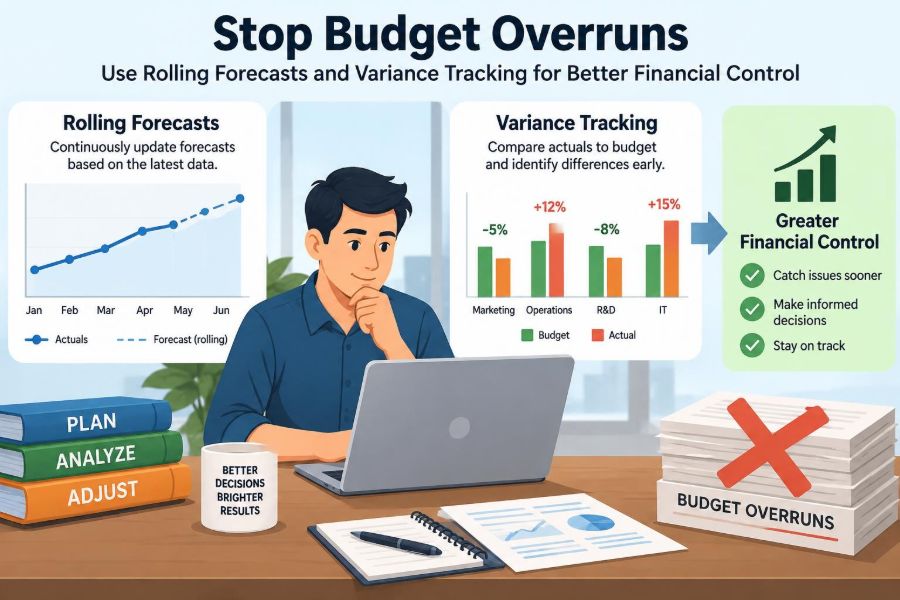
Rolling forecasts and variance tracking turn financial control from a backward-looking explanation into a forward-looking management routine. Used together, they help teams see changes early, investigate what is driving them, and make deliberate decisions before small gaps become major surprises.
🧭 What a budget overrun really means
A budget overrun occurs when actual spending exceeds the amount authorized or planned for a period, project, department, or organization. It may also describe a situation where expected future spending will exceed the available budget, even if the overspend has not happened yet.
That distinction matters. A reported overrun is historical; a forecasted overrun is an opportunity to act. Financial control should focus on both.
📅 Why annual budgets lose relevance
Most budgets are built before the fiscal year begins, using assumptions about sales, staffing, prices, production, and project timing. Those assumptions are necessary, but they are not permanent facts.
Customer demand can shift, implementation dates can slip, exchange rates can move, and an unexpected vacancy can create contractor costs. When managers keep comparing reality only with an outdated plan, the budget becomes a weak guide for current decisions.
🔍 The difference between budgeting and forecasting
A budget is a formal plan: it allocates resources, sets spending boundaries, and supports accountability. A forecast is the organization’s best current estimate of what will happen, based on actual results and known conditions.
They answer different questions. The budget asks, “What did we intend to do?” The forecast asks, “Given what we know now, where are we likely to land?” A forecast is not an excuse to rewrite the budget.
🔄 Defining a rolling forecast
A rolling forecast is updated regularly and always looks forward over a consistent time horizon. For example, a company may update monthly while maintaining a forecast for the next 12 months.
As one month closes, another future month is added. This prevents planning from ending simply because the calendar year is approaching its final quarter.
⏳ Why the forecast horizon matters
The right horizon depends on decision lead times. A retailer may need visibility far enough ahead to order inventory. A construction business may need a longer view because labor, equipment, and subcontract commitments are made well before work begins.
A horizon that is too short captures immediate pressure but misses strategic commitments. One that is too long can become speculative. The useful question is: how far ahead must leaders see to change a meaningful decision?
📊 Understanding variance tracking
A variance is the difference between two financial measures, commonly actual results and budget. Variance tracking identifies the size, direction, timing, and cause of that difference.
For costs, actual spending above budget is generally unfavorable; spending below budget is generally favorable. But labels alone can mislead. Lower maintenance spending, for instance, may reflect postponed work rather than a genuine saving.
🧮 Basic variance calculations
The basic monetary calculation is straightforward:
Variance = Actual amount − Budget amountFor comparability across categories, teams often calculate a percentage:
Variance % = (Actual amount − Budget amount) ÷ Budget amount × 100Interpret signs consistently. A positive expense variance may indicate overspending, while a positive revenue variance often indicates revenue above plan. Reports should state the convention clearly.
🧱 Separate price, volume, and timing effects
A useful explanation goes beyond “over budget.” Cost variances commonly arise from a different price, a different quantity, or a different period of recognition.
| Variance type | Typical question | Example |
|---|---|---|
| Price | Did the unit cost change? | A supplier increased material rates. |
| Volume | Did activity change? | More customer orders required more shipping. |
| Timing | Did spending move between periods? | An annual software renewal was paid earlier than planned. |
These causes require different responses. A timing difference may need no corrective action, while a price or volume shift may change the full-year outlook.
🗓️ Timing differences are not always savings
Managers can celebrate an underspend too early when an invoice, recruitment start date, or project milestone has merely moved forward. A monthly report may look favorable while the annual outcome remains unchanged.
Rolling forecasts force the question: will this cost disappear, or will it occur later? That discipline reduces the temptation to treat delayed expenditure as available funding.
🚦 Use thresholds to focus attention
Not every variance deserves an investigation. Small differences occur through rounding, normal timing, and ordinary operational fluctuation. Reviewing all of them consumes time without improving decisions.
Set practical materiality thresholds using both value and percentage. A small percentage on a large cost center can still be material, while a large percentage on a minor account may not alter a decision.
🧠 Look for the driver, not the account code
General ledger accounts show where costs were recorded, but not always why they changed. “Consulting expense” is a category; the operating driver may be a delayed system implementation, a capability gap, or a one-time regulatory response.
Good variance commentary connects finance data to operational activity. It identifies the driver, explains whether it is recurring, and estimates the likely effect on future periods.
🏗️ Start with the business model
A forecast should reflect how the organization creates revenue and incurs cost. Forecasting payroll by headcount, sales commissions by expected sales, and distribution costs by expected shipments is often more informative than applying a flat percentage increase.
These relationships are called drivers. Driver-based forecasting makes assumptions visible and easier to challenge.
👥 Build ownership into the process
Finance should design the process, maintain controls, and challenge assumptions. Operational managers should own the assumptions about staffing, demand, capacity, contracts, and delivery dates.
A forecast prepared only by finance may be technically tidy but operationally detached. A forecast prepared only by operations may lack consistency. Effective control depends on collaboration.
🧾 Establish a reliable baseline
Before updating a forecast, reconcile actual results to the accounting records and identify committed costs such as signed contracts, purchase orders, and approved hires. A forecast built on incomplete actuals is unreliable from the start.
Then separate what is known from what is estimated. Closed months are actuals; future months require assumptions. Keeping that boundary clear makes review conversations more honest.
📌 Forecast commitments before discretionary spend
Committed expenditure is not always recorded as an expense yet, but it can still consume future cash and budget capacity. Lease obligations, contracted services, approved capital purchases, and purchase orders may all matter.
Showing commitments separately helps prevent a common mistake: treating unspent budget as freely available when much of it has already been promised.
🌦️ Use scenarios for genuine uncertainty
A single forecast can create false certainty when conditions are unstable. Scenario planning develops a limited set of plausible outcomes, such as base case, higher-demand case, and delayed-project case.
Each scenario should change specific assumptions rather than applying arbitrary optimism or pessimism. For example, a higher-demand case might increase units sold, overtime, freight, and working-capital needs together.
📈 Forecast cash as well as profit
An income statement forecast shows expected revenue and expense, but cash moves according to payment terms, inventory purchases, tax timing, capital spending, and debt obligations. A profitable plan can still create a cash squeeze.
Where liquidity matters, connect the operating forecast to a cash forecast. This is especially important for fast-growing businesses, project-based firms, and organizations with long customer collection cycles.
🛑 Create an early-warning process
A forecast becomes useful when it triggers action. Define escalation points: perhaps a projected cost-center overrun, a missed revenue milestone, a declining cash balance, or a project forecast exceeding approved funding.
The goal is not to create alarms for every change. It is to ensure that material risks reach the people who can decide whether to reduce scope, move funding, renegotiate terms, or accept the variance deliberately.
🗣️ Write variance commentary that supports decisions
Strong commentary is short but complete. It states what happened, why it happened, what it means for the forecast, and what action is proposed or underway.
- What: Marketing spend is above monthly budget.
- Why: A campaign was brought forward to support a product launch.
- Outlook: The annual plan is unchanged if later campaign activity is reduced.
- Action: The marketing lead will confirm the revised campaign calendar.
This is more useful than repeating the numerical variance in words.
🧪 A simple hypothetical example
Consider a hypothetical service company with an annual travel budget. In April, actual travel is above plan because a client implementation required extra site visits. A basic report flags an unfavorable monthly variance.
A rolling forecast asks more: are remaining visits still necessary, will other travel be reduced, and does the extra work generate additional revenue? The answer may show a full-year overrun, a timing shift, or a commercially sensible investment. The same number can mean very different things.
🔗 Connect forecasts to operational decisions
Financial reports should not sit apart from staffing plans, procurement meetings, sales pipelines, and project reviews. Those processes generate the information that changes forecasts.
For example, a forecast of labor cost should be updated when recruitment approvals change, not only at month-end. Earlier updates give leaders more options than a retrospective explanation weeks later.
⚖️ Distinguish controllable from uncontrollable factors
Not every variance is within a manager’s direct control. Exchange-rate movements, mandated fees, or broad supplier price changes may affect results without reflecting poor performance.
Still, “uncontrollable” does not mean “irrelevant.” Teams can assess exposure, seek alternatives, adjust pricing, change volume, or escalate the need for additional funding. Fair accountability considers both ownership and available choices.
🧰 Choose tools that fit the process
Spreadsheets can support a disciplined rolling forecast for a smaller organization, especially when data volumes and contributors are limited. Their weaknesses appear when version control, manual consolidation, and formula changes become difficult to manage.
Planning software can improve workflow, audit trails, permissions, and integration, but it cannot repair unclear assumptions or weak accountability. Design the management routine first; then select tools that reduce effort and error.
🔒 Protect data quality and version control
Every forecast should have a defined reporting date, named owner, approved assumptions, and a clear distinction between working versions and the version used for management reporting. Otherwise, teams can debate which file is correct instead of discussing the business.
Controls should also include reconciliations, review of unusual movements, and access rights appropriate to the sensitivity of financial information.
⚠️ Common mistake: reforecasting without learning
Updating a forecast is not valuable if the organization simply replaces last month’s number with this month’s number and forgets why the estimate changed. Forecast accuracy should be reviewed over time, with attention to recurring bias or weak assumptions.
This is not about punishing imperfect forecasts. Conditions change. It is about improving the inputs, timing, and judgment that shape future estimates.
🎯 Common mistake: treating the forecast as a target
Employees may resist honest forecasting if they believe a higher forecast will automatically lead to a higher performance target or a reduced budget. They may then report numbers that look acceptable rather than numbers that are most likely.
Keep performance targets, authorized budgets, and best-estimate forecasts conceptually separate. Leaders can compare them, but should not confuse their purposes.
🪜 A practical monthly cadence
A workable cycle is predictable. Close and validate actuals, review material variances, update operational assumptions, refresh the forward forecast, and discuss decisions with accountable leaders.
- Confirm actual results and committed spending.
- Identify material variances and their drivers.
- Update assumptions for demand, staffing, prices, and timing.
- Produce base and, where needed, scenario forecasts.
- Agree actions, owners, deadlines, and escalation items.
The cadence matters more than producing elaborate reports. Consistent repetition builds organizational memory.
📏 Measure forecast quality thoughtfully
Comparing prior forecasts with actual results can reveal whether certain revenue streams, cost categories, or teams are consistently over- or underestimated. Review accuracy at a useful level of detail; excessive granularity can obscure the main lesson.
Also examine timeliness. A reasonably accurate forecast delivered after decisions are locked may be less useful than a slightly less precise one delivered early enough to influence action.
🤝 Make financial control a management habit
Rolling forecasts work best when leaders use them in regular conversations, not merely in finance presentations. Ask what changed, which assumptions are most exposed, and what decision would be made if the adverse case occurs.
That culture reframes finance from scorekeeping to decision support. It also makes unfavorable news easier to raise before it becomes costly.
🌱 Begin with a focused pilot
Organizations do not need to redesign every planning process at once. Start with a volatile cost area, a major project portfolio, or a business unit where operational drivers are already understood.
Define the horizon, reporting rhythm, required assumptions, materiality thresholds, and decision forum. Refine the process after several cycles, then expand it with lessons learned.
🏁 The core principle: see forward, act early
A budget provides a valuable reference point, but it cannot manage change by itself. Variance tracking explains where performance has departed from plan; rolling forecasts show whether that departure will persist, reverse, or grow.
Neither tool eliminates uncertainty. Together, however, they create a disciplined way to surface assumptions, identify emerging pressure, assign ownership, and choose a response while choices are still available.
The solution to budget overruns is not endlessly defending an old plan; it is maintaining a credible view of the future and acting on it early. With clear drivers, timely variance analysis, and regular forecast conversations, financial control becomes a practical part of everyday management rather than a surprise at year-end. 📊🧭💰