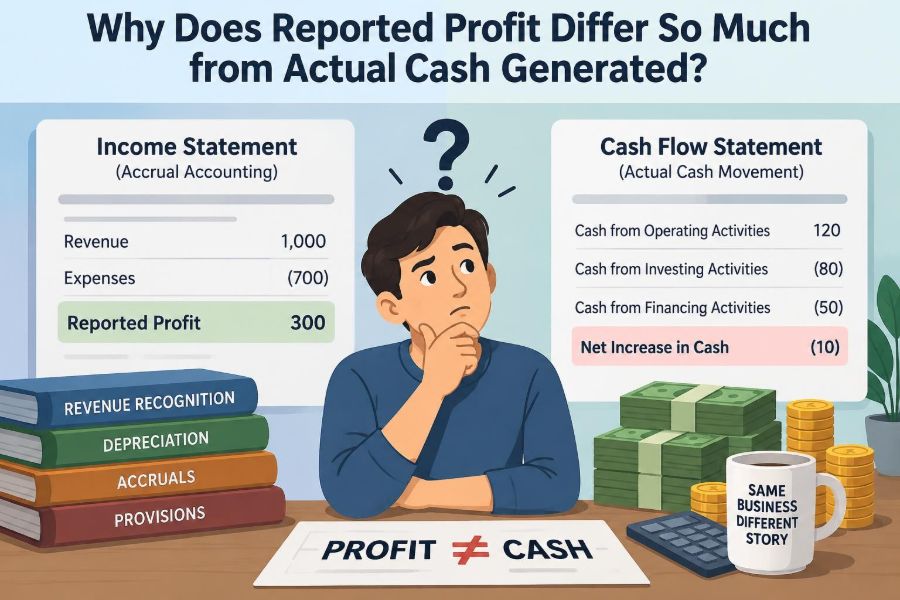

A business can announce a healthy profit and still struggle to pay suppliers on Friday. A growing consultancy may report strong revenue while waiting months for clients to settle invoices. A retailer may produce cash every day at the till yet show a loss after recording inventory costs and depreciation.
That apparent contradiction is not necessarily a mistake. It comes from the fact that profit and cash answer different questions. Profit asks whether the business created economic value during a period; cash asks what money actually moved in and out of its bank accounts.
For students, the gap can make financial statements feel inconsistent. For managers, lenders, and investors, it can determine whether an otherwise promising business can keep operating, expand safely, or meet its obligations.
The key is not to treat one measure as “real” and the other as “accounting.” Both are useful—but each needs interpretation.
🔍 Profit and cash are different measurements
Profit, often called net income or earnings, is revenue less expenses recognized for an accounting period. It is calculated under the accrual basis of accounting, which records economic activity when it is earned or incurred.
Cash generated describes actual cash receipts and payments. It is reported in the cash flow statement, usually divided into operating, investing, and financing activities.
A sale can increase profit before the customer pays. Buying equipment can reduce cash immediately without reducing profit immediately. These timing differences explain much of the gap.
🧾 Accrual accounting records the underlying activity
Under accrual accounting, revenue is generally recognized when a business has delivered goods or services and has a right to payment, not simply when cash arrives. Expenses are recognized when resources are used or obligations arise, rather than only when cash leaves.
This approach makes period performance more comparable. A construction firm that completes work in December should not appear unprofitable merely because its customer pays in January.
However, accrual accounting creates balances—such as receivables, payables, and accrued expenses—that bridge profit and cash.
💵 Cash accounting follows the bank account
A cash-based view is intuitive: money received is an inflow and money paid is an outflow. It shows immediate liquidity, meaning the ability to meet near-term payments.
Its limitation is that it can distort performance across periods. If an annual insurance premium is paid in one month, cash accounting places the full cost in that month even though the coverage benefits the business for a year.
Financial reporting commonly uses accrual accounting for profit and a separate cash flow statement to preserve this liquidity view.
📊 The cash flow statement provides the bridge
The statement of cash flows explains changes in cash and cash equivalents over a period. It connects opening cash to closing cash, while identifying where cash came from and where it went.
| Category | What it usually captures | Typical examples |
|---|---|---|
| Operating activities | Cash from normal trading operations | Customer collections, payroll, supplier payments |
| Investing activities | Cash used for or received from long-term assets and investments | Buying equipment, selling a building |
| Financing activities | Cash from lenders and owners, and cash returned to them | Borrowing, repaying debt, issuing shares, dividends |
A company can have positive total cash flow because it borrowed heavily, even if its operations consumed cash. That is why the categories matter.
🏦 Operating cash flow is usually the first comparison
When people say a profitable company is “not generating cash,” they often mean cash flow from operating activities is weak relative to profit. This measure focuses on cash effects of ordinary business activity.
Operating cash flow does not need to equal profit every year. A fast-growing business may invest in receivables and inventory before collecting from customers. Still, a persistent and unexplained mismatch deserves investigation.
Cash from financing is not a substitute for a viable operating model; it can fund a gap, but it does not explain whether customers and operations are ultimately producing cash.
🧮 Non-cash expenses reduce profit without using current cash
Some expenses lower reported profit but do not require a cash payment in the same period. The most familiar are depreciation and amortisation.
Depreciation allocates the cost of a physical long-lived asset, such as machinery, over its useful life. Amortisation performs a similar role for certain intangible assets. The cash was usually paid when the asset was acquired, not when the expense is recognized.
In the indirect method cash flow statement, these non-cash expenses are commonly added back to profit when calculating operating cash flow.
🏭 Capital expenditure uses cash before profit reflects it
Suppose a manufacturer pays cash for a new production line. The purchase is generally capital expenditure: an investment recorded as an asset rather than an immediate operating expense.
Cash falls on the purchase date, usually within investing activities. Profit is affected gradually through depreciation as the equipment is used. This creates the opposite pattern from depreciation: cash can be weak now while reported profit remains relatively high.
A business can be profitable and cash-hungry because it is building capacity. Whether that is sensible depends on expected returns, financing, and the reliability of demand.
📬 Credit sales create accounts receivable
When a business invoices a credit customer, it may record revenue and profit immediately. Until the customer pays, the amount sits in accounts receivable.
An increase in receivables normally reduces operating cash flow relative to profit because revenue has been recognized without a matching cash collection. A decrease in receivables usually supports operating cash flow because prior-period invoices are being collected.
Imagine a design agency completes a $20,000 project in March and invoices the client. March profit may include the revenue, but March cash does not unless the client pays that month.
⏳ Slow collections can turn growth into a cash strain
Growth often sounds automatically positive, but rapid sales growth on long credit terms can consume cash. Each new sale may require the business to fund payroll, materials, and delivery before the customer pays.
Managers should track invoice aging: how much is outstanding and how long it has been overdue. A rising receivables balance may be normal during expansion, but it can also indicate weak credit control, disputed bills, or customers under financial pressure.
Profit records the sale; cash collection tests whether the sale is being converted into money.
📦 Inventory absorbs cash before it becomes an expense
Retailers, wholesalers, and manufacturers often pay for stock before they sell it. Buying inventory reduces cash but initially creates an asset on the balance sheet rather than an expense in profit.
When the item is sold, its cost moves from inventory to cost of sales. Thus, an inventory build can cause operating cash flow to trail profit, especially before seasonal demand or an expansion.
Too little stock can lose sales, while too much stock ties up cash and raises the risk of obsolescence, damage, or discounting.
🛒 A simple inventory timing example
Consider a hypothetical online retailer that buys $60,000 of products in November and pays immediately. It sells half of them before year-end for $50,000 cash. Ignoring other costs, profit reflects $50,000 revenue and $30,000 cost of sales, or $20,000 gross profit.
Cash, however, has fallen by a net $10,000: $50,000 received less $60,000 paid. The remaining $30,000 of stock is an asset, not a vanished cost.
The example does not mean the retailer performed badly. It shows why the balance sheet must be read alongside profit and cash flow.
🤝 Payables can temporarily support cash flow
Accounts payable are amounts owed to suppliers for goods or services already received. If payables increase, a company has recognized an expense or acquired inventory without yet paying cash.
That generally boosts operating cash flow relative to profit in the short term. If payables later fall because suppliers are paid, cash flow may weaken even if profit is unchanged.
Delaying payments can preserve cash briefly, but consistently stretching suppliers beyond agreed terms can damage relationships, limit supply, or signal financial stress.
🧾 Accrued expenses shift payment into another period
An accrued expense is recognized before it is paid. Examples may include wages earned near year-end, interest that has accumulated, or professional services already received.
The expense lowers profit in the current period, while the cash payment may occur later. This can make current operating cash flow look stronger than profit.
The reverse happens when the accrued amount is settled: cash leaves in a later period even though much of the expense was recognized earlier.
🎟️ Customer deposits bring in cash before revenue
Cash received in advance is not automatically revenue. A software provider paid for a year upfront, or an event organizer receiving ticket deposits, may record a contract liability or deferred revenue until it delivers the promised service.
Cash flow can therefore be strong before profit appears. As service is delivered over time, revenue is recognized, often without a new cash receipt at that moment.
Advance payments can improve working capital, but they also create an obligation to deliver. They are not free cash in an economic sense.
🧱 Prepayments delay expense recognition
A prepayment occurs when a business pays cash before receiving the full benefit. Rent, insurance, and software subscriptions are common examples.
The initial payment reduces cash and creates an asset. Expense is recognized progressively as the coverage or service is consumed. During the payment period, cash may be lower than profit would suggest.
Prepayments are usually smaller than receivables or inventory in many businesses, but they illustrate the same principle: cash timing and expense timing can differ.
🧰 Provisions rely on estimates, not immediate payment
A provision is a liability recognized for a probable obligation whose amount or timing is uncertain, subject to applicable accounting requirements. It may relate to warranties, legal claims, restoration duties, or restructuring commitments.
Recording a provision reduces profit when the obligation is recognized, but the cash outflow may occur later—or may differ from the original estimate. This makes the adjustment from profit to cash more complex.
Readers should examine the nature of material provisions. Estimates are necessary in accounting, but unusually large or frequently revised estimates warrant careful judgment.
📉 Impairments can cut profit without current cash outflow
An impairment occurs when an asset’s carrying amount is reduced because its expected recoverable value has fallen. For example, equipment, acquired intangible assets, or a receivable may no longer be expected to deliver the value previously recorded.
The impairment charge can sharply reduce profit, but it usually does not cause a new cash payment at the time of recognition. It acknowledges that an earlier investment or recorded asset is worth less than expected.
That does not make impairment irrelevant to cash. It may be evidence that future cash generation will be weaker than management once anticipated.
💱 Foreign exchange movements can create accounting gains and losses
A company with foreign-currency receivables, borrowings, or investments may recognize exchange gains or losses when exchange rates change. Some of these amounts are unrealized: no settlement has occurred yet.
Profit can therefore move because a foreign-currency balance is remeasured, while current cash remains unchanged. Cash effects arise when the transaction is eventually settled or when currency is exchanged.
For internationally active businesses, separating operational performance from currency-related effects helps readers understand what management can directly influence.
📈 Gains on asset sales can lift profit but not operating cash
Selling a building, investment, or piece of equipment may generate cash. The accounting gain or loss is the difference between sale proceeds and the asset’s carrying amount, not the full amount of cash received.
In a cash flow statement prepared using the indirect method, the gain is typically removed from operating cash flow because the proceeds belong in investing activities. Otherwise, the same economic event could be counted in the wrong category.
One-off disposal gains can improve reported profit without indicating stronger recurring trading performance.
🏦 Borrowing creates cash without creating profit
Taking out a loan increases cash and liabilities. The borrowing itself is not revenue and does not increase profit. It is normally classified as a financing cash inflow.
Later interest expense reduces profit as it accrues, while principal repayments reduce debt and cash but are not operating expenses. Classification details can vary under applicable reporting frameworks, so readers should consult the stated accounting policy.
Strong bank balances funded by borrowing may provide useful runway, but they should not be confused with cash generated by operations.
🎁 Dividends and share issues affect owners, not operating profit
Paying a dividend distributes cash to owners but does not reduce the period’s profit. Profit is measured before that distribution; retained earnings show how much accumulated profit remains in the business after distributions and other movements.
Issuing shares brings in cash but is not revenue. Like debt financing, it can fund growth or cover a cash shortfall without proving that current operations are cash-generative.
This distinction is especially useful when comparing a company’s reported earnings with its change in cash balance.
🧭 Working capital is the operational cash cycle
Working capital broadly refers to short-term operating assets and liabilities. In cash flow analysis, attention often centers on receivables, inventory, payables, accrued expenses, and contract balances.
A simplified operating cycle runs from paying suppliers, through holding and transforming inventory or delivering services, to collecting from customers. The longer money is tied up in that cycle, the more external funding a business may need.
Different models have different patterns. A supermarket collecting cash at sale may have favorable timing, while a contractor with milestone billing may experience large and uneven working-capital swings.
🧪 Reading the indirect cash flow reconciliation
The indirect method starts with profit and adjusts for non-cash items and working-capital movements to arrive at operating cash flow. It is not merely a technical schedule; it explains the story behind the gap.
- Add back non-cash charges such as depreciation, subject to the company’s presentation.
- Remove gains or losses whose cash effects belong in investing or financing activities.
- Adjust for increases and decreases in operating assets and liabilities.
- Consider cash taxes and interest according to the entity’s reporting policies and framework.
A reader should not memorize signs mechanically. Ask a plain-language question: did this balance mean cash was collected earlier, paid later, or tied up for future use?
🪞 Direct and indirect methods tell the same cash story differently
The direct method presents major classes of operating cash receipts and payments, such as cash collected from customers and cash paid to employees and suppliers. It can be very intuitive.
The indirect method begins with profit and reconciles it to operating cash flow. It is particularly helpful for seeing how accruals and working capital create the difference.
Both methods aim to report operating cash flow; the presentation changes, not the underlying cash. Availability and detail depend on the reporting entity and accounting framework.
🚩 Persistent profit without operating cash is a warning sign
A one-period mismatch can be entirely reasonable: a seasonal inventory purchase, a new contract with normal payment terms, or a major prepayment may explain it. The concern rises when the pattern persists without a credible operating reason.
Potential causes include collections that never arrive, inventory that cannot be sold at expected margins, aggressive revenue recognition, or reliance on unpaid supplier bills. None can be diagnosed from one number alone.
Look for trends across several periods, explanations in management commentary, changes in accounting policies, and whether cash conversion improves after temporary investments should have paid off.
🔎 Cash flow can also look strong for the wrong reasons
Positive operating cash flow is not automatically proof of durable quality. A company may collect old receivables, run down inventory, receive unusually large customer advances, or postpone supplier payments.
Each may be sensible in context. But some are temporary sources of cash and cannot be repeated indefinitely. A business that sells down inventory without replenishing it, for example, may later face lower sales or a renewed cash requirement.
The best question is not “Is cash flow positive?” but “What specifically produced it, and is that source repeatable?”
📏 Free cash flow requires a clear definition
“Free cash flow” is widely used but not defined identically by every company. A common approach starts with operating cash flow and deducts capital expenditure, though the exact treatment of leases, acquisitions, disposals, and other items can differ.
It can be useful because it recognizes that maintaining and expanding productive assets requires cash. Yet comparing free cash flow across companies requires checking each company’s definition and period.
A number labeled free cash flow is an analytical starting point, not a substitute for reading the cash flow statement.
🧠 Profit quality depends on conversion and sustainability
Profit quality describes how informative and sustainable reported earnings appear. Cash conversion—the relationship between profit and operating cash flow over time—is one useful lens, but not a complete verdict.
High-quality earnings often arise from ordinary customer demand, sound margins, collectible receivables, and accounting estimates that remain credible as cash arrives. Low-quality earnings may rely more heavily on assumptions, one-off gains, or revenue not yet converted to cash.
Capital-intensive businesses, subscription models, and high-growth companies naturally convert profit into cash differently. Comparison works best among businesses with similar economics.
🛠️ Managers can improve cash conversion without damaging the business
Better cash generation does not have to mean indiscriminate cost cutting. It often comes from designing operations so that the timing of cash supports the timing of commitments.
- Invoice promptly and resolve disputes before invoices age.
- Set credit terms that reflect customer risk and the cost of funding delays.
- Forecast inventory demand and identify slow-moving stock early.
- Schedule payments responsibly and maintain open supplier communication.
- Link major capital spending to realistic capacity and return assumptions.
- Prepare rolling cash forecasts that include taxes, debt payments, and seasonal swings.
Trying to improve a reporting date through extreme collection pressure or delayed payments can simply move the problem into the next period.
👩🎓 A practical checklist for students and readers
When profit and cash differ substantially, start with a structured review rather than assuming either figure is wrong.
- Compare profit with cash flow from operating activities over several periods.
- Identify major non-cash expenses, impairments, and gains.
- Review movements in receivables, inventory, payables, and customer advances.
- Separate operating cash generation from borrowing, share issues, and asset sales.
- Check capital expenditure and ask whether it is maintenance, expansion, or both.
- Read the notes for significant estimates, accounting policies, and unusual transactions.
This process turns a vague concern about “cash versus profit” into specific, answerable questions.
🧩 The core principle: timing, classification, and economic substance
Reported profit differs from actual cash generated because accounting recognizes performance according to when value is earned, consumed, or estimated, while cash flow reports when money moves. Assets, liabilities, and non-cash charges sit between those two views.
The difference is often informative rather than alarming. Receivables can show sales awaiting collection; inventory can show preparation for demand; depreciation can allocate a past investment. But the same items can reveal operational strain if they grow without a persuasive business explanation.
Sound analysis therefore combines the income statement, balance sheet, and cash flow statement. No single statement fully describes financial health.
Profit tells you whether a business appears to be creating value; cash flow tells you whether that value is being converted into spendable resources at the right time. Reading both together leads to better decisions, better questions, and fewer surprises. 💰📊🔎