
It is Friday afternoon, payroll is due next week, and the bank balance looks comfortable. Then a major customer asks for a two-week extension, an expected supplier invoice arrives early, and a planned equipment repair can no longer wait. None of these events is unusual. Together, they can change the cash picture quickly.
Many businesses discover this problem after approving an annual budget that seemed sensible at the start of the year. Revenue targets may still be achievable, yet the timing of cash receipts and payments has shifted enough to create pressure now.
A static budget answers an important question: what did we expect the year to look like? It is much less effective at answering a more urgent one: what cash decisions should we make over the next few weeks and months?
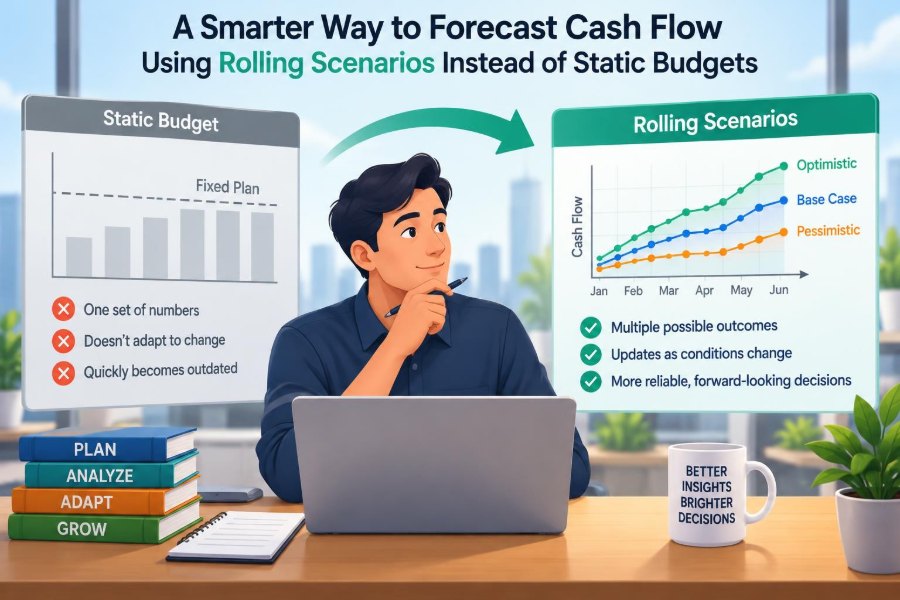
Rolling cash-flow scenarios provide a practical alternative. They turn forecasting from a once-a-year prediction into a repeated decision process that reflects current information, uncertainty, and the timing of real obligations.
🧭 Static Budgets and Rolling Forecasts Serve Different Jobs
A budget is usually a fixed plan for a defined period, often a fiscal year. It sets targets, allocates resources, and creates a benchmark for accountability. Those are valuable governance functions.
A rolling forecast is updated on a regular schedule and always looks forward over a chosen horizon. When one month or week closes, another is added to the end. Its purpose is not to preserve the original plan; it is to improve the next decision.
Confusing these two tools causes trouble. Teams may defend outdated budget numbers because they are formally approved, even when operating evidence points elsewhere.
💵 Cash Flow Is About Timing, Not Just Profit
Profit records whether revenue exceeds expenses under accounting rules. Cash flow tracks when money actually enters and leaves the bank. A profitable business can face a cash shortage when collections lag, inventory is purchased early, or debt principal falls due.
For cash forecasting, dates matter. A sale booked this month may generate cash next month, two months later, or in installments. Likewise, an expense recognized evenly each month may be paid quarterly or annually.
The practical question is simple: will available cash be enough on each relevant date? That requires a calendar of expected inflows and outflows, not only an income statement forecast.
🕰️ Why Annual Plans Become Stale
An annual budget begins with assumptions about demand, hiring, pricing, payment behavior, purchasing, and capital spending. Some assumptions will naturally prove incomplete because conditions change after planning season ends.
A delayed product launch may shift customer billings. A sales promotion may increase orders while also requiring more inventory. A hiring pause can reduce future payroll, while a late tax payment can create an immediate cash issue.
The problem is not that the budget was careless. It is that a budget captures a point in time. A rolling forecast acknowledges that management has learned more since then.
🔄 The Core Mechanics of a Rolling Cash Forecast
Start with the opening bank balance. Add expected cash receipts by period, subtract expected cash payments by period, and calculate the closing balance. That closing balance becomes the next period’s opening balance.
The forecast is refreshed at a consistent cadence, such as weekly for the next 13 weeks and monthly for the following nine to 15 months. The appropriate horizon depends on the business, its volatility, and how early financing or spending decisions must be made.
Each refresh replaces estimates with actual results where available, revises future assumptions, and extends the forecast window. The model stays forward-looking without discarding the audit trail of what changed.
📅 Choose a Horizon That Matches Decisions
There is no universal forecast length. A company with weekly payroll, thin reserves, and variable collections may need a detailed 13-week cash forecast. A stable organization with predictable subscription receipts may rely more heavily on monthly periods.
Use the horizon to support specific choices:
- Weekly detail for payroll, supplier payments, and short-term liquidity.
- Monthly detail for hiring, inventory plans, debt service, and capital expenditure.
- A longer view for financing, dividends, expansion, or covenant planning.
Too little detail hides timing risk. Too much detail far into the future can create an illusion of accuracy unsupported by evidence.
🧱 Build the Forecast From Cash Drivers
Useful forecasts begin with drivers that cause cash movements rather than a single top-line growth percentage. For receipts, drivers might include invoices issued, contract milestones, card settlements, direct-debit dates, and collection patterns.
For payments, consider payroll dates, purchase orders, supplier terms, rent, taxes, loan repayments, insurance renewals, and committed capital spending. Separate recurring items from irregular ones so that a large annual payment does not disappear inside an average monthly expense.
The goal is not to model every minor transaction. It is to identify the drivers that materially affect the timing or size of cash.
🧾 Start With Reliable Opening Cash
The opening balance is the foundation of the entire forecast. Reconcile it to bank statements or the accounting system before using it. An unrecognized bank fee, uncleared payment, restricted balance, or duplicate transfer can distort every projected period.
Also define what “cash” means for the forecast. Some teams include only unrestricted operating bank accounts. Others include short-term deposits or sweep accounts that can be accessed quickly. Restricted cash should normally be shown separately because it may not be available for ordinary obligations.
Clear definitions prevent a reassuring headline balance from masking limited usable liquidity.
📥 Forecast Receipts by Collection Behavior
Revenue is a starting point, not a cash-receipt forecast. Turn expected sales into expected cash using actual billing and collection mechanics. For example, an invoice issued on the last day of a month is unlikely to fund payroll the next morning.
Group receivables into categories with meaningfully different behavior, such as enterprise customers, government contracts, online card sales, or milestone-based projects. Historical patterns can inform estimates, but known customer-specific information should override a broad average.
A collection forecast should identify large invoices, disputed balances, promised payment dates, and concentration risk. These items often matter more than a refined estimate for small accounts.
📤 Forecast Payments by Commitment and Date
Payment forecasting is strongest when it uses commitments already made. Approved purchase orders, payroll registers, lease schedules, tax calendars, debt agreements, and supplier payment runs provide more reliable evidence than expense averages.
Classify payments by how certain they are. A signed software renewal is different from a potential conference expense. Both may be relevant, but they should not carry the same confidence level.
Watch for payment terms that create calendar effects. A business may record costs steadily while paying suppliers on two large monthly runs, creating short periods of pressure that an averaged model misses.
🏷️ Separate Fixed, Variable, and Discretionary Cash Uses
Not all outflows deserve the same response when liquidity tightens. Fixed or near-fixed payments include payroll, rent, debt service, and many taxes. Variable payments may move with sales volume, production, or purchasing.
Discretionary spending includes cash uses that can sometimes be delayed, resized, or canceled without immediately stopping operations. Examples may include nonessential travel, certain marketing campaigns, or an uncommitted equipment upgrade.
This classification makes scenario planning actionable. A forecast should not merely show a shortfall; it should show which levers are genuinely available and the operational cost of using them.
🎯 Define a Base Case Before Adding Alternatives
The base case is the most reasonable current view, not the most optimistic outcome and not an automatic copy of the budget. It should reflect known orders, expected collection patterns, committed spending, and management’s best present assumptions.
Document the assumptions in plain language. For instance: a named customer pays its overdue invoice in the second forecast week; planned hiring begins in the next quarter; inventory purchases follow the revised demand plan.
A transparent base case gives alternative scenarios a meaningful reference point. Without it, scenario discussions become arguments about vague optimism or pessimism.
🌤️ Use Upside Scenarios to Test Capacity
An upside scenario asks what happens if favorable developments occur. Customer demand may exceed plan, a large receivable may arrive early, or a financing process may close sooner than expected.
Upside does not always improve cash immediately. Stronger sales can require additional inventory, commissions, shipping, or implementation staff before collection occurs. This is one reason cash forecasting is more useful than assuming higher revenue automatically means more liquidity.
Use upside scenarios to plan capacity, not to justify avoidable spending. They can reveal when a growth opportunity would require working-capital funding.
🌧️ Use Downside Scenarios to Test Resilience
A downside scenario should represent plausible adverse conditions rather than an arbitrary disaster. Examples include slower customer collections, reduced new sales, a delayed financing event, a supplier requiring earlier payment, or an unexpected repair.
Change the assumptions that would realistically move together. If sales fall, related variable costs may also decline, but existing payroll and rent may not. A credible downside case respects those relationships.
The value is preparation. If the scenario shows a future low point below the required cash buffer, management can act before the bank balance creates an emergency.
🎲 Model Scenarios as Coherent Stories
A scenario is more than a percentage applied to every line. It is a connected operational story with a cause, timing, and financial consequences. “Customer launch slips by six weeks” is more useful than “revenue down 10%.”
The first statement lets the team estimate delayed invoices, postponed implementation costs, altered staffing needs, and effects on supplier purchases. It also gives sales and operations teams something concrete to validate.
Keep the number of active scenarios manageable. A base case plus one or two decision-relevant alternatives is often clearer than a large collection of lightly maintained versions.
📊 Distinguish Sensitivity Analysis From Scenarios
Sensitivity analysis changes one input to show how exposed a result is. For example, the team might ask how the minimum cash balance changes if average collection time extends by ten days.
A scenario changes several connected assumptions to represent a possible operating environment. It might include slower collections, lower new bookings, and reduced variable purchasing at the same time.
| Tool | Main question | Typical use |
|---|---|---|
| Sensitivity analysis | Which assumption matters most? | Testing one driver, such as payment timing |
| Scenario analysis | What happens in a plausible situation? | Planning actions for an operational change |
Both tools are useful. Sensitivities identify fragile assumptions; scenarios support choices under uncertainty.
🚦Track Minimum Cash, Not Only Ending Cash
A monthly forecast can show positive closing cash while missing a shortage inside the month. This happens when a payment run occurs before expected collections. Weekly, or sometimes daily, detail is needed around critical dates.
Track the minimum projected cash balance and the date it occurs. Compare it with a defined operating buffer, not simply zero. A balance slightly above zero may still be unsafe if it leaves no room for payment timing variation.
This measure focuses attention on liquidity when it is most constrained, which is usually where financing and payment decisions matter most.
🏦 Include Financing, Debt, and Banking Constraints
Cash forecasts should reflect more than operating inflows and outflows. Include interest, principal repayments, facility fees, expected drawdowns, repayments of revolving credit, and restrictions on available funding.
A credit facility can provide liquidity, but it is not identical to cash. Availability may depend on borrowing-base calculations, covenants, eligible receivables, lender consent, or documentation. Confirm the actual terms with finance and banking contacts rather than assuming the full limit is usable.
Where debt covenants matter, forecast the relevant measures early. A breach or near-breach can affect options before a cash shortfall appears.
🧮 Treat Taxes as Dated Cash Obligations
Taxes are often underestimated because they may be calculated from accounting results but paid on a separate calendar. Payroll taxes, sales or value-added taxes, income taxes, property taxes, and withholding obligations can create significant outflows.
Use applicable filing and payment dates, and involve the people responsible for tax calculations. Do not simply spread a projected annual tax amount across months unless that matches actual payment timing.
Tax rules differ by jurisdiction and circumstances. A cash forecast is a planning tool, not tax advice, so uncertain amounts should be flagged and updated when better information becomes available.
🏗️ Keep Capital Expenditure Visible
Capital expenditure is easy to hide inside a high-level plan because it is infrequent. Yet equipment deposits, implementation costs, leasehold improvements, and technology projects can change liquidity sharply.
Show each material project separately with approval status, expected payment dates, and cancellation or deferral options. Distinguish a signed commitment from a proposal that management is still evaluating.
This visibility improves capital allocation. A project may be economically attractive over several years but poorly timed if it coincides with a seasonal cash trough.
🧑🤝🧑 Make Ownership Cross-Functional
Finance should coordinate the forecast, but finance rarely owns all the information. Sales knows likely customer timing; collections knows disputed invoices; procurement knows supplier commitments; operations knows production needs; HR knows hiring plans.
Assign named owners for material inputs and agree on cut-off times. A short recurring review is usually more effective than sending a spreadsheet for occasional comments.
Cross-functional ownership also reduces “forecast surprise.” People are more likely to challenge an assumption early when they understand that it affects a shared operating decision.
🗂️ Create an Assumption Register
An assumption register is a simple record of the judgments behind the forecast. For each material assumption, note the owner, source, date updated, confidence level, and expected next confirmation point.
For example, a large receipt might be listed as “customer payment expected in week four; based on accounts receivable call; confirmation due next Tuesday.” This is more useful than burying the same judgment inside a formula.
The register creates accountability without pretending uncertain information is certain. It also makes forecast review faster because the conversation can focus on the assumptions most likely to move cash.
🔍 Reconcile Forecasts to Actual Cash Every Cycle
Forecast accuracy improves through disciplined comparison, not through increasingly complex formulas. At each update, compare expected receipts and payments with actual movements and investigate material variances.
Ask whether the miss came from amount, timing, classification, or missing information. A customer who paid the full invoice two weeks late requires a different adjustment than a customer who paid less because of a dispute.
Measure forecast quality by period and cash category where practical. The aim is learning: which drivers are predictable, which are volatile, and where the process needs better source data.
🧹 Avoid False Precision
Displaying every forecast line to the nearest currency unit can imply confidence the model does not have. A long-range sales estimate may be directionally useful while still being uncertain in both timing and amount.
Use precise dates and amounts where commitments support them, such as payroll or scheduled debt payments. Use ranges, confidence labels, or broader periods where uncertainty is real. Precision should come from evidence, not spreadsheet formatting.
This distinction helps leaders read the forecast appropriately. A number can be decision-useful without being a promise.
⚠️ Common Failure Modes
Rolling forecasts fail when they become a reporting ritual instead of a decision tool. Several patterns deserve attention:
- Using revenue as a direct substitute for cash receipts.
- Leaving last year’s payment assumptions unchanged despite new behavior.
- Ignoring taxes, annual renewals, debt payments, or capital deposits.
- Combining committed and speculative cash flows without labels.
- Updating the file but never discussing actions triggered by the result.
- Maintaining so many scenarios that none receives proper review.
Most of these problems are process failures, not software failures.
🛠️ Build the First Version Simply
A strong first forecast can be built in a controlled spreadsheet or within an existing planning system. Begin with a limited number of material categories, a reliable opening balance, and a horizon aligned to decisions.
- Map significant cash inflows and outflows to expected dates.
- Separate committed items from estimates.
- Build a base case and one downside case.
- Set a weekly or monthly refresh rhythm.
- Review minimum cash and required actions with decision-makers.
Automation becomes useful when transaction volume, entities, currencies, or data sources make manual maintenance unreliable. It should simplify control and visibility, not automate untested assumptions.
🖥️ Design a Decision-Friendly Dashboard
Senior readers usually need a concise view: opening cash, minimum projected cash, ending cash, available funding, the difference from the operating buffer, and the largest changes since the prior forecast.
Operational users need supporting detail, including major receipts, payment commitments, overdue receivables, scenario assumptions, and owner comments. One report rarely serves both groups equally well.
Use charts only when they clarify timing or comparison. A simple cash-balance line across base and downside cases can expose a risk faster than a dense grid of values.
🗣️ Connect Forecast Outputs to Decisions
A forecast creates value when it changes what the organization does. If a projected trough approaches the buffer, options may include accelerating collections, rescheduling discretionary payments, reducing purchases, drawing on an approved facility, or discussing financing early.
Each action has trade-offs. Pressuring a strategic customer can affect the relationship; delaying a supplier payment can affect supply continuity; cutting inventory can constrain future sales. The forecast does not choose automatically, but it makes those trade-offs visible in time.
Record decisions and their expected cash effects. This closes the loop between planning and execution.
⚖️ Preserve the Budget for Accountability
Replacing a static cash view does not mean abandoning the budget. The budget remains useful for target setting, resource allocation, and explaining performance against approved expectations.
Keep budget, forecast, and actual results clearly separated. A variance to budget may show whether the business is meeting its plan. A rolling forecast shows what management currently expects and what liquidity actions may be needed.
Trying to force the rolling forecast to equal the budget defeats its purpose. Honest reforecasting is not poor discipline; it is disciplined use of new information.
🌱 Scale the Process as Forecasting Matures
As the process improves, add sophistication only where it improves decisions. A company may introduce customer-level receipt forecasting, entity-level cash pools, currency exposure, probability-weighted opportunities, or integrations with receivables and procurement systems.
More complexity also creates maintenance risk. Every new driver needs a clear owner, source, and reason for inclusion. A simpler forecast updated faithfully is usually more useful than an elaborate model filled with stale inputs.
Maturity means better judgment and faster learning, not merely a larger workbook.
🧠 The Core Principle: Refresh the Future, Not the Past
Static budgets provide a reference point. Rolling scenarios provide a living view of liquidity. Together, they let organizations distinguish between what was planned, what has happened, and what is now most likely to happen.
The key is to forecast cash from real timing drivers, show uncertainty through coherent scenarios, monitor the lowest point rather than only the final balance, and link the result to specific decisions.
A cash forecast becomes smarter when it is treated as an ongoing operating conversation, not an annual spreadsheet exercise.
When the next delayed receipt, early invoice, or growth opportunity arrives, the objective is not to have predicted every event perfectly. It is to see the implications early enough to respond with options rather than urgency. 💰📈🧭