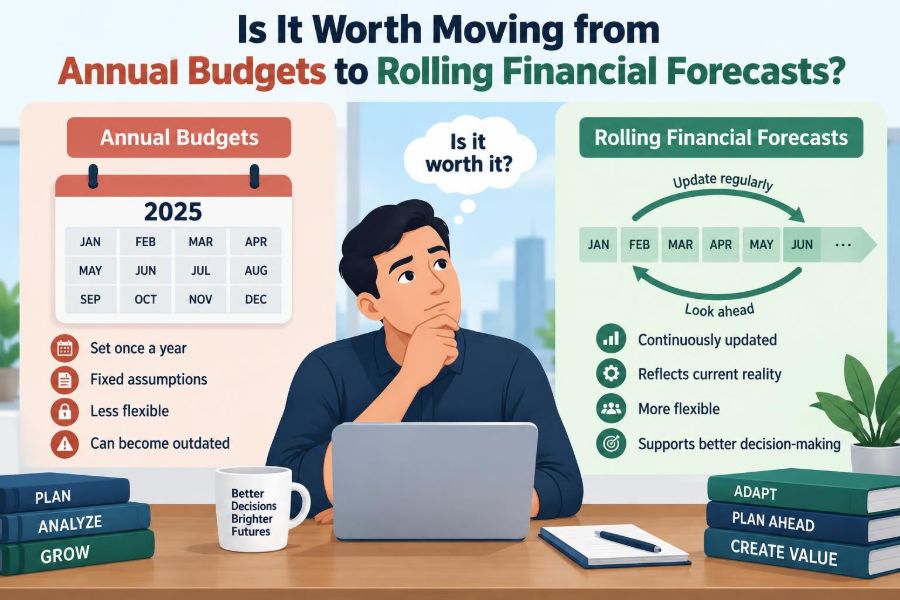

It is October, and a department manager is still being assessed against a budget written nearly a year ago. Since then, a key customer has reduced orders, a supplier has changed prices, and a hiring plan has shifted. The budget remains tidy. The business environment does not.
This is a familiar tension in finance teams. The annual budget offers a fixed destination and clear accountability, yet it can become less useful as the assumptions beneath it age. Managers may spend more energy explaining variance than deciding what to do next.
A rolling financial forecast promises a different approach: update the expected future regularly, using the latest information. It can make planning more responsive, but it also asks more of systems, people, and governance.
The question is not whether annual budgets are obsolete. It is whether a business needs a planning process that better separates target-setting, resource allocation, and its best current view of the future.
🧭 Start with the decision, not the planning label
“Budget” and “forecast” are often used as if they mean the same thing. They do not. A budget commonly expresses an approved plan: expected revenue, spending limits, investment priorities, and performance targets for a defined period.
A forecast is an estimate of what is now likely to happen. It should change when meaningful new evidence changes the outlook. Moving to rolling forecasts is worthwhile when better, timelier decisions matter more than preserving a single annual prediction.
📅 What an annual budget is designed to do
An annual budget usually covers a financial year and is approved before that year begins. It aligns leaders around priorities, translates strategy into financial limits, and gives teams a common baseline for accountability.
It works especially well when operations are stable, demand is reasonably predictable, and spending needs firm authorization. The weakness is not annual planning itself; it is treating its assumptions as current facts long after conditions change.
🔄 What makes a forecast “rolling”
A rolling forecast maintains a constant planning horizon. If management wants visibility for the next 12 months, each completed month is replaced with one additional future month. A forecast prepared at the end of April therefore looks through the following April, not merely to year-end.
The cadence can be monthly, quarterly, or another rhythm suited to the business. The essential feature is that the horizon moves forward and the outlook is refreshed from current assumptions.
🧮 Budget, forecast, and target are different tools
| Tool | Primary question | Typical behavior |
|---|---|---|
| Budget | What resources and commitments are approved? | Set annually; changes are controlled |
| Forecast | What is most likely to happen? | Updated as evidence changes |
| Target | What level of performance are we aiming for? | May be ambitious and directional |
Problems arise when one number must perform all three jobs. A sales target may be intentionally stretching, while a cash forecast must be realistic. Conflating them encourages optimistic reporting and weakens decision quality.
🌦️ Why fixed annual plans lose relevance
Every plan contains assumptions: pricing, volumes, exchange rates, wage costs, lead times, staffing, and customer behavior. Some change gradually; others can change abruptly. A budget does not become wrong because actual results differ from it. It becomes less decision-useful when its forward-looking assumptions no longer describe likely conditions.
This is most visible in businesses with variable demand, project work, commodity inputs, rapid hiring, or long supply chains. It can also matter in stable businesses when a few major contracts or capital decisions drive results.
🔍 Forecasting changes the management conversation
Budget reviews often begin with “Why are we off plan?” That question can reveal accountability issues, but it mainly looks backward. A rolling forecast begins with “What do we now expect, and what choices are available?”
That shift matters. If a margin shortfall is likely, management can reconsider price actions, purchasing, production schedules, or discretionary spend while there is still time to act. A variance explanation alone cannot recover a future outcome.
💵 Cash is often the strongest reason to change
Profit forecasts and cash forecasts are related but not identical. Revenue may be recognized before cash is collected, while inventory purchases and capital spending may require cash well before the associated revenue appears.
A rolling cash forecast keeps attention on collections, payment timing, payroll, tax obligations, debt service, and liquidity headroom. For a growing company, seasonal company, or business with uneven customer payment patterns, this forward view can be more operationally valuable than a static annual profit plan.
📈 Revenue forecasting needs operational evidence
A useful forecast is not created by simply dividing the remaining annual budget across months. Revenue should be connected to the drivers that create it: order backlog, sales pipeline, conversion assumptions, units shipped, utilization, customer renewals, or project milestones.
For example, a software business might forecast recurring revenue from contracted subscriptions and model new sales separately from qualified pipeline. A manufacturer might start with orders and production capacity. The accounting output becomes more credible when it follows the operating reality.
🏗️ Driver-based models reduce false precision
Driver-based forecasting estimates financial outcomes from a manageable set of underlying operating variables. Examples include headcount, average selling price, units sold, labor hours, customer churn, or delivery miles.
The aim is not an elaborate model with every possible input. It is to identify the few drivers that explain most of the movement. A model that looks precise but relies on fragile assumptions is less useful than a transparent one that can be challenged and updated.
🧪 Use scenarios when the future has multiple paths
A single forecast can hide uncertainty. Where a critical assumption is genuinely unclear, scenarios make the decision visible: base case, upside case, and downside case can show how demand, pricing, timing, or costs would affect profit and cash.
Scenarios should be plausible alternatives, not a ritual exercise. They are most useful when linked to actions. If the downside case threatens a cash covenant or minimum liquidity level, leaders should agree in advance which spending, hiring, or funding decisions would be reconsidered.
🚦 Leading indicators give forecasts an early-warning system
Financial results are often lagging indicators. By the time a monthly income statement shows lower revenue, the commercial cause may have appeared weeks earlier in quotes, website traffic, bookings, cancellations, service utilization, or delivery delays.
Select a small number of leading indicators that have a logical connection to the forecast. Review whether that connection continues to hold; an indicator is useful because it informs a decision, not because it is easy to measure.
🧱 A rolling forecast does not remove annual planning
Most organizations still need an annual process. Boards and owners need plans, teams need strategic direction, and some spending requires formal authorization. Long-term investments cannot be governed solely through a near-term forecast.
The practical model is often annual planning plus rolling forecasting. The annual plan establishes strategic priorities and approved envelopes. The rolling forecast continually updates the likely financial landing point and outlook.
🎯 Keep performance evaluation separate where possible
If managers are judged only against a fixed budget, they may resist updating forecasts for fear that honest bad news will be treated as poor performance. That creates a predictable bias: forecasts become negotiations rather than estimates.
Use a clear distinction. Assess stewardship against approved commitments and controllable decisions; use the forecast to manage the future. Not every organization can separate incentives fully, but acknowledging the tension improves the quality of discussion.
🗓️ Choose a horizon that fits the business cycle
Twelve months is common because it provides a full annual view. It is not automatically correct. A construction business may need a forecast aligned to project completion and cash milestones, while a retailer may need detailed visibility through peak trading periods.
The horizon should cover the time needed to see material consequences and take corrective action. If hiring decisions affect costs for a year, a three-month outlook is too short. If reliable demand information only exists for six weeks, highly detailed monthly estimates two years away are misleading.
⏱️ Match update frequency to decision speed
Monthly refreshes fit many businesses because they align with the close process. Weekly updates may be appropriate for a tight cash position, a rapidly changing sales pipeline, or a volatile supply situation. Quarterly refreshes can be sufficient when operations are stable.
More frequent is not always better. Reforecasting consumes time, and a weekly process built on incomplete data can generate noise. The right cadence is the one that gives decision-makers enough warning without distracting teams from running the business.
🧹 Improve data before demanding more forecasts
Rolling forecasts expose data weaknesses quickly: inconsistent customer definitions, unapproved spreadsheets, late time records, unclear project status, or different departments using different versions of sales pipeline data. Finance cannot forecast accurately from inputs that are neither timely nor governed.
Start with practical improvements: common definitions, clear data ownership, a controlled forecast calendar, and reconciliation between operational reports and the general ledger. Better inputs are usually more valuable than a more sophisticated formula.
👥 Assign ownership without making finance the source of all answers
Finance should design the process, challenge assumptions, consolidate results, and explain financial implications. Operational leaders own the assumptions closest to their work: expected hires, delivery capacity, project timing, sales opportunities, and supplier commitments.
A strong process makes ownership explicit. Someone should know who may change each input, what evidence is required, and when exceptions must be escalated. Otherwise, “the forecast” becomes a spreadsheet no one fully owns.
🧾 Build a reliable forecast calendar
Forecasting should follow a predictable sequence after each close. Actual results are locked, material variances are understood, operational inputs are refreshed, finance performs checks, and leaders review the resulting outlook.
A calendar prevents a common failure: numbers changing repeatedly just before an executive meeting. Define submission dates, review meetings, approval points, and a version cutoff. A forecast can be revised next cycle; it should not remain permanently unsettled.
🔗 Connect the income statement, balance sheet, and cash flow
A revenue-and-expense forecast is not enough for decisions involving liquidity or funding. Growth can consume cash through inventory, receivables, deposits, and hiring. Conversely, a profitable period can still produce weak cash collection.
At a minimum, material balance-sheet drivers should be reflected: receivables, payables, inventory, deferred revenue, capital expenditure, debt, and tax timing where relevant. The result is a more realistic view of working capital and cash consequences.
🛠️ Start with a pilot instead of replacing everything
A finance team does not need to rebuild the entire planning architecture at once. Pilot a rolling forecast for the area where volatility and decision value are highest: sales, labor, cash, inventory, or a particular business unit.
For example, a services firm could maintain the annual budget but create a 12-month rolling labor-and-revenue forecast based on signed work, pipeline stages, billable capacity, and planned hires. Learn which assumptions matter before expanding the model.
📊 Use tools that support discipline, not complexity
Spreadsheets can be appropriate for a small, well-controlled process. They become risky when many contributors edit versions, formulas are opaque, or scenario management depends on copying files. Planning software can improve workflow, audit trails, and consolidation, but it cannot repair weak assumptions.
Choose tools after defining the process and model. The critical capabilities are usually version control, controlled inputs, actual-versus-forecast comparison, scenario support, and traceability from summary numbers back to drivers.
⚖️ Understand the cost of the transition
Rolling forecasts require recurring effort. Managers must provide inputs, finance must validate them, and leaders must act on what they see. In the early stages, teams may feel they are doing both a budget and a forecast without receiving enough benefit.
The transition is justified when it improves choices about capacity, cash, pricing, investment, or risk. If the business rarely changes course based on financial information, adding a rolling process may merely add administration.
🧯 Watch for common implementation mistakes
- Reforecasting every line item: focus detail on material, volatile drivers.
- Using the budget as the forecast: this preserves an outdated view rather than updating assumptions.
- Demanding certainty: forecasts are estimates; ranges and scenarios may be more honest.
- Ignoring actuals quality: late or misclassified results contaminate the new outlook.
- Failing to act: a forecast meeting without decisions becomes another reporting ritual.
🗣️ Create a challenge process, not a blame process
Forecast reviews should test logic. What changed? Which evidence supports the revision? What risks could alter it? What action follows? These questions improve estimates without assuming that every unfavorable outcome reflects poor management.
Psychological safety has a practical financial benefit: people are more likely to surface adverse information early. Leaders can still demand accountability, but they should not punish teams for replacing an unrealistic number with a more credible one.
📉 Know when annual budgets may still be enough
A fixed budget may be sufficient when revenue is contractually stable, costs are predictable, decision cycles are slow, and management already has other effective operational signals. Small organizations may also lack the data and capacity for a formal rolling model.
Even then, a lightweight quarterly outlook can be useful. The choice is not between a rigid annual budget and an elaborate forecasting platform; it is between using stale assumptions and refreshing the assumptions that matter.
🏢 Different business models need different designs
A subscription business may emphasize renewals, churn, bookings, and customer acquisition costs. A project business may emphasize backlog, project margins, milestone billing, and resource availability. A retailer may focus on units, footfall, inventory turns, markdowns, and seasonal timing.
Copying another company’s template is a mistake. Design the forecast around the economics and operating decisions of your own business. The best model is understandable to the people who must supply inputs and use its conclusions.
🔐 Governance protects credibility
Because forecasts affect decisions, lenders, investors, and internal confidence, controls matter. Keep a record of major assumption changes, lock completed periods, restrict access to key formulas, and reconcile reported actuals to the accounting records.
Governance should not make updates impossible. Its role is to distinguish a documented revision based on evidence from an unexplained adjustment that makes a result look better.
📏 Measure whether the process is getting better
Forecast accuracy is useful, but it should be evaluated carefully. Compare prior forecasts with actual outcomes at meaningful levels, such as revenue, gross margin, operating expense, and cash. Look for persistent bias as well as large misses.
Accuracy is not the only test. Ask whether the process gave earlier visibility, improved resource choices, shortened time spent reconciling versions, or prompted useful action. A forecast that is imperfect but timely can be more valuable than a late forecast that is slightly more precise.
🚀 A practical first 90-day approach
- Identify the decisions currently harmed by stale plans, such as hiring, cash, or inventory.
- Select a 12-month or otherwise appropriate rolling horizon and a realistic update cadence.
- Choose a small set of material drivers and define their owners.
- Build one controlled model that connects actuals, assumptions, and output.
- Pilot the process, document lessons, and refine before broad rollout.
This approach keeps the project tied to decisions rather than treating forecasting as a finance technology exercise.
✅ The core principle: plan annually, learn continuously
Moving from annual budgets to rolling financial forecasts is worth considering when the cost of acting on outdated assumptions exceeds the cost of maintaining a current view. It is especially compelling where cash, capacity, demand, or input costs can change faster than an annual cycle.
The strongest approach is rarely a dramatic replacement. Use the annual budget for strategic alignment and authorization. Use the rolling forecast for the best current estimate, early warning, scenarios, and decisions. Planning sets intent; forecasting keeps that intent connected to reality.
A rolling forecast is valuable not because it predicts the future perfectly, but because it helps people make better choices while the future is still changeable. Build the process around decisions, reliable drivers, clear ownership, and a willingness to update the story when evidence changes. 📊💡💰