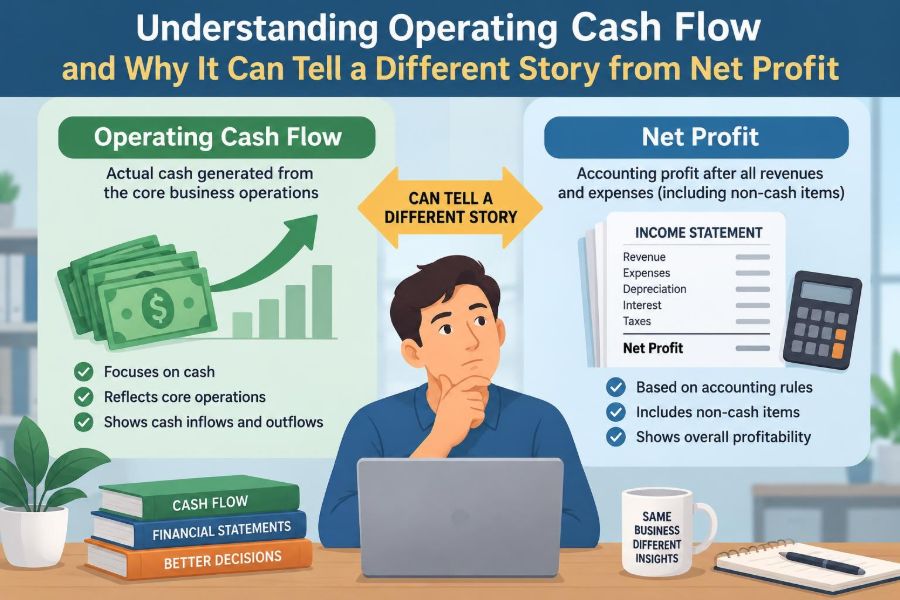

A business can report a healthy profit and still struggle to pay suppliers on time. It can also report a loss while keeping plenty of cash flowing through the bank account. At first, that sounds contradictory.
Consider a small consulting firm that completes a major project in December and records the revenue that month. The client may not pay until February. The firm looks profitable on its income statement, but rent, payroll, and software bills still need cash in January.
This gap matters to managers deciding whether they can hire, investors judging business quality, and students learning why financial statements do not always point in the same direction. Profit measures performance under accounting rules; cash flow tracks movement of cash.
Operating cash flow helps connect those two views. It shows whether a company’s normal operations are actually generating cash, rather than merely generating accounting earnings.
💡 The basic idea of operating cash flow
Operating cash flow, often shortened to OCF or CFO, is the cash a business generates or uses through its core day-to-day activities. It generally includes cash collected from customers and cash paid for inventory, wages, rent, taxes, and other operating costs.
It does not primarily describe borrowing money, issuing shares, buying a factory, or selling an investment. Those items belong elsewhere in the cash flow statement because they relate to financing or investing decisions rather than ordinary operations.
📄 Where operating cash flow appears
OCF appears in the first major section of the statement of cash flows, alongside cash flows from investing and financing activities. Reading all three sections together reveals where cash came from and where it went.
- Operating activities: cash tied to normal business activity.
- Investing activities: cash spent on or received from long-term assets and investments.
- Financing activities: cash from lenders and owners, and cash returned to them.
A company can have positive total cash flow because it borrowed heavily, even while operations consume cash. That is why the operating section deserves separate attention.
📊 Net profit measures something different
Net profit, also called net income, is the bottom-line result on the income statement: revenue minus expenses for an accounting period. Under accrual accounting, revenue and expenses are recognized when earned or incurred, not necessarily when cash changes hands.
This matching approach can give a useful picture of economic performance. A company should recognize the revenue from work it completed even if a customer pays later. But it also means net profit is not a direct count of cash received.
⏱️ Timing is the source of many differences
The simplest reason profit and OCF differ is timing. A sale may be recorded today, while the cash arrives weeks or months later. Likewise, an expense can reduce profit before the business pays the related invoice.
Imagine a retailer sells goods on credit near year-end. Its income statement may include the sale and related profit immediately. Until customers settle their balances, however, that profit has not increased the retailer’s cash.
🧾 Accrual accounting creates receivables
When a company has earned revenue but has not yet collected payment, it records an accounts receivable asset. Receivables are promises from customers to pay, not cash available for payroll.
An increase in receivables usually reduces operating cash flow relative to net profit. The company recognized revenue, but more of that revenue remains unpaid at the reporting date. A later collection increases cash without creating new revenue at that moment.
📦 Inventory can absorb cash before a sale
Inventory creates the opposite timing pattern. A manufacturer or retailer may pay suppliers for goods well before selling them to customers. The cash outflow occurs early, while the related cost reaches the income statement only when the goods are sold.
As a result, a growing inventory balance often lowers OCF in the short term. This is not automatically bad: a business may be stocking up for a predictable seasonal rush. The question is whether the inventory will sell at the expected price and pace.
🧮 Payables can temporarily support cash flow
Accounts payable are amounts a company owes suppliers for goods or services already received. If payables increase, the company has recorded an expense or acquired inventory without paying all of the cash yet.
That can make OCF higher than net profit for the period. It may reflect sensible supplier credit terms, but it can also signal delayed payments caused by cash pressure. Context matters: a one-time increase and a persistent pattern mean different things.
🏭 Depreciation lowers profit without using current cash
Depreciation is a common reason operating cash flow exceeds net profit. When a company buys equipment, it normally pays cash at purchase. Accounting then spreads the asset’s cost over its useful life as depreciation expense.
Each later depreciation charge reduces profit, but it does not require another cash payment in that period. Under the common indirect cash flow method, depreciation is added back to net profit to avoid treating it as a current operating cash outflow.
🔁 The indirect method reconciles profit to cash
Most large-company cash flow statements use the indirect method for operating activities. It starts with net profit, reverses non-cash items, and adjusts for changes in operating assets and liabilities.
Its core logic is straightforward: remove accounting effects that did not use or provide current operating cash, then account for cash timing differences. The reconciliation is one of the most useful bridges between the income statement and balance sheet.
🧩 A simplified reconciliation
Net profit
+ Non-cash expenses, such as depreciation
- Increase in accounts receivable
- Increase in inventory
+ Increase in accounts payable
= Operating cash flow
Real statements can include more adjustments, including taxes, provisions, deferred items, gains, and losses. The principle remains the same.
💵 The direct method follows cash receipts and payments
The direct method reports major categories of actual operating cash movements, such as cash received from customers and cash paid to employees and suppliers. It can feel more intuitive because it resembles a cash ledger.
For example, it may show that customers paid $900,000 while suppliers and employees received $780,000. The difference, after other operating payments, produces OCF. Reporting rules and company practices affect presentation, so readers commonly encounter the indirect method in published statements.
🧠 A profit-to-cash example
Suppose a hypothetical design business reports net profit of $100,000. During the same year, accounts receivable rise by $45,000 because several clients have not paid. Inventory is irrelevant, but payables rise by $10,000, and depreciation is $15,000.
Its simplified OCF would be $80,000: $100,000 profit + $15,000 depreciation − $45,000 receivables + $10,000 payables. The business earned a profit, yet only part of that profit became operating cash during the year.
📈 When cash flow is stronger than profit
Positive OCF above net profit can arise for healthy reasons. A company may collect old customer balances, receive customer deposits, reduce excess inventory, or record substantial non-cash depreciation.
It can also arise for less reassuring reasons, including postponing supplier payments or reducing inventory so aggressively that future sales suffer. The result is informative, but it is not a verdict on its own.
📉 When profit is stronger than cash flow
Profit exceeding OCF often means the business is investing cash in working capital: receivables, inventory, and other short-term operating resources. A growing company frequently experiences this as it sells more on credit or prepares for higher demand.
The risk appears when collections slow, stock becomes obsolete, or revenue growth is not real. Profits that repeatedly fail to convert into cash deserve closer investigation because bills cannot be paid with receivables alone.
🧱 Working capital is the crucial bridge
Working capital generally refers to short-term operating assets and liabilities. For OCF analysis, the most relevant components are receivables, inventory, payables, and accrued expenses.
A useful mental model is that working capital holds cash while a business completes its operating cycle. Cash becomes inventory, inventory becomes a sale, the sale becomes a receivable, and the receivable becomes cash again. Efficient cycles release cash; slow cycles tie it up.
🔄 The cash conversion cycle adds operating context
The cash conversion cycle estimates how long cash is committed between paying suppliers and collecting from customers. It combines inventory days and receivable days, then subtracts payable days.
A shorter cycle can improve liquidity, but shorter is not always better. A firm that pressures suppliers too hard may damage relationships, while a company offering customers longer payment terms may gain sales. The goal is a sustainable cycle that fits the industry and business model.
🏪 Business models produce different patterns
A subscription business that bills customers in advance may receive cash before recognizing all of the revenue. This can support OCF while creating a liability often called deferred or unearned revenue.
A construction contractor may incur labor and material costs long before billing milestones or collecting cash. A grocery retailer may sell quickly and pay suppliers later. Comparing OCF patterns makes most sense among businesses with similar operating models.
🌱 Growth can consume cash
Growth is often presented as an uncomplicated positive, but rapid expansion can strain cash. More orders may require more inventory, larger payrolls, additional delivery capacity, and credit extended to more customers.
A profitable company can therefore need external funding while it grows. This is not necessarily a failure; it is a financing challenge created by timing. Management needs forecasts that identify the cash requirement before obligations become due.
🛑 Positive OCF is not automatically healthy
A company can produce positive operating cash flow by collecting old receivables, cutting inventory, or stretching payments to suppliers. None of these actions can continue indefinitely without limits.
Readers should ask what produced the cash. Was it recurring customer collection from current sales? Was it a temporary release of working capital? A multi-period view is usually more revealing than a single favorable year.
⚠️ Negative OCF is not automatically a failure
Negative OCF can be understandable during expansion, seasonal inventory build-ups, or a temporary shift in customer payment timing. Some early-stage companies also spend heavily to establish operations before they generate stable collections.
Still, recurring negative OCF requires a credible explanation and a source of funding. A business may survive a planned cash shortfall; it cannot indefinitely cover operating outflows without cash reserves, financing, or an eventual improvement in its operating cycle.
🔍 Look for the quality of earnings
Earnings quality describes how faithfully reported profit reflects sustainable economic performance. Cash conversion is one lens for assessing it, especially when revenue growth and receivable growth move in very different directions.
Strong earnings quality does not mean OCF must exceed profit every year. It means the relationship between profit and cash makes business sense, follows understandable drivers, and is not dependent on unusual or unsustainable working-capital movements.
🧭 Read several periods, not one snapshot
A single annual cash flow statement can be distorted by seasonality, a large customer payment, or an inventory purchase made near the reporting date. Quarterly patterns can also fluctuate because businesses do not operate in neat accounting intervals.
Review multiple periods and compare trends in revenue, net profit, OCF, receivables, inventory, and payables. Ask whether cash generation is broadly keeping pace with the scale of the business over time.
📏 Useful measures, used carefully
Analysts often compare operating cash flow with net profit, sales, or current liabilities. These comparisons can highlight changes in cash conversion and short-term resilience, but no single ratio can diagnose a company.
| Measure | What it can help reveal | Key caution |
|---|---|---|
| OCF compared with net profit | Whether earnings are converting into operating cash | Working-capital timing can make one period unusual |
| OCF margin | Operating cash generated per unit of revenue | Margins differ widely by industry |
| OCF compared with current liabilities | Capacity to support near-term operating obligations | Debt maturities and cash balances also matter |
Ratios become more meaningful when compared with a company’s own history, its business model, and appropriate peers.
🧾 Separate operations from investing needs
OCF tells you whether normal operations generate cash. It does not, by itself, tell you whether the business has enough cash after replacing equipment, maintaining facilities, or expanding capacity.
For that broader question, analysts often consider capital expenditures and the idea of free cash flow. Definitions vary, but a common approach begins with OCF and subtracts spending on long-lived assets. Always check the definition being used before comparing figures.
🏦 Financing can hide an operating shortfall
Borrowing can keep a company solvent when OCF is weak. Equity investment can do the same. These may be sensible choices, especially during expansion or a temporary disruption.
But financing cash is not a substitute for a viable operating model forever. The statement of cash flows helps distinguish cash generated by customers from cash supplied by lenders and owners.
🧰 What managers can do to improve OCF
Improving OCF does not simply mean collecting faster at any cost. Durable improvements come from designing a better operating cycle and protecting customer and supplier relationships.
- Invoice promptly and resolve billing disputes before they age.
- Set credit terms that reflect customer risk and competitive realities.
- Forecast inventory demand to reduce unnecessary stock without causing shortages.
- Negotiate payment terms transparently and pay suppliers as agreed.
- Build rolling cash forecasts that include taxes, payroll, and large seasonal commitments.
These actions work best when commercial, operations, and finance teams share the same assumptions.
🧑🎓 A practical reading sequence for students
Start with the income statement: did revenue and net profit rise or fall? Then move to the operating cash flow section and identify the largest adjustments from profit.
Next, inspect the balance sheet balances behind those adjustments. If receivables rose sharply, ask whether sales terms changed or collections weakened. If inventory fell, consider whether the company became more efficient or merely sold down stock.
🧑💼 Questions working professionals should ask
Professionals preparing budgets, credit reviews, or management reports should turn the numbers into operating questions. The objective is not to admire a cash flow figure, but to understand what will happen next.
- Which customers account for overdue receivables?
- Which inventory categories are slow-moving or at risk of obsolescence?
- Are supplier payment patterns deliberate and sustainable?
- Which cash movements are seasonal, and which are structural?
- What assumptions would cause the forecast to miss?
🚩 Common interpretation mistakes
One mistake is treating depreciation as “free money.” It is non-cash in the current period, but the equipment being depreciated usually required cash earlier and may need replacement later.
Another is assuming every increase in payables is beneficial. It boosts short-term OCF, but late payment can lead to lost discounts, supply disruption, or strained relationships. A final mistake is comparing companies without considering their business models and revenue cycles.
🧩 Operating cash flow has real limitations
OCF is powerful, but it is not a complete measure of performance. It can be affected by timing choices, seasonality, and classifications permitted under applicable accounting standards. It also says little by itself about profitability, competitive position, debt terms, or future capital needs.
Use it with the income statement, balance sheet, notes to the financial statements, and management’s explanation of major changes. Financial analysis becomes stronger when each statement is allowed to answer its own question.
🎯 The core principle: profit is not cash
Net profit answers whether revenue exceeded expenses under accrual accounting during a period. Operating cash flow answers whether the company’s ordinary activities produced or used actual cash during that period.
The difference is often explained by non-cash expenses and the movement of working capital through receivables, inventory, payables, and similar accounts. Neither measure should replace the other. Together, they reveal both reported performance and financial practicality.
A business becomes easier to understand when you ask not only “Was it profitable?” but also “When did the cash arrive, and what is still tying it up?” That habit turns a cash flow statement from a technical schedule into a practical map of how the business works. 💰📊🔍