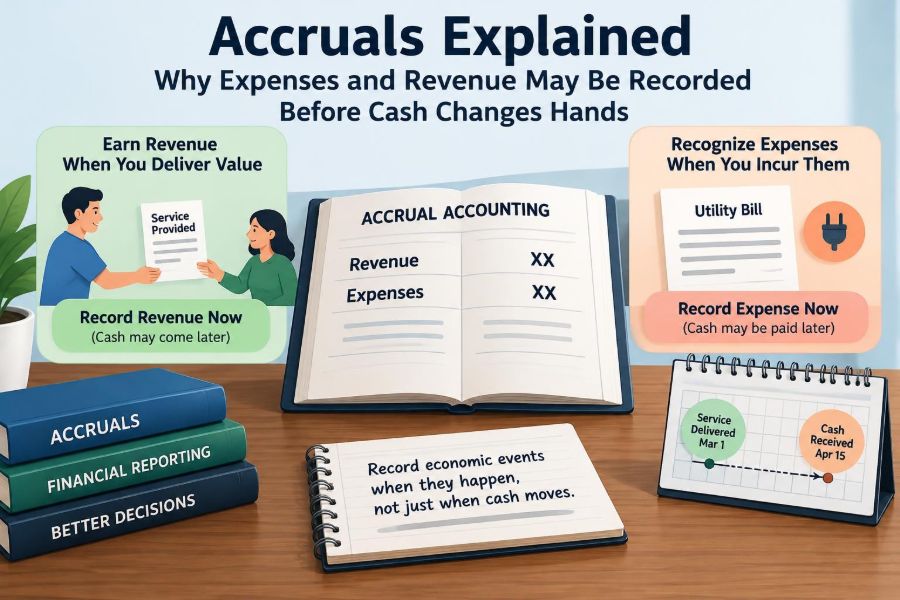

Imagine a consulting firm finishing a project in the last week of December. The client will not pay until January, but the work is complete, accepted, and billable. If the firm waits for the bank deposit to record revenue, December may appear much quieter than it really was.
Now consider the other side. A business uses electricity throughout December, receives the bill in January, and pays it later that month. The lights, equipment, and heating supported December’s operations—not January’s—regardless of when the utility company asks for payment.
These situations are ordinary, but they expose a central accounting problem: cash timing and economic activity rarely line up perfectly. Accrual accounting addresses that gap by recording revenue when it is earned and expenses when they are incurred.
For students, accruals can initially feel like bookkeeping entries made ahead of time. For managers, lenders, investors, and working professionals, they are the mechanism that makes a period’s financial statements describe what actually happened during that period.
🧭 The core idea behind accrual accounting
Accrual accounting records the financial effects of events when the underlying economic activity occurs, rather than only when cash is received or paid. Revenue is generally recognized when it has been earned; expenses are generally recognized when resources have been used or obligations have arisen.
This does not mean cash is unimportant. Cash determines whether an organization can pay its bills, invest, and survive. Accrual accounting simply answers a different question: what income did the business generate, and what did it consume, during this reporting period?
💵 Cash basis versus accrual basis
Under the cash basis, a customer payment becomes revenue when money arrives, and a supplier payment becomes an expense when money leaves. That approach is intuitive and can be useful for simple cash tracking.
Under the accrual basis, the timing is tied to performance and consumption. A December service completed for a January payment belongs in December revenue. December wages owed but paid in early January belong in December expense.
| Event | Cash-basis focus | Accrual-basis focus |
|---|---|---|
| Customer receives completed service in December, pays in January | January revenue | December revenue |
| Employees work in December, are paid in January | January expense | December expense |
| Customer pays before a future subscription begins | Revenue on receipt | Liability until service is provided |
Many organizations also prepare a cash flow statement. So adopting accrual accounting does not hide cash; it separates cash movements from performance measurement.
🧩 Why timing differences are normal
Businesses often deliver goods or services before issuing an invoice. Suppliers may allow payment terms after delivery. Payroll is usually paid after employees have worked, and utility bills arrive after a period of usage.
These timing differences create balances that sit between income statement recognition and cash settlement. Accounts receivable, accounts payable, accrued expenses, deferred revenue, and prepaid expenses are the accounting records that hold those differences.
📅 The reporting-period problem accruals solve
Financial statements are prepared for defined periods: a month, quarter, or year. Without accruals, one period could look unusually profitable merely because customers paid quickly, while the next could look weak because the same customers paid late.
Accruals aim to put related activity in the same period. Revenue from a completed sale is reported alongside the costs incurred to generate it. This gives readers a more coherent view of period performance.
🔗 The matching idea: useful, but not a shortcut
People often describe accrual accounting through the matching principle: recognize expenses in the period in which they help generate revenue. The idea is useful because it explains why December payroll should not be moved into January just because the payment date falls later.
But matching is not permission to choose a convenient expense amount. Recognition must still be based on actual consumption, contractual obligations, estimates supported by evidence, and the applicable accounting framework. Some costs benefit more than one period and require systematic allocation, such as depreciation or insurance expense.
📈 Revenue is recorded when it is earned
In broad terms, revenue is earned when an entity has substantially performed what it promised and has a right to consideration under the arrangement. The exact analysis can be more detailed for contracts involving multiple goods or services, returns, milestones, variable amounts, or long-term delivery.
For a simple example, suppose a graphic designer completes a logo package for a client on December 28 and invoices the client that day. If payment is due in January, the designer generally records December revenue and an amount receivable from the client.
🧾 Accrued revenue: earned before billing or collection
Accrued revenue is revenue that has been earned but has not yet been billed, collected, or sometimes formally invoiced. The related asset is often called accrued receivable, unbilled receivable, or accounts receivable, depending on the facts and the organization’s chart of accounts.
A law firm, for example, may have performed work through month-end but invoice clients after reviewing time records. An adjusting entry records the portion earned through the reporting date, even though the invoice will be sent later.
Debit  Accrued receivable        4,000
Credit Service revenue           4,000
The debit records a claim to future cash; the credit records revenue earned in the current period.
🏗️ Performance obligations can change the revenue answer
Not every signed contract means all revenue is earned immediately. A contract may contain several promised goods or services, such as software access, installation, training, and support. Revenue recognition depends on when each promise is satisfied, not merely on the contract date or payment date.
For long-running work, revenue may be recognized over time if the relevant accounting criteria are met. In other arrangements, it is recognized at a point in time, such as delivery or customer acceptance. The contract’s terms and the substance of performance matter.
📥 Cash received before revenue is earned
Cash arriving early does not automatically create revenue. If a customer prepays for a future service, the business owes performance. Until it delivers that service, the receipt is generally a liability, often called deferred revenue, unearned revenue, or contract liability.
Suppose a fitness studio sells a three-month membership in advance. On the payment date, the studio has cash but still owes access over the membership period. Revenue is recognized as that access is provided.
On receipt:   Debit Cash / Credit Deferred revenue
As earned:    Debit Deferred revenue / Credit Revenue
🧮 Why an advance payment is not a profit
Calling every customer receipt “sales” can overstate current-period income and understate obligations. It also makes later periods look weaker, because services are provided then without the associated revenue being recorded.
Deferred revenue is a useful reminder that an organization can hold cash while still owing goods, access, support, or other work. In that sense, the liability records an unfinished promise, not a failure or a loss.
🧱 Expenses are recorded when incurred
An accrued expense is a cost recognized before it is paid because the business has received the related benefit or has become obligated for it. Expenses may include wages, interest, rent, professional services, utilities, taxes, and repairs.
Suppose a manufacturer receives security services throughout the final month of the year. The provider sends its invoice the following month. If the service was used before year-end, the manufacturer records the cost in the earlier period and a liability for the amount owed.
👥 Payroll accruals capture work already performed
Payroll is one of the clearest accrual examples. Employees may be paid every two weeks, but the reporting date can fall in the middle of a pay cycle. Wages earned by employees through that date are a current-period expense, even if the payroll run occurs afterward.
The entry generally debits wage expense and credits wages payable or accrued payroll. Depending on local rules and the employer’s obligations, related payroll taxes and benefits may also need to be accrued. The details depend on the payroll structure and applicable requirements.
⚡ Utilities and recurring services often need estimates
Businesses consume electricity, internet access, water, cloud services, and similar resources continuously, while invoices arrive periodically. At month-end, the precise bill may not yet exist, but the organization may still need an estimate of the portion used.
A reasonable estimate can use meter readings, contract rates, usage records, historical patterns adjusted for known changes, or a supplier’s preliminary information. The purpose is not to predict perfectly. It is to make a supportable estimate and update it when better information becomes available.
🏦 Interest accrues day by day
Interest is often paid monthly, quarterly, or at loan maturity, but borrowing costs accumulate over time. A company with a loan outstanding at period-end may owe interest for days that have passed since the last payment.
Recording that accrued interest prevents the income statement from omitting a real financing cost simply because the lender has not yet collected it. It also recognizes the corresponding obligation on the balance sheet.
📦 Prepaid expenses are the opposite timing issue
A prepaid expense occurs when cash is paid before the related benefit is consumed. Rather than recording the full payment as an immediate expense, the business initially records an asset because it has a right to future benefit.
Annual insurance paid at the beginning of the coverage period is a familiar example. As each month of coverage passes, part of the prepaid asset becomes insurance expense. This is not an accrual in the narrow “expense before cash” sense, but it belongs to the same family of timing adjustments.
🔄 A quick map of the four common timing patterns
The most common period-end adjustments can be understood by asking two questions: has cash moved, and has the revenue or expense been earned or incurred?
| Timing pattern | What has happened first? | Typical balance-sheet account |
|---|---|---|
| Accrued revenue | Revenue is earned before cash | Receivable |
| Deferred revenue | Cash is received before revenue is earned | Liability |
| Accrued expense | Expense is incurred before cash | Payable or accrued liability |
| Prepaid expense | Cash is paid before expense is incurred | Asset |
This framework is more durable than memorizing journal entries. First identify the economic event; then identify whether the remaining balance is a right to receive value or an obligation to provide it.
⚖️ Every adjusting entry affects at least two accounts
Accrual accounting uses double-entry bookkeeping. Every adjustment has equal debits and credits, which helps preserve the accounting equation: assets equal liabilities plus equity.
For accrued revenue, an asset rises and revenue increases equity through profit. For accrued expenses, a liability rises and expense reduces equity through profit. The entry is not arbitrary; it represents both the income-statement effect and the unsettled balance-sheet effect.
🗂️ Adjusting entries usually happen at period-end
Adjusting entries are entries made near the end of a reporting period to recognize amounts that routine invoices, receipts, and payments have not captured in the correct period. Monthly closes often include recurring adjustments for payroll, interest, depreciation, subscriptions, and known service costs.
Some organizations record estimates monthly and reverse them at the beginning of the next period. A reversing entry can simplify processing when the actual supplier invoice or payroll payment is recorded later. It is a workflow tool, not a substitute for reviewing the real amount.
🔁 Reversing entries reduce duplicate expense risk
Consider an estimated December legal-services accrual. If the organization records the expense in December and then books the January invoice to expense without a reversal or other clearing process, the cost may be recorded twice.
With a reversing entry, the January opening balance cancels the estimate. When the invoice arrives, the normal invoice process can record the actual amount. Teams still need controls: a reversal does not fix a poor estimate or an invoice that relates partly to another period.
🔍 Estimates are acceptable; unsupported guesses are not
Many accruals require judgment because the final invoice or payroll calculation is unavailable at close. Accounting does not demand impossible precision. It does require a basis that can be explained, reviewed, and refined.
Good documentation may include a contract, purchase order, work-completion evidence, calculation schedule, prior invoice, correspondence with a vendor, or an explanation of assumptions. An estimate should reflect information known at the reporting date, not a target profit figure.
🧠 Materiality guides the level of effort
Materiality asks whether an omission or error could reasonably influence the decisions of financial-statement users. A small recurring difference may not justify elaborate calculation, while an unrecorded bonus, litigation-related service fee, or major customer milestone could be significant.
Materiality is not a universal dollar cutoff. It depends on the organization’s size, the nature of the item, the users of the statements, and whether the item affects a sensitive measure such as a debt covenant, profit trend, or regulatory threshold.
📊 Accruals shape the income statement
Without accrued revenue, income can be understated in periods when work is completed near the reporting date. Without accrued expenses, profit can be overstated because costs already consumed are missing.
That is why accruals matter for gross margin, operating profit, tax-related calculations, bonus measures, budgets, and performance comparisons. They do not make a business more profitable or less profitable in total over its life; they allocate the effects to the periods that best reflect the activity.
🏛️ Accruals also shape the balance sheet
The balance sheet shows the unfinished financial consequences of past activity. Receivables represent amounts customers owe. Accrued liabilities represent amounts the business owes. Deferred revenue represents obligations to customers, while prepaid expenses represent future economic benefit already paid for.
A balance sheet missing these amounts can make liquidity and obligations difficult to assess. A company may appear to have lower liabilities than it truly does, or may show cash received from customers without showing the services it still owes.
🌊 Profit and cash flow can move in different directions
A profitable business can face cash pressure when customers take a long time to pay. Conversely, a business can receive substantial customer prepayments and show strong operating cash inflow before it has earned the associated revenue.
This is not a contradiction. Profit measures performance under accrual accounting; cash flow measures cash movement. Sound analysis often needs both views, plus the working-capital balances that explain the gap between them.
🧰 Working capital reveals the operational consequence
Receivables, prepayments, payables, and deferred revenue are often part of working capital: short-term operating assets and liabilities. Their movement affects how much cash the business needs to fund day-to-day activity.
For example, revenue growth can increase receivables if invoices are unpaid, requiring more cash to support operations. In contrast, collecting deposits in advance can provide cash before service delivery, while also creating a deferred-revenue obligation.
🚩 Common mistake: treating invoices as the only trigger
An invoice is useful evidence, but it does not always determine the accounting period. A supplier may invoice late for services already received, or a company may invoice a customer before it has delivered the promised goods or services.
Start with the underlying event: what was delivered, used, earned, owed, or still promised by the reporting date? The invoice then helps establish the amount and settlement terms, but it cannot rewrite the economic substance.
🚩 Common mistake: confusing a receivable with revenue
Accounts receivable and revenue often arise together, but they are not the same thing. A receivable is an asset: a claim against a customer. Revenue is an income-statement measure of value earned during the period.
Likewise, cash and revenue are not interchangeable. A cash receipt may settle an old receivable, create deferred revenue, or represent current-period revenue. The account depends on why the money was received.
🚩 Common mistake: using accruals to manage earnings
Because many accruals involve estimates, they can be vulnerable to bias. Delaying needed expense accruals can inflate current profit. Recording unsupported provisions or excessive expenses can depress it and shift results into future periods.
Strong review processes look for unusual changes, late entries, round-number adjustments, unsupported assumptions, and reversals that do not agree with subsequent invoices. Estimates should be updated in good faith as evidence improves, not used to engineer a preferred result.
✅ A practical month-end accrual process
A reliable close process is repeatable. It turns accrual accounting from a last-minute search for missing entries into a structured review of activity that crossed the period boundary.
- Set the reporting cut-off date and identify material account areas.
- Review contracts, purchase orders, timesheets, payroll calendars, service reports, and recurring vendor arrangements.
- Look for goods received or services performed before cut-off that have not been invoiced or paid.
- Calculate each accrual using available evidence and document the method.
- Prepare and review entries, including any planned reversals.
- Compare estimates with subsequent invoices or payments and investigate significant differences.
The final step improves future estimates and helps identify whether the process missed recurring items.
🧾 Documentation makes accruals reviewable
An accrual schedule should allow another person to understand the balance without relying on memory. It commonly identifies the vendor or customer, description, service period, amount, calculation basis, supporting evidence, preparer, reviewer, and planned reversal date where relevant.
Clear support matters for internal management, external audit, and continuity when staff change. It also makes it easier to explain why an amount changed from one period to the next.
🤖 Systems help, but they do not replace judgment
Accounting software can automate recurring entries, allocate prepaid costs, flag uninvoiced purchase orders, and generate aging reports. These features reduce manual work and can make routine close activities more consistent.
However, systems only process the rules and data they receive. Someone still needs to determine whether a service was actually received, whether a contract obligation was satisfied, whether an estimate remains reasonable, and whether an automated entry should be adjusted.
🌍 Standards and tax rules may not align perfectly
Financial reporting frameworks generally use accrual concepts, but detailed recognition requirements differ by jurisdiction, entity type, and applicable standards. Revenue arrangements, leases, income taxes, employee benefits, and provisions can involve rules beyond the basic examples in this article.
Tax reporting may use different timing rules from financial reporting, especially for small businesses or particular deductions. An entry that is appropriate for financial statements does not automatically determine a tax return position. When the stakes are meaningful, consult the relevant standards and qualified advisers.
🎓 A simple way to reason through any accrual question
When facing a confusing transaction, pause before selecting an account. Ask four questions:
- What economic activity occurred before the reporting date?
- Has cash moved yet?
- Does the organization now have a right to receive value or an obligation to provide or pay value?
- What evidence supports the amount and the period?
Those questions usually lead to the right category: receivable, payable, deferred revenue, prepaid asset, current revenue, or current expense. They are more reliable than trying to memorize dozens of journal-entry patterns.
🏁 The central takeaway: record the economic reality
Accruals are not a technical trick for making the books look more sophisticated. They are the bridge between the messy timing of invoices, payroll runs, deposits, and bank transfers and the economic reality of a reporting period.
When revenue is recorded as it is earned and expenses as they are incurred, financial statements better show what the organization delivered, what it consumed, what it is owed, and what it still owes. Cash remains essential—but cash timing alone cannot tell the full performance story.
Accrual accounting records the work, value, and obligations of the period in which they arise, even when cash settles the transaction earlier or later. Once that principle is clear, journal entries become a logical record of business reality rather than a set of rules to memorize. 💰📘✅