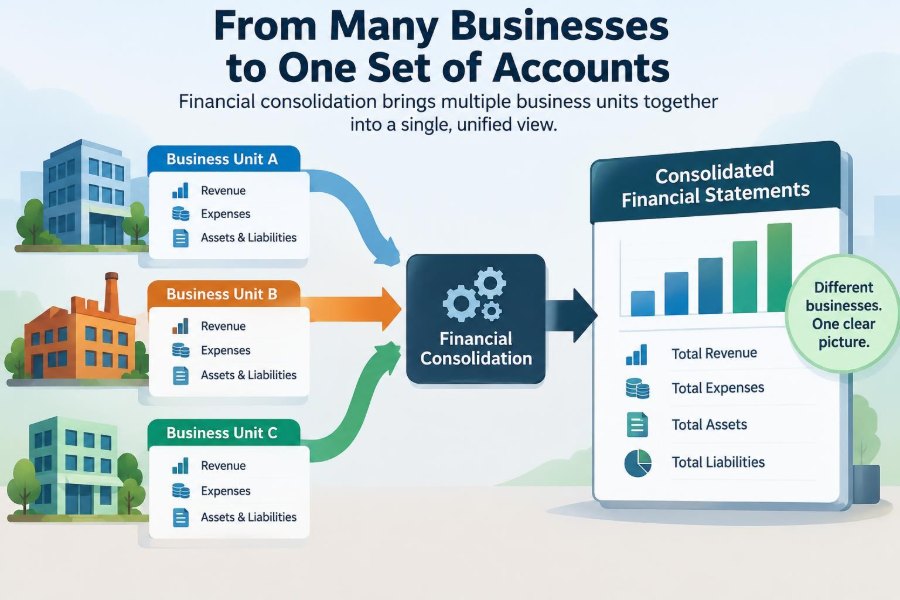

Imagine a company that owns a retailer, a logistics business, a software platform, and several overseas subsidiaries. Each unit closes its books at month-end, produces a profit figure, and reports a balance sheet. Yet investors, lenders, and directors need one answer: what did the whole economic group earn, own, and owe?
Adding the separate reports together seems like an obvious solution. It is also usually wrong. One company’s sale may be another company’s purchase, a parent’s investment may represent a subsidiary’s net assets, and different businesses may report in different currencies or use different accounting policies.
Financial consolidation is the disciplined process that turns those separate records into a single set of accounts for the group. It is where accounting becomes a form of systems engineering: data must be collected, standardized, matched, adjusted, eliminated, reviewed, and explained.
For students, consolidation shows why a group is not merely a larger version of one legal entity. For professionals, it explains why the close process involves far more than importing trial balances into a reporting tool.
🧩 What Financial Consolidation Actually Means
Financial consolidation is the preparation of financial statements that present a parent company and the entities it controls as though they were one economic entity. The resulting statements generally include a consolidated statement of financial position, profit or loss, cash flows, and changes in equity.
The legal entities do not disappear. They still file taxes, sign contracts, pay employees, and maintain their own ledgers. Consolidation is a reporting view that overlays those legal records to tell the group-level story.
🏢 Why Groups Have More Than One Legal Entity
Businesses create separate entities for practical reasons: local legal requirements, acquisitions, regulatory licenses, risk separation, joint ventures, financing arrangements, or distinct operating brands. A group can therefore be commercially unified while legally fragmented.
That fragmentation creates an accounting challenge. A transaction that is entirely real and correctly recorded by two legal entities may have no economic effect on the group when viewed from outside the group.
🎯 The Core Idea: Control Rather Than Ownership Alone
Consolidation normally follows control, not simply a percentage of shares held. Under widely used accounting frameworks, control generally involves power over the investee, exposure to variable returns, and the ability to use power to affect those returns.
A parent holding all voting shares will commonly control a subsidiary. More complicated structures require judgment: contractual rights, dispersed other shareholders, decision-making authority, and protective rights can all affect the conclusion.
Ownership is useful evidence, but it is not a shortcut around the control assessment.
🔍 Which Entities Belong in the Consolidated Group
The consolidation perimeter, sometimes called the reporting boundary, identifies entities included in the group accounts. It may contain direct subsidiaries, subsidiaries held through intermediate companies, and special-purpose entities controlled through arrangements rather than conventional share ownership.
Associates and joint arrangements may be accounted for differently, depending on the applicable framework and the facts. The key question is not whether an entity is economically interesting; it is whether the reporting entity controls it.
🗂️ Separate Accounts and Consolidated Accounts
A parent’s separate financial statements report its own assets, liabilities, income, and investments in other entities. A subsidiary’s individual accounts do the same for that legal company.
Consolidated financial statements instead replace the parent’s investment in subsidiaries with the underlying assets and liabilities of those subsidiaries, then remove transactions within the group. Both views can be useful, but they answer different questions.
| View | Main question answered | Typical focus |
|---|---|---|
| Individual entity accounts | How did this legal company perform? | Legal obligations, local compliance, distributable results |
| Consolidated accounts | How did the economic group perform? | Group resources, external activity, overall financing |
🧱 The Starting Point: A Trial Balance From Every Entity
Each entity supplies a trial balance: a list of ledger account balances before consolidation adjustments. This is the raw material for the group close.
Strong processes also collect supporting details, such as intercompany receivable and payable balances, revenue by counterparty, fixed-asset movements, tax data, and ownership information. A total balance without support is difficult to eliminate or validate.
🧭 Building a Common Chart of Accounts
One subsidiary may post office rent to “occupancy cost,” while another uses “administrative premises.” A consolidation team maps both local accounts to a common group reporting account.
This chart-of-accounts mapping is more than a coding task. Poor mappings can move costs between categories, obscure margins, or cause inconsistent disclosures. The group chart must be stable enough for comparison but detailed enough for management and external reporting.
📅 Aligning Reporting Dates and Accounting Policies
Consolidation works best when group entities close on the same reporting date. Where dates differ, the group may need adjustments for significant transactions that occur between an entity’s close date and the group reporting date, subject to applicable requirements.
Policies must also be aligned. If one entity depreciates similar equipment differently, measures inventory using a different permitted method, or recognizes revenue on a different basis, the group may need consolidation adjustments before combining its numbers.
🌍 Translating Foreign Currency Operations
A multinational group may receive trial balances in euros, yen, pounds, or other currencies while presenting consolidated statements in one reporting currency. Translation is not the same as converting an invoice for payment.
Assets and liabilities are commonly translated using closing exchange rates, while income and expenses are commonly translated using rates appropriate to the period. Exchange differences arising from translation are often reported separately in equity until relevant circumstances, such as disposal of an operation, occur.
Exchange-rate conventions depend on the accounting framework and facts, so teams should document their policy rather than apply a single rate mechanically.
➕ Combining Like With Like
After alignment and translation, consolidation begins with aggregation. Cash is added to cash, external revenue to external revenue, receivables to receivables, and so on.
But this is only the first layer. Combining balances without elimination entries can substantially overstate group revenue, assets, liabilities, or equity. The group column is built from additions and adjustments.
🔁 Why Intercompany Transactions Must Disappear
Suppose a manufacturing subsidiary sells goods to a group-owned distributor. The sale is valid in the manufacturer’s ledger and the purchase is valid in the distributor’s ledger. From the group’s perspective, however, the goods have merely moved from one internal location to another.
Until the distributor sells to an outside customer, recognizing group revenue and group cost of sales would make an internal transfer look like external economic activity. Consolidation eliminates the internal sale and corresponding purchase.
🤝 Matching Intercompany Balances Before Eliminating Them
Intercompany elimination is often presented as a neat debit-and-credit exercise. In reality, the difficult step is reconciliation. A lender entity may report a receivable of 1,000 while the borrower reports a payable of 980 because one side posted interest, foreign exchange, timing differences, or an incorrect counterparty code.
Teams match balances by entity, counterparty, currency, document type, and aging. They investigate differences before posting an elimination, because forcing an entry to make a report balance can hide a genuine error.
- Intercompany loans and accrued interest
- Trade receivables and trade payables
- Management fees and service charges
- Dividends, royalties, and internal rent
- Internal purchases and sales of goods or services
📦 Eliminating Profit Still Sitting in Inventory
An internal sale can create a further issue when inventory remains unsold at period-end. Consider a hypothetical case: Entity A sells inventory that cost 80 to Entity B for 100, and B still holds it at year-end. The group has not yet earned the 20 profit from an external customer.
Consolidation removes that unrealized profit from inventory and group profit. When B later sells externally, the profit becomes realized at group level. This adjustment prevents internal markups from inflating assets and earnings.
🏗️ Internal Sales of Fixed Assets Create Longer Effects
If one group entity sells machinery to another at a gain, the group has not gained anything from an outside party. The gain is eliminated, and the asset is presented as if the internal transfer had not created a new group-level cost basis.
Depreciation may also need adjustment in future periods. Otherwise, the buying entity could depreciate the internally increased carrying amount, causing group depreciation to be misstated over the asset’s remaining useful life.
💳 Internal Loans, Interest, and Cash Pooling
Groups often fund subsidiaries through internal loans or centralized cash pools. In individual books, the lending entity earns interest and the borrowing entity incurs interest expense. At group level, those amounts normally cancel because the group cannot earn interest from itself.
External bank balances remain, of course. The distinction matters when analyzing leverage: a group may have extensive internal funding arrangements but relatively modest debt owed to outside lenders.
🏷️ The Parent’s Investment Versus the Subsidiary’s Equity
A parent commonly records its purchase of a subsidiary as an investment asset in its separate accounts. The subsidiary’s own accounts show share capital, reserves, and retained earnings.
On consolidation, the parent’s investment is eliminated against the parent’s share of the subsidiary’s equity, with adjustments arising from the acquisition accounting process. Leaving both balances in the consolidated statement of financial position would double count the same economic interest.
🧮 Acquisition Accounting and the Purchase Price Allocation
When a business is acquired, the accounting is not always a simple comparison of purchase price with the subsidiary’s book equity. The acquired identifiable assets and liabilities may require measurement at values required by the relevant accounting framework at the acquisition date.
This exercise is often called a purchase price allocation. It can identify items not fully recognized in the acquiree’s historical balance sheet, such as customer relationships, brands, technology, or contingent liabilities, where recognition criteria are met.
It is technical and judgment-heavy, which is why acquisition documentation, valuation support, and early involvement from finance teams matter.
✨ Understanding Goodwill Without the Mystery
Goodwill is broadly the residual amount that can arise when the consideration paid for a business, together with other required components, exceeds the fair value of identifiable net assets acquired. It may reflect expected synergies, assembled workforce benefits, market position, or future growth expectations that cannot be separately recognized as individual assets.
Goodwill is not a cash account and does not mean the group has a pile of extra money. It is an accounting result of an acquisition, subject to subsequent assessment under the relevant standards, including impairment considerations.
👥 Non-Controlling Interests: When the Parent Owns Less Than 100%
A parent can control a subsidiary without owning every share. The portion owned by other shareholders is a non-controlling interest, often abbreviated as NCI.
Consolidated statements include 100% of the controlled subsidiary’s assets, liabilities, income, and expenses, then present the share attributable to non-controlling interests separately. This reflects control while showing that not all returns belong to the parent’s shareholders.
📈 Attributing Profit and Equity Fairly
After calculating consolidated profit, the group allocates it between owners of the parent and non-controlling interests according to applicable ownership rights and arrangements. Equity is similarly presented with a separate NCI component where relevant.
This is a common point of confusion: NCI is not a liability simply because it belongs to someone outside the parent. Its classification follows the nature of the interest and the governing accounting requirements.
💸 Tax Effects of Consolidation Adjustments
Book consolidation entries can have tax consequences in the accounts even when no tax return is filed on a consolidated basis. For example, eliminating an internal profit may affect deferred-tax calculations if the carrying amount of an asset and its tax base differ.
Tax law varies by jurisdiction, and tax consolidation regimes differ from financial reporting consolidation. Finance teams should avoid assuming that a group accounting elimination automatically changes current tax payable.
📊 Consolidated Cash Flow Is Not Just a Plug
The consolidated cash flow statement explains movements in group cash and cash equivalents. Internal transfers of cash generally do not represent group cash inflows or outflows, although they may be highly relevant for treasury management at the entity level.
Preparing cash flows requires consistency with the consolidated balance sheet and income statement. Acquisitions, disposals, foreign-exchange effects, non-cash adjustments, and cash held in restricted entities can make the analysis more complex than a simple comparison of two bank totals.
📝 Consolidation Journals: The Audit Trail of the Group Close
Most group adjustments are recorded as consolidation journals rather than posted back into local ledgers. Examples include eliminating intercompany balances, aligning policies, removing unrealized profit, recording acquisition adjustments, and allocating NCI.
Each journal should have a clear purpose, support, preparer, reviewer, period, and reversal logic where applicable. A transparent audit trail helps reviewers understand not only the final number, but also why it belongs in the group accounts.
⚙️ What Consolidation Software Can and Cannot Do
Modern consolidation systems can import trial balances, apply mappings, translate currencies, process ownership structures, generate standard eliminations, and preserve workflow evidence. These capabilities reduce manual handling and make recurring processes more repeatable.
Software does not decide whether control exists, whether an intercompany difference is valid, or whether a valuation assumption is reasonable. Automation accelerates a sound process; it can also accelerate poor data and weak judgments.
✅ Controls That Make the Close More Reliable
Reliable consolidation depends on controls that are both preventive and detective. Preventive controls standardize data before it enters the consolidation system. Detective controls identify exceptions before reporting is finalized.
- Approved entity structures and ownership records
- Locked account mappings with controlled changes
- Intercompany confirmation and dispute procedures
- Review thresholds for unusual movements or manual journals
- Documented foreign-exchange rates and policy adjustments
- Reconciliations from consolidation outputs back to entity submissions
Controls should be proportionate. A small group may use well-designed spreadsheets and review checklists; a complex multinational group may need integrated workflows and tighter access controls.
🚩 Common Errors That Distort Group Reporting
Many consolidation errors are ordinary operational failures rather than exotic technical problems. A subsidiary may submit the wrong period, use an outdated mapping, book a transaction with the wrong group counterparty, or omit a late invoice.
Other risks arise from judgment: excluding an entity that is in fact controlled, carrying forward outdated acquisition adjustments, or overlooking impairment indicators. The most damaging errors are often plausible enough to pass a superficial review.
🕒 Why Timing Matters at Month-End and Year-End
A group close has a deadline, but each extra day spent resolving mismatches can improve accuracy. The challenge is to create a timetable that brings forward predictable work rather than compressing every decision into the final days.
Good teams reconcile recurring intercompany positions throughout the month, maintain acquisition files continuously, and discuss unusual transactions before close. Year-end should involve deeper disclosures and review, not the first attempt to understand the group.
🔄 A Practical Consolidation Workflow
Although details vary, a disciplined cycle usually follows a recognizable order. Sequencing matters because later steps rely on earlier data being complete and comparable.
- Confirm the reporting perimeter and ownership changes.
- Collect and validate entity trial balances and supporting schedules.
- Map accounts, align policies, and translate foreign operations.
- Reconcile intercompany activity and resolve material differences.
- Post eliminations, acquisition adjustments, and NCI entries.
- Review analytics, disclosures, cash flows, and reconciliations.
- Obtain approvals and retain evidence for audit and future periods.
📉 Reading Consolidated Statements With Better Questions
Users of consolidated accounts should remember what has been removed. Revenue reflects sales to external customers, not the volume of internal trading. Debt generally focuses attention on obligations to outsiders, not loans among group entities.
Useful questions include: Which entities drive performance? How much goodwill arose from acquisitions? Are there significant non-controlling interests? What judgments shaped the consolidation boundary? The notes to the accounts often provide context that totals alone cannot show.
🛠️ Skills That Matter for Consolidation Work
Technical accounting is necessary, but effective consolidation professionals also need data discipline, spreadsheet or systems fluency, reconciliation skills, and the confidence to ask precise questions across finance teams. They must understand both debit-and-credit mechanics and the commercial events behind them.
For learners, start by mastering a simple two-company example before tackling currencies, NCI, and acquisitions. For practitioners, improving counterparty data and documentation often solves more close pain than adding another complex spreadsheet formula.
🧠 The Central Principle Behind One Set of Accounts
Consolidation does not create a fictional business. It removes the accounting effects of transactions that occurred inside the reporting boundary so the statements show the group’s relationship with the outside world.
That principle explains the major adjustments: internal sales are removed, internal receivables and payables cancel, the parent’s investment is replaced by the subsidiary’s underlying net assets, and only external profit remains. The technical rules can be detailed, but the economic logic is consistent.
A consolidated account is a carefully reconciled view of one economic group, not a simple sum of separate legal-company accounts. Once that distinction is clear, eliminations, acquisition adjustments, currency translation, and non-controlling interests become parts of the same coherent process. 💰🧩📊