
Imagine a successful local coffee chain being sold. Its espresso machines, inventory, leasehold improvements, and cash can be counted. Its debts can be identified too. Yet a buyer may still offer far more than the difference between those assets and liabilities.
That extra amount is not necessarily irrational. The buyer may be paying for loyal customers, a respected name, experienced staff, prime locations, efficient routines, or the chance to expand faster than building a new chain from scratch.
Accounting needs a way to explain that premium without pretending it is simply more cash, more equipment, or a larger inventory balance. That is where goodwill enters the picture.
Goodwill matters because it can become one of the largest assets on an acquirer’s balance sheet—and because a later write-down can signal that an acquisition has not performed as expected.
🧭 The basic idea behind goodwill
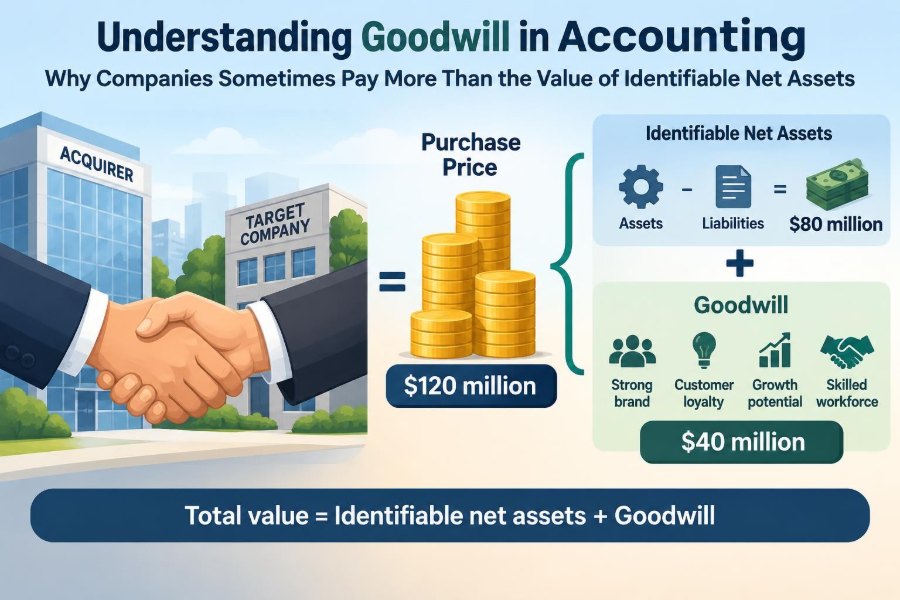
In accounting, goodwill arises when one company acquires another and pays more than the fair value of the acquired company’s identifiable net assets. Identifiable net assets are identifiable assets minus assumed liabilities, each measured at fair value at the acquisition date.
The word “identifiable” is essential. A building, customer contract, patent, inventory balance, or trademark may be separately recognized if it meets the relevant recognition criteria. Goodwill is the residual: what remains after those specific pieces have been measured.
🏢 Why buyers pay above book value
A target company’s book value reflects accounting records, not necessarily its economic appeal. Some valuable resources may have been developed internally and expensed over time rather than recorded as assets.
A buyer may also expect benefits that become available only after the combination. For example, a manufacturer may acquire a distributor partly because its products can move through the distributor’s network at lower cost.
- Established customer relationships and repeat business
- A trained workforce and operating know-how
- Market reputation and a trusted brand
- Expected cost savings or revenue opportunities
- Control of a strategic competitor, channel, or technology platform
These factors can make the target worth more to a particular buyer than the standalone carrying amounts suggest.
➗ The core goodwill calculation
For a straightforward acquisition of 100% of a business, the simplified calculation is:
Goodwill = Consideration transferred − Fair value of identifiable net assets acquired
“Consideration transferred” commonly includes cash, shares issued, debt instruments, or contingent payments promised to the sellers. The accounting can become more complex when a buyer acquires less than 100%, already owned part of the target, or agrees to an earn-out.
The logic remains the same: determine what was paid, determine the fair value of identifiable assets and liabilities, and identify the unexplained residual.
🧾 A simple acquisition example
Suppose Company A buys Company B for $12 million in cash. At the acquisition date, Company B’s identifiable assets have a fair value of $15 million, while its identifiable liabilities have a fair value of $6 million.
Its identifiable net assets are therefore $9 million. The resulting goodwill is $3 million:
Purchase price:                         $12 million
Less: identifiable net assets acquired:  $9 million
Goodwill:                                $3 million
That $3 million does not represent a separate physical item. It represents the value attributed to benefits that cannot be individually recognized after the acquisition, including expected synergies.
🔍 Fair value matters more than old book values
Goodwill is not calculated by subtracting the target’s reported shareholders’ equity from the purchase price. The buyer must generally reassess identifiable assets and liabilities at fair value as of the acquisition date.
A property carried at historical cost may be worth substantially more or less than its book amount. Inventory may need a fair-value adjustment. Previously unrecorded customer relationships or developed technology may also need recognition as identifiable intangible assets.
As a result, acquisition accounting can produce a balance sheet very different from the target’s pre-acquisition financial statements.
🧠 What goodwill can represent
Goodwill is often described as the value of a company’s reputation. Reputation can contribute, but that description is too narrow. Goodwill is a broad residual category created by an acquisition.
It may reflect expected synergies, assembled workforce value, future customers, favorable market position, going-concern value, and benefits from combining two businesses. Some of these items are valuable but cannot be separated and sold independently.
Because goodwill combines several drivers, readers should resist treating it as a precise measurement of a single asset called “reputation.”
🧩 Goodwill versus identifiable intangible assets
Many acquisitions involve intangible assets, but not every intangible asset is goodwill. An intangible asset is generally recognized separately when it is separable—meaning it can be sold, licensed, rented, or exchanged—or when it arises from contractual or legal rights.
| Item | Usually separately identifiable? | Typical accounting consequence |
|---|---|---|
| Patent | Yes | Recognized as an intangible asset |
| Customer contract | Yes | Recognized separately when measurable |
| Trademark or trade name | Often yes | Recognized separately when criteria are met |
| Assembled workforce | Generally no | Often contributes to goodwill |
| Expected future synergies | No | Included in goodwill |
This distinction affects later accounting. Separately identified intangible assets may be amortized if they have finite useful lives, while goodwill follows a different subsequent-measurement approach under major reporting frameworks.
🤝 Synergies are often the biggest reason for the premium
Synergy means the combined businesses are expected to create more value together than separately. A buyer may anticipate reduced duplicate overhead, greater purchasing power, broader distribution, or cross-selling opportunities.
Consider a software company buying a cybersecurity business. The cybersecurity product may be valuable on its own, but the buyer may pay a premium because it expects to sell that product to its existing customers. That incremental opportunity is not normally a separately identifiable asset.
Synergies are forecasts, not guarantees. If integration fails, the premium can later become difficult to support.
🪜 Goodwill exists only after a business combination
A company cannot normally create goodwill on its own balance sheet simply by building an excellent brand or retaining talented employees. Internally generated goodwill is generally not recognized because it cannot be measured reliably and separated objectively from the business’s ordinary development activities.
This creates an apparent inconsistency: two companies with similarly strong brands may report very different asset totals if one built its reputation internally and the other acquired a business with an established brand.
The difference is a result of recognition rules, not proof that one business is necessarily more valuable.
📦 The acquisition method creates the accounting entry
Business combinations are generally accounted for using the acquisition method. The acquirer identifies the acquisition date, measures consideration, recognizes identifiable assets and assumed liabilities, and records goodwill or, in unusual cases, a bargain purchase gain.
This process is more than a bookkeeping exercise. It requires valuation judgments about property, technology, customer relationships, contingent liabilities, deferred taxes, and other items that may not have been previously measured at fair value.
Purchase accounting specialists, valuation professionals, legal teams, and management often all contribute to the analysis.
📅 The acquisition date sets the measurement point
Fair values and consideration are measured at the acquisition date: the date control of the acquired business passes to the buyer. Market conditions and expectations at that point drive the initial accounting.
Events after the acquisition date can still matter, but they do not automatically revise goodwill. Accounting standards distinguish between new information about facts that existed at the acquisition date and genuinely new post-acquisition events.
This timing distinction prevents companies from continuously rewriting the original deal based on later performance.
🧮 Consideration is more than the cash paid
Cash is the clearest form of purchase consideration, but it is not the only one. If the buyer issues shares, assumes certain obligations, or promises future payments based on performance, those components may affect the amount recorded.
An earn-out, also called contingent consideration, is a common example. The seller may receive additional payments if the acquired business reaches specified milestones. Depending on its terms, that obligation may be measured at fair value as part of the acquisition accounting.
Deal teams often focus on the headline price. Accountants must focus on the full economic substance of what the buyer transferred.
⚖️ Assumed liabilities can increase goodwill
When a buyer takes on liabilities, those liabilities reduce identifiable net assets. All else equal, a lower net asset amount produces more goodwill for a given purchase price.
For example, environmental obligations, customer refund commitments, litigation exposures, or deferred tax liabilities may be recognized at acquisition even if the target had not recorded them in the same way before the deal.
This does not mean liabilities “cause” goodwill in isolation. It means accurate measurement of both assets and liabilities is necessary before the residual can be determined.
🧪 Valuation work is central, not incidental
The fair value of an acquired customer list, technology asset, or brand often cannot be observed directly in a market quotation. Valuation specialists may use income-based models, market comparisons, or cost approaches, depending on the asset.
These methods rely on assumptions such as expected revenue, customer attrition, royalty rates, discount rates, and useful lives. Small changes in assumptions can shift value between identifiable intangibles and goodwill.
That does not make acquisition accounting arbitrary, but it does mean users of financial statements should understand that professional judgment is involved.
📉 Bargain purchases are the unusual opposite
Occasionally, the fair value of identifiable net assets acquired exceeds the consideration transferred. This is called a bargain purchase.
Before recognizing a gain, the acquirer must reassess its measurements. A bargain result may indicate an overlooked asset, an incorrectly valued liability, or a mistake in the consideration calculation.
If the result remains after review, accounting standards generally require recognition of a gain. Genuine bargains can occur in distressed sales, forced dispositions, or unusual market conditions, but they are far less common than goodwill.
📚 Goodwill under IFRS and U.S. GAAP
Both IFRS and U.S. GAAP require the acquisition method for business combinations and generally treat goodwill as an indefinite-lived asset rather than routinely amortizing it for public-company reporting.
Both frameworks also require impairment assessment, though the detailed testing models, unit of account, reversals, and procedural requirements differ. The applicable standards, entity type, and jurisdiction matter.
Some private-company or local reporting frameworks may offer alternatives, including amortization approaches. Students and practitioners should avoid assuming one jurisdiction’s treatment applies everywhere.
🚫 Why goodwill is usually not amortized
Amortization systematically allocates an asset’s cost over a defined useful life. Goodwill is generally not amortized under IFRS and under U.S. GAAP for many reporting entities because its useful life and pattern of consumption are difficult to determine reliably.
Instead, the focus is on whether its carrying amount remains recoverable. This approach aims to recognize a loss when the expected benefits of the acquisition have declined rather than spreading a predetermined expense each year.
The trade-off is that impairment testing requires significant judgment and may recognize losses later than some users would prefer.
🩺 Impairment is the key subsequent accounting issue
Impairment occurs when an asset’s carrying amount is no longer supported by the value expected to be recovered from it. Because goodwill does not generate cash independently, it is tested with a group of assets and operations that generate cash flows together.
Under IFRS, goodwill is allocated to cash-generating units or groups of units expected to benefit from the combination. Under U.S. GAAP, goodwill is generally tested at the reporting-unit level. The terminology differs, but the practical question is similar: has the acquired business or related operation performed well enough to support the recorded goodwill?
Goodwill impairment losses are generally recognized in profit or loss and reduce the carrying amount of goodwill.
🚨 Signs that goodwill may be impaired
Annual testing is required in many circumstances, and additional testing may be needed when indicators suggest a decline in value. Management should not wait for a formal calendar date if a major adverse event occurs.
- Loss of a major customer or key distribution agreement
- Unexpected competition or technological obsolescence
- Lower-than-expected revenue, margins, or cash flows
- Integration problems after an acquisition
- A significant fall in market capitalization, considered with other evidence
- Regulatory changes that weaken the acquired business model
An indicator does not automatically produce an impairment charge. It signals that the underlying valuation must be examined carefully.
📊 Impairment testing relies on forecasts
Testing commonly compares a unit’s carrying amount with a recoverable or fair-value-based measure, depending on the framework. Forecasts of future cash flows are often central to the process.
Those forecasts must be plausible and consistent with available evidence. Aggressive sales growth, unrealistically stable margins, or discount rates that understate risk can delay recognition of a loss.
For analysts, a goodwill balance is therefore a reason to read management’s discussion of acquisition performance, assumptions, and impairment disclosures—not merely a number to skim past.
🔁 Goodwill impairment reversals are restricted
Once goodwill has been impaired, later improvement in performance does not normally allow the goodwill balance to be written back up. This restriction reflects the difficulty of separating a recovery in the original purchased goodwill from newly generated goodwill created after the acquisition.
The rule supports caution. A company should not treat a temporary recovery in business conditions as permission to recreate an asset that has already been written down.
This is another reason initial purchase-price discipline matters: overpayment may create an accounting consequence that cannot simply be undone later.
🪧 Goodwill is not the same as brand value
A well-known brand can be an identifiable intangible asset when acquired and when it meets recognition requirements. Its fair value may therefore be measured separately from goodwill.
Goodwill begins only after identifiable brand value, technology, contracts, licenses, and other qualifying assets have been recognized. Calling all acquisition premiums “brand value” can obscure this important distinction.
In practice, a premium may relate partly to a brand, partly to customer relationships, and partly to integration benefits. Accounting attempts to separate the first two where possible and places the remaining residual in goodwill.
🧾 Goodwill is not cash and cannot pay bills
Goodwill appears in non-current assets, which can make total assets look larger. But it is not cash, inventory, or a receivable. It cannot be sold separately in the ordinary course of business, and it usually cannot be used directly to settle obligations.
This matters when evaluating liquidity and tangible net worth. Creditors and analysts often calculate measures that exclude goodwill and other intangible assets to focus on more readily realizable resources.
A large goodwill balance is not automatically unhealthy, but it should be interpreted differently from a large cash balance.
🔎 What investors and lenders often examine
Financial statement users may compare goodwill with total assets, equity, or the size of the acquired business. They may also examine whether acquisition-related revenue and operating targets are being achieved.
Useful questions include:
- What business was acquired, and what strategic benefit was expected?
- How much of the purchase price was assigned to identifiable intangibles versus goodwill?
- Have subsequent impairment charges occurred?
- Are forecasts supporting the balance consistent with operating results?
- Would a reduction in goodwill affect debt covenants, capital measures, or market perception?
No single ratio gives a complete answer. Context, deal rationale, and subsequent execution are more informative than a percentage alone.
🏗️ A high goodwill balance can have sensible explanations
Asset-light businesses often have relatively few tangible assets compared with their earning potential. A consulting firm, digital platform, consumer brand business, or specialized service provider may therefore produce substantial goodwill in an acquisition.
Likewise, a strategic buyer may reasonably pay more than a financial buyer because it has unique distribution channels, customer access, or complementary products. The same target can have different values to different acquirers.
The concern is not goodwill itself. The concern is whether the assumptions behind the premium were realistic and whether the expected benefits materialize.
⚠️ Large goodwill can also reveal acquisition risk
A very large goodwill amount may mean that the buyer paid heavily for future expectations rather than assets already capable of separate measurement. That can increase the risk of impairment if market conditions shift.
Serial acquirers deserve particular attention because repeated deals can build a large goodwill balance over time. Strong integration capabilities may support that strategy; weak discipline can compound problems.
Accounting does not decide whether an acquisition was wise. It records the deal and later tests whether the remaining recorded value is supportable.
🧯 Common mistake: using book equity as the shortcut
A frequent classroom and workplace error is calculating goodwill as purchase price minus the target’s pre-acquisition equity. That shortcut ignores fair-value adjustments and separately identifiable intangible assets.
For a rough first estimate, book equity may help explain why a premium exists. It is not a reliable acquisition-accounting calculation.
The better sequence is to identify consideration, remeasure identifiable assets and liabilities, compute net assets at fair value, and then determine goodwill as the residual.
🧯 Common mistake: treating goodwill as a vague plug
Goodwill is a residual, but it should not become an unexamined “plug” used to make an acquisition entry balance. A high residual may be reasonable, but it also prompts questions about whether identifiable intangibles, liabilities, deferred taxes, and contingent consideration were properly measured.
Strong acquisition accounting documents the rationale for key values and reconciles them to the deal structure. Clear documentation helps management, auditors, regulators, and future finance teams understand what the original premium represented.
🧯 Common mistake: assuming an impairment means fraud
An impairment charge can be serious, but it does not by itself prove misconduct. Business conditions can change unexpectedly: interest rates may rise, customers may alter purchasing behavior, a technology may be disrupted, or a planned integration may become harder than expected.
At the same time, a large impairment may indicate that the price paid, forecast quality, or integration plan was overly optimistic. The appropriate response is investigation, not an automatic conclusion.
Readers should consider the timing, the acquisition’s original assumptions, subsequent events, and the company’s explanations.
🛠️ Practical acquisition discipline before goodwill is recorded
The best time to manage goodwill risk is before signing the deal. Finance teams should connect the purchase price to a realistic operating plan rather than treating valuation and integration as separate exercises.
- Identify the specific value drivers the buyer expects to obtain.
- Test revenue and cost-synergy assumptions under less favorable scenarios.
- Plan how customers, people, systems, and operations will be integrated.
- Perform careful valuation of identifiable assets and assumed obligations.
- Assign responsibility for tracking whether promised benefits occur.
These steps cannot eliminate uncertainty, but they make a premium more transparent and easier to monitor.
📖 A compact worked example with identifiable intangibles
Assume Buyer Co. acquires Target Co. for $50 million. Fair-value work identifies $18 million of tangible assets, $12 million of customer relationships and technology, and $10 million of liabilities.
Identifiable net assets equal $20 million: $18 million plus $12 million minus $10 million. Goodwill is therefore $30 million.
Consideration transferred:              $50 million
Fair value of identifiable assets:      $30 million
Less: fair value of liabilities:       ($10 million)
Identifiable net assets:                $20 million
Goodwill:                               $30 million
This hypothetical result does not mean Target Co. had “nothing” besides goodwill. It means the buyer attributed $30 million to combined benefits and other nonseparable value after separately recognizing the items it could identify.
🎓 How students can solve goodwill questions accurately
Start by separating the data into three groups: consideration transferred, identifiable assets at fair value, and liabilities assumed at fair value. Do not mix carrying amounts with fair values unless the question specifically says they are equal.
Then calculate net identifiable assets and subtract them from consideration. If noncontrolling interests, prior ownership interests, deferred taxes, or contingent consideration are included, incorporate them according to the framework being tested.
Finally, label the result clearly. A clean schedule is often more valuable than trying to do the entire problem mentally.
💼 How professionals can communicate it clearly
When explaining goodwill to non-accountants, avoid starting with technical standards language. Begin with the business reason for the acquisition: what did the buyer expect to gain that it could not readily buy as a separate asset?
Then explain that accounting separately values recognizable assets and obligations first. The remaining premium is goodwill, and it must be monitored for impairment as the business performs.
This framing helps boards, operational leaders, and investors connect the accounting balance to the original commercial decision.
🧠 The core principle to remember
Goodwill is not a mysterious bonus asset and not simply an admission that a buyer overpaid. It is the accounting residual produced when a buyer pays for a business whose combined economic benefits exceed the fair value of assets and liabilities that can be separately identified.
Its presence should lead to thoughtful questions: What was the buyer expecting? Which benefits were separately valued? Has the acquired operation delivered on the plan? Those questions connect a balance-sheet number to strategy, valuation, and accountability.
Goodwill records the premium for a business’s inseparable future benefits, while impairment testing asks whether those expected benefits still support that premium.
When you see goodwill on a balance sheet, look beyond the label. It is a record of an acquisition thesis—and a continuing test of whether that thesis has held up. 💼📊✨