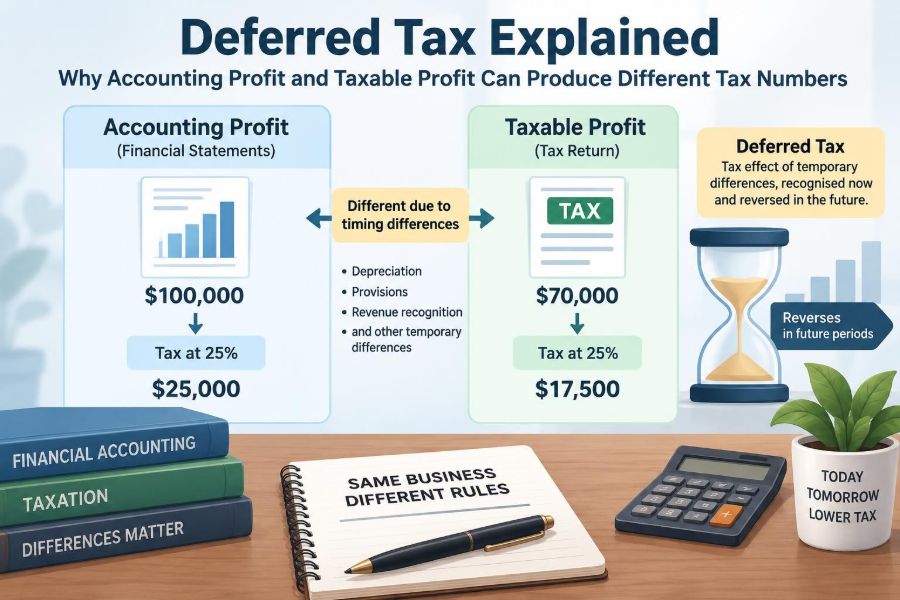

A company reports a healthy profit in its annual accounts, yet its tax return shows much less taxable income. Another business records a tax expense even though it has made a loss and paid little or no current tax. At first glance, both situations can look like mistakes.
Usually, they are not. Financial accounting and tax law answer different questions, on different timetables. Financial statements aim to portray economic performance and financial position; tax rules determine the amount owed to a government under legislation.
That gap creates one of the more confusing areas of accounting: deferred tax. It explains tax consequences that belong to the current accounting period economically, but will be paid or recovered in a different period.
For students, deferred tax connects the income statement, balance sheet, and tax return. For working professionals, it is also a practical issue in reporting, forecasting cash tax, acquisitions, audits, and explaining an effective tax rate that does not match the headline rate.
🧭 Start with two different measures of profit
Accounting profit, often called profit before tax, is calculated under a financial reporting framework such as IFRS or US GAAP. It applies concepts such as accrual accounting, matching, impairment, and fair presentation.
Taxable profit is calculated under the tax law of the relevant jurisdiction. Tax legislation may disallow some expenses, allow deductions at prescribed rates, or tax income only when a legal condition is met.
Both measures may begin with similar business transactions, but they do not have to produce the same result. Deferred tax exists because some differences reverse over time.
🧾 Current tax is the tax bill for this period
Current tax is the amount of income tax payable or recoverable for the current year based on taxable profit under the applicable tax rules. It is closely connected to the tax return, although final assessments and estimates can differ.
If a company has taxable profit of 100 and the applicable tax rate is 25%, a simplified current-tax calculation is 25. That is the tax attributable to the year under tax law, before considering payments, credits, interest, or penalties.
Current tax answers: “What tax is due for this period?” Deferred tax answers a different question: “What future tax effect arises from balances already reported?”
⏳ Deferred tax looks ahead from today’s balance sheet
Deferred tax is an accounting estimate of future tax consequences arising from existing assets, liabilities, and certain unused tax attributes. It is not normally a separate invoice from the tax authority.
A deferred tax liability generally represents tax expected to become payable in a future period when a temporary difference reverses. A deferred tax asset generally represents future tax relief, subject to rules about whether that relief is likely to be usable.
The calculation is balance-sheet based: compare an item’s carrying amount in the accounts with its tax base. This approach is central under IAS 12 and is also broadly reflected in US GAAP accounting for income taxes, though detailed rules and terminology differ.
🔍 Why financial reporting and tax law diverge
Financial reporting tries to recognize income and expenses in periods that reflect economic activity. Tax systems also raise revenue, but often pursue administrative simplicity, policy incentives, anti-avoidance objectives, or cash-collection timing.
For example, tax law may encourage investment by allowing accelerated deductions for qualifying equipment. Financial reporting may depreciate the same equipment evenly over its useful life. Neither treatment is automatically “wrong”; they serve different purposes.
The key question is whether the difference is permanent or whether it will unwind later. Only the latter normally produces deferred tax.
🔄 Temporary differences reverse; permanent differences do not
A temporary difference arises when an item is recognized differently for accounting and tax purposes now, but the difference will reverse in a future period. Different depreciation patterns are a familiar example.
A permanent difference affects accounting profit or taxable profit without reversing. Depending on local law, examples can include non-deductible fines, certain exempt income, or expenses that tax law permanently disallows.
Permanent differences affect the relationship between accounting profit and current tax, but they do not usually create deferred tax because there is no future taxable or deductible amount to track.
📐 The tax base is the bridge between books and tax
The carrying amount is the amount shown for an asset or liability in the statement of financial position. Its tax base is, broadly, the amount that will be deductible or taxable for tax purposes when the asset is recovered or the liability is settled.
For an asset, a simple practical question is: “When the company recovers this asset’s value, how much tax deduction remains?” For a liability: “When the company settles it, how much tax deduction remains?”
The answers can be counterintuitive, especially for revenue received in advance or expenses accrued in the accounts but deductible only when paid.
🧮 A simple asset example: different depreciation schedules
Assume a company buys equipment for 100. In its accounts, it depreciates the equipment evenly and reports a carrying amount of 80 at year-end. Tax rules allow faster deductions, leaving a tax base of 60.
The taxable temporary difference is 20: the accounting carrying amount exceeds the tax base. At a 25% enacted tax rate, the simplified deferred tax liability is 5.
The company has already received more tax deductions than accounting depreciation so far. In later periods, tax deductions will be lower than accounting depreciation, causing more taxable profit then. The liability represents that future tax consequence.
📉 A liability example: an accrued expense deductible on payment
Suppose a business recognizes a warranty expense of 40 because claims are expected from goods already sold. Financial reporting records the expense now, but tax law allows a deduction only when claims are paid.
The warranty provision is a liability with a carrying amount of 40. If settling it will produce a future tax deduction of 40, its tax base is commonly treated as nil in this simplified analysis.
The deductible temporary difference is 40. At a 25% rate, it could create a deferred tax asset of 10, provided the business expects to have sufficient taxable profit against which the future deduction can be used.
🏷️ Taxable and deductible differences move in opposite directions
A useful shortcut is to focus on the tax result when an item reverses. A taxable temporary difference creates future taxable amounts and usually leads to a deferred tax liability.
A deductible temporary difference creates future tax deductions and may lead to a deferred tax asset. “May” matters: recognizing an asset requires more than identifying a difference.
| Balance-sheet comparison | Likely future effect | Typical deferred-tax result |
|---|---|---|
| Asset carrying amount exceeds tax base | Future taxable income | Deferred tax liability |
| Asset carrying amount is below tax base | Future tax deduction | Deferred tax asset |
| Liability carrying amount exceeds tax base | Future tax deduction | Deferred tax asset |
| Liability carrying amount is below tax base | Future taxable income | Deferred tax liability |
This table is a strong starting point, not a substitute for checking the detailed rules and the facts of the transaction.
🧱 Depreciation is common, but it is not the whole story
Accelerated tax depreciation is often the first example taught because it is easy to visualize. Yet deferred tax can arise from many balances, including provisions, lease-related amounts, retirement obligations, share-based payments, inventory adjustments, and business combinations.
The source is not “depreciation.” The source is a difference between the financial statement carrying amount and the tax base that will have a future tax effect.
This broader view helps avoid a common reporting error: looking only at the income statement and overlooking differences embedded in the balance sheet.
📈 Fair value changes can create tax before cash arrives
Some accounting frameworks require or permit assets and liabilities to be measured at fair value. A gain might increase the carrying amount of an asset even though tax law does not tax the gain until sale.
For example, if an investment property is remeasured upward in the accounts but retains its historical tax base, the resulting taxable temporary difference can create a deferred tax liability. No current tax may be payable at the remeasurement date.
This is a useful reminder that deferred tax is about expected tax on recovery or settlement, not simply the immediate movement of cash.
🏢 Business combinations bring deferred tax into purchase accounting
When one company acquires another, identifiable assets and liabilities may be recognized at fair values for accounting purposes. Their tax bases may remain unchanged. That difference can generate significant deferred tax balances on the acquisition date.
For instance, an acquired customer relationship may have an accounting value but no corresponding tax deduction. The resulting deferred tax liability affects the accounting for goodwill in many cases.
Acquisition accounting is technical, and exceptions vary by reporting framework. The practical lesson is clear: tax due diligence must consider more than the target’s filed tax returns.
🧾 Tax losses can be valuable future deductions
A business with a tax loss may be unable to use the loss immediately, but tax law may permit it to offset future taxable profits, subject to conditions. The unused loss can be a potential source of a deferred tax asset.
However, a tax loss is not automatically an accounting asset. The business must assess whether it is probable or otherwise sufficiently supported under the applicable framework that future taxable profit will be available before the loss expires or becomes restricted.
A history of losses calls for particularly persuasive evidence, such as forecast taxable reversals, contracted income, or credible operational changes—not optimism alone.
🧠 Recognition of deferred tax assets requires evidence
Deferred tax liabilities are generally recognized for taxable temporary differences, subject to specified exceptions. Deferred tax assets are more cautious because their benefit depends on future taxable profit.
Evidence may include:
- taxable temporary differences that will reverse in the right period;
- realistic forecasts of taxable profit based on approved budgets;
- feasible tax-planning actions that are consistent with law and business intent; and
- the expiry dates, ownership restrictions, and utilization rules of losses and credits.
Forecasts should be challenged for consistency with other financial statement estimates. A deferred tax asset should not be supported by a growth assumption that management rejects elsewhere in the accounts.
🚫 Valuation allowances and recognition thresholds are not identical
Under US GAAP, deferred tax assets are recognized and then reduced by a valuation allowance when it is more likely than not that some portion will not be realized. Under IFRS, IAS 12 uses a recognition threshold based on probable future taxable profit rather than the same valuation-allowance presentation.
The economic question is similar: will the tax benefit actually be used? But the mechanics, disclosures, and language are not interchangeable.
When reading multinational accounts, identify the reporting framework before applying familiar terminology.
🧪 Measuring deferred tax uses the expected reversal rate
Deferred tax is usually measured using tax rates expected to apply when the temporary difference reverses, based on tax rates that have been enacted or substantively enacted by the reporting date, depending on the framework and jurisdiction.
It is not automatically measured at the current statutory rate if a known future rate change will apply at reversal. Nor is it normally discounted for the time value of money.
Measurement also depends on the expected manner of recovery. An asset recovered through use may have a different tax outcome from one recovered through sale, particularly where capital gains and ordinary income receive different treatment.
🗓️ Timing differences can reverse over many years
Not every temporary difference reverses next year. Property, equipment, long-term provisions, tax losses, and acquired intangibles can affect deferred tax for years or decades.
That long horizon creates estimation risk. Tax rates can change, profitability can shift, assets may be sold rather than used, and tax rules may limit deductions after restructurings.
For this reason, deferred tax schedules should identify both the origin of each difference and the likely timing of reversal. A single net figure without supporting detail is difficult to review or forecast.
📊 The effective tax rate tells a different story from cash tax
The effective tax rate is commonly calculated as total income tax expense divided by accounting profit before tax. Total income tax expense includes current tax and deferred tax, so it need not equal cash taxes paid.
Cash tax payments can also differ from current tax because of installments, refunds, audits, prior-year adjustments, and payment timing. Comparing all three measures—current tax, deferred tax, and cash tax—reveals more than any one number alone.
A low effective tax rate may reflect incentives, exempt income, losses, or rate changes. It cannot be interpreted reliably without the tax-rate reconciliation and supporting notes.
📝 The tax-rate reconciliation explains the gap
Financial statements commonly reconcile expected tax at a benchmark rate to reported income tax expense, subject to applicable reporting requirements. The reconciliation helps users understand why the effective tax rate differs from the statutory or domestic rate.
Typical reconciling items include permanent differences, different rates in foreign jurisdictions, changes in unrecognized tax benefits or deferred tax assets, tax incentives, and adjustments related to earlier periods.
Temporary differences may affect total tax expense in a particular year, but their longer-term effect often reverses. Permanent differences do not, which is why they deserve careful attention in rate analysis.
📚 Deferred tax appears in more than the income statement
Deferred tax follows the accounting location of the transaction that created it. If a pre-tax item is recognized in other comprehensive income or directly in equity, the related deferred tax is generally recognized there as well under the relevant framework.
For example, a revaluation or a cash-flow hedge reserve may generate related tax effects outside profit or loss. Recording all deferred-tax movements through tax expense can misstate both the income statement and equity movements.
This “follow the transaction” discipline is a frequent area of review in year-end close processes.
🔗 Netting deferred tax balances is restricted
A group may have several deferred tax assets and liabilities, but it cannot always present one net amount. Offsetting usually depends on legal rights and whether balances relate to the same taxation authority and appropriate taxable entities.
The details vary by framework, but the principle is practical: economic expectations of group-wide tax savings do not automatically create a legal right to offset taxes across separate entities or jurisdictions.
Careful entity-by-entity mapping prevents a net presentation from hiding exposure, restrictions, or unused tax attributes.
🌍 Cross-border operations add rate and currency complexity
Multinational groups may face different tax rates, loss-utilization rules, withholding taxes, currency effects, and rules on remitting profits. A deferred tax balance must reflect the tax law applicable to the entity and expected transaction, not simply the parent company’s headline rate.
Additional complexity can arise when outside basis differences exist in investments in subsidiaries, branches, associates, or joint arrangements. Whether a deferred tax liability is recognized can depend on control over reversal and expectations about distributions or disposals.
These judgments are often material and require coordination between consolidation teams, local tax advisers, and legal teams.
⚙️ A practical workflow for building the calculation
A robust deferred-tax process is usually more reliable than a clever last-minute calculation. Start with the balance sheet, then connect each item to tax evidence and future reversal assumptions.
- List relevant accounting assets, liabilities, losses, credits, and off-balance-sheet tax attributes.
- Determine the tax base of each item using applicable tax law.
- Calculate temporary differences and classify them as taxable or deductible.
- Apply the appropriate expected tax rate and recovery assumption.
- Assess recognition of deferred tax assets using documented evidence.
- Reconcile movements to profit or loss, other comprehensive income, equity, acquisitions, and foreign exchange where relevant.
A detailed schedule also creates an audit trail for future periods, when reversals and rate changes must be tracked.
🗂️ Documentation turns judgment into supportable reporting
The difficult part of deferred tax is often not multiplication; it is the evidence behind tax bases, rates, forecasts, and conclusions. Maintain schedules that link accounting balances to tax returns, fixed-asset registers, legal agreements, and loss carryforward records.
For deferred tax assets, retain the forecast and assumptions supporting recoverability. Explain why projected taxable income is achievable, how it aligns with budgets, and which tax attributes it uses.
Clear documentation also makes handovers easier. Deferred-tax balances can outlive the people who originally created them.
⚠️ Common mistakes that distort deferred tax
Several errors recur because the subject mixes accounting estimates with legal tax analysis:
- treating every book-tax difference as deferred tax, including permanent differences;
- using accounting depreciation instead of remaining tax deductions to determine tax base;
- recognizing tax-loss assets without credible evidence of utilization;
- using an outdated or inappropriate tax rate;
- forgetting tax effects in other comprehensive income, equity, or business combinations; and
- netting balances across entities without meeting offset criteria.
Each mistake can affect reported profit, equity, disclosures, and the credibility of forecasts built from those statements.
🧩 A compact end-to-end example
Consider a hypothetical company with profit before tax of 200. Its current-year tax depreciation exceeds book depreciation by 30, and it records a warranty provision of 20 that is deductible only when paid. Assume a 25% tax rate and no permanent differences.
Taxable profit is 170: accounting profit of 200, less the extra current tax depreciation of 30. Current tax is therefore 42.5. The depreciation difference creates a deferred tax liability of 7.5, while the warranty provision creates a deferred tax asset of 5, assuming recoverability.
Total tax expense is 45: current tax of 42.5 plus a net deferred tax expense of 2.5. The example shows why tax expense can differ from both taxable profit multiplied by the rate and the cash ultimately paid.
🔮 What deferred tax can and cannot tell an analyst
Deferred tax balances can signal accelerated deductions, accumulated losses, fair-value adjustments, acquisition accounting, or provisions that have not yet received tax relief. Their movement can help explain changes in earnings and expected future tax payments.
But deferred tax is not a precise forecast of a company’s future cash tax bill. It depends on future profits, tax rates, transaction structures, recovery methods, and legal rules that may change.
Analysts should read deferred tax alongside capital expenditure plans, loss-expiry disclosures, tax-rate reconciliations, and management’s discussion of tax risks.
🧑💼 Questions professionals should ask at close
A focused review can reveal issues before financial statements are finalized:
- Have all material balance-sheet differences been identified, not only fixed assets?
- Do tax bases agree to current tax computations and supporting records?
- Have enacted or substantively enacted rate changes been reflected?
- Are deferred tax assets supported by usable taxable profit in the correct entity and period?
- Does the movement reconcile to the income statement, other comprehensive income, equity, and acquisitions?
- Are disclosures understandable enough to explain significant judgments and rate movements?
These questions are equally useful for preparers, reviewers, and students checking whether a textbook calculation reflects real reporting practice.
🎯 The core principle: match future tax effects to today’s balances
Deferred tax does not mean a company is avoiding tax, nor does it mean it will necessarily pay the exact recorded amount on a specified future date. It is an accounting mechanism for recognizing the tax consequences of differences that already exist at the reporting date.
The discipline is simple in principle: identify the carrying amount, determine the tax base, understand the reversal, apply the appropriate rate, and test whether future tax benefits are supportable. The application becomes complex because tax law, forecasts, entities, and transactions are rarely simple.
Once that distinction is clear, the apparent contradiction disappears: accounting profit and taxable profit can differ today while financial reporting still captures the related future tax effect.
Deferred tax is best understood as the bridge between the tax timing in the accounts and the tax timing required by law. That bridge helps financial statements tell a more complete story about performance, obligations, and future tax consequences. 💰📊🧭