
A company can report rising profits, open new locations, and celebrate a record year—yet still leave its owners economically worse off. That sounds contradictory until we ask a question that ordinary profit measures do not fully answer: did the business earn more than the cost of all the money tied up in it?
Consider a manager choosing between two projects. One produces a healthy accounting profit, while the other produces a smaller profit but requires far less investment. The first may look more impressive on an income statement. The second may create more wealth once the cost of financing machinery, inventory, buildings, and working capital is considered.
This is the problem Economic Value Added, or EVA, is designed to address. It reframes performance around an economic reality: capital is not free, even when it comes from shareholders rather than lenders.
For students, EVA connects finance concepts such as cost of capital and invested capital to managerial decisions. For working professionals, it offers a disciplined way to evaluate growth, operating performance, and incentives without confusing size with value creation.
💡 What Economic Value Added Measures
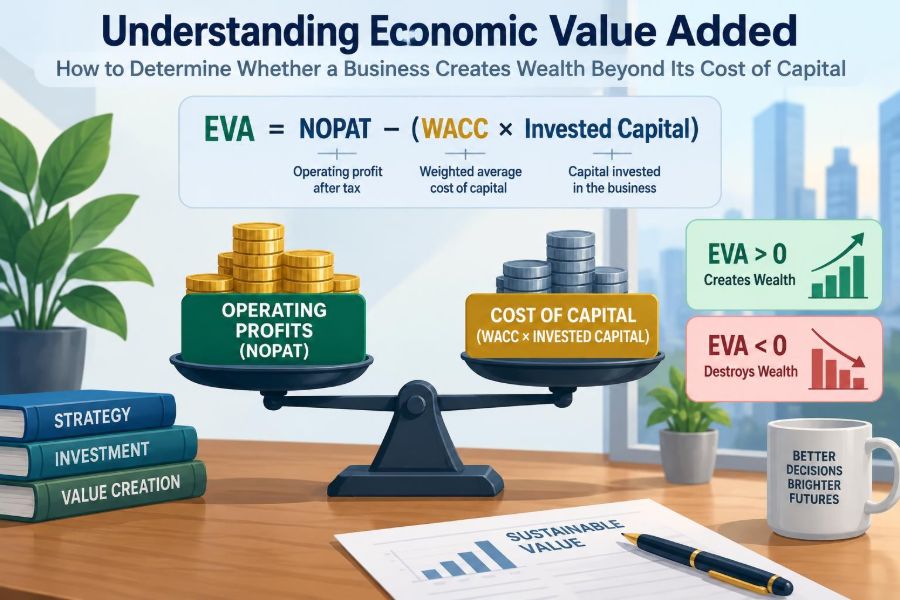
Economic Value Added (EVA) measures the wealth a business creates after covering its operating costs, taxes, and the full cost of capital employed in operations. A positive EVA means operating returns exceeded investors’ required return. A negative EVA means the business earned less than its capital cost, even if it reported net income.
EVA is sometimes described as economic profit. The term distinguishes it from accounting profit, which recognizes interest expense but generally does not charge a business for the equity capital supplied by owners.
🎯 Why Accounting Profit Is Not the Whole Story
Net income answers whether revenues exceeded recognized expenses under accounting rules. It does not directly answer whether a company generated an adequate return on the funds entrusted to it.
Suppose a business earns $12 million after tax using $150 million of capital. If investors require a 10% return, the annual capital charge is $15 million. The business is profitable in an accounting sense, but it has an EVA of negative $3 million.
This does not mean the company is worthless or failing in every respect. It means that, for that period and under those assumptions, its operating assets did not earn the return required to compensate providers of capital for risk and opportunity cost.
🧮 The Core EVA Formula
The standard calculation is straightforward:
EVA = NOPAT − (Invested Capital × WACC)In this formula, NOPAT is net operating profit after tax, invested capital is the operating capital used by the business, and WACC is the weighted average cost of capital. The term in parentheses is called the capital charge.
The formula is simple; the judgment lies in defining its inputs consistently. A careful EVA calculation uses operating profit and operating assets, rather than mixing operating measures with financing measures.
🏭 Understanding NOPAT
NOPAT stands for net operating profit after tax. It estimates the after-tax profit generated by core operations before the effects of financing choices.
A common starting point is earnings before interest and taxes, or EBIT. Applying an appropriate tax rate produces a basic version of NOPAT:
NOPAT = EBIT × (1 − tax rate)Because interest is excluded, NOPAT lets analysts compare businesses with different debt levels more fairly. Two otherwise similar companies should not appear to have fundamentally different operating performance merely because one uses more borrowing.
🧾 Why Interest Expense Is Excluded
Interest is a financing cost, not an operating cost. EVA recognizes the cost of debt and equity together through WACC, so deducting interest in NOPAT and then charging WACC would count debt financing twice.
This separation is useful when a manager controls pricing, production, inventory, and capital spending but does not control the company’s overall financing structure. EVA first asks what the operations earned; the capital charge then asks whether that return was sufficient.
📦 Defining Invested Capital
Invested capital is the money committed to operating assets. It can be viewed from the asset side as operating assets minus operating liabilities, or from the financing side as interest-bearing debt plus equity, adjusted for non-operating items.
Typical operating investments include property, equipment, inventory, receivables, software used in operations, and other assets required to generate revenue. Accounts payable and accrued operating expenses often reduce the funding needed from investors because suppliers and employees provide short-term operating financing.
🔍 Operating Assets Versus Non-Operating Assets
Not every balance-sheet item should be included automatically. Cash needed for payroll, transactions, or operating resilience may be operating cash. Excess cash held without an operating purpose is often treated as non-operating.
Similarly, an investment portfolio unrelated to the company’s core business should usually be separated from operating capital and evaluated independently. The objective is to match the profit measure to the assets genuinely used to produce it.
🏦 What WACC Represents
Weighted average cost of capital (WACC) is the blended required return demanded by debt holders and equity investors. It reflects the risk of the business’s operating assets and the mix of financing used to support them.
Debt is generally less risky than equity because lenders have contractual claims and priority in liquidation. Equity investors bear more uncertainty, so their required return is generally higher. WACC weights these required returns according to the firm’s capital structure and considers the tax deductibility of interest where applicable.
⚖️ The Capital Charge in Plain Language
The capital charge is the annual economic rent paid for using investors’ funds. If a company employs $80 million of capital and its WACC is 9%, it must generate $7.2 million of after-tax operating profit just to meet the required return.
Any NOPAT above that threshold creates positive EVA. Any NOPAT below it destroys value relative to that required return. This is why a capital-intensive company can show large profits while still producing weak economic performance.
📊 A Complete Hypothetical EVA Calculation
Assume a manufacturer reports EBIT of $30 million. Its effective operating tax rate is 25%, invested capital is $200 million, and its WACC is 11%.
| Step | Calculation | Result |
|---|---|---|
| NOPAT | $30 million × (1 − 0.25) | $22.5 million |
| Capital charge | $200 million × 0.11 | $22 million |
| EVA | $22.5 million − $22 million | $0.5 million |
The manufacturer created $0.5 million of economic value under these assumptions. The positive result is modest, but it tells a different story from looking at EBIT alone: nearly all operating profit was needed to satisfy the cost of the capital base.
📈 Positive, Zero, and Negative EVA
Positive EVA indicates that operations earned more than the required return on invested capital. Zero EVA means the business earned exactly its cost of capital. Negative EVA indicates an economic shortfall.
- Positive EVA: value creation during the period.
- Zero EVA: capital providers received their required return, but no excess economic profit was generated.
- Negative EVA: operations did not cover the full opportunity cost of capital.
One period of negative EVA is not automatically alarming. A new facility, product launch, or turnaround may require investment before returns appear. The pattern over time and the credibility of future returns matter.
🔗 EVA and Return on Invested Capital
EVA is closely related to return on invested capital (ROIC). ROIC measures the percentage return earned on invested capital:
ROIC = NOPAT ÷ Invested CapitalThe relationship can be expressed as:
EVA = Invested Capital × (ROIC − WACC)This version makes the central test visible. Value is created when ROIC exceeds WACC. EVA then converts that spread into a currency amount, showing how much value was created or lost in dollars, euros, or another reporting currency.
🪜 Why the ROIC–WACC Spread Matters
A 3% return spread means very different things at different scales. A business earning ROIC of 12% against a 9% WACC creates a 3% spread. On $20 million of capital, that produces $0.6 million of EVA; on $2 billion, it produces $60 million.
Managers need both perspectives. The spread indicates capital efficiency, while EVA indicates the total value effect. A large company can create substantial EVA with a moderate spread, and a small unit can post an excellent spread while contributing little absolute value.
🌱 Growth Creates Value Only Under Conditions
Revenue growth is often celebrated automatically, but growth consumes capital. New stores need fixtures and inventory, subscription businesses may spend heavily to acquire customers, and manufacturers may require plants and working capital.
Growth creates value when new investments are expected to earn returns above their cost of capital. Growth below that threshold can make a company larger while reducing its overall economic value. This is one of EVA’s most useful disciplines: it asks not merely whether a project grows, but whether it clears the required return.
🏗️ Capital Intensity Changes the Interpretation
Companies in asset-heavy sectors often need substantial investment before producing sales. Utilities, transportation businesses, manufacturers, and retailers with large store networks can therefore face high capital charges.
Asset-light businesses may require less physical capital but can still consume significant economic resources through receivables, capitalized development spending, acquired intangible assets, or customer-acquisition investment. EVA should reflect the economic capital actually required, not simply the visibility of tangible assets.
🧠 Accounting Adjustments and Economic Reality
Some EVA frameworks make detailed adjustments to accounting statements to better approximate economic profit. Examples may include treating certain long-term investments differently from immediate expenses, adjusting for acquired goodwill, or normalizing unusual charges.
These adjustments can improve comparability when they are well reasoned and applied consistently. They can also introduce discretion. For most classroom analyses and internal management use, a transparent, limited set of material adjustments is usually more useful than a highly elaborate model nobody can audit or understand.
🧪 Research and Development: A Common Judgment Area
Research and development is often expensed immediately under accounting rules, even though successful development may produce benefits over several years. An EVA analyst may argue that a portion of R&D should be treated as an investment and amortized over an estimated useful life.
That approach can better match costs with future benefits, but estimates of useful life and commercial success are uncertain. There is no universally correct adjustment for every company. The key is to explain the policy, use it consistently, and avoid adjusting merely to improve a preferred result.
🧹 Removing One-Off Items Carefully
Restructuring charges, asset-sale gains, litigation settlements, and impairment losses can distort a single year’s operating profit. Excluding unusual items may help reveal recurring performance, especially when evaluating management decisions.
However, “one-off” should not become a label for every inconvenient cost. If a company repeatedly restructures, writes off failed projects, or records supposedly exceptional charges, those events may be part of the economic reality of the business.
🕰️ Why EVA Should Be Tracked Over Time
A one-year EVA result is a snapshot, not a complete verdict. Investment-heavy strategies may show negative EVA initially and positive EVA later if projects ramp up as planned.
Trend analysis helps separate a temporary investment phase from persistent underperformance. Useful questions include whether EVA is improving, whether invested capital is rising faster than NOPAT, and whether the ROIC–WACC spread is widening or narrowing.
🧭 Using EVA to Evaluate Business Units
EVA can be applied to divisions, stores, product lines, and projects when their revenues, costs, and capital can be reasonably assigned. This makes it more informative than sales or profit alone for managers deciding where to expand, fix operations, or redeploy capital.
Allocation must be handled carefully. Corporate technology, shared facilities, and central functions may support several units. Arbitrary allocations can make a strong unit look weak or vice versa, so internal reports should distinguish controllable unit performance from centrally determined charges where possible.
🚦 EVA in Capital Budgeting Decisions
For an individual project, EVA can be estimated year by year. A proposed warehouse might require a large initial investment, generate operating profit over time, and release working capital at the end of its life.
Decision makers should examine whether forecast operating returns exceed the capital charge in each phase and whether the present value of expected future EVA is positive. This naturally aligns EVA with net present value, or NPV: both seek to identify investments expected to add value after considering required returns.
🔄 The Relationship Between EVA and NPV
NPV discounts a project’s expected future cash flows at an appropriate required return. EVA starts with periodic operating profit and deducts a capital charge. When calculated consistently, the present value of future EVA should reconcile with the project’s NPV.
The measures serve different practical purposes. NPV is especially effective before committing capital because it focuses on forecast cash flows. EVA is valuable after investment because it creates an ongoing operating scorecard for whether the committed capital is producing adequate returns.
👥 Incentives Can Improve—or Distort—Decisions
Linking compensation to EVA can encourage managers to consider capital discipline rather than pursuing revenue, profit, or budget targets in isolation. A manager may become more willing to reduce slow-moving inventory, sell underused equipment, or reject a low-return expansion.
But any performance measure can be gamed. Short-term EVA targets may encourage managers to defer maintenance, cut valuable training, avoid promising long-term projects, or reduce investment simply to shrink the capital charge. Incentive plans need multi-year horizons, quality controls, and thoughtful oversight.
✂️ Improving EVA Through Better Operations
There are only a few fundamental ways to improve EVA: increase NOPAT, use less capital to produce the same NOPAT, reduce the cost of capital without taking inappropriate risk, or invest additional capital only where returns exceed WACC.
- Improve pricing, product mix, productivity, or cost control to raise operating profit.
- Reduce excess inventory, shorten collection periods, and dispose of idle assets to release capital.
- Repair, redesign, or exit activities that persistently earn below the required return.
- Protect high-return investments instead of cutting all spending indiscriminately.
The last point matters. “Reduce capital” is not always the answer. Selling productive assets or underinvesting in capacity can damage future NOPAT and reduce long-term value.
🧾 Working Capital Is a Hidden EVA Lever
Inventory, receivables, and payables may seem like routine balance-sheet accounts, but they directly affect invested capital. A company that carries avoidable inventory needs more funding and therefore faces a larger capital charge.
Improving working-capital efficiency can raise EVA even when revenue and EBIT remain unchanged. For example, reducing obsolete stock frees capital; if service levels and margins are preserved, the lower capital base improves economic value.
🛠️ Fixed Assets Require More Than Utilization Ratios
Higher asset utilization can improve EVA by generating more NOPAT from the same asset base. Yet utilization should not be pursued blindly. Running equipment beyond reliable capacity can raise downtime, safety risk, quality failures, and future maintenance costs.
Good EVA management asks whether an asset earns more than its capital charge over its useful life. It does not simply demand that every asset be used as intensely as possible in the current quarter.
⚠️ Common Errors in EVA Calculations
Many mistakes come from inconsistent definitions rather than difficult mathematics. A useful calculation should be reconciled to financial statements and documented clearly.
- Using net income while also subtracting a WACC-based capital charge, which can double-count financing costs.
- Including non-operating cash or investments in capital without including related income in NOPAT.
- Applying a WACC that does not reflect the risk of the business unit or project being evaluated.
- Mixing beginning, ending, and average capital balances without a stated policy.
- Making numerous subjective adjustments without explaining their rationale or materiality.
🧱 Limits of EVA as a Performance Measure
EVA depends on estimates, especially WACC, tax assumptions, asset values, and accounting adjustments. Small changes in these inputs can affect the reported result, particularly for businesses close to the break-even threshold.
It also cannot capture every strategic consideration. Customer trust, employee capability, regulatory resilience, innovation pipelines, and environmental obligations may not appear fully in a current-period EVA number. They can nonetheless shape future value creation and risk.
🧰 EVA Works Best With Complementary Metrics
A balanced performance system pairs EVA with measures that explain its drivers and protect long-term health. Examples include customer retention, product quality, safety, delivery reliability, innovation milestones, cash conversion, and employee turnover where relevant.
The point is not to dilute accountability with dozens of dashboards. It is to avoid treating an economic-profit measure as the sole description of a business. EVA tells managers whether value was created after a capital charge; supporting metrics help explain why and what actions are sustainable.
🗂️ A Practical Workflow for Building an EVA Analysis
Start with a simple, reproducible model before attempting sophisticated adjustments. The following sequence works for many internal analyses:
- Identify operating profit and calculate a clearly defined NOPAT.
- Determine operating invested capital and separate material non-operating assets.
- Select a WACC appropriate to the business or project risk.
- Calculate the capital charge and subtract it from NOPAT.
- Compare EVA with prior periods, plans, peers where appropriate, and the ROIC–WACC spread.
- Investigate operational drivers rather than stopping at the final number.
Document each assumption. An EVA model is most valuable when another analyst can understand how it was constructed and challenge its conclusions constructively.
📚 A Simple Interpretation Checklist
Before acting on an EVA result, ask a few diagnostic questions. Is NOPAT recurring, or is it affected by unusual gains and losses? Has invested capital been measured consistently? Does the WACC fit the risk being evaluated? Is negative EVA a temporary ramp-up effect or evidence of a structurally weak return?
Also ask what management can actually control. A unit manager may be able to improve inventory turns but not alter corporate tax policy or capital structure. Fair evaluation separates controllable operating choices from broader assumptions.
🌟 The Core Principle of Economic Value Added
EVA turns an abstract finance principle into a practical management question: after paying everyone who supplied capital the return they require, is there anything left? It focuses attention on the relationship between operating profit, the capital needed to generate it, and the risk of that capital.
A business does not create wealth merely by reporting positive earnings or expanding its footprint. It creates wealth when its operations produce returns above the cost of the resources committed to them. That principle can guide project selection, performance review, and capital allocation without replacing informed managerial judgment.
Economic Value Added reminds us that real value creation begins only after a business earns more than its full cost of capital. Used with sound assumptions and complementary measures, it helps turn financial performance from a headline number into a clearer decision-making tool. 💰📈🧭