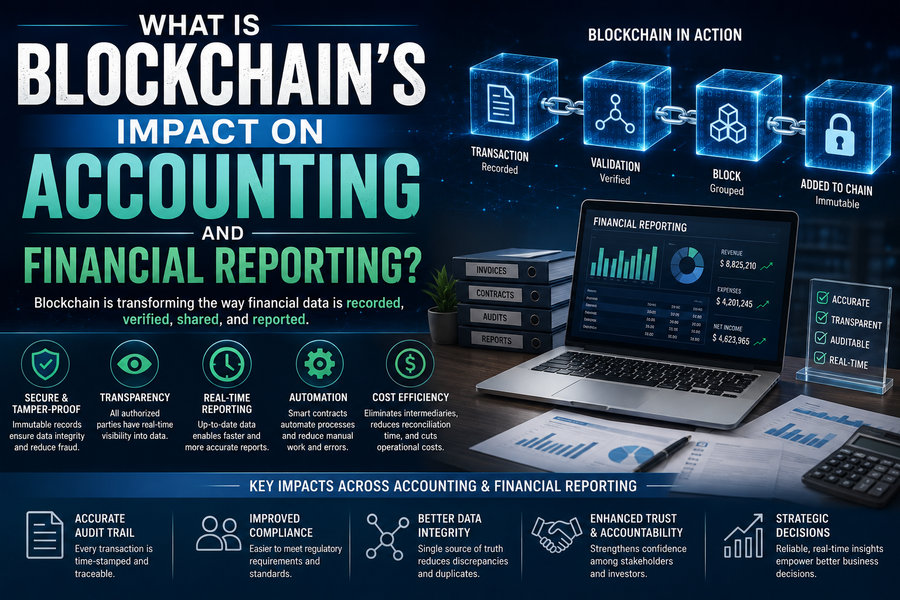

Blockchain technology is best known for powering cryptocurrencies such as Bitcoin and Ethereum, but its potential extends far beyond digital currencies. One of the industries where blockchain could have a particularly significant influence is accounting and financial reporting. 📚💻
Accounting depends heavily on trustworthy records. Businesses record transactions, reconcile accounts, prepare financial statements, maintain audit trails, and provide evidence that their reported numbers are accurate. Traditionally, this information is stored in databases controlled by individual organizations.
Blockchain introduces a different approach: a shared, cryptographically secured ledger in which authorized participants can record and verify transactions.
This could reduce reconciliation work, improve auditability, increase transparency, and change how financial information is reported. At the same time, blockchain introduces new challenges involving privacy, regulation, governance, valuation, cybersecurity, and accounting standards.
Blockchain is therefore unlikely to eliminate accountants. Instead, it could change what accountants spend their time doing. 🔍📈
⛓️ What Is Blockchain?
A blockchain is a type of distributed ledger technology, often abbreviated as DLT.
Instead of keeping a database on only one organization’s computer system, copies of the ledger may be maintained across multiple participating systems.
Transactions are grouped or otherwise recorded using cryptographic techniques, and the network follows rules for validating and updating the ledger.
Depending on the blockchain, participants may include:
- Businesses
- Banks
- Suppliers
- Customers
- Auditors
- Regulators
- Financial institutions
Once information has been confirmed and recorded, altering historical records can be difficult because changes would conflict with the cryptographically linked data and network rules.
This creates a record that can be highly resistant to unauthorized modification.
However, blockchain should not automatically be described as completely “immutable.” Governance mechanisms, software changes, permission structures, or extraordinary network events can sometimes affect recorded information.
A better description is that well-designed blockchains can provide strong tamper resistance and traceability. 🔐
📚 How Traditional Accounting Works
Modern accounting systems generally use double-entry bookkeeping.
Every financial transaction affects at least two accounts.
For example, if a company buys equipment for cash:
Equipment increases
Cash decreases
This creates an internal accounting record.
However, another organization involved in the transaction maintains its own separate records.
For example:
Company A records money paid to Company B.
Company B separately records money received from Company A.
The two organizations then need to ensure that their records agree.
This process creates extensive reconciliation work.
Banks, suppliers, customers, auditors, and financial institutions may all hold separate versions of related transactions.
Blockchain could provide a shared source of transaction evidence.
🔺 The Idea of Triple-Entry Accounting
Blockchain is sometimes associated with the concept of triple-entry accounting.
Traditional double-entry bookkeeping does not disappear.
Instead, the idea is that two counterparties maintain their own accounting entries while also sharing a cryptographically verified transaction record on a distributed ledger.
Think of it as:
Company A’s record + Company B’s record + shared verified record
The third element does not literally replace the two accounting entries.
Instead, it provides external digital evidence that both organizations can reference.
This could significantly improve verification and reconciliation.
However, the term “triple-entry accounting” is used somewhat differently by different researchers and technology providers, so it should not be interpreted as a universally standardized accounting method.
🔄 1. Blockchain Could Reduce Reconciliation Work
Reconciliation is one of the most time-consuming activities in accounting.
Imagine a retailer purchasing inventory from a supplier.
The retailer records:
📦 Inventory received
💸 Amount owed
The supplier records:
📤 Goods shipped
💰 Amount receivable
Their banks maintain separate payment records.
If information differs, accountants must investigate.
Problems can result from:
- Timing differences
- Data-entry mistakes
- Duplicate transactions
- Incorrect invoices
- Currency conversions
- Banking delays
If authorized organizations share transaction information through a blockchain system, they may be able to reference the same verified data.
This could reduce the number of discrepancies requiring manual investigation.
For large organizations processing millions of transactions, the savings could be substantial. ⚡
🔍 2. Auditing Could Become More Continuous
Traditional financial audits often examine historical transactions.
Auditors obtain documents such as:
- Invoices
- Bank statements
- Contracts
- Purchase orders
- Receipts
- Inventory records
They then test samples to determine whether financial statements are fairly presented.
Blockchain could change this process.
If transactions are recorded on a reliable shared ledger, auditors may gain access to transaction evidence much closer to real time.
Instead of performing only periodic reviews, certain audit procedures could become increasingly continuous and automated.
Software might monitor blockchain transactions and automatically flag unusual activity.
For example:
🚨 Unusually large payment
🚨 Transaction outside approved limits
🚨 Unexpected supplier address
🚨 Duplicate transaction pattern
This could shift auditing from historical sampling toward ongoing risk monitoring.
📊 3. Financial Reporting Could Become Faster
Public companies traditionally report financial results quarterly and annually.
Preparing financial statements requires collecting data from many systems, subsidiaries, departments, and locations.
This process can take time.
If financial transactions are standardized and recorded using interconnected blockchain systems, some financial information could potentially become available much more quickly.
In theory, businesses could move toward more real-time financial reporting.
Executives might see updated revenue, expenses, inventory movements, and liabilities continuously.
Investors and regulators could also receive selected information more rapidly.
However, reporting speed alone does not guarantee accounting quality.
Many financial statement items require judgment rather than simple transaction recording.
Examples include:
- Asset impairment
- Expected credit losses
- Depreciation estimates
- Warranty obligations
- Fair-value measurements
Blockchain cannot automatically eliminate these accounting judgments.
🧾 4. Blockchain Can Strengthen Audit Trails
A strong audit trail helps accountants understand:
Who recorded a transaction?
When was it recorded?
What changed?
Which parties verified it?
Blockchain can provide detailed chronological transaction histories.
Cryptographic signatures may identify which authorized participant submitted or approved a transaction.
Because historical data is difficult to alter silently, unauthorized modifications may become easier to detect.
This could help auditors investigate:
🔎 Fraud
🔎 Accounting errors
🔎 Unauthorized payments
🔎 Suspicious transaction patterns
However, blockchain protects the integrity of recorded data—it does not guarantee that the original data was truthful.
This leads to an important principle:
Garbage in, garbage out. 🗑️➡️⛓️
If false information is entered into a blockchain and properly validated according to flawed rules, the blockchain may preserve the false information very effectively.
🤖 5. Smart Contracts Could Automate Accounting Processes
A smart contract is software stored or executed within a blockchain environment that automatically performs predefined actions when certain conditions are met.
Suppose a company has an agreement:
Pay a supplier automatically when shipment confirmation is received.
A smart contract could potentially detect the required condition and trigger payment automatically.
Accounting entries might also be generated automatically.
Smart contracts could be used for:
- Invoice settlement
- Royalty payments
- Insurance claims
- Interest calculations
- Escrow arrangements
- Lease payments
- Supply-chain transactions
This can reduce manual processing and administrative delays.
However, smart contracts also introduce risk.
A programming error can cause incorrect transactions.
Therefore, businesses need strong procedures for:
🧑💻 Code review
🔐 Access control
📋 Contract governance
🧪 Testing
⚖️ Legal compliance
💰 6. Blockchain Changes How Assets Can Be Represented
Blockchain allows physical and financial assets to be represented digitally through tokens.
Tokenized assets could potentially represent:
🏢 Real estate
📈 Securities
🎨 Intellectual property
🥇 Commodities
📦 Inventory
💵 Financial claims
Tokenization could make ownership transfers easier to track.
For accountants, however, tokenized assets create important questions.
How should the asset be classified?
How should it be valued?
When should revenue be recognized?
Who legally owns the underlying asset?
Accounting treatment depends on the legal rights attached to the token, not merely on the fact that blockchain technology is being used.
🪙 7. Cryptocurrency Creates New Accounting Challenges
Cryptocurrencies are among the most visible blockchain-based assets.
Companies holding crypto assets may face complicated accounting issues involving:
- Recognition
- Classification
- Valuation
- Impairment
- Fair value
- Gains and losses
- Tax reporting
Digital assets can experience extreme price volatility. 📉📈
A cryptocurrency worth $100,000 today could potentially have a very different market value weeks later.
Accounting standards have been evolving to address these issues, and treatment can differ depending on jurisdiction, asset characteristics, and applicable accounting framework.
Accountants therefore need specialized knowledge when organizations hold significant digital assets.
🔐 8. Blockchain Could Help Reduce Certain Types of Fraud
Blockchain can make some fraudulent activities more difficult.
For example, a shared transaction ledger could help detect:
- Duplicate invoices
- Unauthorized changes
- Fake transaction histories
- Altered payment records
Cryptographic verification makes it more difficult to modify records without leaving evidence.
However, blockchain does not eliminate fraud.
Fraudsters may instead target:
🔑 Private keys
💻 Smart contracts
🌐 Exchanges
🧑💼 Human users
📱 Digital wallets
If an attacker steals the credentials controlling blockchain assets, legitimate-looking transactions may still be authorized.
Cybersecurity therefore becomes deeply connected with accounting controls.
🏢 9. Internal Controls Will Need to Change
Traditional accounting controls include:
- Password restrictions
- Approval limits
- Bank reconciliations
- Segregation of duties
- Transaction review
Blockchain systems require additional controls.
Organizations may need procedures governing:
🔑 Private-key storage
👥 Multi-signature approvals
📜 Smart-contract updates
🌐 Network permissions
🧩 Digital identity management
For example, if one employee controls the private key to a company cryptocurrency wallet, that employee may effectively control the assets.
A stronger system could require multiple authorized individuals to approve transactions.
This is similar to requiring two signatures on a traditional payment.
🕵️ 10. Privacy Is a Major Concern
Financial information is highly sensitive.
Businesses generally do not want competitors to see:
- Supplier prices
- Payroll information
- Customer transactions
- Profit margins
- Strategic purchases
Public blockchains can make transaction activity visible to many participants.
Therefore, many business applications are likely to use permissioned blockchain networks.
In a permissioned blockchain, access is restricted to authorized participants.
Different users may receive different levels of visibility.
For example:
🏢 Company — Full transaction access
🔍 Auditor — Audit-related access
🏦 Bank — Payment information
⚖️ Regulator — Compliance data
Designing the correct balance between transparency and confidentiality is one of blockchain accounting’s biggest challenges.
⚖️ 11. Regulation and Accounting Standards Must Keep Evolving
Financial reporting depends on established rules.
These include frameworks such as:
📘 IFRS
📗 US GAAP
🏛️ National accounting regulations
Blockchain technology develops much faster than accounting standards traditionally change.
New types of tokens, decentralized finance platforms, smart contracts, and digital assets can create accounting questions that existing standards were not originally designed to answer.
Regulators must consider issues including:
- Asset classification
- Revenue recognition
- Custody
- Ownership
- Taxation
- Disclosure requirements
This creates uncertainty for businesses adopting new blockchain-based financial systems.
👨💼 12. Will Blockchain Replace Accountants?
Probably not.
Blockchain can automate recordkeeping, reconciliation, and transaction verification.
But accounting involves much more than recording transactions.
Professional accountants also perform:
🧠 Financial analysis
⚖️ Accounting judgment
📊 Forecasting
🔍 Internal controls
🧾 Tax planning
🏢 Business advisory
📈 Risk assessment
Automation may reduce the amount of routine data-entry work accountants perform.
At the same time, demand may increase for professionals who understand both finance and technology.
Future accountants may need knowledge of:
- Blockchain architecture
- Digital assets
- Cybersecurity
- Data analytics
- Smart contracts
- Information systems
The profession may therefore become more analytical and technology-oriented.
🧑💻 13. Auditors May Need to Understand Code
If a company’s financial processes depend on smart contracts, auditors may need to understand how those contracts work.
Auditing could increasingly involve examining:
💻 Program logic
🔐 Access permissions
📡 Blockchain nodes
🧠 Automated controls
This means audit teams may include specialists such as:
- Accountants
- Software engineers
- Cybersecurity professionals
- Data scientists
Auditing may become increasingly multidisciplinary.
🌍 14. Blockchain Could Improve Supply-Chain Accounting
Imagine a product moving through several businesses:
Manufacturer → Shipping company → Distributor → Retailer → Customer
Each organization maintains its own records.
Blockchain could create a shared history of the product’s movement.
This information might record:
📦 Production
🚢 Shipment
🏭 Warehouse arrival
🏪 Retail delivery
💳 Payment
Accountants could use this information to verify inventory ownership and transaction timing.
This could improve accounting for industries with complicated international supply chains.
🌱 15. ESG and Sustainability Reporting
Companies increasingly report environmental, social, and governance information.
Blockchain could potentially help track certain underlying data.
For example, a supply-chain blockchain might record:
🌍 Material origin
♻️ Recycling information
⚡ Energy usage
🚢 Transportation records
This could make sustainability claims easier to verify in some circumstances.
However, reliable reporting still depends on accurate measurements.
A blockchain cannot independently determine whether environmental data entered by a company is truthful.
External verification remains important.
⚠️ Major Challenges of Blockchain Accounting
Despite its potential, blockchain adoption faces several obstacles.
These include:
💰 Implementation Cost
Replacing existing accounting systems can be expensive.
🔗 Integration
Blockchain platforms must communicate with existing ERP, banking, payroll, and tax systems.
📜 Regulation
Digital asset rules are still evolving.
🔐 Security
Private keys and smart contracts introduce new cybersecurity risks.
🕵️ Privacy
Businesses must protect confidential financial information.
📈 Scalability
Some blockchain networks may struggle with extremely high transaction volumes.
⚡ Energy Consumption
Certain blockchain consensus systems can consume substantial energy, although many newer systems use much more energy-efficient approaches.
🔮 The Future of Blockchain in Accounting
Blockchain is unlikely to replace traditional accounting systems overnight.
A more realistic future is gradual integration.
Businesses may use blockchain for specific applications such as:
- Supply-chain transactions
- Intercompany settlements
- Digital assets
- Automated payments
- Identity verification
- Audit evidence
Accounting software could connect with blockchain networks while still maintaining traditional financial databases.
Over time, automation may allow accountants and auditors to spend less time collecting evidence and more time analyzing risk and interpreting financial information. 📊🤖
🏁 Final Thoughts
Blockchain has the potential to significantly reshape accounting and financial reporting by creating shared, cryptographically verifiable transaction records.
Its greatest advantages could include:
✅ Reduced reconciliation
✅ Stronger audit trails
✅ Faster reporting
✅ Automated transactions
✅ Improved transparency
✅ Continuous auditing
However, blockchain also creates major challenges involving privacy, cybersecurity, smart-contract errors, regulations, digital asset valuation, and accounting standards.
Perhaps the most important misconception is that blockchain can automatically guarantee the truth of financial information.
It cannot.
Blockchain can help prove that a particular record has not been secretly altered, but accountants must still determine whether the underlying transaction is legitimate, correctly measured, and properly reported.
Rather than eliminating the accounting profession, blockchain is more likely to transform it.
The accountant of the future may spend less time matching invoices and more time interpreting data, reviewing automated systems, evaluating controls, and advising organizations on increasingly digital financial environments. ⛓️📊🧠