
A manufacturing company may produce thousands of products every day, yet one deceptively simple question can be surprisingly difficult to answer:
How much does each product actually cost to make? 🏭📊
At first, the answer might seem obvious. Add the cost of raw materials, labor, and electricity, then divide by the number of units produced.
In reality, manufacturing costs are much more complicated.
A factory may also pay for:
- Machine maintenance
- Quality inspections
- Tooling
- Engineering support
- Factory rent
- Depreciation
- Supervisors
- Scrap and rework
- Warehousing
- Utilities
- Production planning
Some costs can be traced directly to a product. Others must be allocated across many products, departments, or production lines.
This is where cost accounting becomes extremely valuable.
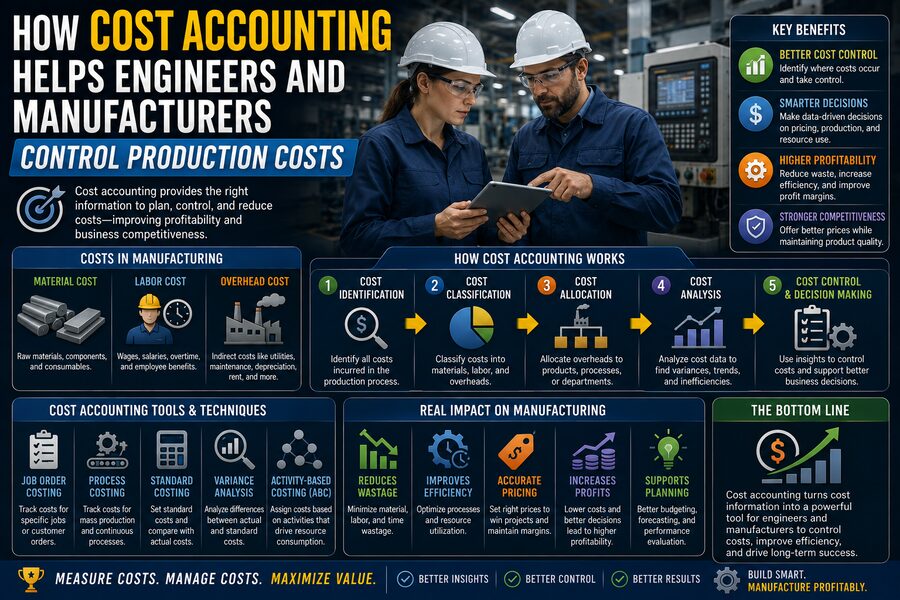
Cost accounting is the process of measuring, classifying, analyzing, and controlling the costs associated with producing goods or delivering services. For engineers and manufacturers, it connects technical decisions on the factory floor with their financial consequences.
A design change that saves 30 seconds of machining time may appear insignificant to an engineer. But if a factory produces two million units per year, that small improvement could create enormous savings. ⚙️💵
Cost accounting helps reveal those opportunities.
🧮 What Is Cost Accounting?
Cost accounting focuses on understanding where a company’s money is being spent.
Unlike financial accounting, which is primarily concerned with reporting overall financial performance to external stakeholders, cost accounting is often used internally by managers, engineers, operations teams, and finance departments.
It helps answer questions such as:
- How much does one product cost?
- Which production line is most efficient?
- Why did manufacturing costs increase?
- How much money is being lost through scrap?
- Should a component be made internally or purchased?
- Which products generate the highest contribution?
- Are labor and machine hours being used efficiently?
Cost accounting turns factory activity into measurable economic information.
🧱 The Three Major Manufacturing Cost Categories
Manufacturing costs are commonly grouped into three major categories:
🧰 1. Direct Materials
Direct materials are raw materials that can be clearly traced to a finished product.
For example, a manufacturer producing steel cabinets might use:
- Sheet steel
- Hinges
- Handles
- Paint
If one cabinet consumes $45 worth of materials, that amount can be assigned directly to the cabinet.
Direct material cost is often one of the easiest production costs to measure.
👷 2. Direct Labor
Direct labor includes employee costs directly associated with producing a product.
Examples include:
- Assembly workers
- Welders
- Machine operators
- Production technicians
Suppose assembling one machine requires four labor hours at an average direct labor cost of $25 per hour.
Direct labor cost would be:
4 × $25 = $100
However, labor calculations may also include payroll-related costs depending on the company’s accounting method.
🏭 3. Manufacturing Overhead
Manufacturing overhead includes production-related costs that cannot easily be traced to one specific unit.
Examples include:
- Factory electricity ⚡
- Equipment depreciation
- Maintenance
- Production supervision
- Factory insurance
- Indirect materials
- Quality-control staff
- Facility costs
Overhead is one of the most challenging areas because manufacturers must decide how to distribute these shared costs among products.
📊 The Basic Product Cost Formula
A simplified manufacturing cost calculation is:
Total Manufacturing Cost = Direct Materials + Direct Labor + Manufacturing Overhead
Suppose a company produces 10,000 components during a month.
Costs are:
Direct materials = $200,000
Direct labor = $80,000
Manufacturing overhead = $120,000
Total manufacturing cost is:
$400,000
If all units are identical, the average manufacturing cost per unit would be:
$400,000 ÷ 10,000 = $40 per unit
But real factories often make many different products, so allocating those costs correctly becomes much more complicated.
⚙️ Why Engineers Should Care About Cost Accounting
Engineers make decisions that directly influence cost.
A mechanical engineer may decide:
- Which material to use
- How thick a component should be
- What tolerance is required
- Which manufacturing process to choose
- Whether a part should be welded or bolted
- How many operations are needed
Each decision has economic consequences.
For example, specifying an unnecessarily tight tolerance might require:
- More expensive machinery
- Slower machining speeds
- Additional inspections
- Higher scrap rates
A dimension requiring ±0.01 mm may cost significantly more to manufacture than one requiring ±0.1 mm.
If the tighter tolerance does not improve product performance, the extra manufacturing cost is wasted.
Cost accounting helps engineers understand this relationship between technical specifications and production economics.
🧠 Cost Awareness During Product Design
A large percentage of a product’s eventual manufacturing cost can be influenced during the design stage.
Once production begins, changing materials, tooling, or manufacturing processes may become much more expensive.
This is why manufacturers use concepts such as:
Design for Manufacturing, or DFM.
Engineers ask questions such as:
- Can the number of parts be reduced?
- Can expensive machining be eliminated?
- Can standard components replace custom ones?
- Can assembly time be shortened?
- Can material waste be reduced?
Cost-accounting data helps quantify the financial value of these improvements.
⏱️ Machine Time Has a Cost
Production machines are expensive assets.
A CNC machining center, industrial robot, stamping press, or injection-molding machine may cost hundreds of thousands or millions of dollars.
Manufacturers therefore calculate a machine-hour rate.
Suppose a machine costs the company approximately:
$120 per operating hour
A product requiring 30 minutes of machine time consumes:
0.5 × $120 = $60
of machine-related cost.
If an engineer redesigns the component so machining takes only 20 minutes:
0.333 × $120 ≈ $40
The redesign saves roughly:
$20 per part
At 100,000 parts per year, that represents approximately:
$2 million in annual machine-cost reduction. 💰
This illustrates why engineering efficiency can have enormous financial impact.
🗑️ Scrap Is More Expensive Than It Looks
Scrap refers to material or products that cannot be sold because they fail to meet requirements.
Suppose a factory buys $1 million worth of raw material every month and has a 5% scrap rate.
That means approximately:
$50,000 of material may be lost every month.
But scrap cost can go beyond raw materials.
A defective component may already contain:
- Labor
- Machine time
- Electricity
- Tool wear
- Inspection effort
If the defect occurs near the end of the process, almost the entire production cost may already have been spent.
Cost accounting allows manufacturers to calculate the true financial impact of scrap.
🔧 Rework Is Also a Hidden Cost
Not every defective product is discarded.
Some can be repaired or reprocessed.
This is called rework.
For example, a component with an incorrect hole might be corrected through an additional machining operation.
Although the part can still be sold, the extra work consumes:
- Employee time
- Machine capacity
- Inspection resources
- Energy
Frequent rework can make an apparently profitable production line much less profitable.
Engineers can use cost data to prioritize the defects that generate the largest financial losses.
🎯 Standard Costing Helps Establish Expectations
Many manufacturers use standard costs.
A standard cost represents what a product is expected to cost under normal operating conditions.
For example, the standard cost might assume:
Material: $30
Labor: $15
Overhead: $20
Total standard cost:
$65 per unit
At the end of the month, accountants compare the standard cost with the actual cost.
Suppose the actual cost was:
$71 per unit
The difference is a variance.
Management then investigates why production cost exceeded expectations.
📉 What Is Variance Analysis?
Variance analysis separates cost differences into useful categories.
For materials, engineers might investigate:
- Higher purchase prices
- Excess material usage
- Increased scrap
For labor:
- Higher wage rates
- More labor hours than planned
- Low productivity
For overhead:
- Unexpected maintenance
- Higher energy consumption
- Lower production volume
Rather than simply saying:
“Costs increased by $500,000,”
variance analysis helps identify why they increased.
That makes the information actionable. 🔍
🧱 Material Usage Variance
Suppose one product should require:
5 kg of material
but actual production consumes:
5.5 kg
The additional 0.5 kg might come from:
- Excess cutting waste
- Poor nesting
- Process variation
- Scrap
- Incorrect machine settings
If material costs $8 per kilogram, the extra cost is:
0.5 × $8 = $4 per unit
At one million units annually, that becomes:
$4 million
Cost accounting makes engineering losses visible in financial terms.
👷 Labor Efficiency Variance
Suppose the standard assembly time is:
20 minutes per unit
but the actual average is:
25 minutes
That extra five minutes could indicate:
- Poor workstation layout
- Inadequate training
- Tooling problems
- Material shortages
- Product-design complexity
Industrial engineers can investigate the process and determine whether time can be reduced.
A few minutes saved per unit can create substantial annual savings in high-volume production.
🏭 Understanding Fixed and Variable Costs
Production costs can also be categorized as fixed or variable.
🔒 Fixed Costs
Fixed costs generally remain relatively stable over a certain production range.
Examples include:
- Factory rent
- Salaried supervision
- Some depreciation
- Certain insurance costs
Whether the factory produces 10,000 or 20,000 units, these costs may remain similar.
📈 Variable Costs
Variable costs tend to increase as production volume rises.
Examples can include:
- Raw materials
- Packaging
- Piece-rate labor
- Certain energy consumption
Understanding this difference helps managers evaluate production volume and pricing decisions.
📦 Why Production Volume Changes Unit Cost
Suppose a factory has:
$1,000,000 in fixed manufacturing costs per year
If it produces:
100,000 units
fixed cost per unit is:
$10
If production increases to:
200,000 units
fixed cost per unit becomes:
$5
The fixed expense is spread across more units.
This is one reason higher utilization can reduce average production cost.
However, increasing output only makes sense if the company can actually sell the additional products profitably.
📍 Cost Centers Help Locate Expenses
Large factories often divide operations into cost centers.
Examples might include:
- Machining department
- Welding department
- Assembly department
- Maintenance department
- Quality-control department
Costs are tracked for each area.
This helps managers identify where spending is occurring.
If machining costs suddenly increase by 15%, management can investigate that department instead of searching the entire factory.
Cost centers create financial visibility across complex operations.
🧩 Job Costing for Customized Manufacturing
Some manufacturers make unique or low-volume products.
Examples include:
- Custom industrial machinery
- Specialized fabrication
- Construction equipment
- Engineering projects
In these environments, companies may use job costing.
Each project or job receives its own cost record.
The company tracks:
- Materials used
- Labor hours
- Machine time
- Subcontracting
- Allocated overhead
Suppose a custom machine sells for:
$250,000
but the final job cost is:
$235,000
The project generated much less margin than managers may have expected.
Job costing helps reveal which types of projects are genuinely profitable.
🔄 Process Costing for Mass Production
Factories producing large quantities of similar products often use process costing.
Examples include:
- Chemicals
- Cement
- Paper
- Food
- Petroleum products
Instead of tracking every individual unit, costs are accumulated by production process or department.
Total process cost is then divided among units produced.
This approach fits continuous or high-volume manufacturing where individual products are nearly identical.
🎯 Activity-Based Costing Can Improve Overhead Allocation
Traditional costing systems sometimes allocate overhead using a simple measure such as labor hours.
But modern factories may be highly automated.
Labor may represent only a small portion of total cost.
Activity-Based Costing, or ABC, attempts to allocate costs based on the activities that actually create them.
Cost drivers might include:
- Number of machine setups
- Purchase orders
- Inspections
- Production runs
- Engineering changes
Suppose Product A requires 20 setups while Product B requires only two.
ABC may show that Product A consumes much more support effort, even if both use similar direct labor.
This can produce a more realistic picture of product profitability.
🏷️ Cost Accounting Helps Set Prices
Manufacturers cannot set sensible prices without understanding cost.
Suppose a product costs:
$80 to manufacture
Selling it for $82 may technically generate revenue but leave almost no margin for:
- Administration
- Sales
- Research
- Taxes
- Profit
Cost information helps management establish minimum acceptable pricing.
However, price is ultimately influenced by both:
Cost structure + customer value + market competition
Cost accounting does not determine the market price automatically, but it tells managers whether a particular price is financially sustainable.
🏭 Make-or-Buy Decisions
Manufacturers frequently ask:
Should we manufacture this component ourselves or buy it from a supplier?
Suppose internal production appears to cost:
$18 per component
while a supplier offers:
$16
Buying seems cheaper.
But the decision requires careful analysis.
The $18 internal cost may include fixed overhead that will remain even if production stops.
The company must evaluate avoidable costs, capacity constraints, supplier risk, quality, logistics, and strategic importance.
Cost accounting provides the financial framework for analyzing these decisions.
🤖 Automation Decisions Need Cost Analysis
Engineers often propose automation to reduce labor or improve throughput.
Suppose a robotic cell costs:
$800,000
and is expected to save:
$250,000 per year
A simplified payback period would be:
$800,000 ÷ $250,000 = 3.2 years
But the full investment analysis may also consider:
- Maintenance
- Training
- Financing
- Energy
- Depreciation
- Increased capacity
Cost accounting allows technical automation proposals to be evaluated financially.
🔧 Preventive Maintenance Can Reduce Total Cost
Maintenance is often viewed only as an expense.
But insufficient maintenance can cause much larger costs.
A machine failure may create:
- Production downtime
- Overtime
- Scrap
- Late deliveries
- Emergency repair charges
Cost accounting can compare the expense of preventive maintenance against the expected cost of failures.
This helps engineers justify reliability programs economically.
📉 Downtime Has a Financial Cost
Suppose a production line generates:
$10,000 of contribution per hour
If an equipment failure stops production for six hours, the lost opportunity may be substantial.
Maintenance teams can use this information to prioritize critical equipment.
A machine responsible for $50,000 per hour of lost production deserves very different reliability planning from a low-utilization machine with minimal operational impact.
Cost accounting helps transform downtime from a technical measurement into a business measurement.
⚡ Energy Cost Can Be Tracked Per Product
Manufacturing processes can consume large amounts of electricity, natural gas, steam, compressed air, or water.
Energy-intensive industries include:
- Steel
- Glass
- Cement
- Chemicals
- Plastics
Engineers can calculate energy cost per production unit.
For example:
Energy Cost per Unit = Total Energy Cost ÷ Good Units Produced
If the number rises unexpectedly, possible causes include:
- Equipment inefficiency
- Air leaks
- Excess idle time
- Poor production scheduling
Energy accounting can therefore become a powerful engineering tool. ⚡🌱
🧮 Break-Even Analysis
Cost information helps manufacturers determine how much they must sell before a product becomes profitable.
Suppose:
Selling price = $100
Variable cost = $60
Contribution per unit:
$40
If fixed costs are:
$400,000
break-even volume is:
$400,000 ÷ $40 = 10,000 units
The company must sell approximately 10,000 units before total contribution covers the fixed costs.
This information can influence product-launch and capacity decisions.
📈 Cost Accounting Supports Continuous Improvement
Lean manufacturing and continuous-improvement programs focus on eliminating waste.
Common forms of waste include:
- Defects
- Excess inventory
- Waiting
- Unnecessary transportation
- Overproduction
- Excess motion
- Unnecessary processing
Cost accounting helps quantify their financial impact.
Instead of saying:
“Changeover time seems too long,”
a team can estimate:
“Reducing average changeover time by 20 minutes could save $300,000 annually.”
That makes improvement priorities much clearer.
🛒 Inventory Also Costs Money
Manufacturers often hold:
- Raw materials
- Work in process
- Finished goods
Inventory ties up cash.
It may also create costs through:
- Storage
- Insurance
- Handling
- Damage
- Obsolescence
Producing more than customers need can therefore create hidden financial costs.
Cost accounting helps management understand the economic consequences of excessive inventory.
📊 Cost per Good Unit Matters More Than Cost per Unit Produced
Suppose a factory produces:
100,000 units
but only:
90,000 pass quality inspection
If total production cost is:
$900,000
cost per unit produced appears to be:
$9
But the cost per saleable good unit is:
$900,000 ÷ 90,000 = $10
The defective units increase the real cost of usable production.
This is why yield is such an important manufacturing metric.
💡 Engineers Can Use Cost Data to Prioritize Projects
Factories may identify hundreds of possible improvement opportunities.
Management cannot fund all of them simultaneously.
Cost accounting helps rank projects.
For example:
Project A: saves $50,000 annually.
Project B: saves $700,000 annually.
Project C: saves $200,000 and improves safety.
Financial information is not the only factor, but it helps allocate engineering resources where they can produce the greatest value.
🖥️ ERP Systems Integrate Cost and Production Data
Modern manufacturers frequently use Enterprise Resource Planning, or ERP, systems.
These systems can connect:
- Purchasing
- Inventory
- Production
- Labor
- Finance
- Sales
When material enters production, labor is recorded, and finished products are completed, the ERP system can capture the related costs.
This gives managers a much more integrated view of operations.
Engineers can compare technical metrics with financial outcomes.
📡 Real-Time Manufacturing Data Is Improving Cost Control
Modern factories increasingly use connected sensors and manufacturing-execution systems.
Machines can automatically report:
- Cycle time
- Downtime
- Energy consumption
- Production quantity
- Scrap
When this information is linked with cost data, companies can estimate production economics much faster.
A manager might see that one machine has:
Higher energy use + lower throughput + greater maintenance expense
than another similar machine.
This supports faster operational decision-making. 📊⚙️
⚠️ Cost Reduction Should Not Damage Quality or Safety
Reducing cost is valuable only if the resulting product still meets necessary requirements.
Cutting material thickness might reduce cost but create structural failure.
Reducing inspection might save labor while allowing dangerous defects through.
Skipping maintenance could reduce expenses temporarily while increasing future breakdowns.
Good cost engineering therefore seeks to eliminate waste, not necessary value.
The objective should be:
Lower total cost while maintaining required safety, quality, reliability, and performance.
📊 Production Cost Control at a Glance
A strong manufacturing cost-control system often follows this cycle:
Set standard cost
⬇️
Measure actual production cost
⬇️
Compare actual vs. standard
⬇️
Identify variances
⬇️
Investigate root causes
⬇️
Implement engineering improvements
⬇️
Measure savings
This creates a feedback loop between accounting and engineering.
Finance identifies where the money changed.
Engineering helps determine why.
Operations implements improvements.
Then accounting measures whether the improvement actually worked.
🌟 Final Thoughts
Cost accounting helps engineers and manufacturers understand one of the most important realities of production:
Every engineering decision eventually has an economic consequence. 💰⚙️
Material waste becomes money.
Machine time becomes money.
Downtime becomes money.
Scrap, rework, maintenance, energy consumption, tooling, and labor all become part of the real cost of manufacturing a product.
Cost accounting organizes these expenses so companies can see where resources are being consumed and where improvements will have the greatest financial impact.
For engineers, this information can transform technical optimization into measurable business value.
Reducing a cycle time by ten seconds may appear insignificant.
Reducing scrap by 1% may sound modest.
Replacing a custom component with a standardized one may seem like a minor design decision.
But when multiplied across hundreds of thousands or millions of products, these small improvements can generate enormous savings. 📈
The most effective manufacturing organizations therefore do not treat engineering and accounting as separate worlds.
They connect them.
Engineers understand how the product and process work.
Cost accountants understand where money is being consumed.
Operations teams understand how production behaves every day.
When those perspectives are combined, manufacturers can make better decisions about design, automation, capacity, quality, maintenance, pricing, and investment.
In that sense, cost accounting is not simply about recording what a factory spent yesterday.
It is a tool for helping engineers and managers decide how the factory should operate tomorrow. 🏭📊💡