
It is month-end in a factory, and the production manager is certain that a product line was profitable. The finance team’s report says otherwise. Materials cost more than expected, one machine was down for two shifts, and the overtime bill arrived after the first margin review.
The disagreement may not be about the shop floor at all. It may come from the way the factory assigns and interprets cost. A business using planned cost rates can reach a very different early conclusion from one waiting to accumulate every invoice, time record, and overhead expense.
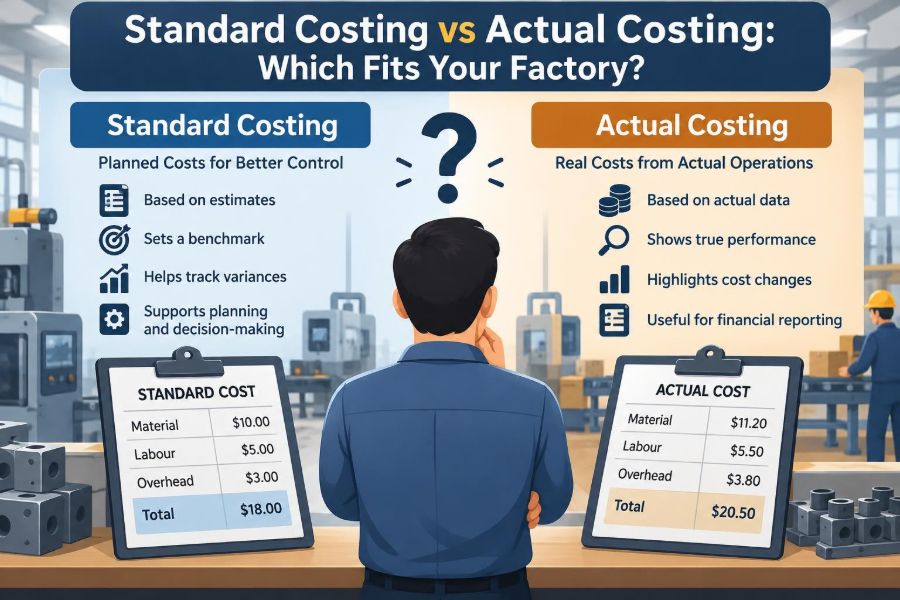
This is the practical choice between standard costing and actual costing. Both methods can produce useful information, but they answer different questions and demand different disciplines.
For students, the distinction connects cost-accounting formulas to operational decisions. For working professionals, it affects budgeting, inventory valuation, pricing, performance reviews, and the speed at which management can react. ⚙️
🏭 1. The factory costing decision
A manufacturing cost system has to do more than attach a number to finished goods. It should help managers understand what resources a product consumed, why costs changed, and whether operations are moving toward plan.
Standard costing begins with expected unit costs. Actual costing records the costs actually incurred. The best choice depends on the factory’s operating environment, reporting needs, data quality, and management purpose.
📘 2. What standard costing means
Under standard costing, the company establishes a predetermined cost for material, labor, and overhead for each unit or process. These standards are based on expected prices, quantities, labor time, production volume, and operating conditions.
For example, a standard may state that one product should use a set quantity of material at an expected purchase price and require a set number of labor hours. Actual results are then compared with that benchmark.
🧾 3. What actual costing means
Actual costing assigns costs using amounts actually paid or incurred. Direct materials are valued from actual purchases or issues, direct labor comes from actual payroll costs, and overhead is derived from actual indirect costs.
The phrase can mean slightly different things in practice. Some factories use actual direct material and labor costs while applying overhead using a predetermined rate, because complete actual overhead may not be known until after the period ends.
🔍 4. The central difference
The central distinction is timing and comparison. Standard costing asks, What should this unit have cost under normal expected conditions? Actual costing asks, What did this unit cost based on recorded spending and activity?
Neither question is automatically superior. A factory needs both a reliable record of economic events and a way to judge whether those events represent good or poor performance.
| Feature | Standard costing | Actual costing |
|---|---|---|
| Cost basis | Predetermined expected amounts | Recorded amounts incurred |
| Information speed | Fast during the period | May be slower, especially for overhead |
| Main management use | Planning and variance analysis | Historical measurement and traceability |
| Key risk | Outdated or unrealistic standards | Late information and cost volatility |
🧱 5. The building blocks of a product cost
Both approaches normally organize manufacturing cost into three elements: direct materials, direct labor, and manufacturing overhead. Direct costs can be traced economically to a product, while overhead supports production more broadly.
- Direct materials: components, ingredients, or raw materials incorporated into output.
- Direct labor: wages and related costs for work that can be traced to production.
- Manufacturing overhead: indirect labor, utilities, maintenance, depreciation, supervision, and other factory support costs.
The challenge is not merely collecting these costs. It is assigning them in a way that is useful and consistent with the factory’s production reality.
🎯 6. Why standards exist
A standard is a target, not a prediction that every single production run will match perfectly. It represents the cost expected for efficient operations under defined, attainable conditions.
Good standards turn a broad spending total into a focused operational question. Instead of observing only that material cost rose, managers can investigate whether the issue was a higher purchase price, excess material use, scrap, mix changes, or a specification problem.
🧮 7. Setting a material standard
A material standard usually combines a standard quantity and a standard price. The quantity should include the amount reasonably required for the product, with an appropriate treatment of expected normal waste where relevant.
The standard price may reflect supplier quotations, contracts, expected freight, purchasing conditions, and anticipated market conditions. Finance should not set this alone: engineering, procurement, quality, and production all hold information needed to make the standard credible.
👷 8. Setting a labor standard
A labor standard combines an expected time per unit with an expected labor rate. Time standards may come from engineering studies, routing data, prior experience, production trials, or validated process observations.
The rate should represent the labor mix needed for the work, not simply one employee’s wage. Changes in shift premiums, overtime patterns, skill requirements, or staffing design can all make an old labor standard misleading.
🏗️ 9. The special challenge of overhead
Overhead is often the most difficult element because it includes many costs that are indirect, partly fixed, and affected by production volume. Factories commonly establish predetermined overhead rates using an expected activity base such as labor hours, machine hours, or units.
A rate may be calculated by dividing budgeted overhead by expected activity. The choice of activity base matters: a highly automated plant may find machine hours more meaningful than direct labor hours.
📊 10. Variances turn standards into insight
A variance is the difference between a standard cost and an actual result. Favorable and unfavorable describe the arithmetic direction relative to the standard; they do not, by themselves, prove that management performed well or poorly.
A favorable material price variance, for example, could result from effective purchasing. It could also reflect lower-quality inputs that later increase scrap, rework, warranty claims, or customer dissatisfaction.
💰 11. Material price and quantity variances
The material price variance isolates the effect of paying a different price than expected. The material quantity variance isolates the effect of using more or less material than the standard allows for actual output.
These measures direct attention to different causes. Purchasing conditions, supplier changes, freight, and market movement may influence price, while production methods, equipment settings, design quality, and worker training may influence usage.
⏱️ 12. Labor rate and efficiency variances
The labor rate variance compares the actual hourly cost with the standard rate. The labor efficiency variance compares actual hours used with standard hours allowed for the output produced.
Excess hours are not always a labor-team problem. Material defects, production scheduling, machine downtime, poor maintenance, engineering changes, and weak instructions can all increase labor time.
🛠️ 13. Overhead variances need careful interpretation
Overhead analysis often separates spending differences from activity or volume differences. A spending difference asks whether actual overhead differed from budgeted overhead for the activity level; a volume-related difference considers whether fixed overhead was spread across the expected level of output.
These concepts can become technical, but the managerial message is straightforward: distinguish a change in spending from a change in capacity use. Do not treat lower production volume as though it were automatically careless spending.
🚦 14. Actual costing offers a different strength
Actual costing preserves a close connection to recorded transactions. When materials, payroll, freight, maintenance, and utilities fluctuate materially, managers may want to see those changes directly rather than viewing them first through a standard-rate lens.
This can be particularly useful for project-based work, highly customized orders, unusual production runs, or new operations where stable standards do not yet exist.
🕰️ 15. The timing problem with actual costs
Actual costs are not always available when decisions are needed. Supplier invoices may arrive late, inventory adjustments may remain unresolved, and a complete actual overhead total may require the period to close.
If product margins are reported only after these steps, a factory may discover a problem after the chance to correct it has passed. Fast feedback is one of standard costing’s strongest practical advantages.
📦 16. Inventory valuation and cost flow
Costing methods influence the amounts assigned to work in process, finished goods, and cost of goods sold. A standard-cost system typically records inventory at standard cost and accumulates variances separately for analysis and later treatment.
An actual-cost system values inventory using actual accumulated costs, subject to the company’s defined procedures. Financial reporting requirements and local rules matter, so the management accounting design should be coordinated with the organization’s accounting policies.
🧪 17. A simple production example
Suppose a product’s standard calls for 4 kilograms of material at 6 per kilogram and 1.5 labor hours at 20 per hour. Its standard direct cost is therefore 54 before overhead.
If actual production uses 4.3 kilograms at 6.40 per kilogram and 1.7 hours at 21 per hour, actual direct cost is higher. Standard costing does not hide that fact; it identifies separate price, usage, rate, and efficiency questions for investigation.
🔄 18. Standards must be maintained
Standards lose value when they are not reviewed. A bill of materials may change, a supplier may alter packaging, a redesigned fixture may shorten cycle time, or inflation may materially affect input prices.
Frequent changes, however, can erase the benchmark before managers learn from it. Establish a review cadence and clear triggers for revision, such as approved engineering changes, significant process changes, or sustained cost shifts.
🧭 19. Ideal, practical, and current standards
An ideal standard assumes near-perfect conditions, such as no avoidable waste or interruption. It can inspire process improvement, but it is often unsuitable for routine performance evaluation because normal operating realities are excluded.
A practical or attainable standard incorporates normal, expected operating conditions. A current standard reflects reasonably up-to-date prices and process expectations. For routine factory control, attainable and current standards are usually more informative than impossible ideals.
🏃 20. When standard costing fits well
Standard costing is often a strong fit when products are repetitive, processes are stable, and management needs quick control information. It works especially well when bills of materials, routings, and production data are reliable.
- High-volume production with repeatable operations.
- Businesses that budget and monitor performance regularly.
- Factories seeking early visibility into material, labor, and overhead deviations.
- Operations with a mature engineering and master-data process.
🧩 21. When actual costing fits well
Actual costing can be more natural when every job differs significantly, input prices vary sharply, or production is too irregular for a meaningful unit standard. It also helps explain the historical cost of a unique customer order or prototype.
That does not mean such factories cannot use budgets or estimates. It means that a detailed standard-cost framework may provide less benefit than a well-designed job-costing system with timely actual cost capture.
🤝 22. Many factories use a hybrid
The choice is rarely absolute. A factory may value direct materials at actual cost, use standard labor times for operational reporting, and apply overhead with predetermined rates. Another may use standards for internal control and adjust to actual costs for period-end reporting.
A hybrid design is sensible when it is intentional. Teams should document which costs use which basis, why the method was chosen, how variances are handled, and when the information becomes final.
⚠️ 23. Avoid dysfunctional incentives
Cost variances can improve accountability, but they can also encourage harmful behavior if used mechanically. A buyer rewarded only for purchase-price savings may choose inferior material. A supervisor pressured only on labor efficiency may build excess inventory or defer necessary maintenance.
Use a balanced set of measures. Quality, safety, delivery, scrap, customer outcomes, inventory levels, and long-term process capability should accompany cost metrics.
🧠 24. Assign responsibility with care
A variance report should prompt collaboration rather than blame. The department that observes a variance may not control its root cause, and a single cause can affect several cost elements at once.
For example, a design change can alter material usage, labor time, scrap, and machine setup. Cross-functional review involving finance, operations, engineering, procurement, and quality produces better conclusions than isolated scorekeeping.
💻 25. Data and systems determine usefulness
Neither approach can overcome weak data. Inventory records, production quantities, labor reporting, machine data, routings, purchase information, and overhead classifications need defined ownership and timely validation.
An enterprise system can calculate costs quickly, but automation does not guarantee relevance. If the bill of materials is obsolete or the activity driver is poorly chosen, the resulting cost report can be precise in appearance and wrong in meaning.
🗓️ 26. Questions to ask before choosing
Before designing or revising a costing system, leaders should clarify what decisions the system must support. The answer may differ for pricing, quoting, operational control, financial reporting, capacity planning, and customer profitability.
- How repetitive and stable are products and processes?
- How quickly must managers receive cost signals?
- Can engineering, purchasing, and operations maintain credible standards?
- Which cost fluctuations are meaningful, and which are temporary noise?
- What level of detail can the organization use without delaying action?
📈 27. Implement the method in stages
A move to standard costing should begin with a limited product family or pilot area. Validate bills of materials, routings, activity drivers, and ownership of variance review before extending the design across the factory.
Likewise, an actual-cost approach needs disciplined cost capture and a clear closing process. Start with decision needs, test reports with their users, and refine the method before treating results as a basis for high-stakes decisions.
⚖️ 28. The core principle: fit the method to the decision
Standard costing is most valuable as a forward-looking control framework: it makes deviations visible early and structures operational learning. Actual costing is most valuable as a record of what was incurred: it grounds analysis in recorded economic events.
The strongest factory accounting systems often combine those strengths. They use realistic standards to manage the operation, actual information to confirm and explain outcomes, and thoughtful analysis to avoid confusing a number with a cause.
The right costing method is the one that gives your factory timely, credible information for better decisions—not simply the one that produces the most calculations. ⚙️ 📊 🤝