
It is the last week of the financial year, and the ledger looks complete. Bank accounts have been reconciled, invoices have been entered, and the profit-and-loss statement is ready to export. Yet tax preparation still feels like a separate, urgent project.
That feeling usually comes from a gap between recording transactions and proving their tax treatment. A ledger tells the story of money moving through a business, but a tax return also requires classifications, supporting documents, cut-off checks, and decisions about adjustments.
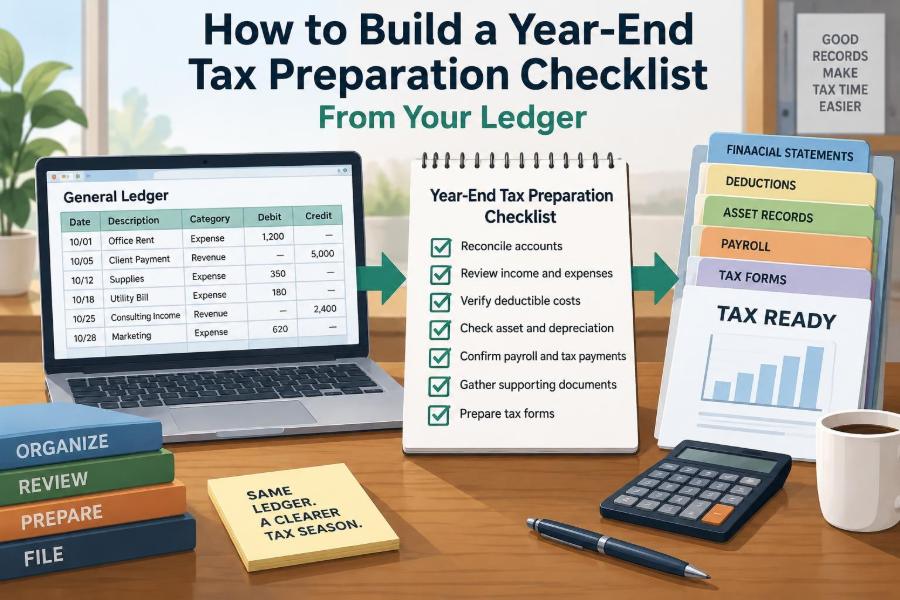
A year-end tax preparation checklist closes that gap. It turns the general ledger into a controlled set of questions: What happened? Is it recorded in the right period? Is the account classification correct? What evidence supports the amount? Does a tax rule require a different treatment?
For students, this process makes the link between bookkeeping, financial reporting, and tax work clearer. For working professionals, it creates a repeatable close process that reduces rushed corrections and makes conversations with tax advisers much more productive. 📚
🧭 1. Start With the Purpose of the Checklist
A tax preparation checklist is not merely a list of documents to send to an accountant. It is a year-end control tool that helps you convert ledger balances into a supportable tax filing position.
Its purpose is to identify missing records, unusual balances, tax-sensitive transactions, and items that need professional judgment. The checklist should also create a clear audit trail of who reviewed each item and what conclusion was reached.
📅 2. Define the Tax Year Before Reviewing Balances
Begin by confirming the exact accounting period and tax period being prepared. They may be the same, but they are not always aligned, especially when a business has a non-calendar financial year or has changed its reporting date.
Write the start and end dates at the top of the checklist. Also note relevant filing deadlines, payment dates, extension deadlines, and the date by which information must be delivered to an internal reviewer or external tax preparer.
🏢 3. Identify the Taxpayer and Reporting Basis
The same ledger can lead to different tax questions depending on the legal entity, ownership structure, jurisdiction, and accounting method. Confirm who is filing before deciding what information is needed.
- Legal name and tax identification number
- Entity type and ownership changes during the year
- Tax residence and operating locations
- Accounting basis used for tax, such as cash or accrual where applicable
- Prior-year filing position and open tax matters
This information frames the review. A balance that is routine for one entity may need special treatment for another.
🔒 4. Freeze a Clean Ledger Version
Create a controlled year-end version of the general ledger before tax review begins. Save the trial balance, detailed general ledger, chart of accounts, and relevant subledgers using a consistent naming convention.
Do not assume the first export is final. If post-close entries are later made, retain a record of the original version, the revised version, and each adjustment. This prevents the team from preparing schedules from different sets of numbers.
⚖️ 5. Reconcile the Trial Balance First
The trial balance is the starting map for the checklist. Confirm that total debits equal total credits and that the balances agree with the financial statements or management reports being used for year-end close.
If the trial balance is not internally consistent, tax review should pause. Tax classification cannot repair incomplete bookkeeping, duplicated entries, or unexplained posting errors.
Core reconciliation questions
- Do the opening balances agree to the prior-year closing balances?
- Have all close journals been posted?
- Are suspense, clearing, or uncategorized accounts empty or explained?
- Do control accounts agree to their supporting subledgers?
🏦 6. Complete Cash and Bank Reconciliations
Reconcile every bank, payment platform, petty-cash fund, and merchant processor account through the year-end date. A bank balance alone is not enough; the reconciliation must explain the difference between the statement and ledger balance.
Review outstanding checks, deposits in transit, pending card settlements, and unidentified transactions. Old reconciling items are especially important because they may indicate duplicate payments, missing entries, or stale liabilities.
🧾 7. Tie Revenue Accounts to Source Records
For each material revenue account, connect the ledger total to invoices, point-of-sale reports, contracts, sales reports, or other source records. The goal is to verify both completeness and correct period recognition.
Look closely at credits, refunds, rebates, sales returns, and manual revenue journals. These are not automatically errors, but they deserve explanations because they can materially change taxable income.
⏱️ 8. Test Revenue Cut-Off Around Year-End
Cut-off testing asks whether transactions were recorded in the correct period. Review sales activity immediately before and after year-end, then compare invoice dates, delivery or service dates, payment dates, and ledger posting dates.
The correct tax result depends on applicable rules and the taxpayer’s method of accounting. Your checklist should identify exceptions, document the facts, and flag situations requiring tax advice rather than making unsupported assumptions.
💳 9. Reconcile Accounts Receivable
Match the accounts receivable control account to the customer-level aging report. Investigate credit balances, old invoices, unapplied cash, disputed balances, and customers whose balances do not agree to statements or billing records.
Receivables can affect tax differently under cash and accrual methods. Even where a balance is not currently taxable, its support matters because it explains the relationship between book revenue and tax revenue.
🛒 10. Review Purchases and Cost of Sales
Review purchases, cost-of-sales, subcontractor, freight-in, and production accounts for completeness and classification. Trace significant year-end entries to purchase orders, supplier invoices, receiving records, or service confirmations.
Separate expenses that relate to resale inventory, production, capital assets, prepaid periods, and ordinary operating costs. The ledger may group these items together, while tax reporting may require them to be considered separately.
📦 11. Count and Value Inventory Carefully
If the business holds inventory, retain the physical count instructions, count sheets, adjustment records, and final inventory valuation schedule. Reconcile the final inventory report to the inventory ledger and to the financial statements.
Investigate negative quantities, obsolete items, unexplained write-downs, and large manual adjustments. Inventory accounting and inventory tax treatment can involve detailed rules, so clearly document the method used and refer uncertain issues for review.
🧰 12. Separate Repairs From Capital Expenditure
Expense accounts often contain purchases that create, improve, or extend the useful life of an asset. Review repairs and maintenance, equipment, technology, furniture, leasehold improvements, and construction-related accounts for potential capitalization.
A practical checklist question is: did the payment maintain an existing asset, or did it acquire or substantially improve something with benefits beyond the current period? The answer may require both accounting and tax analysis.
🏗️ 13. Build a Fixed-Asset Rollforward
Create a schedule that begins with opening asset balances and traces additions, disposals, transfers, depreciation, and closing balances. Tie total additions to the ledger and retain invoices, contracts, disposal documents, and financing records for significant items.
| Schedule item | Ledger evidence | Tax preparation question |
|---|---|---|
| Asset additions | Capital expenditure accounts and invoices | Is the item eligible for capitalization, depreciation, or another tax treatment? |
| Disposals | Asset register, proceeds, and write-off entries | Was the asset removed correctly, and is gain or loss analysis needed? |
| Depreciation | Depreciation expense and accumulated depreciation | Does tax depreciation differ from book depreciation? |
| Construction in progress | Project costs and completion records | When was the asset placed in service, if applicable? |
Do not use book depreciation as a substitute for a tax depreciation calculation. Keep the book and tax schedules distinct, then reconcile the difference.
📜 14. Examine Leases and Long-Term Commitments
Review lease expense, right-of-use asset accounts, lease liabilities, rent deposits, and new contracts signed during the year. The ledger may reflect financial reporting entries that do not directly determine tax deductions.
Keep copies of agreements, amendments, payment schedules, and any incentives. A checklist should flag new, modified, terminated, or related-party leases because these often require closer interpretation.
👥 15. Reconcile Payroll, Benefits, and Withholdings
Match wage and salary expense to payroll registers, year-end payroll reports, and payroll tax filings. Reconcile withholding and payroll tax liability accounts to amounts remitted or still payable at year-end.
Review bonuses, commissions, accrued vacation or leave, retirement contributions, health benefits, reimbursements, and contractor payments. Payment timing, employee classification, and substantiation can matter as much as the expense total.
Payroll checklist evidence
- Payroll registers and annual wage summaries
- Filed payroll tax returns and proof of remittance
- Employee benefit and retirement plan records
- Contractor agreements, payment reports, and required information returns
- Year-end accrual calculations and subsequent-payment evidence
🧑💼 16. Review Owner, Partner, and Related-Party Accounts
Inspect shareholder, owner, partner, director, and related-party accounts line by line. Personal payments, loans, reimbursements, management charges, distributions, and intercompany transfers should never remain as vague ledger entries.
Document the counterparty, relationship, purpose, approval, repayment terms where relevant, and supporting agreement. Related-party transactions may need special tax treatment or disclosure, so this is a key escalation area.
🎯 17. Test Prepayments and Accrued Expenses
Prepaid expenses represent payments made before receiving the full benefit. Accrued expenses represent obligations recognized before payment. Both accounts can become catch-all balances if they are not supported by detailed schedules.
For every material balance, identify the underlying invoice or contract, service period, calculation, and expected reversal or payment date. Review entries made near year-end especially closely.
📌 18. Inspect Other Assets, Liabilities, and Suspense Accounts
Accounts named “other,” “miscellaneous,” “clearing,” or “suspense” are signals to investigate, not final destinations. Obtain a detailed listing and assign each item to a real balance-sheet or income-statement category.
Also review deposits, advances, deferred revenue, customer credits, loans, taxes payable, and intercompany balances. A concise explanation and support for each material account make the tax file much stronger.
🧮 19. Create a Book-to-Tax Difference Schedule
Taxable income often begins with accounting income but does not end there. Build a schedule that starts with book profit or loss and lists each adjustment needed to arrive at the relevant tax measure.
Some differences are temporary, meaning they may reverse in a later period. Others are permanent, meaning they affect book and tax results differently without a later reversal. The exact categories depend on local law, but the discipline is universal: identify, support, and explain each difference.
- Book depreciation versus tax depreciation
- Non-deductible or specially treated expenses
- Income recognized in different periods for book and tax
- Accruals, reserves, or provisions with different tax timing
- Prior-year adjustments affecting the current filing
🧾 20. Review Tax-Sensitive Expense Categories
Scan the general ledger for accounts and descriptions that commonly require substantiation or special treatment. Rather than assuming an entire account is deductible or non-deductible, review the underlying transactions.
Accounts worth targeted review
- Meals, entertainment, travel, and vehicle costs
- Gifts, donations, sponsorships, and promotional spending
- Fines, penalties, legal settlements, and political expenditures
- Home-office, personal-use, or mixed-use expenses
- Professional fees, insurance, subscriptions, and training
Keep receipts, business-purpose notes, attendee information where relevant, mileage or usage logs where applicable, and approval records. Good evidence is usually more valuable than a late attempt to reconstruct the story.
🌍 21. Consider Sales, Indirect, and Local Taxes
Income tax is not the only year-end tax concern. Reconcile sales, value-added, goods-and-services, excise, payroll-related, property, or other indirect tax accounts that apply to the business.
Compare tax collected and tax paid to filed returns, exemption certificates, invoices, and payment records. Differences may result from timing, but they should be documented rather than left embedded in revenue or expense accounts.
🏛️ 22. Gather Prior-Year Returns and Carryforward Schedules
Prior-year tax returns are essential opening documents, not historical clutter. They provide prior-year balances, elections, depreciation bases, loss carryforwards, credit carryforwards, and unresolved items that may affect the current year.
Set up a carryforward tracker with the opening amount, current-year use, expiration or limitation information where applicable, and closing amount. Have a qualified reviewer confirm figures that depend on technical tax rules.
🔍 23. Compare This Year With Last Year
Perform a comparative review of major income-statement and balance-sheet accounts. The purpose is not to prove that every change is wrong; it is to identify movements that deserve a business explanation.
A sharp increase in professional fees, a new loan balance, a drop in gross margin, or a large negative expense may reflect a legitimate event. Add the explanation, supporting documents, and any tax consequence to the checklist. 🔎
🚩 24. Flag Unusual Journal Entries
Filter the ledger for manual journals, round-dollar entries, late postings, entries posted directly to cash, entries with vague descriptions, and transactions recorded by unusual users. Then inspect the documentation and approval for material or unexpected items.
Journal-entry review improves both tax readiness and financial-control quality. It is especially useful for finding reclassifications that were made for reporting purposes but were never evaluated for tax.
🗃️ 25. Organize Supporting Documents by Checklist Item
Build a digital workpaper folder that mirrors the checklist sequence. Use clear file names that identify the year, account or topic, document type, and version.
A useful workpaper should let another reviewer answer three questions quickly: where did the number come from, how was it calculated, and what evidence supports the conclusion? Avoid storing only final totals without the underlying detail.
🤝 26. Separate Preparation From Technical Review
Bookkeepers and finance staff can prepare reconciliations, schedules, and transaction summaries. Tax professionals or designated technical reviewers should assess matters involving elections, jurisdiction-specific rules, uncertain treatments, and filing positions.
This division does not reduce accountability. It improves it by making the handoff explicit: the preparer provides complete facts and evidence; the reviewer provides informed tax judgment.
✅ 27. Add Status, Owner, and Evidence Columns
A checklist becomes operational when every line has an owner and a status. Use simple labels such as not started, in progress, ready for review, question raised, and complete.
Include columns for ledger account, amount, source report, preparer, reviewer, issue description, conclusion, and document location. This structure prevents a common failure: assuming an item is complete because someone discussed it informally.
🧑💻 28. Build the Checklist Into Next Year’s Monthly Close
The best year-end tax checklist is not created once a year. Move recurring tasks into the monthly or quarterly close process: bank reconciliations, fixed-asset updates, payroll tie-outs, sales-tax reconciliations, and document retention.
Maintain a running issues log for unusual contracts, asset purchases, owner transactions, and new revenue arrangements. At year-end, the tax team will review a curated record rather than search through twelve months of email and ledger descriptions.
🛡️ 29. Protect Records and Retain the Final Package
Tax workpapers contain sensitive financial, payroll, ownership, and identification information. Limit access, use approved storage systems, maintain backups, and avoid sending unprotected records through informal channels.
After filing, retain the final return, filed confirmations, payment evidence, adjustment schedules, reconciliations, key correspondence, and supporting workpapers according to applicable legal and organizational retention requirements. Record where the final package is stored.
🏁 30. The Core Principle: Make Every Ledger Balance Explainable
A reliable year-end tax preparation checklist follows one central principle: every material ledger balance should be reconciled, classified, supported, and reviewed. Reconciliation proves the number; classification explains what it represents; support provides evidence; review tests whether tax treatment needs adjustment.
When those four elements are built into a repeatable workflow, year-end tax preparation becomes less of a scramble and more of an extension of good accounting engineering. The ledger is no longer just a record of transactions—it becomes a structured source of defensible tax information.
Build the checklist from the ledger, but finish with evidence, explanations, and clear ownership for every important tax decision. 🗂️✅🔍