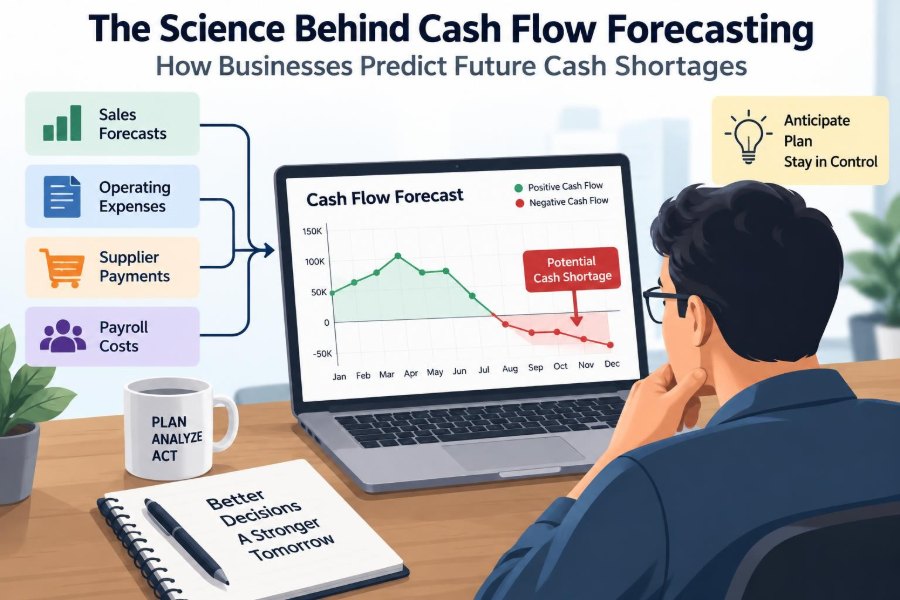

A business can look profitable on paper and still struggle to pay its bills on Friday. A customer may owe a large invoice, inventory may be selling well, and the income statement may look healthy—yet the bank balance can be too low to cover payroll.
That gap is where cash flow forecasting becomes essential. It turns a simple but urgent question, “Will we have enough cash when payments are due?” into a disciplined planning process.
For a café ordering supplies, a contractor waiting for project milestones, or a growing software company hiring ahead of renewals, timing matters as much as total revenue. Cash shortages rarely arrive as a complete surprise; they are often visible in the pattern of expected inflows and outflows.
Forecasting cannot make the future certain. What it can do is reveal pressure points early enough for managers to collect faster, delay a nonessential purchase, arrange funding, or change the plan before a routine payment becomes a crisis.
🔬 Cash Flow Forecasting Is a Timing Model
A cash flow forecast estimates the cash that will enter and leave a business over future periods, then calculates the expected ending cash balance. It is a timing model, not merely a profit estimate.
A basic forecast follows a simple relationship: opening cash plus cash receipts minus cash payments equals closing cash. The useful work lies in estimating when each receipt and payment will actually occur.
Closing cash = Opening cash + Cash inflows − Cash outflows
Most businesses prepare forecasts weekly or monthly. A company facing tight liquidity may also track daily cash, because a shortage on one day can matter even if the month ends positive.
🏦 Cash Is Not the Same as Profit
Profit measures whether revenue exceeds expenses under accounting rules. Cash measures money available in bank accounts or immediately accessible funding. These can move in different directions.
Suppose a retailer sells goods on account in March. It may recognize March revenue and profit, but if the customer pays in May, the sale does not supply March cash. Meanwhile, the retailer may have paid suppliers before making the sale.
Depreciation offers the opposite example. It reduces accounting profit over time but does not create a current-period cash payment when it is recorded. A forecast therefore begins with expected cash movements rather than copying figures directly from the income statement.
⏱️ Timing Creates Most Shortages
Many cash problems are not caused by permanently unprofitable operations. They arise because cash leaves before it arrives. Wages, rent, tax payments, loan instalments, and supplier invoices have fixed or predictable due dates, while customer payments may be late or uneven.
A business can have enough expected receipts for the quarter and still fail to meet obligations in the second week. This is why a quarterly total alone is insufficient; the forecast needs periods short enough to show the gap.
The practical question is not only “How much will we earn?” but “On which date can we use the money?”
🧱 The Core Building Blocks
A reliable forecast separates cash into categories that behave differently. Combining everything into one broad estimate makes assumptions difficult to test and update.
- Opening balance: cash actually available at the start of the period.
- Operating inflows: customer collections, cash sales, subscriptions, and other routine receipts.
- Operating outflows: payroll, suppliers, rent, utilities, marketing, and taxes.
- Investing flows: equipment purchases, asset sales, or deposits on long-term projects.
- Financing flows: loan proceeds, repayments, interest, owner contributions, and distributions.
This structure also helps people see whether a shortfall comes from normal operations, a large investment decision, or a financing commitment.
📅 Choosing the Right Forecast Horizon
Forecast horizon means how far ahead the model looks. A rolling 13-week forecast is common because it provides near-term detail without pretending that every transaction months away can be known precisely.
Monthly forecasts are often useful for annual planning, seasonal businesses, and board reporting. Daily forecasts may be necessary around payroll dates, major tax payments, or periods of heavy transaction volume.
A sensible approach is to use more detail close to today and broader assumptions further out. Forecast accuracy generally declines with distance because customer behavior, sales volume, costs, and operating decisions can change.
🧾 Start With the Opening Bank Position
The forecast is only as credible as its starting point. Opening cash should be reconciled to bank statements, payment platforms, petty cash where relevant, and restricted cash arrangements.
Not all reported cash is freely available. A business may hold funds in a separate account for taxes, customer deposits, debt-service requirements, or a particular project. Treating restricted funds as available operating cash can hide a real shortage.
Teams should also account for payments already initiated but not yet cleared. A bank balance alone may overstate usable cash if approved payments will leave shortly.
💳 Forecasting Customer Collections
Sales forecasts are a starting point, but collections forecasts require another layer: expected payment behavior. For each invoice, the model needs an expected collection date and amount.
Historical payment patterns can help. If a customer contract says 30 days but the customer typically pays in 45, using the contractual due date will make the forecast too optimistic. For large accounts, it is often better to forecast invoices individually.
Cash sales and card receipts have their own timing. A card transaction may occur today while settlement reaches the bank later, after processing fees or weekends affect timing.
🧑💼 Segment Customers by Payment Risk
Not every receivable deserves the same assumption. A small group of large customers can determine whether a business meets payroll, so treating all invoices as one average collection rate can be misleading.
| Receivable group | Forecast approach | Reason |
|---|---|---|
| Large named invoices | Track invoice by invoice | One delayed payment can materially change cash. |
| Stable repeat customers | Use recent payment patterns | History may provide a reasonable timing range. |
| New or disputed accounts | Use cautious timing or scenarios | Collection date is less certain. |
| Cash and card sales | Model settlement lag and fees | Sale date and bank receipt date differ. |
This is not about assuming customers will fail to pay. It is about matching the forecast to evidence and recognizing uncertainty where evidence is weak.
📦 Inventory Turns Cash Into Stock
Inventory-heavy businesses often face a cash conversion challenge. They purchase goods before selling them, and may then wait again for customers to pay. Growth can therefore consume cash even when demand is strong.
A seasonal retailer, for example, may pay for stock months before its peak selling period. The forecast should include purchase orders, supplier deposits, freight, duties where applicable, and the expected timing of sales collections.
Slow-moving stock deserves attention because it represents cash tied up in items that cannot quickly fund wages or invoices. Inventory value in accounting records does not mean the same amount is available in the bank.
🏗️ Map Fixed and Variable Payments
Some payments are predictable: rent, scheduled payroll, insurance, subscriptions, and debt repayments. Others vary with activity, such as materials, shipping, sales commissions, and transaction fees.
Fixed payments provide the forecast’s baseline. Variable payments require a driver, such as units produced, expected sales, headcount, purchase orders, or a percentage of card receipts.
Using drivers makes revisions more coherent. If the sales plan drops, shipping and commission assumptions can change with it rather than remaining as unexplained fixed numbers.
👥 Payroll Has More Than One Cash Date
Payroll is often one of the least flexible cash commitments. A forecast should include net employee pay, employer taxes or contributions where applicable, benefits, bonuses, contractor payments, and the dates those amounts are due.
The expense may be recognized as employees work, but the bank impact can occur on a regular pay date. Related payroll taxes may be remitted on a different schedule. Missing that distinction can make an apparently manageable week look safer than it is.
Planned hiring should enter the forecast before offers are finalized if management is using the model to test affordability.
🏛️ Taxes Need Their Own Cash Schedule
Tax obligations are frequently underestimated because they do not always align with sales or expense dates. Sales taxes, payroll-related taxes, income tax instalments, and other local obligations may be collected or accrued over time but paid in periodic lumps.
The exact requirements depend on jurisdiction and business structure, so a forecast should use dates confirmed by the organization’s tax advisers, payroll provider, or official filings calendar. It should not rely on a generic rule copied from another business.
Setting tax cash aside operationally can prevent management from mistaking collected tax amounts for funds available to spend.
🔩 Capital Expenditure Changes the Picture
Capital expenditure, often shortened to capex, is spending on long-lived assets such as machinery, vehicles, technology infrastructure, or leasehold improvements. It may be capitalized in accounting records rather than expensed immediately, but the cash outflow is real when paid.
Forecasts should show deposits, progress payments, delivery payments, installation costs, and expected tax effects separately where material. A single “equipment purchase” line can conceal a sequence of cash commitments.
Before approving capex, decision-makers can test whether the purchase creates a temporary funding gap and whether delaying it would meaningfully reduce operational risk.
🏦 Debt Can Protect Cash or Drain It
Borrowing can bridge a timing gap, but it also creates future obligations. The model should distinguish loan proceeds from principal repayments and interest payments, because each has a different effect and schedule.
A revolving credit facility may improve flexibility, yet availability can depend on lender terms, borrowing-base calculations, covenants, or collateral. A forecast should not assume the full facility is usable without checking those constraints.
Equity contributions and owner distributions belong in the financing section too. They should be explicit management decisions, not silent balancing figures inserted to make the closing balance look acceptable.
🔄 Working Capital Explains the Operating Cycle
Working capital broadly describes short-term operating resources and obligations. For cash forecasting, the key issue is the cycle between paying suppliers and receiving money from customers.
Receivables tie up cash after a sale. Inventory ties it up before a sale. Payables can delay an outflow, within agreed terms. Changes in these balances often explain why cash moves differently from profit.
A business can improve cash flow by collecting receivables sooner, reducing excess inventory, or negotiating payment terms. Each option has trade-offs: aggressive collection can strain relationships, lean inventory can cause stockouts, and delayed supplier payments can damage trust.
🧮 Build the Forecast in Cash Dates, Not Accounting Dates
A common modeling error is to place every item in the period it is earned or incurred. Cash forecasting instead uses the period when money is expected to clear.
For example, a supplier invoice recorded in April might be paid in May. A subscription paid annually in advance may create one large cash outflow even though the expense is recognized gradually in the accounts.
Accounting records remain valuable source data. The adjustment is conceptual: translate accounting activity into expected bank movements.
🧭 Use a Rolling Forecast, Not a Static File
A forecast should be updated as actual cash movements occur. In a rolling process, the completed week or month is replaced with actual results, a new future period is added, and assumptions are revised based on new information.
This makes forecast-versus-actual review possible. If collections repeatedly arrive later than predicted, the organization can adjust its assumptions and investigate whether the issue is invoicing, disputes, customer credit quality, or weak follow-up.
A static annual spreadsheet can be useful for a budget, but it becomes less useful for cash decisions as conditions change.
🎯 Separate the Base Case From Scenarios
The base case should represent the most reasonable current expectation, not the best imaginable outcome. It is then useful to add scenarios that test particular uncertainties.
Useful scenario questions
- What happens if a major customer pays two weeks late?
- What if sales fall below plan while payroll remains unchanged?
- What if a supplier requires an earlier deposit?
- What if a planned financing draw is unavailable or delayed?
Scenarios are not predictions. They expose how sensitive the cash position is to assumptions and reveal which events deserve active monitoring.
📉 Sensitivity Analysis Finds the Real Pressure Points
Sensitivity analysis changes one assumption at a time to measure the effect on closing cash or peak borrowing. A small change may matter greatly if it affects a large or early payment.
For a contractor, the timing of one milestone payment may be more important than a modest change in office costs. For a retailer, a delayed inventory shipment may shift both the supplier payment and the expected sales receipts.
Focus management attention on the few assumptions that can move cash materially. A detailed model is not automatically insightful if it gives equal attention to trivial and critical items.
🚦 Define a Minimum Cash Buffer
Zero is rarely a safe target for cash. Payments can clear earlier than expected, receipts can be delayed, and bank fees or small unplanned costs can appear. A business should define a minimum operating cash buffer appropriate to its volatility and commitments.
The buffer is not a universal number. A firm with stable daily receipts may need a different cushion from a project-based business dependent on a handful of milestone payments.
Once the buffer is visible in the forecast, managers can distinguish a technical positive balance from a genuinely comfortable liquidity position.
⚠️ Read the Early Warning Signals
A forecast is valuable because it surfaces warning signs before the bank balance collapses. The key is to act when the warning first appears, not after payments have already failed.
- Expected closing cash falls below the defined buffer.
- Receipts are increasingly concentrated in a few customers.
- Invoices become overdue beyond normal customer behavior.
- Supplier payments are being delayed without a negotiated agreement.
- Credit facility usage rises while operating collections weaken.
- New commitments are approved without appearing in the cash plan.
Any one signal may have an ordinary explanation. A pattern across several signals calls for closer review.
🛠️ Respond to a Forecast Shortfall Early
A projected shortage calls for choices, not panic. The best response depends on cause, duration, commercial relationships, and available options.
Potential actions include accelerating accurate invoicing, following up on overdue receivables, rescheduling discretionary spending, negotiating supplier terms before invoices become overdue, adjusting inventory orders, or arranging financing with enough lead time.
Some actions only shift the problem forward. For example, routinely postponing supplier payments may preserve cash briefly but can reduce supply reliability or credit terms. The forecast should show the later consequence as well as the immediate relief.
🧑🤝🧑 Cash Forecasting Is a Cross-Functional Process
Finance owns the model’s discipline, but no finance team can forecast alone. Sales knows deal timing, operations knows purchasing and production needs, human resources knows hiring plans, and procurement knows supplier commitments.
Clear ownership improves accuracy. For example, an account manager can confirm a customer’s expected payment date, while the accounts receivable team records whether an invoice is disputed or already promised for payment.
The goal is not to make every department fill out a spreadsheet. It is to establish a routine for providing timely, decision-relevant information.
🗂️ Data Quality Is an Engineering Problem
Cash forecasting resembles engineering because it converts messy operating data into a decision system. Weak input data produces weak output, even when the formulas are correct.
Common data issues include duplicate invoices, outdated customer terms, missing purchase orders, inconsistent project codes, and bank transactions that have not been categorized. Reconciliations, standard naming, and documented assumptions reduce these failures.
Automation can help import bank data, receivables, payables, and payroll schedules. But automated data still needs review; a system cannot reliably infer a commercial dispute or an unapproved project delay from transaction history alone.
📊 Useful Metrics Alongside the Forecast
The cash balance is the headline number, but supporting measures help explain why it is changing. Days sales outstanding, often called DSO, indicates how long customers take to pay on average. Inventory turnover and payable days can also reveal changes in the operating cycle.
These metrics should be interpreted carefully. An average may conceal a major overdue account, and a lower inventory balance may reflect better planning or a harmful stock shortage.
Use metrics as diagnostic signals alongside invoice-level and payment-level detail, not as substitutes for it.
🧪 A Simple Illustrative Example
Consider a hypothetical design agency beginning a four-week period with $60,000 in available cash. It expects $80,000 of customer collections, but $50,000 depends on one client paying in the final week.
During the first three weeks, payroll, contractors, rent, and software charges total $75,000. Even though the full-month forecast shows a positive ending balance if the client pays on time, the agency may fall below its $20,000 buffer before that payment arrives.
The forecast reveals a timing risk. Management might ask the client to confirm payment timing, draw on an approved facility if appropriate, defer a nonessential contractor engagement, or retain more cash earlier in the month. None of those choices requires guessing; each responds to a visible gap.
🧯 Common Forecasting Mistakes
Many forecasting errors are behavioral rather than mathematical. Optimism, incomplete communication, and failure to update assumptions can be more damaging than a complicated formula error.
- Using budgeted sales as if they were cash receipts.
- Assuming every customer pays exactly on contractual terms.
- Forgetting taxes, annual renewals, deposits, or debt payments.
- Counting restricted cash as available operating cash.
- Using one monthly number when daily or weekly timing is tight.
- Ignoring approved spending because an invoice has not arrived.
- Hiding uncertainty instead of showing scenarios.
The remedy is usually transparency: clear assumptions, named owners, timely actuals, and a willingness to revise the forecast when facts change.
🔍 Review Variances Without Blame
A variance is the difference between forecast and actual results. Reviewing variances should improve the next forecast, not become a search for someone to blame whenever the future differs from the plan.
Ask specific questions: Which receipt moved? Was the delay known but not communicated? Did a cost occur earlier than expected? Was the original assumption unsupported? The answers improve both the model and the operating process.
Repeated favorable variance can also be instructive. If collections consistently beat the forecast, assumptions may be too conservative, or the business may have changed in a way the model has not captured.
🧠 Match Model Complexity to the Decision
A small business may need a carefully maintained spreadsheet with weekly bank balances and major receipts and payments. A larger organization may need integrated systems, multiple entities, currencies, and detailed treasury controls.
Neither extreme is automatically superior. A complex model that nobody updates is less useful than a simple model that accurately tracks material cash commitments. Complexity should increase when it improves a real decision or reduces a meaningful risk.
The best forecast is understandable enough for decision-makers to challenge its assumptions and detailed enough to reveal the timing of material exposures.
🌱 Better Cash Forecasts Improve Better Decisions
Cash forecasting is not solely defensive. A clear view of liquidity helps a business decide when it can hire, invest, offer customer terms, purchase inventory, repay debt, or return funds to owners.
It also improves conversations with lenders and investors because management can explain its assumptions, downside cases, and funding needs with evidence rather than vague reassurance.
Most importantly, it connects everyday operating choices to their financial timing. A discount, a purchase order, and a hiring decision may all be commercially sensible, but their cash consequences still need a place in the plan.
✅ The Core Principle: Forecast Cash Before You Need It
The science behind cash flow forecasting is disciplined measurement of timing, uncertainty, and interdependence. It combines accounting data with operational knowledge: who will pay, when bills clear, what commitments already exist, and how quickly circumstances can change.
A useful forecast begins with reconciled cash, models receipts and payments on realistic dates, separates operating activity from investment and financing decisions, and tests the assumptions most likely to create a shortfall. It is updated continuously as actual events replace estimates.
Forecasts will never eliminate uncertainty. Their value is giving people enough notice to make deliberate choices while options are still available.
Businesses do not manage cash successfully by predicting the future perfectly; they manage it by seeing plausible shortages early and responding with informed, timely action. 💰📈🧭