
A café owner buys coffee beans, pays staff, accepts card payments, and orders a new espresso machine. At the end of the month, one question sits behind every decision: where did the money go—and what does the business now own or owe?
A simple list of cash received and cash paid can answer part of that question. But it cannot reliably show whether a purchase created an asset, settled a debt, or merely covered an ordinary expense. It also struggles to reveal when a record is missing.
Double-entry bookkeeping changed that. Its central insight is deceptively simple: every financial event has at least two effects, and records should show both sides.
That idea became the organizing logic of modern accounting. It still powers the ledgers, accounting software, financial statements, audit trails, and controls used by organizations of every size.
🧭 The Core Idea Behind Double Entry
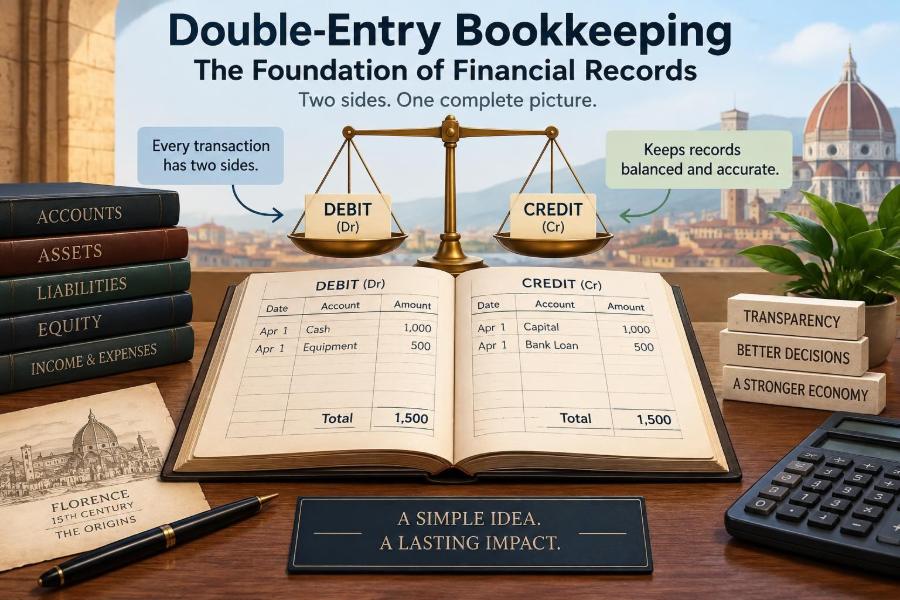
Double-entry bookkeeping records each transaction in at least two accounts. One or more accounts receive debits, and one or more accounts receive credits, with total debits always equal total credits.
This does not mean every transaction involves two bank accounts or two pieces of paper. It means the accounting equation remains in balance after every event.
For example, when a business pays cash for office supplies, cash decreases and supplies or expense increases. The transaction has a source and a destination within the business’s financial records.
⚖️ The Equation That Holds the System Together
The framework rests on the accounting equation:
Assets = Liabilities + Equity
Assets are resources the business controls, such as cash, inventory, equipment, and amounts customers owe. Liabilities are obligations, such as loans and unpaid supplier bills. Equity is the residual interest belonging to the owners after liabilities are subtracted from assets.
Revenue increases equity through profit, while expenses reduce it. Double entry is the practical recording method that keeps these connected categories aligned.
🏺 Recordkeeping Before the Modern Method
Merchants kept records long before formal double entry. Ancient and medieval societies used lists, receipts, inventories, tax records, and single-entry cash books to track goods and obligations.
These systems could be useful for routine trade. A merchant could note that a customer owed money or that a shipment had arrived. Yet separate lists did not automatically prove that all related records agreed.
As commerce grew more complex, businesses needed a way to connect cash, credit, inventory, partnerships, and claims in one coherent system.
🚢 Why Expanding Trade Needed Better Records
Long-distance trade created financial relationships that lasted months or years. Goods could leave one port, be financed by several parties, insured separately, and sold later on credit in another market.
In that environment, a cash-only view was inadequate. A business might have little cash on hand while still owning valuable inventory and holding enforceable claims against customers.
Double entry made it easier to distinguish cash movement from economic activity. That distinction remains central whenever a company sells on credit, borrows, invests, or carries inventory.
📜 Luca Pacioli’s Lasting Contribution
Double-entry methods developed through merchant practice rather than appearing fully formed from a single inventor. However, the Franciscan friar and mathematician Luca Pacioli played a major historical role in 1494 when he described Venetian bookkeeping practices in a printed mathematical work.
Pacioli did not claim to invent the system. His contribution was to explain a working method clearly enough that it could be studied, copied, and taught more widely.
That publication helped turn practical merchant knowledge into a recognizable body of accounting technique.
🏛️ What the Venetian Method Organized
The Venetian approach described a sequence of records rather than one isolated book. Transactions began with detailed notes, moved into a journal, and were then classified in a ledger by account.
This flow mattered because it created order. The journal preserved events chronologically, while the ledger grouped all activity affecting cash, debtors, merchandise, capital, and other accounts.
Modern software performs those steps electronically, but the underlying logic is familiar: capture the event, classify it, post it, and check the totals.
📖 The Journal: A Chronological Story of Transactions
A journal entry records a transaction by date and identifies the accounts affected. It is the first structured accounting description of an event.
Suppose a design studio receives $2,000 cash from a client for services already provided. The entry is:
Debit  Cash                 2,000
Credit Accounts Receivable       2,000
The entry says more than “cash came in.” It says the payment settled an amount the client already owed, rather than creating new revenue on the payment date.
📚 The Ledger: Where Account Balances Take Shape
The general ledger collects entries by account. Instead of scanning every transaction to find changes in rent expense or accounts payable, a bookkeeper can review the dedicated account.
A cash ledger account shows all debits and credits affecting cash. A supplies account shows purchases, usage, adjustments, and its remaining balance. The ledger turns scattered events into usable account-level information.
This classification is why financial statements can be prepared from accounting records rather than assembled from memory.
↔️ Debits and Credits Are Directions, Not Good or Bad
One of the most persistent beginner mistakes is treating debit as “money out” and credit as “money in.” In accounting, they are simply directional labels: debit means the left side of an account; credit means the right side.
The effect depends on the account type. Assets normally increase with debits, while liabilities and equity normally increase with credits. Revenue normally increases with credits, and expenses normally increase with debits.
| Account category | Normal increase | Common examples |
|---|---|---|
| Assets | Debit | Cash, inventory, equipment |
| Liabilities | Credit | Loans, accounts payable |
| Equity | Credit | Owner capital, retained earnings |
| Revenue | Credit | Sales, service income |
| Expenses | Debit | Rent, wages, utilities |
The terms may feel counterintuitive at first, but they make sense once accounts are viewed as left-and-right balances rather than labels for favorable and unfavorable events.
💵 A Cash Sale Shows Two Effects at Once
Imagine a bakery sells $120 of pastries for cash. Assuming the entry focuses only on revenue, the accounting record is:
Debit  Cash                 120
Credit Sales Revenue             120
Cash, an asset, increases. Sales revenue increases profit and therefore increases equity. Both effects are present at the same moment.
If the bakery also records the cost of ingredients used, that is a separate but related entry. A single customer sale can have more than two lines when more than two accounts are affected.
🧾 Credit Sales Separate Revenue From Collection
Now suppose the bakery invoices a corporate customer for $500 and expects payment later. The initial entry is:
Debit  Accounts Receivable  500
Credit Sales Revenue             500
The business earned revenue and gained an asset: the legal claim to collect cash. Cash has not yet increased.
When the customer pays, the bakery debits cash and credits accounts receivable. This separation lets financial reports show both performance and unpaid customer balances accurately.
📦 Buying an Asset Is Not Always an Expense
Consider a retailer paying cash for a delivery van. Recording the entire amount as an immediate expense would usually misstate the period’s operating costs because the van is expected to serve the business over multiple periods.
The initial entry generally increases a vehicle asset and decreases cash. Expense is recognized over time through depreciation, subject to the applicable accounting framework and the business’s estimates.
This is a major strength of double entry: it forces the recorder to ask what the transaction is, not merely whether cash moved.
🏦 Borrowing Makes Obligations Visible
When a business receives funds from a loan, cash rises, but the money is not revenue. The other side is a liability.
Debit  Cash                 10,000
Credit Loan Payable              10,000
Without the credit to loan payable, a cash record could make the business appear more profitable or less indebted than it really is. Double entry prevents that by showing the claim held by the lender.
Later interest payments and principal repayments are recorded differently because interest is a cost of borrowing, while principal reduces the liability itself.
🤝 Owner Investment and Business Income Are Different
When an owner contributes personal funds to start or support a business, the business receives cash. But the amount is generally not sales revenue, because it was not earned from customers.
The entry increases cash and increases owner’s equity or contributed capital. Keeping these categories separate helps users understand whether growth came from profitable operations or additional owner financing.
This distinction is especially valuable in small businesses, where personal and business activity can easily become mixed.
🔍 The Trial Balance Tests Arithmetic Equality
After transactions have been posted to the ledger, accountants can prepare a trial balance: a list of accounts and their debit or credit balances. Total debits should equal total credits.
That agreement is a useful check, but it is not proof that every record is correct. A transaction can be posted to the wrong account and still keep debits equal to credits.
For example, recording office rent as advertising expense may balance perfectly while distorting management’s view of spending.
🧮 What a Balanced Trial Balance Can Miss
Double entry is powerful, not magical. Several errors may survive the debit-credit check:
- A transaction is omitted entirely.
- The correct amount is posted to the wrong account.
- Two equal and opposite errors offset each other.
- A transaction is recorded twice with balanced entries.
- A fraudulent transaction is supported by deliberately false documentation.
That is why accounting depends on source documents, reviews, reconciliations, approval controls, and professional judgment in addition to balanced books.
🔄 Adjusting Entries Match Activity to the Right Period
Some economic events occur gradually or are known only at period end. Adjusting entries update records so revenue and expenses are recognized in the period they relate to, rather than only when cash changes hands.
Examples include wages earned but not yet paid, insurance paid in advance, depreciation of equipment, and revenue earned before invoicing.
These entries are essential under accrual accounting. They show why bookkeeping is more than recording bank transactions: the accounts aim to represent the business’s financial position and performance at a particular date.
🗓️ Accrual Accounting Changes the Timing, Not the Logic
Cash-basis records recognize many transactions when money is received or paid. Accrual accounting recognizes revenue when it is earned and expenses when they are incurred, subject to the relevant accounting rules.
Both approaches can use double-entry mechanics. The difference is the timing of recognition and the accounts that appear, such as receivables, payables, prepaid expenses, or accrued liabilities.
For decision-making, accrual information often gives a fuller picture of obligations and activity. Yet cash flow remains crucial because a profitable business can still face difficulty if it cannot pay bills when due.
📊 From Ledger Entries to Financial Statements
Double-entry records feed the major financial statements. Each statement answers a different question, and their connections are not accidental.
- Balance sheet: What assets, liabilities, and equity exist at a date?
- Income statement: What revenue, expenses, and profit occurred during a period?
- Cash flow statement: How did cash change through operating, investing, and financing activities?
A properly maintained ledger provides the detailed account balances behind these summaries. The statements are different views of one integrated record system.
🧩 Why Every Transaction Has an Economic Story
A useful way to learn bookkeeping is to narrate each transaction before choosing debits and credits. Ask: what did the business receive, give up, earn, incur, own, or owe?
For a utility bill paid immediately, the business receives electricity service and gives up cash. For inventory purchased on credit, it receives inventory and incurs an obligation to the supplier.
This approach is more reliable than memorizing isolated rules. Once the economic story is clear, the affected accounts usually become easier to identify.
🛡️ Double Entry Creates an Audit Trail
Because transactions connect accounts, reviewers can trace balances backward. A balance in accounts receivable can be linked to invoices, sales entries, customer records, subsequent collections, and any adjustments.
This traceability is an audit trail. It does not guarantee that the underlying event was legitimate, but it makes questions more answerable and irregular patterns easier to investigate.
Strong records also help management resolve disputes, prepare tax filings, support financing applications, and explain results to investors or owners.
🔐 Internal Controls Build on the Ledger Structure
Double entry supports control, but good control requires procedures around it. A well-designed process may separate the person who approves a payment from the person who records it and the person who reconciles the bank account.
Other useful safeguards include numbered invoices, documented approvals, restricted system access, timely bank reconciliations, and review of unusual journal entries.
Controls should fit the organization’s size and risk. A small business may not be able to separate every duty, but an owner can still review bank activity independently and retain supporting documents.
🖥️ Software Automates Posting, Not Understanding
Modern accounting systems can import bank feeds, create recurring entries, connect invoices to receivables, and generate reports quickly. These features reduce manual posting, but they do not eliminate the need for classification and review.
If a software rule categorizes a loan deposit as revenue, the system can produce polished but misleading reports. Automation makes errors faster and more repeatable when the underlying setup is wrong.
Professionals still need to understand accounts, timing, documentation, and the economic substance of a transaction.
⚠️ Common Beginner Mistakes in Double Entry
Most early errors come from misunderstanding the event rather than from poor arithmetic. Watch for these patterns:
- Treating all cash received as revenue.
- Treating all cash paid as an expense.
- Confusing a customer invoice with cash collection.
- Recording owner contributions as income.
- Ignoring liabilities created by purchases on credit.
- Using a suspense account as a permanent place for unexplained differences.
A practical remedy is to retain the source document, write a one-sentence transaction story, and identify the accounts before entering amounts.
🧠 A Repeatable Method for Analyzing Entries
When facing an unfamiliar transaction, use a consistent sequence:
- Identify the event and the date it occurred.
- Determine what the business received and what it gave up or became obligated to do.
- Name every affected account.
- Decide whether each account increases or decreases.
- Apply the debit-credit rules for those account types.
- Confirm total debits equal total credits.
- Attach or retain the supporting evidence.
This method scales from a student exercise to a complex business process. Complexity may increase, but the discipline remains the same.
🌍 Why the Method Travels Across Industries
A manufacturer tracks raw materials, work in process, finished goods, machinery, payroll, and customer balances. A nonprofit may track grants, restrictions, program costs, and donor receivables. A software company may track subscriptions, development costs, deferred revenue, and cloud expenses.
The account names and reporting requirements differ, but each organization still needs to show changes in resources, obligations, and accumulated results. That is why double entry has adapted across industries and legal forms.
Its durability comes from its structure, not from a single set of account titles.
📏 Where Judgment and Standards Enter the Picture
Double entry ensures balance, but it does not answer every measurement question. Accountants must still decide, under the applicable standards and policies, when revenue is recognized, how long an asset will be useful, whether a receivable is collectible, or how an obligation should be estimated.
Two organizations can use correct double-entry mechanics yet report differently if their circumstances or permitted accounting policies differ. Entries need both mathematical balance and sound accounting judgment.
For regulated reporting, tax compliance, audits, or significant transactions, professional advice may be necessary because rules vary by jurisdiction and entity type.
🧱 Limits of the System
Financial records are designed primarily to capture transactions and measurable balances. They do not fully portray every source of value, such as staff expertise, customer trust, brand reputation, or a founder’s relationships.
They may also rely on estimates, including depreciation, inventory valuation, and expected credit losses. Those estimates can change as new information becomes available.
So double entry provides disciplined structure, not perfect economic omniscience. Readers of accounts should combine ledger-based reports with operational context and informed judgment.
🎓 How Students Can Build Real Fluency
Memorizing debit and credit mnemonics may help initially, but fluency develops through repeated analysis. Practice with ordinary events: buy supplies, invoice a client, borrow from a bank, pay wages, receive an owner contribution, and record a month-end adjustment.
For each example, draw the accounting equation before writing the journal entry. Then post the amounts to simple T-accounts and prepare a trial balance.
This slower manual process reveals the connections that software normally hides. Once those connections are clear, digital tools become easier to use critically.
💼 How Working Professionals Can Use It Better
Even professionals who do not work in accounting benefit from double-entry literacy. Managers can ask whether a favorable profit result is supported by cash collection. Operations teams can understand why inventory errors affect both costs and assets. Founders can separate business performance from new borrowing.
When reviewing reports, useful questions include:
- What transaction or estimate caused this balance to change?
- Is the change operating, investing, or financing in nature?
- What documentation supports it?
- Will the cash effect occur now, later, or not at all?
These questions lead to more productive conversations with finance teams.
🏁 The Foundation Beneath Financial Records
Double-entry bookkeeping became foundational because it captures the connected nature of economic events. Every recorded transaction affects a wider financial picture: what an organization controls, what it owes, what it has earned, and what remains for its owners.
Its balance check makes errors easier to detect. Its linked accounts create an audit trail. Its ledger structure converts daily activity into financial statements that can be reviewed, compared, and used for decisions.
Most importantly, the method teaches a durable habit of thought: do not ask only where money moved. Ask what changed in the business as a result.
Double-entry bookkeeping endures because it turns individual transactions into a coherent, testable story of financial reality. That story is never complete without judgment and evidence, but it remains the foundation on which modern financial records are built. 💰📚⚖️