
A business can report a healthy profit and still struggle to make payroll on Friday. That sounds contradictory until a customer payment is late, inventory has already been purchased, and a tax bill arrives before the expected cash does.
This situation is common because profit reports and cash flow forecasts answer different questions. One explains whether the business has created value over a period. The other asks whether the bank account will hold enough money on the dates obligations must be paid.
For a café owner ordering supplies, a contractor waiting for a project milestone payment, or a software company paying annual insurance, timing can matter more than the profit shown at month-end.
Profit reporting remains essential. But when decisions depend on when cash moves, rather than simply whether revenue exceeds expenses, a cash flow forecast becomes the more useful management tool.
🧭 Start With the Question Each Report Answers
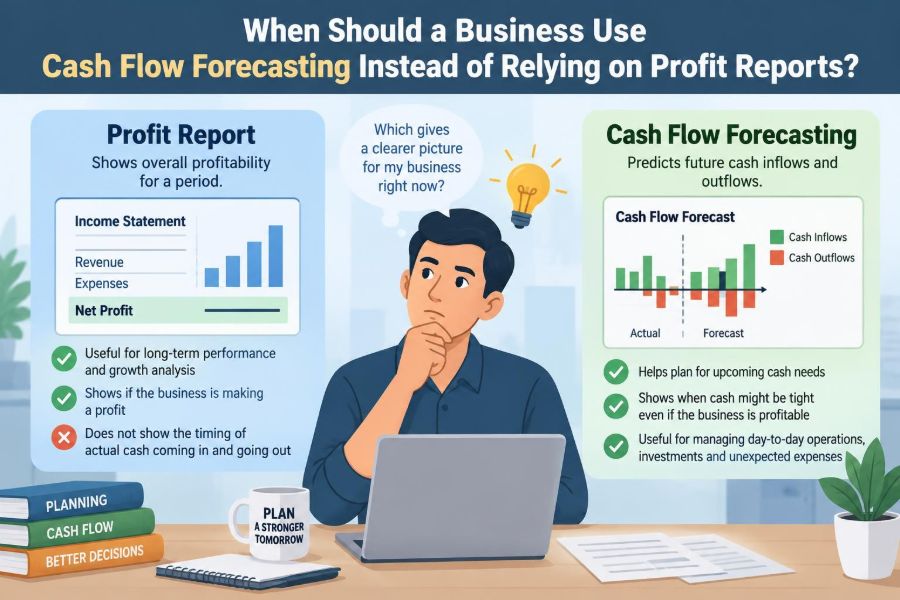
A profit report, often called an income statement or profit and loss statement, summarizes revenue earned and expenses incurred during a chosen period. It answers: Did the business generate a profit from its activity?
A cash flow forecast maps expected cash receipts and payments by day, week, or month. It answers: Will the business have enough available cash when bills fall due?
Neither is a replacement for the other. The right choice depends on the immediate decision. Pricing, efficiency, and longer-term viability call for profit information. Payment scheduling, borrowing, and survival through a tight period call for a forecast.
📚 Understand Why Profit Is Not Cash
Most financial statements use accrual accounting. Under this approach, revenue is usually recognized when it is earned, and expenses are recognized when resources are used, not necessarily when cash changes hands.
Suppose a design agency completes a $12,000 project in March and invoices the client with 60-day terms. March profit may include the revenue, even though the payment will not arrive until May.
Likewise, buying a machine may use cash immediately, but accounting rules may spread its cost through depreciation over several years. Profit and cash can therefore move in different directions without either report being wrong.
⏱️ Use Forecasts When Timing Creates the Real Risk
Cash flow forecasting is especially valuable when the timing gap between earning money and collecting money is meaningful. A profitable business can become illiquid—unable to pay obligations when due—during that gap.
Timing risk increases when payment dates are fixed but receipts are uncertain. Rent, wages, loan payments, supplier commitments, and taxes generally have deadlines. Customer receipts may be delayed, disputed, or split into installments.
When management needs to know what happens in the next few days or weeks, a historical monthly profit report is often too late and too aggregated to guide action.
🏦 Watch the Bank Balance, Not Just the Bottom Line
The bank balance is not a complete measure of financial health, but it is the immediate constraint on making payments. A cash forecast starts with the opening available balance, then adds expected inflows and subtracts scheduled outflows.
The result is a projected closing balance for each period. Looking across several periods reveals the lowest point, sometimes called the cash trough. That low point is frequently more decision-useful than the total profit for the quarter.
A business may have a strong balance today and still face a shortfall next month. Forecasting makes that future pressure visible while there is still time to respond.
🧾 Forecast Receivables When Customers Pay Later
Businesses that invoice customers after delivering goods or services should not treat every sale as cash received. Accounts receivable represent amounts owed by customers, and their collection dates drive liquidity.
Use actual due dates and realistic payment behavior in the forecast. If a customer contract says 30 days but the customer often pays at 45 days, a cautious forecast should not assume payment on day 30.
For major invoices, consider separate scenarios: paid on time, moderately late, or materially late. This is more informative than assuming all receivables will arrive exactly as planned.
📦 Use It When Inventory Absorbs Cash Before Sales
Retailers, manufacturers, wholesalers, and many online sellers often pay suppliers before inventory is sold. Profit may be recognized only when goods are sold, but cash leaves much earlier.
Seasonal buying makes this effect sharper. A business may need to build stock months before its busy period. The purchase can create a cash shortage even if expected sales will eventually be profitable.
A forecast should show supplier deposits, freight, duties where applicable, and final payments in the periods they are expected. It also helps management test whether order quantities fit available funding.
🏗️ Apply It to Project-Based Work
Construction firms, consultants, agencies, event businesses, and software implementers may spend heavily before receiving milestone payments. Staff time, subcontractor costs, materials, and travel are paid according to one schedule; customer billing follows another.
A project can be profitable on paper but create a severe cash burden if its payment milestones are back-loaded. Forecasting at project level makes this mismatch easier to identify.
For a hypothetical contractor, moving a deposit from project completion to project commencement may not change total contract profit. It can dramatically change the cash needed to perform the work.
👥 Protect Payroll and Other Non-Negotiable Payments
Payroll is usually among the least flexible operating cash outflows. Employees expect to be paid on the agreed date, regardless of whether a large customer has paid an invoice.
Businesses should use a short-term rolling forecast when payroll, contractor payments, taxes, rent, or debt service cluster in the same week. The goal is not simply to predict a shortage; it is to avoid discovering it after options have narrowed.
Separating essential payments from discretionary spending also clarifies which outflows might safely be delayed if a receipt slips.
🗓️ Increase Forecast Frequency During Volatile Periods
An annual budget is useful for planning direction, but it is not enough for a rapidly changing cash position. Forecast frequency should match the speed and uncertainty of the business.
| Situation | Helpful forecasting rhythm | Why it helps |
|---|---|---|
| Stable business with predictable collections | Monthly, reviewed regularly | Tracks broad funding needs and planned spending |
| Growing business or seasonal operation | Weekly or biweekly during pressure periods | Shows timing gaps around stock, hiring, or peak sales |
| Late collections or immediate liquidity concern | Daily or weekly short-term view | Supports payment prioritization and prompt action |
More frequent forecasting is not automatically better. It needs reliable updates and clear ownership. The practical aim is a cadence that catches material changes before they become emergencies.
📉 Forecast Before Committing to Growth
Growth consumes cash when it requires additional people, equipment, marketing, stock, facilities, or systems before added sales are collected. This is one reason fast-growing businesses can feel cash-poor despite rising reported profits.
Before accepting a large order or opening a new location, model the timing of all related cash movements. Include deposits, setup costs, extra payroll, supplier terms, expected customer collections, and any financing.
If the forecast shows a temporary deficit, growth may still be sensible. But management needs a credible plan to fund the gap rather than assuming revenue growth will solve it automatically.
🚀 Use Cash Forecasts Before Major Capital Spending
Capital expenditure means spending on long-lived assets such as vehicles, machinery, technology, or building improvements. These purchases often require a large upfront payment that profit reports do not present as a single operating expense.
A forecast tests whether the business can make the purchase and continue meeting routine obligations. It can also compare paying cash, leasing, financing, or delaying the investment.
The decision should still consider return on investment and total financing cost. A cash forecast does not determine whether an asset is economically worthwhile; it shows whether the timing is affordable.
💳 Model Debt, Interest, and Financing Dates
Loan proceeds may solve an upcoming gap, but only if they arrive before the gap occurs. Repayments, interest, fees, and covenant-related requirements should also be placed on the relevant dates.
Businesses often focus on the total facility limit and overlook the timing of drawdowns and repayments. A forecast reveals whether the facility is large enough at the period of peak need, not merely on average.
For revolving credit, maintain a conservative view of availability. The usable amount can be affected by lender conditions, borrowing-base calculations, or changes in receivables and inventory.
🏷️ Plan for Taxes Without Confusing Them With Profit
Tax payments can be substantial and may be due on a timetable that does not align with customer collections. Sales taxes collected from customers, payroll-related taxes, income taxes, and other obligations should be forecast separately where relevant.
Collecting tax in a sale does not necessarily mean the funds are available for general spending. Treating those amounts as operating cash can produce an unpleasant shortfall when the remittance date arrives.
Tax rules and payment schedules vary by jurisdiction and business structure. A forecast should use the business’s actual obligations and be reviewed with an appropriate accountant or tax adviser when uncertainty exists.
🌦️ Account for Seasonality and Lumpy Receipts
Many businesses do not collect cash evenly across the year. Tourism, education, agriculture, retail holidays, annual subscriptions, and industry-specific purchasing cycles can create predictable peaks and troughs.
Profit reports may show a good full-year result while concealing a quiet period with limited incoming cash. A month-by-month forecast shows how much reserve is needed to bridge that interval.
For lumpy receipts, avoid smoothing expected cash across every month merely because it makes the chart look stable. Record cash in the period it is reasonably expected to arrive.
🔍 Make Customer Concentration Visible
A business that depends on a few large customers has a different cash risk from one with many smaller, independent payers. One delayed invoice can materially alter the forecast.
List significant expected receipts individually instead of burying them in a single “sales collections” line. Note the customer, amount, due date, confidence level, and any condition that must be met before payment.
This does not mean every major customer will pay late. It means the forecast should expose dependence so management can prepare a response if timing changes.
🧮 Build From Actual Cash Dates, Not Accounting Categories Alone
A useful forecast begins with a simple schedule: opening cash, expected receipts, expected payments, and closing cash. The quality comes from the assumptions behind each line.
- Place customer receipts on expected collection dates.
- Schedule supplier payments according to agreed terms and planned payment runs.
- Include wages, taxes, rent, debt service, insurance, and subscriptions on their actual dates.
- Separate committed payments from estimates and optional spending.
Accounting records provide much of this data, but the forecast needs operational input too. Sales teams know deal timing; purchasing knows orders; project managers know milestones.
🔄 Use a Rolling Forecast Rather Than a One-Time Spreadsheet
A rolling cash flow forecast is updated continuously as one period closes and another is added. It is a living management tool, not a forecast prepared once for a board meeting and then ignored.
Each update replaces old assumptions with new information: invoices sent, receipts received, orders placed, dates revised, and unexpected expenses identified. This process makes the forecast progressively more useful near term.
Keep the horizon long enough to see upcoming commitments. The right length varies, but it should extend beyond the next major cash cycle, seasonal event, or financing decision.
🎯 Distinguish Expected Cash From Possible Cash
Forecasts become unreliable when optimistic possibilities are entered as if they were committed receipts. A prospective sale, a renewal under negotiation, or a pending loan approval may be useful to track, but it should not automatically fund payroll in the base case.
Use clear classifications such as committed, probable, and upside. The base forecast should generally rely on amounts with a reasonable basis and timing support.
This distinction is not pessimism. It is disciplined planning. If upside cash arrives, the business gains flexibility; if it does not, essential commitments remain protected.
🧪 Run Scenarios Instead of Trusting One Number
A single forecast can imply more certainty than the business actually has. Scenario analysis tests how the projected balance changes if key assumptions move.
Useful scenario questions
- What if the largest customer pays two weeks later?
- What if sales are lower than expected but fixed costs remain unchanged?
- What if a key supplier requests an earlier deposit?
- What if a planned financing arrangement is delayed?
A downside scenario should be plausible, not theatrical. Its purpose is to identify trigger points and response options before pressure becomes urgent.
🚦Set a Minimum Cash Buffer and Trigger Points
Not every projected positive balance is comfortable. A business needs a practical cash buffer for routine variation, unexpected costs, and the possibility that expected receipts shift.
The appropriate buffer depends on volatility, access to finance, payment obligations, and management’s tolerance for risk. It should not be chosen as a universal formula.
Set actions for projected balances below the buffer: follow up specific invoices, pause discretionary purchases, defer a noncritical project, draw approved funding, or speak with suppliers early. Predefined triggers reduce last-minute decision-making.
🤝 Use the Forecast to Start Better Conversations
A forecast supports more constructive discussions with lenders, suppliers, investors, and internal teams because it turns a vague concern into a dated plan. It can show the size, duration, and cause of a funding requirement.
For example, a supplier may be more open to adjusted terms when approached before a due date with a realistic payment proposal. A lender can better assess a request when management understands the expected draw and repayment pattern.
Transparency does not guarantee favorable terms, but early communication usually offers more options than waiting until a payment has already been missed.
📊 Keep Profit Reports for Performance Decisions
Choosing cash flow forecasting for a timing decision does not mean ignoring profit. A business that always has cash because it delays payments or borrows more is not necessarily economically healthy.
Profit reports remain central for assessing gross margin, operating expenses, pricing, product mix, and whether the underlying model is sustainable. They also support formal financial reporting and tax-related accounting, subject to applicable requirements.
The strongest management routine compares the two perspectives. If profit rises but cash weakens, investigate working capital—the cash tied up in receivables, inventory, and operating payment cycles.
⚖️ Recognize the Limits of a Cash Forecast
A cash forecast is an estimate, not a promise. It can be wrong because customers change plans, sales vary, suppliers alter terms, costs emerge unexpectedly, or input data is incomplete.
Its reliability depends less on complicated software than on current information, sensible assumptions, and regular review. A simple spreadsheet updated honestly can be more useful than a sophisticated model built on stale data.
Forecasts also do not replace bank reconciliations, accounting controls, budgets, or financial statements. They complement those tools by adding a forward-looking view.
🚫 Avoid Common Cash Forecasting Mistakes
Several errors repeatedly reduce the value of otherwise good models:
- Counting invoices as cash without considering collection dates.
- Leaving out annual, quarterly, or irregular payments.
- Using expected sales figures without translating them into cash collection timing.
- Forgetting tax, debt, owner distributions, or capital purchases.
- Updating the file only after a problem appears.
- Allowing too many people to change assumptions without clear accountability.
The remedy is usually practical: reconcile frequently, identify a forecast owner, document assumptions, and compare projected receipts and payments with what actually happened.
🛠️ Match the Tool to the Business Complexity
A small business with limited transactions may begin with a well-structured spreadsheet. Clear dates, separate assumptions, and a weekly review often matter more than advanced automation.
As transaction volume, entities, currencies, projects, or reporting needs increase, accounting integrations and dedicated forecasting tools may reduce manual work. Automation can improve speed, but it cannot judge whether a disputed invoice will actually be paid.
Use systems to collect and organize information; retain managerial judgment for assumptions, exceptions, and decisions. Access controls and version discipline are particularly valuable when several people contribute.
🧑💼 Give Clear Ownership to the Process
Finance may maintain the model, but reliable forecasting is cross-functional. Sales should update likely close dates and customer commitments. Operations should report purchasing plans. Project leaders should flag changed milestones. Senior management should make decisions when the forecast reveals a gap.
Assigning ownership for each key input reduces the “someone else knows” problem. It also makes deviations easier to explain: was the assumption wrong, did an event change, or was information not communicated?
A short recurring review meeting can be enough when participants focus on exceptions and upcoming decisions rather than reading every line item aloud.
🧾 Compare Forecast With Actual Results
After each period, compare the forecast with actual cash receipts, payments, and closing balance. This is called forecast variance analysis: examining the difference between what was expected and what occurred.
Do not treat every variance as a failure. The purpose is learning. A delayed payment may reveal a collection problem; consistently underestimated freight may reveal a weak cost assumption; recurring surprises may reveal missing communication.
Over time, this feedback improves both accuracy and confidence. It also identifies which assumptions deserve the most attention because they move cash materially.
🧭 Know the Practical Decision Rule
Use profit reports when the decision is mainly about economic performance over a period: Are products profitable? Are margins shrinking? Can the business sustain its cost base?
Use cash flow forecasting when the decision is mainly about liquidity and timing: Can we pay people and suppliers? Can we afford this purchase now? When will funding be needed? What happens if a receipt is delayed?
Many decisions require both. A new contract might be profitable but cash-intensive. The responsible conclusion is not simply “accept” or “reject”; it may be “accept with a deposit, revised milestones, supplier terms, or financing in place.”
💡 The Core Principle: Profitability Does Not Pay a Bill on Its Own
Profit reporting tells the business whether its activities are producing an economic return. Cash flow forecasting tells it whether the timing of receipts and payments allows it to keep operating without avoidable stress.
Businesses should lean on forecasting whenever cash timing is uncertain, obligations are near, growth requires upfront spending, or a small number of receipts determine whether commitments can be met. In stable conditions, it still provides useful early warning; in volatile conditions, it becomes a core operating discipline.
The goal is not to predict the future perfectly. It is to see enough of the likely path ahead to make earlier, calmer, and better-informed choices.
Use profit reports to judge whether the business is working; use cash flow forecasts to ensure it can keep working while the money moves. 💰📅📈