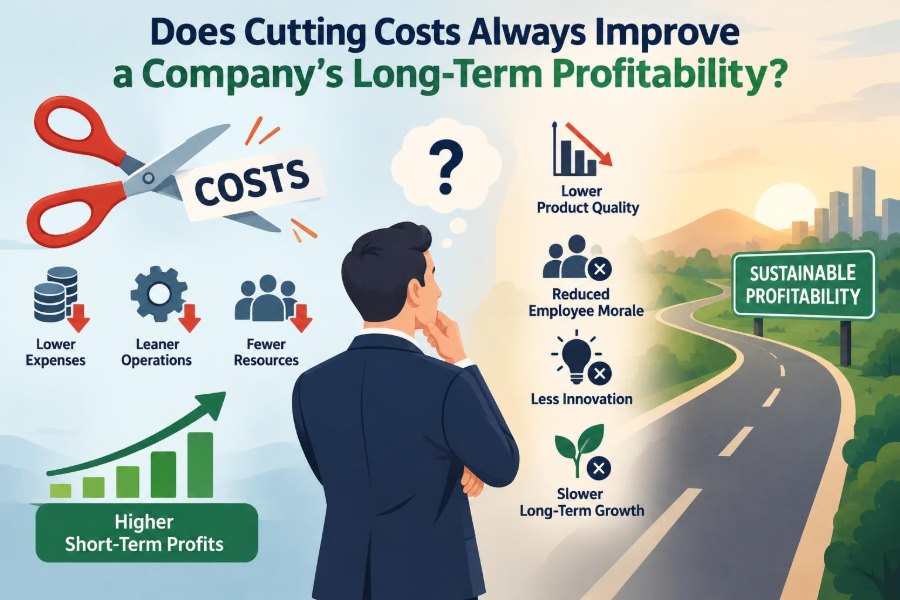

A manager sees profits tightening and asks every department for a 10% reduction. Travel is frozen, vacant roles stay unfilled, software subscriptions are cancelled, and suppliers are pressed for lower prices. By the next reporting period, expenses have fallen. The decision appears to be working.
But several months later, customer response times are slower, experienced employees have left, equipment failures are more frequent, and the sales team has fewer qualified leads. The company spent less, yet it may also have weakened the activities that produce future revenue.
This is the central tension in cost management. A lower cost base can protect cash and improve margins, especially when spending is genuinely wasteful. But some costs are not merely deductions from profit; they are inputs that support quality, capacity, innovation, compliance, and customer trust.
For students and professionals, the useful question is not simply, “Can this cost be cut?” It is: “What value does this cost protect or create, what happens if it is reduced, and will the financial benefit last?”
🧭 The short answer: cost cutting can help or harm
Cutting costs does not automatically improve long-term profitability. It improves profitability when the savings exceed the economic value lost from reducing the activity. That sounds obvious, but the lost value often appears later, in another department, or outside the accounting period used to judge the decision.
A company that eliminates duplicate software, renegotiates an overpriced contract, or reduces scrap may become more efficient without hurting customers. A company that removes maintenance, training, or quality controls may report lower expenses now while creating larger future costs.
The goal is not the lowest possible spending. It is the best sustainable relationship between resources used, customer value delivered, and profit earned.
📊 Profit is broader than an expense line
At a simple level, profit equals revenue minus expenses. Reducing an expense therefore raises profit if revenue and every other cost remain unchanged. In real businesses, however, those other elements rarely stay unchanged.
Lower staffing may reduce payroll but also reduce sales capacity. Cheaper materials may lower unit cost but increase returns. Closing a local service centre may cut rent but increase customer cancellations. The original saving is visible; the follow-on effects are often dispersed.
Long-term profitability also depends on the ability to keep earning acceptable returns over time. A decision that boosts this quarter’s operating income but damages future sales, pricing power, or reliability may be financially attractive only on paper.
🔍 Separate waste from productive spending
A practical first step is to distinguish waste from spending that enables performance. Waste consumes resources without contributing meaningfully to customer value, risk control, or necessary operations. Examples can include duplicated data entry, avoidable rework, idle inventory, and unused subscriptions.
Productive spending is not automatically efficient, but it has a purpose. Skilled technicians, preventive maintenance, customer support, employee training, and cybersecurity may all support outcomes that are easy to take for granted until they disappear.
The difficult category is spending whose benefit is indirect. A training programme may not create an immediate invoice, yet it can reduce errors, retain capable employees, and make new systems usable. These costs require analysis rather than a blanket reduction target.
⏳ Timing can make a bad decision look good
Accounting reports classify costs in periods, while operational consequences may develop across years. This mismatch creates a timing problem. The savings from cancelling an inspection programme can occur immediately, while the cost of a failure may emerge much later.
Consider a hypothetical manufacturer that postpones servicing a production machine. Maintenance expense falls this year. If the machine later breaks down during a busy period, the business may face repairs, lost output, overtime, late deliveries, and damaged customer relationships.
Short-term reporting is necessary, but it should not be the only lens. Managers need to ask when a saving will be realized, when potential harms may arise, and whether the organization can detect those harms early.
🧮 Fixed costs create misleading intuitions
Many cost-cutting discussions treat every expense as if it changes directly with sales volume. In practice, businesses have fixed, variable, and mixed costs. Rent for a facility may stay broadly stable over a relevant range of activity, while packaging rises with each unit shipped.
Reducing fixed costs can be valuable, particularly when demand has permanently declined. Yet fixed-cost cuts may also remove capacity needed for recovery. Closing a plant, office, or distribution point can be difficult and expensive to reverse once customer demand returns.
A sound decision considers the relevant cost: the cash flow that will actually change because of the choice. Allocated overhead on a report is not always a cost that can be avoided in the short term.
⚙️ Variable costs deserve a quality check
Variable costs are often easier to target because they move with production or sales. Procurement teams may seek cheaper components, packaging, freight, or temporary labour. The saving per unit can appear compelling at high volume.
Yet a lower purchase price is not necessarily a lower total cost. A component with inconsistent quality may require more inspection, create defects, slow assembly, or produce warranty claims. Freight savings may be offset by stockouts if deliveries become unreliable.
Use a total-cost perspective: acquisition cost plus handling, defects, delays, service requirements, and end-of-life consequences. The cheapest invoice is not always the cheapest operating choice.
🏭 Capacity cuts can limit future revenue
Capacity is the ability to serve demand: production equipment, trained staff, warehouse space, delivery vehicles, call-centre coverage, or software infrastructure. When capacity is cut, the immediate saving may be clear, but the lost opportunity is harder to record.
Suppose a retailer reduces fulfilment staff to match a quiet season. If online orders rise unexpectedly, slow dispatch may cause customers to abandon purchases or buy from competitors. The company has not only saved wages; it has changed its ability to convert demand into revenue.
Capacity should be matched to realistic demand scenarios, not maintained without purpose. But leaders should identify the cost and time required to restore it before deciding it is surplus.
👥 Labour reductions affect more than payroll
Payroll is commonly one of the largest controllable costs, so workforce reductions can produce rapid savings. They can also be necessary when work has genuinely disappeared or the organization has unsustainable overhead.
However, headcount is not interchangeable in every role. Experienced employees hold technical knowledge, customer history, process understanding, and informal networks. When they leave, remaining teams may spend more time solving problems, onboarding replacements, or covering critical work.
Before reducing roles, examine the work itself. Can processes be simplified, low-value tasks eliminated, schedules redesigned, or skills redeployed? Cutting jobs without redesigning work often transfers an unrealistic workload to fewer people.
🧠 Training is often an investment disguised as a cost
Training appears as an expense, while its benefits may include fewer mistakes, safer work, better supervision, and stronger employee capability. This does not mean every course deserves approval. Training should relate to a real skill gap or operational objective.
A company that installs new accounting or inventory software but cuts training may save money at implementation. Later, employees may use workarounds, enter data incorrectly, or fail to use features that were expected to create efficiency.
Useful evaluation looks beyond attendance. Ask what behaviour or process should improve, how managers will support application on the job, and what evidence would show the programme is contributing value.
🛠️ Maintenance prevents expensive interruptions
Preventive maintenance is a classic example of spending that can look optional during a cost review. Its benefit is largely the avoidance of breakdowns, defects, and safety incidents, none of which appears as revenue on a normal day.
Not every asset needs the same maintenance schedule; excessive servicing can itself be wasteful. The right approach depends on failure risk, repair cost, downtime consequences, safety requirements, and the availability of backups.
When reducing maintenance budgets, distinguish between removing unnecessary activity and deferring essential work. A maintenance plan based on asset condition and risk is stronger than an across-the-board cut.
✅ Quality cuts can create a hidden cost spiral
Quality control may involve testing, inspections, supplier checks, and process monitoring. Cutting it can reduce direct labour or testing costs, but poor quality can trigger rework, returns, refunds, warranty claims, complaints, and lost repeat business.
These consequences often sit in separate accounts. Production records a lower inspection cost; customer service absorbs complaint handling; sales faces resistance from unhappy customers. No single manager may see the complete financial effect.
Measure quality costs across the process. It can be useful to distinguish prevention and appraisal costs from failure costs. Spending to prevent errors may be justified when it avoids much larger internal or external failures.
🤝 Supplier savings require relationship management
Negotiating better terms with suppliers can improve margins without reducing product value. Consolidating purchases, improving demand forecasts, paying predictably, and simplifying specifications may create legitimate savings for both parties.
Problems arise when a buyer repeatedly demands price reductions without considering supplier economics. A pressured supplier may reduce service, substitute materials, delay investment, or decide that the customer is no longer worth prioritizing.
For important inputs, assess supplier reliability, financial resilience, quality performance, and switching costs alongside price. A collaborative agreement can be more durable than a low price that destabilizes the supply base.
📣 Marketing cuts can shrink tomorrow’s pipeline
Marketing budgets are especially vulnerable because the connection between activity and sales is not always immediate. When cash is constrained, a company may pause campaigns, events, market research, or brand activity to protect near-term earnings.
The effect depends on the business. A company with a full order book and weak delivery capacity may sensibly reduce demand generation temporarily. A business with a long sales cycle may damage future revenue by cutting the activity that creates awareness and qualified opportunities today.
Rather than treating marketing as one block, review channel performance, customer segments, acquisition cost, conversion quality, and the stage of the sales pipeline affected by each expense.
💬 Customer service shapes retention and pricing power
Customer support is sometimes labelled a cost centre because it does not directly invoice customers. Yet it can influence renewals, repeat purchases, referrals, complaint resolution, and the willingness of customers to pay for a trusted provider.
Reducing service levels may be sensible if the organization removes unnecessary contacts through better product design, clearer billing, or self-service tools that customers genuinely prefer. It is riskier when the change merely makes help harder to obtain.
Track service quality alongside cost. Response time, resolution rate, repeat contacts, cancellations, and recurring complaint themes can reveal whether a saving is creating friction that will later affect revenue.
🔐 Compliance and controls are not easy savings
Internal controls, legal compliance, data protection, safety procedures, and audit support can feel burdensome because their value includes avoiding adverse events. Their absence may not be visible until a breach, error, regulatory issue, or fraud occurs.
This does not justify inefficient bureaucracy. Controls should be proportionate to risk, clearly owned, and periodically reviewed. Redundant approvals and manual checks can often be simplified through better process design.
But removing a control should follow a risk assessment, not a general spending target. The potential downside may be far larger than the recurring cost being removed.
💻 Technology cuts may raise manual work
Cancelling unused software is a sensible way to reduce overhead. Cutting core systems, integration support, data backups, or cybersecurity tools without understanding dependencies can create manual work and operational risk.
For example, eliminating a workflow tool may save a subscription fee but require staff to reconcile spreadsheets and emails. The labour cost, error risk, and weak audit trail may exceed the saving, even if no single budget captures all three effects.
Technology reviews should map who uses each system, what process it enables, what alternatives exist, and which costs would return if it were removed. Usage data is helpful, but low usage alone is not proof of low importance.
📦 Inventory reductions can free cash and cause stockouts
Reducing inventory can release cash, lower storage costs, and reduce the risk of obsolescence. These are meaningful benefits, particularly where stock levels were built without a reliable demand or lead-time rationale.
However, inventory is also a buffer against uncertainty. If suppliers have long lead times or demand varies sharply, very lean stock can lead to missed sales, emergency freight, production stoppages, and frustrated customers.
Set inventory targets by item characteristics rather than one universal rule. Demand variability, supplier reliability, replenishment time, margin, shelf life, and criticality all influence the appropriate buffer.
📉 Pricing and cost cutting interact
A lower cost base can support lower prices, which may increase demand in competitive markets. It can also support margin protection when customers resist price increases. But price reductions are not automatically the best use of a cost saving.
If a business cuts quality or service to fund a lower price, it may attract customers who are highly price-sensitive while alienating those who valued reliability. The result can be lower revenue per customer and a weaker market position.
Consider what customers actually value. In some markets, speed, consistency, specialist expertise, or low risk supports pricing power more effectively than being the cheapest option.
🧾 Accounting classification can obscure economics
Financial accounting provides vital information, but managers should avoid treating a single reported figure as the full economics of a decision. Depreciation, allocations, accruals, and non-cash charges serve reporting purposes that may differ from a decision’s cash consequences.
For instance, an asset may be fully depreciated in the accounts but still useful in operations. Replacing it is not “free,” even though its book expense is low. Conversely, a shared overhead allocation may not disappear if one product line is discontinued.
Decision analysis should reconcile accounting data with incremental cash flows, operational constraints, and strategic effects. Finance teams add value when they help translate reports into decisions rather than merely reporting variances.
🎯 Use contribution margin for product decisions
Contribution margin is sales revenue minus variable costs. It shows how much a product, order, or customer contributes toward fixed costs and profit. It is often more useful than a fully allocated profit figure for short-run decisions.
A product with a modest or even negative allocated margin may still make a positive contribution if it covers its variable costs and the fixed costs would remain anyway. Discontinuing it could reduce total profit if the lost contribution exceeds avoidable fixed-cost savings.
Contribution margin is not a licence to accept every order. Capacity, customer fit, quality demands, and long-run price expectations matter. It is a tool for understanding the economics, not a substitute for judgment.
🧱 Avoid the “salami slicing” approach
Salami slicing means asking every function to reduce spending by the same percentage. It feels fair and is easy to administer. It also assumes that every department contains the same amount of waste and that every cost has the same strategic value.
A uniform cut may remove a trivial amount from an overfunded activity while crippling a small, critical team. It can encourage managers to postpone maintenance, stop training, or reclassify expenses merely to meet a target.
Prioritize instead. Protect activities that are essential to safety, compliance, customer commitments, scarce capabilities, and credible growth plans. Challenge spending with weak evidence of value more aggressively.
🗺️ Map cause and effect before approving cuts
A cost proposal should include a simple map of what changes operationally. If a role, supplier, system, or service is removed, what work stops, who absorbs it, and what customer outcome may change?
Useful questions include:
- Which cash costs are truly avoided, and when?
- Which revenues, volumes, service levels, or risks could change?
- Will work move elsewhere rather than disappear?
- What assumptions must hold for the saving to be real?
- What leading indicators would warn that the cut is damaging performance?
This exercise does not need an elaborate model for every small purchase. The scale of analysis should match the size, reversibility, and risk of the decision.
📐 Evaluate total economic impact
A disciplined business case compares more than the visible budget reduction. It estimates the likely changes in revenue, direct costs, working capital, capital expenditure, risk exposure, and implementation effort over a relevant time horizon.
Where future outcomes are uncertain, use scenarios rather than a single confident forecast. A base case, an adverse case, and an upside case can reveal whether a proposed saving depends on optimistic assumptions.
| Question | Narrow cost view | Long-term profitability view |
|---|---|---|
| What is saved? | Budgeted expense | Net cash and resource savings |
| What is lost? | Often not assessed | Revenue, quality, capacity, capability, or resilience |
| When is it measured? | Current reporting period | Across the decision’s useful life |
| What risks matter? | Budget overrun | Operational, customer, compliance, and recovery risks |
🚦Choose metrics that cannot be gamed easily
If managers are rewarded only for reducing expenses, they may make decisions that improve their local budget while harming the wider business. Balanced measures make trade-offs more visible.
Relevant metrics vary by context, but a cost initiative may be monitored alongside service levels, defect rates, on-time delivery, employee turnover, customer retention, cash conversion, safety incidents, and operating margin.
No dashboard removes judgment. The purpose is to prevent the organization from celebrating a cost reduction while ignoring evidence that value is being destroyed elsewhere.
🧪 Pilot reversible changes when uncertainty is high
Some savings can be tested before they are rolled out. A company might trial a new shift pattern at one site, consolidate a supplier category in one region, or change a service process for a defined customer group.
A pilot should have a clear baseline, a time frame, ownership, and criteria for continuing, changing, or stopping the initiative. It is not simply a small launch; it is a way to learn about effects that forecasts cannot reliably capture.
Reversibility matters. Cuts involving layoffs, site closures, discontinued products, or lost supplier relationships are harder to undo. They deserve stronger evidence and more careful contingency planning.
🌱 Invest to remove the cause of cost
The strongest cost reductions often come from redesign rather than deprivation. Automation can reduce repetitive work; better forecasting can reduce inventory; process improvement can eliminate rework; product redesign can simplify assembly; and clearer policies can reduce avoidable service contacts.
These initiatives may require upfront spending and management attention. That can make them less attractive than an immediate freeze, even when they offer better long-term economics.
The distinction is crucial: a spending cut removes an input, while productivity improvement changes the amount of input needed to produce the same or better outcome. The second approach is usually more sustainable.
🏦 Cash preservation and profitability are different tests
During a liquidity crisis, preserving cash may be the urgent objective. A company may need to delay nonessential projects, renegotiate payment terms, reduce discretionary spending, or sell non-core assets to remain solvent.
Those actions can be rational even if they do not maximize long-term profit in isolation. Survival matters. But emergency measures should be labelled as such, with a plan to revisit them once immediate pressure eases.
Confusing cash preservation with permanent efficiency can lead to damaging decisions. A business can reduce cash outflows today while impairing the assets and relationships needed to generate healthy cash flows tomorrow.
🏗️ Strategy determines which costs are worth carrying
Cost decisions should fit the company’s competitive strategy. A low-cost provider may invest heavily in scale, efficient logistics, standardized processes, and purchasing discipline. A premium specialist may need deeper expertise, superior service, and stricter quality assurance.
Both businesses should control waste. But the same expense can have different value in each model. Cutting expert support might be sensible in a simple self-service offering and destructive in a high-trust advisory service.
Ask whether the cost strengthens the promise made to customers. If it does, remove it only after finding another reliable way to keep that promise.
🧑💼 Finance should challenge both spending and assumptions
Accounting and finance professionals are well placed to improve cost decisions because they can connect operational proposals to financial outcomes. Their role is not merely to say no to spending or yes to a lower budget.
They can ask whether savings are cash-real, whether costs are avoidable, where impacts will appear, and whether performance measures capture delayed effects. They can also identify double counting, such as when several departments claim savings from the same reduced activity.
Good financial challenge is constructive. It helps operational leaders make assumptions explicit and supports decisions that improve the whole enterprise rather than one departmental report.
⚠️ Common warning signs of destructive cost cutting
Several patterns deserve closer scrutiny. None proves a proposal is wrong, but each signals that the analysis may be incomplete.
- The target is an identical percentage for every department.
- Savings are counted before contracts, roles, or assets can actually be removed.
- Customer, quality, safety, or compliance measures are absent.
- The proposal assumes remaining staff can absorb work without capacity evidence.
- The decision is difficult to reverse, but no scenario analysis is presented.
- Managers cannot explain how service or output will be maintained.
A cost plan with these features may still contain useful actions. It should, however, be tested more carefully before being treated as a profit improvement.
🪜 A practical sequence for better cost decisions
A repeatable process can make reviews more rigorous without making them slow. Start by defining the problem: is it weak demand, poor productivity, excessive overhead, a cash shortage, or an outdated operating model? Different problems require different remedies.
- Identify the activity behind the expense, not just the account code.
- Classify the cost as avoidable, variable, fixed, committed, or discretionary within the decision horizon.
- Map likely effects on revenue, quality, capacity, risk, and working capital.
- Estimate net impact under reasonable scenarios.
- Choose measures and decision checkpoints.
- Pilot or phase changes where practical, then compare results with the case.
This sequence turns cost control from a budget exercise into a management discipline.
🏁 The core principle: reduce cost without reducing value
Long-term profitability improves when a company removes waste, simplifies work, uses assets better, and buys inputs intelligently while preserving the capabilities customers rely on. The best savings often improve both cost and performance.
By contrast, profitability can deteriorate when leaders cut the activities that protect quality, build demand, retain talent, manage risk, or provide capacity. The accounting result may initially look favourable because the damage has not yet reached the income statement.
A cost cut is successful only when the business delivers equal or greater customer and strategic value with fewer resources, not merely when an expense line becomes smaller.
Cutting costs can strengthen a company, but only when the saving is real, the consequences are understood, and the value that creates future profit is protected. 🧮🌱📈