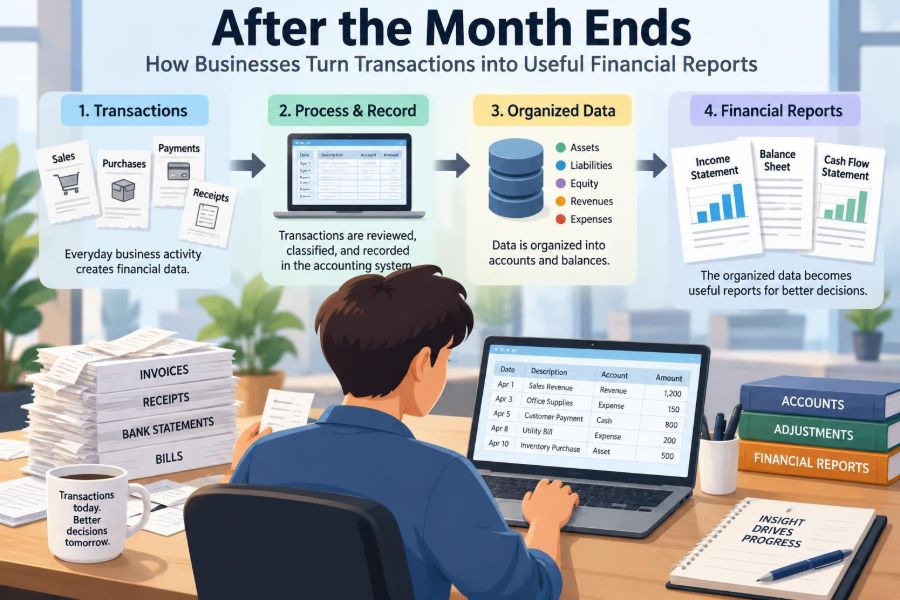

It is the first week of a new month, but the previous month is not really over. The sales team wants to know whether revenue grew. A manager wants to compare spending with the budget. The owner is asking whether there is enough cash to pay suppliers.
Meanwhile, transactions are scattered across bank feeds, invoices, payroll records, expense claims, point-of-sale systems, and spreadsheets. A single payment may be easy to understand. Thousands of payments, received and made at different times, are not.
The process that turns that activity into a reliable picture of performance is called the month-end close. It is both an accounting workflow and a decision-making deadline.
Useful financial reports do not emerge simply because software has collected transactions. They result from classification, evidence, judgment, review, and a disciplined sequence of checks. Here is how the pieces fit together.
🧾 A Transaction Is Only the Starting Point
A transaction is an economic event: a customer is invoiced, inventory is purchased, an employee is paid, or rent is charged to a bank account. It creates data, but not necessarily an answer to a business question.
For example, a $1,200 annual insurance payment is clearly cash leaving the bank. Whether all $1,200 should appear as this month’s expense requires additional accounting treatment. Financial reporting begins by interpreting what the event means.
📅 What “Month-End” Actually Means
Month-end is the point at which an organization closes a defined accounting period and prepares reports for that period. “Close” does not mean operations stop; sales and payments continue. It means the accounting team establishes a cutoff for reporting the prior month.
The result is a consistent time window. If January’s report includes February invoices or excludes January costs, comparisons become misleading.
🎯 Why Businesses Need More Than Bank Balances
A bank balance answers one narrow question: how much cash is available in that account at a moment in time. It does not show money owed by customers, unpaid supplier bills, inventory on hand, or obligations that have been incurred but not yet paid.
A profitable business can have low cash while waiting for customers to pay. Another business can have ample cash after borrowing, even while its operations are losing money. Financial statements separate these different stories.
📚 The General Ledger as the Central Record
The general ledger is the organized set of accounts used to record a company’s financial activity. Each account represents a category such as cash, accounts receivable, sales revenue, wages expense, equipment, or loans payable.
Think of it as a library rather than a pile of receipts. Source documents provide evidence; the ledger groups the effects of those documents into a structure that can be summarized and reviewed.
⚖️ Double-Entry Accounting Keeps the System in Balance
Most business accounting uses double entry: every recorded transaction has at least one debit and one credit, with total debits equal to total credits. Debit and credit are technical labels, not synonyms for good and bad or money in and money out.
If a business pays a supplier invoice, cash may decrease while accounts payable decreases too. The transaction changes two balance-sheet accounts. The equal-entry rule provides a built-in arithmetic control, although it cannot by itself prove that the chosen accounts are correct.
🗂️ The Chart of Accounts Gives Transactions Meaning
The chart of accounts is the company’s list of ledger accounts and often includes codes, descriptions, and groupings. Its design shapes how well managers can understand the reports later.
Too few accounts can hide useful detail: combining advertising, software subscriptions, and travel under “miscellaneous” makes spending harder to manage. Too many narrowly defined accounts can slow coding and produce inconsistent choices. A practical chart is detailed enough for decisions and simple enough to use consistently.
🏷️ Coding Turns Documents into Accounting Data
Coding assigns a transaction to accounts and, where needed, to departments, projects, locations, products, or customers. A software invoice might be coded to an operating expense account and tagged to the team that uses it.
This extra information matters when a business wants to ask more precise questions: Which site is profitable? Did a project exceed its budget? Which product line generates the highest gross margin?
📥 Source Documents Create an Audit Trail
Invoices, receipts, contracts, purchase orders, timesheets, bank statements, and credit-card records support entries in the ledger. Together, they form an audit trail: a path from a reported number back to the underlying event.
Good records are not only for external audits. They help employees resolve ordinary questions, such as why a vendor charge increased or whether a customer was billed according to a contract.
⏱️ Cutoff Determines Which Period Owns a Transaction
Cutoff is the rule for deciding whether an event belongs in the current period or the next one. The key question is usually when goods or services were delivered, received, or earned—not simply when payment occurred.
Suppose a consulting firm completes work on March 30 and invoices the customer in April. Under accrual accounting, the March work may belong in March revenue. The exact treatment depends on the facts, the contract, and the reporting framework the company follows.
🌊 Cash Accounting and Accrual Accounting Tell Different Stories
Cash-basis accounting records income when cash is received and expenses when cash is paid. It is straightforward and can be useful for monitoring liquidity or for organizations permitted to use it for their purposes.
Accrual accounting recognizes revenue when earned and expenses when incurred. This better matches activity to the period in which it happened, but it requires estimates and adjustments. Neither view makes cash irrelevant; they answer different questions.
| Event | Cash view | Accrual view |
|---|---|---|
| Customer pays an old invoice | Cash received now | Often reduces receivable; revenue was recognized earlier |
| Annual insurance paid upfront | Cash paid now | Expense may be recognized over coverage months |
| Work completed before billing | No cash effect yet | Revenue may be recorded in the work period |
🔄 The Close Calendar Creates Order
A close calendar assigns tasks, owners, deadlines, and dependencies. Bank reconciliations may need completion before cash is finalized; payroll data may be needed before wage accruals are calculated; management reporting follows review of the trial balance.
A calendar makes bottlenecks visible. It also prevents the close from relying on one person’s memory, especially when staff are absent or responsibilities change.
🏦 Bank Reconciliations Test the Cash Record
A bank reconciliation compares the cash balance in the ledger with the bank statement or bank feed. Differences can be legitimate, such as deposits in transit, outstanding checks, bank fees, or timing differences between systems.
Unexplained differences deserve investigation. They can reveal duplicated entries, missing transactions, incorrect amounts, or—in some circumstances—unauthorized activity. Reconciliation is a control, not a clerical formality.
🤝 Accounts Receivable Shows What Customers Owe
Accounts receivable represents amounts customers owe for goods or services already provided. At month-end, accounting teams review open invoices, payments received, credits issued, and disputes that may affect collection.
An aging report groups balances by how long they have been outstanding. It helps finance and sales teams focus collection efforts and consider whether some receivables may not be fully collectible.
📬 Accounts Payable Captures Unpaid Obligations
Accounts payable records bills owed to suppliers. Closing this area involves confirming that invoices have been entered, checking duplicate payments, and identifying goods or services received before month-end but not yet invoiced.
Missing liabilities can overstate profit because the related expense is absent. On the other hand, entering the same invoice twice can overstate expenses and liabilities. Invoice approval and matching procedures reduce both risks.
📦 Inventory Requires a Physical and Financial Check
For businesses that sell physical goods, inventory is often a major asset and a major source of closing complexity. The company needs to know quantities on hand, ownership, unit costs, damaged or obsolete items, and goods in transit where relevant.
Counts alone are not enough. The accounting records must reflect the company’s inventory method and recognize the cost of inventory sold as cost of goods sold. Small count errors can materially distort gross profit when volumes or values are high.
👥 Payroll Is More Than Net Pay
Payroll affects wages expense, cash, taxes, benefits, deductions, and liabilities owed to employees or government authorities. The timing can be awkward: employees may have worked days in the month that will not be paid until the next payroll run.
A month-end wage accrual estimates the cost of work already performed. Payroll rules vary by jurisdiction and employment arrangement, so organizations should use appropriate expertise rather than assume a generic treatment applies everywhere.
🧮 Prepayments Spread Costs Across Their Useful Periods
A prepaid expense occurs when a business pays before receiving all of the related benefit. Insurance, rent, licenses, and subscriptions are common examples.
If a company pays for twelve months of coverage upfront, recording the whole payment as expense immediately may make the payment month look unusually weak and later months look artificially strong. An adjusting entry moves the consumed portion to expense over time.
🛠️ Depreciation Allocates Long-Lived Asset Costs
Equipment, furniture, and certain technology investments may provide value for more than one reporting period. Depreciation allocates their recorded cost over an estimated useful life rather than treating the entire purchase as an immediate operating expense.
Depreciation is an accounting estimate, not a market valuation. An asset may lose market value faster or slower than its depreciation schedule, and land is generally treated differently because it is not normally depreciated in the same way.
📈 Revenue Recognition Needs Judgment
Revenue recognition asks when a business has earned revenue under its applicable accounting rules and contractual obligations. A retail sale may be relatively simple; a multi-month implementation, subscription, or customized project may involve more judgment.
Management should not use month-end pressure to pull future revenue into the current period. Clear contracts, delivery evidence, approval records, and review of unusual transactions support a more faithful result.
🧾 Accruals Capture Costs Not Yet Invoiced
An accrual records an expense and related liability before the supplier invoice arrives. Examples can include utilities used during the month, professional services performed, or interest accumulated on debt.
Accruals improve period matching, but they involve estimates. A sound process documents the basis for the estimate, reverses or updates it appropriately in the next period, and investigates large differences between the estimate and the eventual invoice.
🧹 Adjusting Entries Turn Raw Records into Period Results
Adjusting entries are the bridge between everyday transaction processing and financial reporting. They record accruals, prepayments, depreciation, deferred revenue changes, inventory adjustments, and other period-end effects.
They should be supported, reviewed, and clearly described. A vague journal entry labeled “adjustment” makes future investigation difficult; a well-documented entry explains what changed, why, who prepared it, and who approved it.
🧪 Reconciliations Validate More Than Cash
Reconciliation means comparing a ledger balance with independent detail or evidence and explaining differences. Besides bank accounts, teams reconcile receivables to customer subledgers, payables to supplier listings, payroll liabilities to reports, and fixed assets to asset registers.
The goal is not merely to make totals agree. It is to establish that the balance exists, is complete, is recorded in the right period, and is reasonably measured.
🔎 Review Turns Numbers into Reliable Information
After entries are posted, accounting teams review the trial balance and account movements. A trial balance lists ledger accounts and their balances; it confirms debit-credit arithmetic but does not guarantee that every entry is sensible.
Reviewers compare results with prior months, budgets, forecasts, operational metrics, and expectations. A sharp increase in freight expense, for instance, may be valid because volume rose—or may point to a coding error or an unrecorded vendor credit.
📊 The Income Statement Explains Period Performance
The income statement summarizes revenue, expenses, and profit or loss for a period. It helps answer whether the company’s activities generated more value than they consumed during that month, quarter, or year.
Its usefulness depends on context. A monthly loss might reflect a planned marketing launch, seasonal demand, or a one-time repair. Managers should examine the drivers, not treat one bottom-line number as a complete diagnosis.
🏗️ The Balance Sheet Shows Resources and Claims
The balance sheet reports assets, liabilities, and equity at a specific date. Assets are resources controlled by the business; liabilities are obligations; equity represents the residual interest after liabilities are deducted from assets.
Unlike the income statement, it is a snapshot. It shows whether the business is carrying receivables, inventory, debt, cash, and other balances that influence future flexibility and risk.
💧 The Cash Flow Statement Explains Movement in Cash
A cash flow statement explains changes in cash through operating, investing, and financing activities. It helps readers connect profit to actual cash movement.
For example, revenue can increase while operating cash falls if customers are taking longer to pay. Buying equipment may reduce cash without appearing as an ordinary operating expense. These distinctions help leaders avoid simplistic conclusions.
🧭 Management Reports Add Operational Context
Formal financial statements are essential, but managers often need supporting views: budget-versus-actual reports, departmental spending, customer concentration, inventory turnover, project margins, or overdue receivables.
These reports should be designed around decisions. A regional manager may need results by location, while a founder may need a short cash forecast and a view of upcoming obligations. More data is not automatically more useful.
🚨 Common Close Mistakes and Their Consequences
- Rushing cutoff: shifts revenue or expenses into the wrong month and weakens comparisons.
- Skipping reconciliations: lets errors accumulate until they are harder to trace.
- Using unexplained plug entries: forces accounts to balance without resolving the underlying issue.
- Ignoring unusual variances: misses potential coding errors, fraud indicators, or operational changes.
- Changing prior periods casually: undermines trust in reports already used for decisions.
Not every difference is an error. The discipline lies in identifying, documenting, and resolving material or decision-relevant differences rather than simply making a report look tidy.
🔐 Controls Protect Accuracy and Accountability
Internal controls are procedures that reduce the chance of error or inappropriate activity. Examples include approval limits, separation of duties, restricted system access, bank reconciliation review, and required documentation for journal entries.
Controls should fit the organization. A small business may not be able to separate every duty, but an owner can still review bank activity, approval logs, and significant adjustments. Excessive controls can slow work, while weak controls can leave important risks unmanaged.
🤖 Automation Speeds Routine Work, Not Judgment
Accounting systems can import bank transactions, route invoices for approval, create recurring entries, match payments, and generate reports quickly. Automation reduces manual handling and can make the close more consistent.
But automated rules repeat bad logic efficiently if they are configured incorrectly. Teams still need to review exceptions, validate mappings, protect access, and understand what the system is doing behind the dashboard.
🗣️ Cross-Functional Communication Improves the Close
Accounting cannot reliably close in isolation. Sales may know about contract changes, operations may know that goods were received, human resources may know about bonuses, and procurement may know about commitments not yet invoiced.
A short, repeatable exchange before close helps surface these facts. The best accounting process translates operational reality into financial records rather than asking finance to infer everything from incomplete documents.
📋 A Practical Month-End Close Sequence
- Set the reporting cutoff and collect outstanding source information.
- Record routine transactions, invoices, payroll data, and bank activity.
- Reconcile cash and major balance-sheet accounts.
- Prepare and support adjusting entries for accruals, prepayments, depreciation, and other period-end items.
- Review the trial balance, investigate significant changes, and obtain approvals.
- Produce financial statements and decision-focused management reports.
- Document open issues and improve the process before the next close.
The exact order varies by business, but the principle is stable: establish completeness first, then measure, reconcile, review, and report.
🌱 Building a Better Close Over Time
Improvement rarely comes from asking people to work faster without changing the process. It comes from reducing late information, standardizing account reconciliations, clarifying ownership, using checklists, and eliminating recurring manual work where sensible.
Track recurring exceptions. If the same vendor invoice arrives late every month, the solution may be a purchasing-process change rather than a better month-end spreadsheet. A close becomes faster when upstream operations become cleaner.
💡 The Core Principle: Financial Reports Are Explained Reality
A good month-end close does not merely produce balanced accounts. It creates a defensible explanation of what happened during the period, what the business owns and owes at the end of it, and where cash moved.
That explanation requires timely source data, consistent accounting policies, careful estimates, reconciliation, and thoughtful review. Reports are most useful when readers understand both the numbers and the assumptions behind them.
When transactions are captured carefully and tested before reporting, month-end numbers become a practical guide for decisions rather than a backward-looking pile of totals. 💰📊✅