
It is October, and a sales manager can already see that next year’s customer renewal pattern will not resemble the assumptions in the draft budget. A major account is shrinking. A new product is gaining traction faster than expected. Hiring plans have changed twice.
Yet the budget may still require teams to lock in twelve monthly numbers before the new year begins. Once approved, those numbers can become the reference point for spending permissions, performance conversations, and executive reporting—even as the conditions behind them disappear.
This is the central tension in modern financial planning. Organizations need discipline and accountability, but they also need a current view of where cash, revenue, costs, and capacity are heading.
Rolling forecasts are designed to keep that view current. They do not eliminate budgets, judgment, or long-term strategy. Instead, they replace the idea that one annual prediction should govern decisions for an entire year.
🧭 The Planning Problem Static Budgets Were Built to Solve
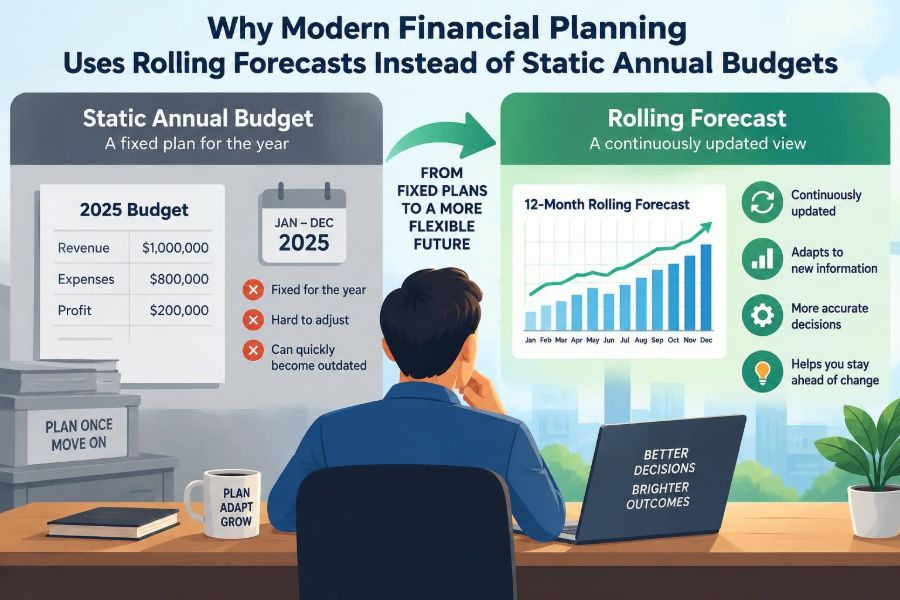
A static annual budget is a financial plan prepared for a fixed period, usually a fiscal year. It sets targets for revenue, expenses, headcount, capital spending, and often cash flow before the period starts.
This structure has clear advantages. It gives leaders a common planning calendar, creates spending boundaries, and helps boards or owners understand management’s intended direction. For organizations with stable operations, a fixed plan can remain useful for many decisions.
The problem arises when the budget is treated as a live prediction rather than a baseline. A number approved months ago may be formally precise but economically outdated.
📅 Why an Annual Cycle Creates a Timing Gap
Annual budgeting often begins several months before the fiscal year starts. By the time departments submit assumptions, finance consolidates them, leaders negotiate trade-offs, and governance groups approve the final plan, some original inputs may already have changed.
The resulting timing gap can be substantial. A budget finalized in late autumn may rely on market, staffing, supplier, and customer assumptions formed during the summer.
That does not mean annual planning is careless. It means the planning process is trying to make a long series of future decisions with a snapshot of information from one point in time.
🌦️ Business Conditions Rarely Stay Still for Twelve Months
Demand shifts, competitors change prices, supply lead times move, interest rates affect financing costs, and employee turnover changes staffing capacity. Even a relatively predictable business can face surprises in one of these areas.
A manufacturer may learn that a critical component will arrive later than planned. A software company may see usage rise but conversion lag. A nonprofit may receive a restricted grant that changes program timing without increasing unrestricted cash.
These are not necessarily planning failures. They are examples of why financial plans need an update mechanism rather than a once-a-year reset.
🔄 What a Rolling Forecast Actually Is
A rolling forecast is a regularly updated projection that always extends a defined distance into the future. Instead of ending on December 31 simply because the calendar year ends, it might always show the next twelve, eighteen, or twenty-four months.
When one month closes, the organization adds a new future month or quarter at the end of the forecast horizon. Actual results replace estimates for the completed period, and remaining projections are reconsidered using current information.
The key feature is continuity. Planning does not stop after budget approval and restart only when the next budget season arrives.
🧮 A Simple Twelve-Month Rolling Example
Imagine a company preparing a forecast at the end of March. It projects April through the following March. At the end of April, actual April revenue and costs are recorded, and the forecast shifts forward to cover May through the following April.
If April sales were lower because a customer delayed an order, management can assess whether the delay affects May, cash collections, inventory purchases, and staffing. The update is not merely a new spreadsheet cell; it is a revised decision picture.
A rolling forecast therefore answers, “What do we now expect?” rather than, “What did we expect when the year began?”
🆚 Budget, Forecast, and Target Are Different Tools
Many planning disputes happen because these three terms are used as if they mean the same thing. They serve different purposes and should not be forced into one number.
| Tool | Primary purpose | How often it should change |
|---|---|---|
| Budget | Allocate resources and set authorized spending boundaries | Usually fixed for a defined period, with controlled revisions |
| Forecast | Estimate the most likely financial outcome using current information | Updated on a regular cycle |
| Target | Express an intended performance ambition or operating goal | May remain stable even when the forecast changes |
For example, a sales team may retain an ambitious annual growth target while honestly forecasting a lower outcome after losing a major customer. Conflating aspiration with prediction encourages people to hide bad news.
🎯 Better Decisions Start With a Current Outlook
Leaders make choices about hiring, purchasing, marketing, production, borrowing, and project timing based on what they believe will happen next. A current forecast makes those choices more explicit.
If demand is strengthening, a forecast can show whether operations have enough labor, inventory, and cash to support it. If demand is weakening, it can reveal whether a planned hiring wave or discretionary expenditure should be delayed.
The value is not that the forecast predicts the future perfectly. Its value is that it makes the organization respond to its best current estimate instead of an obsolete assumption.
💵 Cash Flow Is Often the Strongest Use Case
Profit and cash are related but not identical. Revenue may be recognized before customers pay, while inventory, payroll, tax, debt service, and supplier invoices create cash demands on different schedules.
A rolling cash forecast helps finance teams see short- and medium-term liquidity needs. It can identify a period when collections may be slow, seasonal purchases may peak, or a debt payment may coincide with a major capital commitment.
For smaller businesses especially, this view can be more decision-useful than a broad annual profit budget. It supports conversations with lenders and owners without pretending that exact cash timing is certain.
📈 Revenue Forecasts Need Operational Drivers
A credible rolling forecast should not begin and end with a top-line revenue guess. It should connect revenue to the business activities that produce it, often called drivers.
For a subscription business, drivers might include customer count, renewal rates, average contract value, implementation timing, and expected expansion. For a retailer, they may include store traffic, conversion rate, average transaction value, and product availability.
Driver-based forecasting makes changes easier to explain. Rather than saying revenue fell “because of market conditions,” a team can identify whether the issue is fewer opportunities, lower conversion, delayed delivery, or a changing sales mix.
🏭 Cost Behavior Matters More Than Last Year’s Total
Static budgets often extend last year’s costs with a broad percentage increase. That can be quick, but it misses how costs actually behave.
Some costs are fixed over a relevant range, such as a lease or a salaried leadership role. Others vary with volume, such as shipping, payment processing, materials, or sales commissions. Still others move in steps, such as adding a new shift after capacity is reached.
A rolling forecast that separates these patterns gives better answers to practical questions: What expense will rise if demand rises? What cost can be avoided if a project pauses? What commitment remains even if sales fall?
👥 Headcount Planning Becomes More Honest
People costs are usually among the largest and least flexible expenses. An annual headcount budget may list approved positions, but it can fail to capture hiring delays, attrition, backfills, contractor use, merit changes, and the time needed for a new employee to become productive.
Rolling forecasts update the expected start date and cost of each meaningful role. They can also distinguish between a role that is approved, a role actively being recruited, and a role that remains only a possible future need.
This does not make hiring automatic. It gives managers and finance a shared view of the cost and capacity consequences of staffing choices.
📦 Inventory and Supply Decisions Need Forward Visibility
Businesses that buy, make, or distribute physical goods need to coordinate demand expectations with purchasing and production. Ordering against an outdated budget can create excess stock, shortages, rushed freight, or avoidable markdowns.
A rolling forecast can incorporate revised unit demand, supplier lead times, minimum order quantities, and planned promotions. The output may not be exact, but it provides a repeatable basis for discussing trade-offs.
Finance adds value here by translating operating choices into working-capital effects: more inventory generally ties up cash before it creates sales.
🧱 Capital Spending Benefits From Reprioritization
Capital expenditures—such as equipment, systems, vehicles, facilities, or major upgrades—often span several periods and compete for limited funds. A static annual amount can obscure whether the original sequence still makes sense.
With a rolling outlook, leaders can revisit timing without automatically abandoning the investment case. A project may still be worthwhile but should begin later because demand is softer, a dependency slipped, or cash is needed elsewhere.
The distinction matters: reprioritizing capital is not the same as indiscriminately cutting it. Some investments protect capacity, compliance, quality, or long-term competitiveness.
🕵️ Early Variance Signals Become Useful Information
A variance is the difference between an actual result and a planned or forecasted amount. In traditional budget reporting, teams can spend considerable effort explaining why a number missed the annual plan.
Rolling forecasts shift the more useful question toward what the variance means for the future. Did a missed sales month simply move to the next period, or has customer demand changed? Is an overspend a one-time event, or does it alter the ongoing run rate?
This forward-looking interpretation turns variance analysis from retrospective scoring into a source of operational intelligence.
🚦 Scenario Planning Makes Uncertainty Visible
A single forecast is necessary for coordination, but it can create a false sense of certainty. Scenario planning supplements the base case with plausible alternatives.
A team might model a downside case with slower bookings and longer customer payment times, plus an upside case with stronger demand that requires extra fulfillment capacity. The scenarios should be tied to clear assumptions, not arbitrary optimism or pessimism.
- Base case: the most likely view using current evidence.
- Downside case: a credible adverse combination of drivers.
- Upside case: a credible favorable combination with required resources identified.
The purpose is preparedness. Management can decide in advance which signals would trigger hiring restraint, financing discussions, or capacity investment.
📏 Forecast Accuracy Is Useful, but Not the Only Test
Organizations should evaluate forecast quality, including whether estimates are consistently too high or too low. This can uncover biased assumptions, weak data, or planning methods that need improvement.
However, accuracy should not become a reason to punish forecasters for unavoidable changes. If people fear consequences for revising a forecast downward, they may delay reporting risks until the evidence is overwhelming.
A healthier standard asks whether the forecast used reasonable assumptions, surfaced uncertainty early, and improved decisions. A forecast can be imperfect and still be highly valuable.
🧠 Frequent Updates Reduce the Need for Heroic Replanning
Without a rolling process, organizations often respond to major changes through emergency reforecasts, freezes, or broad cost-cutting exercises. These interventions can be necessary, but they are disruptive when they are the only way to update the plan.
Regular forecasting creates a normal rhythm for reviewing material changes. The team is already accustomed to asking what has changed, what it means, and which decisions need attention.
This is less about producing more reports and more about preventing financial planning from becoming an annual administrative event followed by long periods of stale assumptions.
⏱️ The Forecast Horizon Should Match Decision Lead Times
A twelve-month horizon is common, but it is not universally correct. The best horizon depends on how far ahead the organization must commit resources and how quickly its business model changes.
A business with long construction projects or equipment lead times may need an eighteen- or twenty-four-month view. A fast-moving consumer business may require detailed near-term monthly forecasting and broader quarterly estimates further out.
Detail does not need to be uniform. Near-term periods can be more granular because decisions are imminent, while later periods can use higher-level assumptions until more information becomes available.
🗓️ Monthly, Quarterly, and Continuous Cadences
Many organizations update their rolling forecast monthly because financial actuals, payroll information, and management reporting are commonly available on that cadence. Others use quarterly updates for strategic planning or weekly cash views during volatile periods.
The right cadence balances responsiveness with effort. Updating a full model every week may create noise if the underlying decisions change monthly. Updating only twice a year may be too slow when cash or demand is moving quickly.
A practical design often uses different rhythms: weekly cash monitoring, monthly operating forecasts, and quarterly scenario or strategic reviews.
🧾 Good Data Is Necessary, but Perfect Data Is Not
Rolling forecasting works best when teams have reliable actuals and accessible operational data. Core inputs might come from the general ledger, customer relationship management system, payroll records, inventory system, production reports, and project schedules.
But waiting for a flawless data environment can delay useful planning improvements. Organizations can begin with a small number of well-understood drivers and improve data quality over time.
The important control is transparency. Users should know where inputs come from, when they were updated, and which figures are estimates rather than confirmed transactions.
🤖 Technology Should Support Judgment, Not Replace It
Spreadsheets can support a disciplined rolling forecast, particularly for smaller organizations or early-stage implementations. Dedicated planning software can add workflow controls, version management, integrations, and easier scenario modeling as complexity grows.
Neither tool guarantees a good forecast. A sophisticated system will still produce weak outputs if managers provide unsupported assumptions or if financial definitions differ across departments.
Automation is most useful when it reduces repetitive data collection and reconciliation, leaving finance and operating leaders more time to discuss drivers, risks, and decisions.
🤝 Finance Must Partner With Operating Teams
Finance owns the integrity of the process, but it rarely owns the operational facts behind the forecast. Sales leaders understand pipelines and renewal risks. Operations leaders understand capacity constraints. Procurement understands supplier exposure.
A productive process gives each group responsibility for the assumptions it can influence or observe. Finance then tests whether those assumptions are internally consistent and converts them into integrated financial statements or management views.
This partnership prevents rolling forecasts from becoming a finance-only reporting exercise that business teams neither trust nor use.
🔒 Governance Keeps Flexibility From Becoming Confusion
Frequent updates do not mean anyone can change projections without review. A sound process defines the forecast owner, submission dates, materiality thresholds, approved assumptions, and required commentary for significant movements.
Version control is particularly important. Decision-makers need to know whether they are viewing the latest approved forecast, a working scenario, or the original budget baseline.
Clear governance preserves an audit trail and makes discussions more disciplined. Flexibility works when changes are visible, explainable, and connected to evidence.
⚠️ Common Mistake: Reforecasting Every Line Item
A detailed annual budget can contain hundreds or thousands of accounts. Trying to refresh every line with equal attention each month creates a slow process and encourages superficial updates.
Instead, focus forecasting effort on material and variable drivers. Fixed or stable items can be carried forward with periodic review, while revenue, labor, key input costs, cash collections, project milestones, and major commitments receive closer attention.
Materiality means concentrating on items large enough or uncertain enough to affect decisions. It is a practical safeguard against false precision.
🚫 Common Mistake: Turning Forecasts Into Performance Contracts
If managers are judged only on whether they “meet the forecast,” they may protect themselves by submitting overly conservative numbers. If they are judged only against the annual budget, they may resist updating forecasts that reveal a problem.
Separate the roles where possible. Use targets and performance measures to motivate action, while using the forecast to communicate the most realistic current outlook.
People are more likely to report emerging risks promptly when forecasting is treated as a tool for managing the business rather than a trap for assigning blame.
🧩 Common Mistake: Ignoring Assumptions and Interdependencies
A revenue revision affects more than the income statement. It may change commission expense, inventory needs, receivables, production schedules, tax estimates, and cash requirements.
Forecast models should make major assumptions explicit and connect linked calculations where practical. A manual adjustment may still be appropriate, but it should be visible rather than buried in an unexplained total.
When assumptions are documented, teams can challenge the real source of disagreement. Is the issue the sales volume, the price, the collection period, or the cost per unit?
🛠️ A Practical Starting Model for Implementation
An organization does not need to redesign every planning process at once. Start with the decisions that most need a current outlook, often cash, sales, staffing, and major spending.
- Choose a horizon, such as the next twelve months.
- Identify the few drivers that explain most financial movement.
- Set a monthly or quarterly update calendar tied to actual results.
- Assign named owners for operational assumptions.
- Review changes, scenarios, and required decisions with leadership.
- Improve detail only where it demonstrably improves decisions.
This approach builds trust through usefulness before adding complexity.
🏁 When a Static Budget Still Has a Place
Rolling forecasts do not make annual budgets obsolete. A budget can remain the formal resource-allocation plan, a benchmark for governance, or a basis for communicating annual intent to a board, lender, or owner.
Stable organizations may also find that their annual budget remains close to actual outcomes for long periods. In such settings, a lightweight rolling forecast may be sufficient rather than a highly elaborate model.
The better question is not “budget or forecast?” It is whether the organization has both a disciplined financial baseline and a credible, current view of what is likely to happen.
🌱 The Core Principle: Plan Continuously, Decide Deliberately
Modern planning replaces a rigid annual prediction with a continuing conversation between strategy, operations, and finance. The budget sets boundaries and commitments. The rolling forecast updates expectations. Scenarios prepare leaders for conditions that may differ from the base case.
Used well, this system helps organizations act earlier: slowing a commitment before cash tightens, adding capacity before service suffers, or redirecting investment when evidence changes. It also makes uncertainty discussable instead of something hidden until year-end.
The objective is not constant revision for its own sake. It is to ensure that meaningful decisions are made with the clearest available understanding of the future.
Rolling forecasts work because financial planning is most useful when it remains connected to the business as it actually changes, not only to the assumptions that existed when the year began. 💰📊🔄