
A customer receives an invoice, promises to pay in 30 days, and then goes quiet. At first, the balance seems like a minor delay. A few weeks later, the customer is disputing the order, facing cash pressure, or no longer responding at all.
For a business, unpaid customer balances are more than an administrative inconvenience. They can reduce cash available for payroll and suppliers, distort reported profit, and consume significant time in follow-up.
Yet not every overdue invoice will become a loss. Businesses must make careful judgments: which balances are merely late, which are doubtful, and how much loss should be recognized before the final outcome is known.
That judgment sits at the intersection of credit policy, accounting estimates, customer communication, and internal control. Understanding it helps businesses protect cash while reporting receivables realistically.
📌 What Bad Debt Actually Means
Bad debt is an amount owed to a business that is unlikely to be collected. It usually arises when a customer bought goods or services on credit but cannot or will not pay the invoice.
Bad debt is not the same as a late payment. An invoice can be overdue because an approval is delayed or a payment was sent to the wrong bank account. It becomes a bad-debt concern when available evidence suggests collection is doubtful.
🧾 Accounts Receivable: The Starting Point
When a business sells on credit, it records accounts receivable, an asset representing the customer’s obligation to pay. Revenue may be recognized when the business has earned it, even if cash has not arrived.
This timing difference is commercially useful, but it creates risk. The receivable has value only if the customer pays, so it must be monitored rather than treated as cash in the bank.
🔄 Why Credit Sales Create an Accounting Challenge
A business often knows it has made a sale before it knows whether it will collect every dollar. Waiting until every failed account is certain before recognizing losses can make one period look too profitable and a later period look unnecessarily weak.
Accounting therefore uses estimates to match expected credit losses with the period in which the related sales occurred. The estimate is updated as conditions and customer information change.
⚖️ The Difference Between an Allowance and a Write-Off
An allowance for doubtful accounts is a contra-asset account: it reduces gross receivables to the amount management expects to collect. It is an estimate, not a list of invoices already abandoned.
A write-off happens when a specific customer balance is judged uncollectible. Under the allowance approach, the write-off reduces both the customer’s receivable and the allowance, rather than creating a new expense at that moment.
| Term | What it represents | Typical timing |
|---|---|---|
| Accounts receivable | Amounts customers owe before collection risk is considered | When credit sales are recorded |
| Allowance | Estimated portion of receivables not expected to be collected | At reporting dates and when estimates change |
| Bad debt expense | Cost of expected customer nonpayment | When the allowance is established or adjusted |
| Write-off | Removal of a specifically uncollectible balance | When evidence supports that conclusion |
🧮 Why the Allowance Method Gives a Clearer Picture
The allowance method recognizes expected losses before each individual failed account is known. This generally produces a more realistic net receivables figure and better aligns credit-loss cost with the sales that created the risk.
For example, a business that makes substantial December credit sales may have learned from experience that some customers will not pay. Recognizing an allowance in December avoids presenting all those sales as fully collectible merely because the invoices are new.
📚 The Direct Write-Off Method and Its Limits
Under the direct write-off method, a business records bad debt expense only when a particular account is confirmed as uncollectible. It is simple, and it may be used in limited circumstances depending on applicable accounting and tax rules.
Its weakness is timing. A sale in one period may produce a write-off much later, which can disconnect revenue from the related collection risk. Businesses should follow the reporting framework and tax requirements that apply to them rather than assuming one method works everywhere.
📉 Estimating Losses From Sales History
One practical approach estimates bad debt expense as a percentage of credit sales. If a business has historically experienced a relatively stable level of nonpayment, past loss patterns can provide a starting point.
This approach is easy to apply, but historical experience is not a forecast by itself. A changed customer mix, an economic slowdown, or looser credit approvals may make old percentages less useful.
🗓️ Aging Receivables to Find Risk
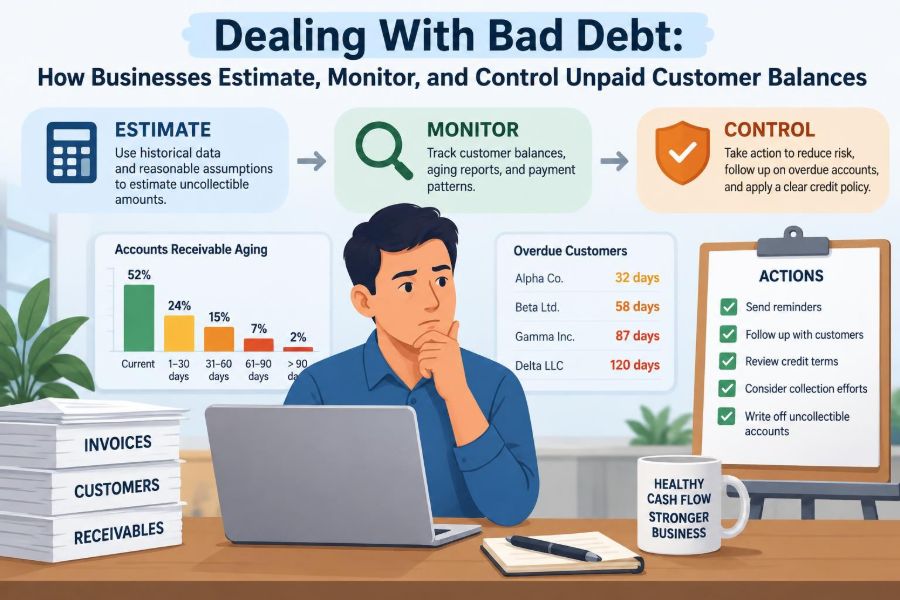
An aging schedule groups invoices by how long they have been outstanding, such as current, 1–30 days overdue, 31–60 days overdue, and older categories. As invoices age, the likelihood of collection often changes.
An aging schedule helps management see where attention is needed. A balance that is only a few days late may need a reminder; a large balance outstanding for several months may require escalation and a more specific loss assessment.
🧠 Estimating by Customer Risk, Not Just Invoice Age
Age is useful but incomplete. A 45-day-old balance from a financially stable, responsive customer with a documented billing dispute may be less risky than a newer balance from a customer who has stopped answering calls.
Better estimates combine aging with customer-specific evidence: payment history, credit limits, disputes, known financial difficulty, industry conditions, and the quality of available security or guarantees.
🌦️ Economic Conditions Can Change the Estimate
Expected collection is affected by conditions outside the accounting department. Higher financing costs, falling demand, supply disruptions, or a downturn in a customer’s industry can make previously reliable debtors more vulnerable.
Management should not automatically increase provisions whenever the economy feels uncertain. The key is evidence: whether conditions are likely to affect the company’s particular customers and outstanding balances.
🔍 Customer-Specific Warning Signs
Some patterns deserve prompt review because they may signal a higher chance of nonpayment:
- Repeated broken promises to pay or unexplained payment delays.
- Orders increasing sharply while older invoices remain unpaid.
- Frequent invoice disputes raised only after reminders.
- Requests to change payment terms after delivery.
- News or direct information suggesting serious financial distress.
None of these signs proves a debt is uncollectible. Together, however, they can justify a targeted credit review rather than relying solely on an average allowance rate.
📞 Collections Start Before an Invoice Is Late
Strong collection practices begin with clear invoices, accurate purchase-order references, correct customer contacts, and agreed payment terms. Many delayed payments are operational problems, not deliberate refusals.
A polite confirmation shortly after invoicing can identify missing documents early. Scheduled reminders then create a consistent process and reduce the tendency to contact customers only after balances become seriously overdue.
🧭 A Sensible Collection Escalation Path
Collection should be firm but proportionate. The objective is usually to recover cash while preserving worthwhile customer relationships.
- Confirm that the invoice, delivery evidence, and contact details are correct.
- Send a clear reminder and ask whether a dispute or document issue exists.
- Call the customer and agree on a specific payment date where appropriate.
- Pause further credit, request a payment plan, or escalate internally.
- Consider external collection or legal advice when the amount, evidence, and likely recovery justify the cost.
Local law, contractual terms, and customer circumstances affect the appropriate next step. A standard workflow should allow informed exceptions.
🛡️ Credit Checks Prevent Some Losses
The cheapest bad debt is often the one avoided before the sale. A credit approval process may review customer references, payment history, financial information where available, ownership structure, and the size of the requested credit line.
Credit checks are not a guarantee. Even a sound customer can encounter sudden difficulty. But structured approval reduces the chance that large exposures are created casually by sales pressure or incomplete information.
🚦 Credit Limits Keep Exposure Visible
A credit limit sets the maximum unpaid balance a customer may carry under normal terms. It converts a broad concern about risk into a practical operational guardrail.
Limits should account for expected purchasing volume, payment behavior, margin, and concentration risk. A customer that represents a large share of receivables may require closer oversight even if it has paid reliably in the past.
🤝 Sales and Finance Need Shared Incentives
Sales teams may focus on revenue and customer growth, while finance teams focus on cash and credit exposure. These goals are not opposites, but they can conflict when a sale depends on extending more credit.
Shared dashboards and approval rules help. If sales staff can see overdue balances and understand why credit holds occur, they are better equipped to resolve issues before promising additional deliveries.
🧾 Disputes Are Not Automatically Bad Debt
A disputed invoice may involve damaged goods, incomplete service, an incorrect price, or a missing approval. The customer may be willing and able to pay once the issue is resolved.
Businesses should track disputes separately from ordinary overdue invoices. This reveals whether the real problem is customer creditworthiness, billing accuracy, delivery performance, or a contract interpretation that needs resolution.
💵 Payment Plans and Settlements Require Judgment
A customer in temporary distress may offer installment payments or a reduced settlement. Accepting can improve recovery compared with immediate escalation, especially if the customer communicates openly and has a credible plan.
But an agreement should be documented clearly: amount, dates, consequences of missed installments, and whether future credit is available. A settlement also may affect revenue, expense, tax, and legal treatment, so appropriate review is needed.
📒 Recording the Basic Journal Entries
When estimating expected uncollectible balances, a typical entry records bad debt expense and credits the allowance for doubtful accounts. The precise account names vary by organization, but the purpose is to recognize the expected reduction in collectible value.
Debit:  Bad debt expense
Credit: Allowance for doubtful accounts
When a specific invoice is written off under the allowance method, the entry reduces the allowance and removes the receivable.
Debit:  Allowance for doubtful accounts
Credit: Accounts receivable
The write-off does not itself reduce net receivables, because both gross receivables and the allowance decrease by the same amount.
🔁 What Happens If a Written-Off Customer Pays
Recovery is possible. A customer may resolve a dispute, obtain financing, or simply pay after collection pressure increases.
In a common allowance-method process, the business first reinstates the receivable and reverses the write-off, then records the cash receipt. This preserves the audit trail and shows that the payment relates to a previously written-off balance.
📊 Key Metrics That Reveal Collection Performance
Metrics do not replace judgment, but they make trends easier to see. Useful measures include the aging distribution, total overdue balances, write-offs by customer group, dispute resolution time, and the gap between estimated losses and actual outcomes.
Days sales outstanding is often used to assess the speed of collection relative to credit sales. It can be helpful for trend analysis, but it may be distorted by seasonality, a few large invoices, or changes in billing timing.
🧪 Testing Whether the Allowance Is Reasonable
After time passes, compare prior estimates with actual collections, write-offs, and recoveries. The purpose is not to demand a perfect prediction; uncertainty is unavoidable. It is to identify systematic bias or outdated assumptions.
If estimates are repeatedly too low, reported receivables may have been overstated. If they are consistently too high, the business may be understating collectible assets or using excessive caution without sufficient support.
🗂️ Documentation Makes Judgment Defensible
Bad-debt estimates involve judgment, so the reasoning should be recorded. Supporting files might include aging reports, customer correspondence, dispute status, payment promises, credit-review notes, and the assumptions behind calculation rates.
Good documentation helps managers challenge estimates constructively and gives auditors or reviewers a clear route from the reported balance to the underlying evidence.
🔐 Internal Controls Reduce Errors and Manipulation
Receivables are vulnerable to both accidental error and intentional concealment. Separation of duties is a basic safeguard: the people approving credit, issuing invoices, receiving cash, and reconciling accounts should not all control the same process.
Other helpful controls include approval of credit-limit overrides, regular bank reconciliations, review of manual journal entries, controlled customer master-data changes, and independent review of aging reports.
⚠️ Common Mistakes Businesses Make
Several habits can turn manageable collection risk into a larger problem:
- Continuing deliveries while an old balance is seriously overdue.
- Using one historical percentage without considering current customers or conditions.
- Writing off accounts too quickly to make aging reports look cleaner.
- Delaying write-offs even when credible evidence shows collection is no longer likely.
- Treating disputed invoices as a collections-only issue instead of fixing root causes.
- Allowing informal payment promises to replace documented agreements.
The common theme is weak feedback. Effective credit management connects sales, billing, collections, accounting, and customer service.
🏗️ Building a Practical Bad-Debt Policy
A workable policy states who can approve credit, how limits are set, when reminders are sent, when accounts go on hold, and who approves settlements or write-offs. It should also define how estimates are prepared and reviewed at each reporting date.
The policy does not need to be complicated to be useful. A small business may use a disciplined spreadsheet and weekly review; a larger organization may need integrated systems, customer risk models, and formal committee oversight.
🧩 When Technology Helps—and When It Does Not
Accounting systems can automate invoice delivery, reminders, aging reports, credit holds, and collection task lists. This reduces missed follow-up and gives teams a more current view of customer exposure.
Technology cannot decide whether an unusual customer promise is credible or whether a dispute reflects a genuine service failure. Data quality, clear ownership, and human review remain essential.
🌱 Balancing Cash Protection With Customer Relationships
A rigid approach may protect short-term cash yet damage valuable relationships, especially when a customer faces a temporary issue and communicates honestly. An overly lenient approach can reward delay and increase losses.
The right balance depends on the customer’s history, the reason for the delay, the amount at risk, available alternatives, and the business’s own cash position. Consistency matters, but thoughtful exceptions can be commercially sensible.
🎯 The Core Principle: Recognize Risk Early, Act on Evidence
Bad debt management is not about assuming customers will fail. It is about recognizing that credit sales carry uncertainty and handling that uncertainty openly in both operations and financial reporting.
Estimate expected losses using relevant evidence, monitor balances before they become critical, resolve disputes quickly, and escalate collection action when facts warrant it. This approach gives leaders a more honest view of both revenue quality and available cash.
The strongest bad-debt process combines realistic accounting estimates with disciplined credit decisions and respectful, timely collection. When those elements work together, unpaid balances become a managed business risk rather than a recurring surprise. 💰📋🤝