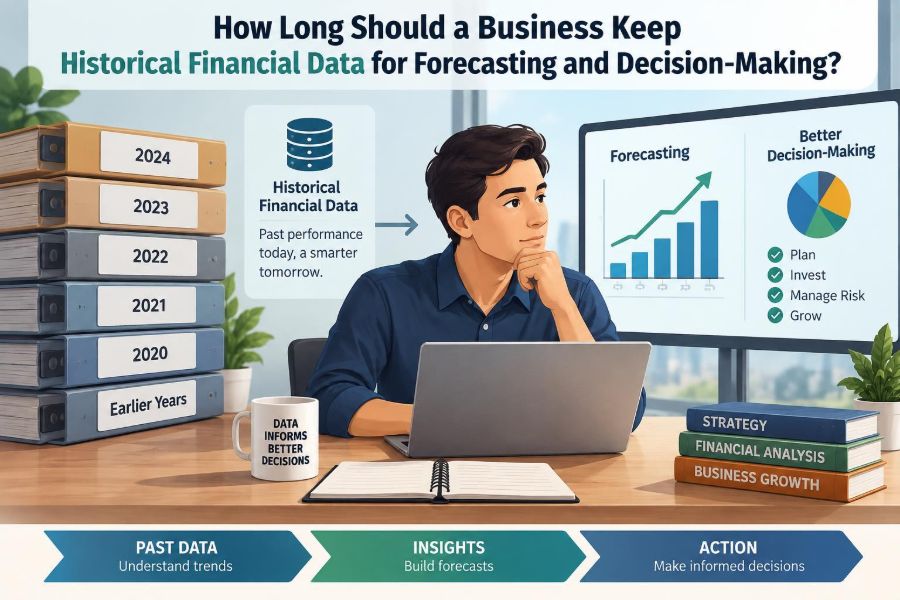

A finance manager is preparing next year’s budget when a department head asks a deceptively simple question: “Can we compare this plan with what happened ten years ago?” The answer may be sitting in an archived accounting system, a spreadsheet on an old drive, or nowhere at all.
Keeping every financial record forever sounds safe, but it can leave a business with expensive storage, confusing reports, outdated assumptions, and weak data governance. Keeping too little is equally risky: a company may lose the context needed to recognize seasonal patterns, defend tax positions, explain a margin change, or build a credible forecast.
The useful question is not “How many years of data should we keep?” It is which records should be retained, at what level of detail, for what purpose, and in what usable format?
Forecasting and decision-making need history, but they do not need all history in the same form. A practical retention approach separates legal records from management data, preserves important business context, and makes the right information easy to find when decisions need to be made.
🧭 Start With the Two Different Retention Questions
Financial-data retention usually combines two separate decisions. The first is a compliance question: how long must a business retain records for tax, audit, corporate, employment, contractual, or regulatory reasons?
The second is a management question: how much historical information remains useful for forecasting, trend analysis, pricing, investment decisions, and performance review? A record can be legally required but analytically unhelpful, or analytically valuable long after its mandatory retention period has ended.
📚 Define What Counts as Historical Financial Data
Historical financial data is broader than annual financial statements. It includes the transactions and operational drivers that explain why reported results changed.
- General ledger balances, journal entries, and trial balances
- Invoices, receipts, purchase orders, payroll records, and bank reconciliations
- Budget versions, forecasts, and management reporting packs
- Sales volumes, customer segments, product costs, inventory movements, and pricing data
- Supporting documents, accounting policies, contracts, and system audit trails
Different data types age differently. A five-year-old bank statement may matter mainly for evidence, while a ten-year series of monthly sales by product may still be highly useful for strategic planning.
🎯 Let the Decision Determine the History You Need
A monthly cash forecast rarely needs twenty years of detail. It needs recent payment behavior, current customer balances, committed spending, and near-term sales expectations.
A decision to open a new location, acquire equipment, or enter a cyclical market may benefit from a much longer record. The right lookback period follows the decision’s time horizon and risk, rather than a universal rule.
Ask: What future uncertainty are we trying to reduce, and what past periods can genuinely inform it? That question is a better starting point than copying a retention policy from another business.
⚖️ Separate Legal Retention From Forecasting Retention
Legal retention periods vary by jurisdiction, entity type, tax position, industry, and document category. They can also be extended by disputes, audits, investigations, insurance claims, or contractual obligations.
For that reason, businesses should obtain advice from qualified legal, tax, and compliance professionals in their relevant jurisdictions. A forecasting policy should never cause the disposal of documents that must still be retained.
Operationally, it helps to maintain two schedules: a records-retention schedule for formal obligations and a management-data schedule for analytical usefulness. They can overlap, but they serve different purposes.
🗂️ Keep Source Evidence Longer Than Convenience Would Suggest
Source records support the amounts in the accounts. Examples include supplier invoices, sales invoices, expense claims, payroll documentation, contracts, and bank records. They are often needed to explain, verify, or reconstruct a historical transaction.
Even when a business stores summarized financial reports indefinitely, deleting source evidence too early can create problems. A summary may show that travel expense rose in a year; the underlying records reveal whether the cause was sales expansion, a one-off event, or miscoding.
📈 Preserve Long-Term Summary Series
Most organizations can retain high-level historical summaries for a very long time at modest cost. Annual and monthly revenue, gross margin, operating expenses, headcount, cash balances, capital spending, and major balance-sheet categories form a valuable long-term business record.
These series help leaders see structural change: the point when a subscription model replaced one-time sales, when a new channel became material, or when fixed costs outpaced growth. Summary data is also easier to migrate between systems than every original transaction.
🔍 Retain Transaction Detail for a Shorter, Purposeful Window
Detailed transaction-level data is powerful for recent analysis but becomes harder to govern over time. It may contain personal information, customer identifiers, outdated product codes, and inconsistent classifications.
A sensible design often keeps detailed records for the period needed for compliance, auditability, and recurring analysis, while preserving standardized summaries beyond that period. The precise window should reflect the business’s obligations and the practical value of detailed drill-down.
🗓️ Match History to the Business Cycle
A business with strong seasonality needs enough complete cycles to distinguish a recurring pattern from an unusual year. Looking at only the last few months can make predictable holiday demand or weather-related slowdowns appear surprising.
Longer cycles matter too. Construction, commodities, hospitality, real estate, and capital-equipment businesses may experience conditions that unfold over several years. If a full cycle can materially affect planning, retain data covering more than one phase of that cycle where possible.
🌦️ Treat Extraordinary Periods Carefully
Not every historical period is a good baseline. A supply disruption, major acquisition, unusual inflation shock, system outage, or emergency closure may distort sales, costs, cash collections, and staffing.
Deleting such periods is usually a mistake. Instead, retain them and label them clearly. Forecast models can exclude, down-weight, or separately scenario-test abnormal data, while decision-makers still retain the evidence needed to understand what happened.
🏷️ Preserve the Context Behind the Numbers
Numbers without metadata can become misleading. Metadata is information that describes data: account definitions, organizational structures, currency, reporting period, system source, approval status, and whether a figure is actual, budget, or forecast.
For example, a sudden jump in “marketing expense” may reflect a real spending increase—or a chart-of-accounts redesign that moved trade-show costs into marketing. Retaining a mapping of old and new account codes prevents false trend conclusions.
🔄 Keep Chart-of-Accounts Mapping Through System Changes
Businesses evolve. Accounts are renamed, departments merge, legal entities are added, and reporting systems change. Without crosswalks, historical comparisons become an exercise in guesswork.
A chart-of-accounts mapping document links prior classifications to current reporting categories. It should explain splits, mergers, reclassifications, and changes in accounting treatment. This small piece of documentation can be more valuable to analysts than years of unstructured exports.
🧾 Do Not Confuse Posted Actuals With Prior Forecasts
Historical forecasts deserve retention because they reveal how the organization planned, not merely what happened. Comparing prior forecasts with actual results exposes recurring bias: perhaps sales are routinely optimistic, labor costs are underestimated, or inventory assumptions lag demand.
Keep the forecast version, issue date, key assumptions, and approval status. Otherwise, a team may accidentally compare actual results with a forecast that was revised after the period began.
🧠 Use Forecast Accuracy as a Retention Test
Historical data earns its place when it improves decisions. One useful test is whether it improves forecast accuracy or helps explain forecast error.
Suppose a retailer finds that monthly sales from the previous three years explain demand well, while data from much earlier periods reflects obsolete products and store formats. The retailer may retain older summaries for strategy but build routine demand forecasts from the more relevant recent history.
📊 Choose an Appropriate Level of Aggregation
More detail is not automatically better. A board considering long-term profitability may need annual and quarterly trends, while a pricing team may need customer, product, region, and discount-level detail.
Aggregation reduces noise and protects sensitive information, but it can hide important shifts. The best approach is tiered: retain a durable executive-level series, preserve management-level detail for meaningful analysis, and control access to sensitive transaction-level records.
🏪 Adjust for Changes in the Business Itself
Historical comparisons assume that the business being compared is reasonably similar across periods. That assumption fails after acquisitions, divestitures, new revenue models, major product launches, or changes in geographic footprint.
Where possible, retain both reported results and adjusted management views. A hypothetical company that acquired a distributor halfway through the year should label consolidated revenue separately from organic revenue. Neither view is “the truth” alone; each answers a different question.
💱 Record Currency, Inflation, and Price Effects
A ten-year revenue series can be difficult to interpret when prices, exchange rates, and purchasing power have changed. Nominal values are the amounts recorded at the time; they may not represent comparable economic activity across distant periods.
For long-range analysis, retain the original currency and the information needed to understand translations and pricing changes. Analysts may create adjusted views when appropriate, but the original reported numbers and adjustment method should remain identifiable.
🔐 Balance Analytical Value Against Privacy Risk
Financial datasets can contain personal information, including employee pay, bank details, addresses, customer identifiers, and sole-trader information. Keeping identifiable detail indefinitely increases exposure if access controls fail or data is mishandled.
Retention should therefore include minimization. After a justified period, a business may be able to remove or restrict identifiers while keeping aggregated data useful for trend analysis. Privacy requirements differ by location and circumstance, so this work should be coordinated with legal and privacy specialists.
🛡️ Make Archived Data Secure and Accessible
An archive that cannot be restored, searched, or understood is not a reliable record. Historical financial data needs access controls, backup procedures, retention locks where required, and a tested way to retrieve records.
Security and usability must coexist. Restricting payroll data is appropriate; making all old financial reports inaccessible to authorized finance staff is not. Define who can view, export, amend, or delete each archive category.
💾 Plan for Software Obsolescence
Accounting software, file formats, and reporting tools eventually change. A database retained for ten years may be useless if nobody can open it or explain its fields.
When systems are replaced, preserve readable exports, data dictionaries, report definitions, and key reconciliation reports. For critical records, test whether the archived format can actually be opened and whether totals reconcile to the final reports from the old system.
✅ Reconcile Before You Archive
Archiving poor-quality data preserves future confusion. Before moving a period into long-term storage, reconcile key balances, resolve known duplicates where possible, document material adjustments, and confirm that management reports agree with the underlying ledger.
A practical archive package often includes final financial statements, trial balance, key reconciliations, approved budgets, major assumptions, accounting-policy notes, and documentation of significant events. This gives future users both the figures and a defensible explanation.
📏 Build a Simple Retention Matrix
A retention matrix turns general intentions into a repeatable operating rule. It identifies each data category, its owner, storage location, retention basis, access level, disposal method, and any legal hold requirement.
| Data category | Primary purpose | Useful retention approach |
|---|---|---|
| Source documents | Evidence, audit, tax, dispute support | Follow applicable legal and contractual rules |
| Detailed ledger transactions | Analysis, reconciliations, investigation | Retain while compliance and analytical value justify detail |
| Monthly management summaries | Trend analysis and planning | Preserve long term in standardized form |
| Budgets and forecasts | Performance review and bias learning | Keep approved versions and key assumptions |
| Master data and mappings | Interpretation across systems | Preserve with the related historical dataset |
The matrix should be reviewed when regulations, systems, business models, or risk exposure change.
👥 Assign Ownership Across Finance, IT, and Legal
Finance understands what the numbers mean. IT manages systems, backups, and security. Legal, compliance, privacy, and records-management teams interpret obligations and exceptions. No single team can create a sound policy alone.
Assign named owners for the policy, data classification, archival process, retrieval testing, and approved disposal. Clear ownership prevents the common outcome where everyone assumes someone else has preserved the critical file.
🚦Use Legal Holds and Exception Rules
A retention schedule is not an automatic deletion machine. If records relate to a known audit, claim, investigation, dispute, or other formal preservation requirement, normal disposal may need to pause.
Document the trigger, scope, responsible owner, and release process for such holds. Staff should know that deleting records under a hold can create serious problems, even if the standard retention period has expired.
🧮 Distinguish Data Retention From Data Backups
Backups exist to restore systems after failure. Retention archives exist to preserve selected records for defined business, legal, and analytical reasons. A backup may be overwritten quickly, difficult to search, and unsuitable as an auditable archive.
Do not rely on old backups as a financial-records strategy. Instead, create intentional archives with clear structure, controls, and retrieval procedures.
🚫 Avoid the “Keep Everything” Default
Indefinite retention feels cautious, but it can increase storage expense, cyber exposure, privacy risk, discovery burden in disputes, and analyst confusion. It also encourages teams to use irrelevant history simply because it is available.
Keeping everything is not the same as preserving knowledge. A well-curated archive with documentation and durable summaries is often more useful than a vast collection of poorly labeled files.
⚠️ Avoid the “Last Year Is Enough” Mistake
The opposite error is treating the latest year as the only relevant history. This approach can miss seasonality, long-term customer behavior, capital-replacement cycles, and prior responses to changing market conditions.
Recent data should normally carry more weight in fast-changing environments. But older data can still identify boundaries, risks, and recurring patterns that a short window cannot reveal.
🔁 Review Relevance Rather Than Using a Fixed Rule Blindly
A fixed number of years is easy to communicate, but relevance should be reviewed periodically. A software business with rapidly changing pricing may need a shorter detailed forecasting window than a utility-like business with stable contracts and long asset lives.
Review questions include:
- Does this data still describe the current business model?
- Can users interpret its classifications and assumptions?
- Has it improved a recent decision or forecast?
- Does it create privacy, security, or storage concerns?
- Should it be summarized, restricted, migrated, or disposed of under the approved policy?
🧪 Test Whether Old Data Improves the Model
Forecasting teams can test several history windows rather than assuming that more history is better. For example, build comparable forecasts using recent periods only, several years of data, and a longer dataset with abnormal periods flagged.
Compare the results against later actual outcomes and assess explainability, not just numerical error. A slightly less precise model may be preferable if managers can understand its drivers and update it when conditions change.
🧱 Create a Layered Historical Data Architecture
A mature approach often uses layers. The first layer holds legally required source evidence. The second contains controlled detailed data for operational analysis. The third preserves standardized long-term summaries, definitions, and decision context.
This structure makes retention more economical and useful. It also allows businesses to protect sensitive detail while retaining the organizational memory needed for long-range decisions.
🧭 The Core Principle: Retain Evidence, Preserve Insight, Remove Unnecessary Risk
There is no responsible universal answer such as “keep all financial data for seven years” for every business and every purpose. Compliance obligations set a minimum for certain records, while forecasting usefulness depends on business cycles, structural changes, data quality, and the decision being made.
The best policy preserves enough detailed evidence to meet obligations and explain material history. It then maintains clean, documented summaries and forecast records for as long as they help the business learn, compare, and plan.
Keep financial history in proportion to its legal duty, decision value, interpretability, and risk—not simply because it is old or easy to store.
A thoughtful retention policy turns old accounting data from a digital storeroom into a reliable decision asset: detailed when proof is needed, summarized when perspective matters, secure throughout, and understandable years after the original transaction. 💼📊🔒