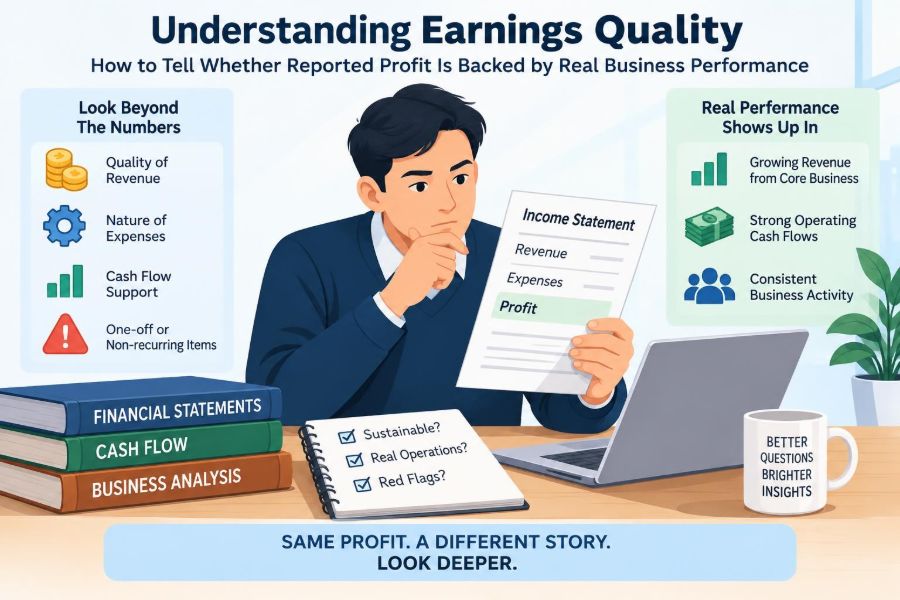

A company reports a strong increase in profit. The headline sounds encouraging, management highlights a record quarter, and the share price may even rise. But a careful reader asks a different question: did the business actually become more productive, or did accounting timing, a one-off gain, or unusually favorable conditions make the result look better?
This distinction matters far beyond investing. Managers use profit to make hiring and pricing decisions. Lenders assess whether borrowers can repay debt. Employees judge the stability of an employer. Students of accounting learn that the income statement is indispensable—but it is not self-explanatory.
Earnings quality is the idea that reported profit should faithfully reflect sustainable economic performance. High-quality earnings are not necessarily fast-growing earnings. They are earnings that are understandable, repeatable, supported by cash generation, and produced without aggressive assumptions.
Learning to assess earnings quality does not mean assuming every accounting estimate is suspicious. It means reading financial statements as connected evidence rather than treating one profit number as a final answer.
🔎 What Earnings Quality Means
Earnings quality describes how useful reported net income is for understanding a company’s underlying performance and for estimating its future earning capacity. The higher the quality, the more closely accounting profit represents the economics of the business.
A retailer that consistently earns profit by selling goods at sensible margins and collecting cash from customers generally has stronger earnings quality than a company whose profit depends heavily on a property sale, a tax adjustment, or optimistic estimates.
🧭 Why the Quality of Profit Matters
Net income feeds valuation models, bonus plans, debt covenants, and performance comparisons. If the number is temporary or poorly supported, decisions built on it can be wrong even when the financial statements comply with accounting rules.
Quality also affects risk. A business with modest but dependable profits may be easier to value and finance than one with larger, volatile profits driven by items that may not recur.
📚 Profit Is an Accounting Measure, Not a Cash Balance
Under accrual accounting, revenue is recognized when it is earned and expenses when resources are consumed—not necessarily when cash changes hands. This matching approach gives a better period-by-period picture than a simple cash ledger, but it creates estimates and timing differences.
For example, a software company may recognize subscription revenue over a service period even if it collected the annual payment upfront. Its cash flow and revenue can both be sensible while moving differently in a given quarter.
💵 The Link Between Earnings and Operating Cash Flow
Over time, a profitable operating business normally needs to convert a meaningful portion of earnings into cash from operations. Operating cash flow begins with net income and adjusts for non-cash charges and changes in working capital.
A single period of weak conversion is not conclusive. A fast-growing business may invest in inventory or extend credit to reliable customers. Persistent growth in profit without corresponding operating cash flow, however, deserves investigation.
🧾 Accruals Explain Many Differences
Accruals are amounts recognized in earnings before cash is received or paid. Accounts receivable, accrued expenses, inventory adjustments, depreciation, and provisions all involve accrual accounting.
Accruals are not inherently bad; they are necessary for useful financial reporting. The quality question is whether the estimates are grounded in evidence and whether accruals reverse into cash or actual costs as expected.
📈 Revenue Recognition Sets the Starting Point
Revenue is often the largest and most visible driver of earnings, so its timing matters greatly. A company should recognize revenue when it has transferred the promised goods or services and reasonably expects to collect consideration, subject to the applicable accounting framework.
Readers should understand what triggers revenue: shipment, delivery, installation, customer acceptance, usage, or time passing. A change in that trigger can change reported growth without changing customer demand.
🚚 Watch for Revenue Pulled Forward
Revenue may be pulled forward when sales are recorded before the company has completed its substantive obligations. Warning signs can include unusually large end-of-period sales, rising contract assets, elevated returns, or disclosures about significant acceptance terms.
Consider a hypothetical equipment supplier that records a sale at shipment even though installation and customer acceptance remain substantial. If those obligations are meaningful, early recognition could make the current period appear stronger than the underlying transaction supports.
🛒 Receivables Reveal Whether Customers Are Paying
Accounts receivable represent sales made on credit. When receivables rise much faster than revenue, the company may be collecting more slowly, granting easier credit, or recognizing sales that have not yet become cash.
Useful comparisons include receivable growth, allowance for expected credit losses, customer concentration, and management’s explanation of payment terms. Seasonal businesses require special care: compare similar periods rather than only sequential quarters.
📦 Inventory Can Hide Pressure on Demand
Inventory should support future sales, but excessive inventory can indicate slowing demand, forecasting errors, or products that may need discounts. It also can delay expense recognition if inventory is carried above the amount expected to be recovered through sale.
Inventory rising faster than sales is a question, not a verdict. A manufacturer may deliberately build stock before a launch or protect supply during a shortage. The key is whether subsequent sales and margins validate that decision.
🏷️ Gross Margin Tests the Economics of Sales
Gross margin is revenue minus the direct cost of goods or services sold. It offers a useful first check on whether growth is profitable, especially for businesses with relatively stable product mixes.
A sudden margin increase may reflect real efficiency, better pricing, or a favorable product mix. It can also reflect lower input costs that may reverse, a classification change, or capitalization of costs that were previously expensed. Notes and management discussion provide needed context.
🧱 Capitalizing Costs Delays Expense Recognition
When a cost creates a resource expected to benefit future periods, accounting may allow capitalization as an asset, followed by expense through depreciation or amortization. Building a factory is a straightforward example.
The judgment becomes harder for development, implementation, acquisition, and internal-use technology costs. Capitalizing too broadly can boost current profit because expenses are postponed. Review changes in capital expenditure, intangible assets, and amortization policies together.
🕰️ Depreciation and Useful-Life Assumptions Matter
Depreciation allocates the cost of a long-lived asset across its expected useful life. Extending an estimated useful life reduces current depreciation expense and increases current earnings, even though the cash paid for the asset has not changed.
There may be valid operational reasons for revised estimates, such as improved maintenance or different usage patterns. A reader should look for whether the revision is disclosed, material, and consistent with the condition and replacement cycle of the assets.
🧮 Provisions Depend on Management Estimates
Provisions and reserves estimate uncertain future costs, including warranty claims, returns, litigation exposure, bad debts, and environmental obligations. Because the final amount is uncertain, reasonable managers can reach different estimates.
Repeatedly releasing prior reserves to meet earnings targets can make profit look smoother than business conditions warrant. Conversely, a large reserve in a weak year can create an easier comparison later. The pattern over several years is more informative than one estimate.
🎁 One-Off Gains Are Real but Not Recurring
A gain on selling land, an insurance recovery, or a favorable legal settlement may legitimately increase net income. Yet it may say little about the earning power of the core business.
Separate economic reality from predictive value. A one-time gain can be genuine and properly reported while still being unsuitable as a basis for forecasting next year’s operating profit.
🔄 Restructuring Charges Need Context
Restructuring can involve severance, facility closures, contract exits, and asset write-downs. Such charges may be necessary to reset a business, but recurring “one-time” restructuring expenses suggest the organization has an ongoing operating problem.
Look at the promised benefits, subsequent cost structure, cash payments, and whether new charges appear year after year. Excluding every restructuring charge from “adjusted” earnings can make a recurring cost disappear from the narrative.
📊 Adjusted Earnings Can Clarify or Mislead
Companies often present adjusted measures that exclude selected items from official accounting results. These measures can help isolate a business’s operating trend, particularly when a large unusual event distorts a period.
But adjustment choices are not neutral. A useful reconciliation starts with the most directly comparable reported measure and clearly explains each exclusion. Be cautious when adjustments are numerous, change frequently, or exclude ordinary costs of operating the business.
| Item | Potentially useful treatment | Reason for caution |
|---|---|---|
| Asset-sale gain | Exclude for operating forecasts | May not recur |
| Acquisition costs | Consider separately | Repeated acquisitions make them operationally relevant |
| Stock-based compensation | Assess separately from cash flow | It can dilute owners and compensate employees |
| Restructuring charge | Examine case by case | Frequent charges may be recurring in substance |
🧾 Tax Rate Changes Can Distort Comparisons
Income tax expense can move because of jurisdictional mix, valuation allowance changes, tax settlements, or deferred tax adjustments. These effects can materially change net income without reflecting a shift in operating sales or costs.
For comparison, many analysts examine pretax income and the effective tax rate alongside net income. This does not dismiss taxes; it identifies whether the change came from the business or from the tax line.
🏦 Debt and Interest Can Mask Operating Strength
Net income includes financing costs. A sound operating business can report lower profit because interest rates or debt levels are high, while another business may look stronger simply because it has less borrowing.
Examine operating profit, interest expense, debt maturity schedules, and cash needed for repayments. Earnings quality includes whether reported profit is available to support the company after its financing obligations.
🏗️ Free Cash Flow Adds a Necessary Question
Operating cash flow is not the same as cash available to owners or lenders. Many companies must spend heavily on equipment, systems, stores, or facilities simply to maintain operations.
Free cash flow is commonly discussed as operating cash flow less capital expenditures, though the precise definition varies. It is especially useful when paired with an understanding of maintenance spending versus growth investment.
📉 Working Capital Can Temporarily Boost Cash Flow
Cash flow can look strong because a company delays payments to suppliers, reduces inventory, or collects customer balances faster. These can be positive operating improvements, but some benefits are temporary.
For instance, extending payables produces a one-time cash lift until payment terms stabilize. Evaluate changes in receivables, inventory, and payables rather than assuming every increase in operating cash flow is sustainable.
🧩 Business Models Need Different Benchmarks
A subscription business may collect cash before recognizing revenue, creating deferred revenue and initially strong cash conversion. A construction company may have milestone billing and contract assets. A retailer may have seasonal inventory swings.
There is no universal “good” ratio. Compare a company with its own history, close competitors, and the normal cash cycle of its industry. A metric becomes meaningful only in context.
🔁 Consistency Makes Trends More Trustworthy
Consistent accounting policies and performance definitions make periods comparable. Changes in revenue presentation, segment composition, expense classification, or key performance indicators can be legitimate, but they complicate trend analysis.
Read disclosures describing policy changes and recast prior periods where available. If management continuously changes the metric it emphasizes, ask whether the old measure stopped telling a favorable story.
🗣️ Read Management’s Explanation Carefully
Management discussion can explain drivers that numbers alone cannot: a supply disruption, pricing action, new facility, lost customer, or investment phase. It is most useful when it connects causes, financial effects, and future uncertainties.
Be alert to vague language such as “timing” or “temporary” without operational detail. A credible explanation does not eliminate risk, but it gives readers enough information to test whether the explanation fits the statements.
📝 Audit Opinions Are Useful, Not a Guarantee
An external audit provides assurance on whether financial statements are presented fairly, in all material respects, under the relevant accounting framework. That is valuable evidence, but it does not guarantee that a company will meet future forecasts or avoid business failure.
Audit reports, critical audit matters where applicable, and internal-control disclosures can point readers toward areas involving difficult judgments. They should prompt better questions rather than replace analysis.
🚩 Look for Patterns Rather Than Isolated Red Flags
One unusual ratio can arise from seasonality, an acquisition, a new product, or a legitimate accounting change. Strong analysis looks for several signals pointing in the same direction.
- Profit rises while receivables and contract assets rise faster.
- Cash conversion weakens for several periods without a clear investment rationale.
- Adjusted profit routinely excludes costs described as unusual.
- Reserves decline even as the underlying operating risk appears to grow.
- Accounting estimates become more favorable during periods of pressure.
These patterns warrant investigation; they do not establish misconduct on their own.
🧪 A Simple Hypothetical Walk-Through
Imagine a distributor whose reported net income increases from one year to the next. At first glance, performance appears better. But sales rose modestly, receivables rose sharply, operating cash flow fell, and management excluded a recurring warehouse reorganization cost from adjusted earnings.
None of those facts alone proves the profit is unsound. Together, they suggest questions: Are customers paying more slowly? Were sales concentrated near year-end? Is the reorganization truly temporary? What cash will the business generate after maintaining its distribution network?
The conclusion may be that earnings are partly sustainable, but their growth is less robust than the headline implies. That is a more useful judgment than either unquestioning optimism or automatic suspicion.
🧰 A Practical Review Sequence
A disciplined process prevents readers from getting lost in disclosures. Start broad, then test the drivers of the result.
- Read the income statement and identify the main source of profit change.
- Compare net income with operating cash flow and capital expenditure.
- Review receivables, inventory, payables, and deferred revenue.
- Identify unusual gains, charges, and tax effects.
- Read accounting policies and notes on material estimates.
- Compare several years and relevant peers before reaching a conclusion.
This sequence is adaptable for students, managers, investors, and credit analysts.
⚖️ Avoid Treating Cash Flow as Perfect
Cash flow is harder to accelerate indefinitely through accrual estimates, but it is not immune to timing or classification effects. A company can improve reported operating cash flow temporarily by managing payment dates, selling receivables, or receiving customer advances.
Likewise, a young company may have negative free cash flow because it is funding worthwhile expansion. The objective is not to demand immediate cash in every period; it is to understand the mechanism and whether it can endure.
🎯 Align the Analysis With Your Decision
A lender may focus on debt service, covenant headroom, and downside cash flow. An equity investor may care more about long-run margins and reinvestment returns. A manager may need to distinguish controllable operating improvement from accounting noise.
The same statements support different decisions, but the central question remains stable: what portion of reported earnings reflects normal, repeatable value creation?
🌱 High-Quality Earnings Are Usually Boring in a Good Way
The most dependable earnings often have an unglamorous profile: clear revenue drivers, stable policies, sensible estimates, cash conversion that fits the business model, and transparent explanations when results change.
Volatility is not automatically low quality. Cyclical industries and innovative businesses can be volatile for genuine economic reasons. Quality means the volatility is visible and honestly explained rather than concealed by selective adjustments.
🧠 The Core Principle to Remember
Reported profit is a starting point for analysis, not the endpoint. Trace it back to customers, contracts, production costs, assets, financing, and cash movement. Then ask what is likely to recur after unusual items and timing effects fade.
The strongest earnings are those a company can explain clearly, support with evidence, and convert into durable economic value over time. That principle keeps analysis focused on business reality rather than on a single attractive headline.
When you read beyond net income and connect the income statement, balance sheet, cash flow statement, and notes, profit becomes more than a number—it becomes a story you can test. 📘💵🔍