
A company can report a healthy profit and still be a disappointing business. That sounds contradictory until you ask a second question: how much money, equipment, inventory, property, and working capital did it take to create that profit?
Imagine two café owners. Each earns $100,000 in operating profit. One needed $500,000 invested in premises, kitchen equipment, and stock; the other needed $2 million. Their profits match, but their use of capital clearly does not.
That is the practical question behind Return on Capital Employed, usually shortened to ROCE. It helps investors, managers, lenders, and students look past the profit total and assess how productively a business uses long-term funding.
ROCE is not a verdict on its own. Different industries need different amounts of capital, accounting choices can affect the measure, and one year rarely tells the whole story. Used carefully, though, it reveals a great deal about business efficiency.
🧭 What Return on Capital Employed Measures
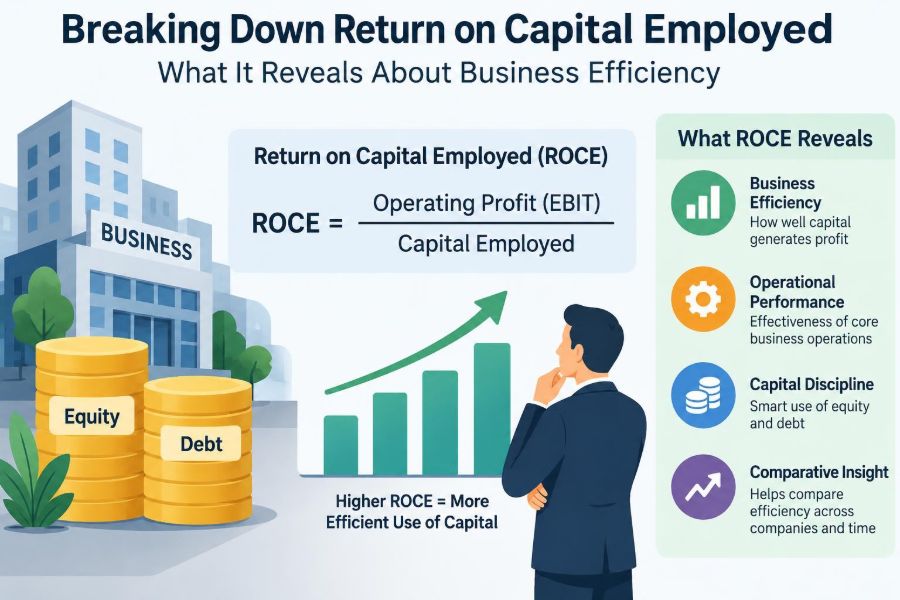
ROCE measures the operating return generated from the capital committed to a business. In simple terms, it asks: for every dollar of long-term capital used, how much operating profit did the business create?
It is a profitability ratio, but not merely a margin. Profit margin compares profit with sales. ROCE compares operating profit with the capital needed to support operations.
This distinction matters because revenue can grow simply by adding stores, factories, inventory, or acquisitions. ROCE tests whether those additional resources are producing an adequate return.
🧮 The Core ROCE Formula
The most common calculation is:
ROCE = EBIT ÷ Capital Employed × 100
EBIT means earnings before interest and tax, often called operating profit. It represents profit from operations before considering how the company financed itself and before tax.
Capital employed is commonly calculated as total assets minus current liabilities, or as equity plus non-current liabilities. When calculated consistently, the two approaches should broadly reconcile.
🔍 Why EBIT Is Used Rather Than Net Profit
Interest expense depends on financing choices. Two similar businesses may operate equally well while one uses more debt and therefore reports lower net profit after interest.
Using EBIT makes ROCE primarily an operating-performance measure. It allows the return to be assessed before the claims of lenders and tax authorities are taken into account.
That does not make financing irrelevant. Debt still affects risk, cash flow, and shareholder returns. It simply means those questions should be examined separately rather than mixed into the operating return calculation.
🏗️ Understanding Capital Employed
Capital employed represents the funds tied up in running the business over the longer term. It includes resources such as property, plant, equipment, inventory, receivables, and cash needed for operations, net of short-term operating obligations.
For a manufacturer, expensive machinery and inventories may dominate the figure. For a retailer, store fit-outs and stock may be central. For a software business, the reported capital base may be relatively small even when the company has substantial economic value.
The denominator is therefore as important as the numerator. A business cannot be judged fairly without understanding what assets it needs to produce its operating profit.
⚖️ Two Common Ways to Calculate the Denominator
| Method | Calculation | What it emphasizes |
|---|---|---|
| Net operating assets approach | Total assets − current liabilities | Assets financed by longer-term capital |
| Long-term funding approach | Equity + non-current liabilities | Sources of permanent or longer-term finance |
Analysts must check definitions in annual reports and databases. Some providers make adjustments for leases, excess cash, discontinued operations, or pension balances, so apparently similar ROCE figures may not be perfectly comparable.
Consistency is more valuable than chasing a single “correct” version. Use the same definition across years and across the companies being compared.
🧾 A Simple Hypothetical Calculation
Suppose Northside Tools reports EBIT of $240,000. Its total assets are $1,600,000 and its current liabilities are $400,000.
Capital employed = $1,600,000 − $400,000 = $1,200,000
ROCE = $240,000 ÷ $1,200,000 × 100 = 20%
The business generated 20 cents of operating profit for every dollar of capital employed during the period. On its own, that is descriptive rather than decisive. The next questions are whether 20% exceeds the company’s cost of capital, whether it is sustainable, and how it compares with peers.
🎯 What a Higher ROCE Usually Suggests
A higher ROCE generally indicates that management is generating more operating profit from the capital invested in the business. It can point to efficient asset use, pricing power, a strong operating model, disciplined investment, or some combination of these factors.
For established companies, a persistently strong ROCE may indicate that profitable expansion opportunities have been identified and managed well. It can also signal an economic advantage, such as a trusted brand, network effects, specialist know-how, or lower-cost operations.
But “higher” is not automatically “better.” A high ratio can result from old, heavily depreciated assets, underinvestment, unusually low working capital, or temporarily elevated profits.
📉 What a Low ROCE Can Reveal
A low ROCE means a large amount of capital is producing relatively little operating profit. The cause may be weak demand, low prices, inefficient production, excess capacity, costly acquisitions, slow-moving inventory, or poor collection of receivables.
It can also arise in a new project before revenues mature. A utility building new infrastructure, for example, may carry the capital cost well before the project contributes fully to EBIT.
The ratio is a prompt for investigation, not proof of poor management. The timing of investment and the economics of the industry need to be understood first.
🪜 ROCE and the Cost of Capital
One of ROCE’s most useful comparisons is with the company’s cost of capital: the return providers of debt and equity funding require for bearing risk.
If a business earns a return on capital above its cost of capital over time, it is generally creating economic value. If it earns below that hurdle, growth may consume capital without producing an adequate return.
The exact cost of capital is an estimate, not a fixed universal number. It changes with business risk, interest rates, financing structure, and investor expectations. Still, the principle is powerful: growth is valuable only when returns justify the capital committed.
🚦 ROCE Is Not the Same as Profit Margin
Profit margin is usually calculated as EBIT divided by revenue. It shows how much operating profit remains from each sales dollar. ROCE adds the capital side of the equation.
A luxury goods company might have high margins and modest capital needs, creating a strong ROCE. A supermarket may operate on low margins but turn inventory quickly and require relatively limited capital per dollar of sales, also potentially producing an attractive ROCE.
The relationship can be expressed as:
ROCE = EBIT margin × Capital turnover
This identity explains why businesses can reach similar ROCE figures through very different operating models.
🔄 The Role of Capital Turnover
Capital turnover is revenue divided by capital employed. It shows how efficiently a business generates sales from its capital base.
A high-turnover model can compensate for thin margins. Discount retailers and distribution businesses often rely on this pattern: each sale produces little profit, but assets and inventory generate sales repeatedly.
Conversely, a business with low turnover needs stronger margins to earn an attractive ROCE. Hotels, specialized manufacturers, and infrastructure operators may have capital tied up for long periods before it generates revenue.
🏭 Why Industry Context Changes Everything
Comparing a capital-light consulting firm with a railway operator using ROCE alone would be misleading. The consulting firm may need little physical capital; the railway requires costly, long-lived infrastructure before it can provide any service.
Useful comparisons usually involve businesses with similar economics, asset intensity, maturity, accounting policies, and geographic conditions. Even within a sector, one company may own its premises while another leases them, affecting the reported capital base.
Compare a company against its own history first, then against carefully selected peers. Broad cross-industry league tables are interesting but often shallow.
🏢 Capital-Intensive and Asset-Light Businesses
Capital-intensive businesses require substantial investment in physical assets. Airlines, utilities, mining companies, manufacturers, and telecommunications networks commonly fall into this category. Their ROCE may be constrained by the large denominator even when operations are sound.
Asset-light businesses rely more heavily on people, intellectual property, platforms, or outsourced production. They can report high ROCE because relatively little tangible capital appears on the balance sheet.
Neither model is inherently superior. Asset-light models can be vulnerable to competition or dependence on skilled staff, while capital-intensive assets can create barriers to entry and support stable long-term demand.
📦 Working Capital’s Quiet Influence
Working capital is the difference between current operating assets and current operating liabilities. Inventory and customer receivables usually increase the capital tied up in operations; supplier payables can reduce it.
Improving stock planning, invoicing promptly, and collecting receivables efficiently can reduce capital employed without cutting sales. If EBIT is maintained, ROCE rises.
There is a limit. Delaying supplier payments excessively may damage relationships, and cutting inventory too far can cause stockouts. Good working-capital management is about matching resources to operational needs, not simply shrinking the denominator.
🧱 Fixed Assets, Depreciation, and Asset Age
Depreciation reduces the accounting carrying value of equipment and buildings over time. As assets age, the capital employed shown on the balance sheet may decline, which can lift ROCE even if the business has not become more productive.
An older factory may therefore appear highly efficient just before it needs major replacement investment. A competitor that recently modernized its plant may look weaker initially because its asset base is higher.
When assessing trends, look for capital expenditure, asset age, maintenance needs, and whether reported returns are being supported by underinvestment.
🏷️ Leases Can Affect Comparability
Many accounting frameworks require substantial lease obligations and right-of-use assets to appear on the balance sheet. This can increase reported assets and liabilities, changing both EBIT and capital employed.
For businesses that rent stores, offices, vehicles, or equipment, the treatment of leases can materially affect ROCE and comparisons with businesses that own similar assets outright.
Read the company’s accounting policies and use adjusted figures with care. The goal is to compare economic reality as closely as possible, not merely to compare a ratio copied from two screens.
🧠 Intangible Assets and the Accounting Gap
Brands, customer relationships, patents, software, and employee expertise can be crucial to a company’s ability to earn profits. Yet internally developed intangibles are often treated differently from assets acquired through an acquisition.
As a result, two economically similar businesses may report different capital employed. One may have built a brand internally, while another bought a brand and records goodwill and other acquired intangibles on its balance sheet.
This is a limitation of all balance-sheet-based return measures. ROCE remains useful, but its numbers should be interpreted alongside the business model and acquisition history.
🛒 Acquisitions Often Test ROCE Discipline
Acquisitions typically add assets, goodwill, and sometimes debt. Immediately after a deal, capital employed may rise faster than EBIT because integration benefits and revenue synergies take time—or fail to materialize.
A falling ROCE after repeated acquisitions can indicate that the company is paying too much, buying businesses with lower returns, or struggling to integrate them. It can also reflect a temporary investment phase.
Ask whether management explains the expected return, the time required to achieve it, and the measures used to track performance after the purchase.
📈 Why Trends Matter More Than One Year
A single year’s ROCE may be distorted by unusual gains, restructuring costs, commodity-price movements, write-downs, or a sharp change in demand. A multi-year pattern provides a clearer view of underlying performance.
A steadily rising ratio may show better margins, improved turnover, or a more focused asset base. A gradual decline can signal that new capital is earning lower returns than the existing business.
Plotting ROCE alongside revenue growth, EBIT margin, capital expenditure, and free cash flow often tells a richer story than any one metric alone.
🌀 Cyclical Businesses Need a Normalized View
In cyclical industries, profits can rise sharply in strong markets while the capital base changes little. ROCE may look exceptional at the top of the cycle and weak during a downturn.
For a commodity producer or shipping company, it is often more informative to consider returns across a full cycle rather than treating a peak-year result as permanent.
Normalize with caution: there is no perfectly objective adjustment. The practical aim is to distinguish recurring operating performance from temporary price or demand conditions.
💵 Cash Generation Is a Necessary Companion
ROCE uses accounting profit, not cash flow. A company can report solid EBIT while cash is tied up in inventory, overdue receivables, or expensive investment requirements.
Review operating cash flow and capital expenditure alongside ROCE. A strong operating return that repeatedly fails to translate into cash deserves closer attention.
Equally, a temporary cash shortfall does not automatically invalidate ROCE. Fast-growing firms may deliberately invest in working capital before the cash benefits arrive. The key is whether the cash pattern makes economic sense.
🧪 A Practical Company-Analysis Process
- Calculate ROCE using a clearly stated definition of EBIT and capital employed.
- Review at least several years, rather than relying on the latest result.
- Break movement into changes in EBIT margin and capital turnover.
- Compare with carefully chosen peers and, where possible, the estimated cost of capital.
- Read notes on acquisitions, leases, impairments, capital expenditure, and unusual items.
- Check whether operating profit is supported by operating cash flow.
This process turns ROCE from a headline percentage into a framework for asking better business questions.
🧰 How Managers Can Improve ROCE Responsibly
Improvement should come from better economics, not cosmetic accounting. The most durable routes are raising operating profit, reducing unnecessary capital tied up in operations, or avoiding investments with inadequate expected returns.
- Improve pricing, product mix, productivity, or procurement to strengthen EBIT.
- Sell or redeploy underused assets where doing so does not harm operations.
- Reduce avoidable inventory and accelerate legitimate collections from customers.
- Apply disciplined hurdle rates to new projects and acquisitions.
- Maintain equipment and service quality instead of merely postponing investment.
The last point matters. Slashing maintenance or refusing necessary upgrades can boost a ratio briefly while eroding capacity, reliability, and future returns.
⚠️ Common ROCE Mistakes
One common error is comparing companies across unrelated industries. Another is treating a high ROCE as proof that a stock, project, or company is automatically attractive.
Analysts also sometimes use year-end capital employed even when the business grew or contracted substantially during the year. In those cases, average capital employed—using opening and closing balances—can better match the period’s EBIT.
Finally, do not confuse a ratio improvement with value creation without examining its cause. A disposal, impairment, or reduction in investment can increase ROCE while weakening the enterprise.
🧾 Average Capital Employed and Seasonal Businesses
Using average capital employed can reduce timing distortions:
Average capital employed = (Opening capital employed + Closing capital employed) ÷ 2
This is particularly useful when a company makes a large investment during the year or has pronounced seasonal inventory levels. A toy retailer, for example, may carry much more stock before a holiday selling period than at another reporting date.
For highly seasonal operations, even a simple average may not fully capture the picture. Monthly or quarterly averages, where available, can offer a more representative denominator.
🧑💼 ROCE for Project and Investment Decisions
Managers can use return-on-capital thinking before money is committed. A proposed new production line should be evaluated not only on predicted sales, but on the operating profit it is expected to generate relative to the capital required.
Suppose a project requires $5 million and is expected to add $750,000 of sustainable annual EBIT. Its indicative operating return is 15% before considering tax, timing, risk, and depreciation assumptions. Management can then compare that return with its hurdle rate and alternative uses of funds.
Real investment appraisal should also consider cash flows and timing, often through methods such as net present value. ROCE is a useful lens, not a substitute for a full capital-budgeting analysis.
📊 ROCE, ROE, ROA, and ROI Compared
| Metric | Typical focus | Useful question |
|---|---|---|
| ROCE | Operating profit relative to long-term capital | How efficiently does the business use committed capital? |
| ROE | Net profit relative to shareholders’ equity | What return do equity holders receive? |
| ROA | Profit relative to total assets | How productively are assets used overall? |
| ROI | Return relative to a specific investment | Did this project or expenditure pay off? |
Each ratio answers a different question. ROE is strongly affected by leverage, ROA may include assets financed by short-term liabilities, and ROI can be defined in many ways. Using several measures prevents overreliance on one viewpoint.
🔎 Questions to Ask When ROCE Changes
When ROCE moves, start with the numerator and denominator rather than the percentage itself. Did EBIT rise because of better recurring operations, or because of a non-recurring item? Did capital employed fall because assets became more efficient, or because the business stopped investing?
- Did margin change, turnover change, or both?
- Were there acquisitions, disposals, impairments, or large capital projects?
- Has working capital changed because of genuine efficiency or short-term pressure?
- Is the result consistent with cash flow and management’s operational narrative?
- Would the conclusion look different using average capital employed?
These questions make the analysis more resistant to superficial conclusions.
🧭 A Balanced Interpretation of Business Efficiency
ROCE is most valuable when it is treated as a bridge between the income statement and balance sheet. It connects operating profit with the resources required to earn it.
A strong and durable ROCE can indicate that a company converts capital into operating earnings effectively. A weak or declining figure can reveal idle assets, poor investment decisions, difficult market conditions, or a business still building future capacity.
The essential task is to understand the story behind the ratio: the industry, investment cycle, accounting treatment, cash conversion, competitive position, and cost of capital.
🏁 The Core Takeaway
Revenue tells you how much a business sells. EBIT tells you how much operating profit it makes. ROCE tells you how effectively the business turns the capital entrusted to it into operating profit.
Use it consistently, compare it thoughtfully, and look beyond a single period. The best analysis does not ask whether a percentage is simply high or low; it asks whether returns are durable, cash-supported, and sufficient for the risks and capital required.
Return on capital employed turns a basic profit figure into a clearer test of whether a business is truly using its resources well. 💰📊🔍