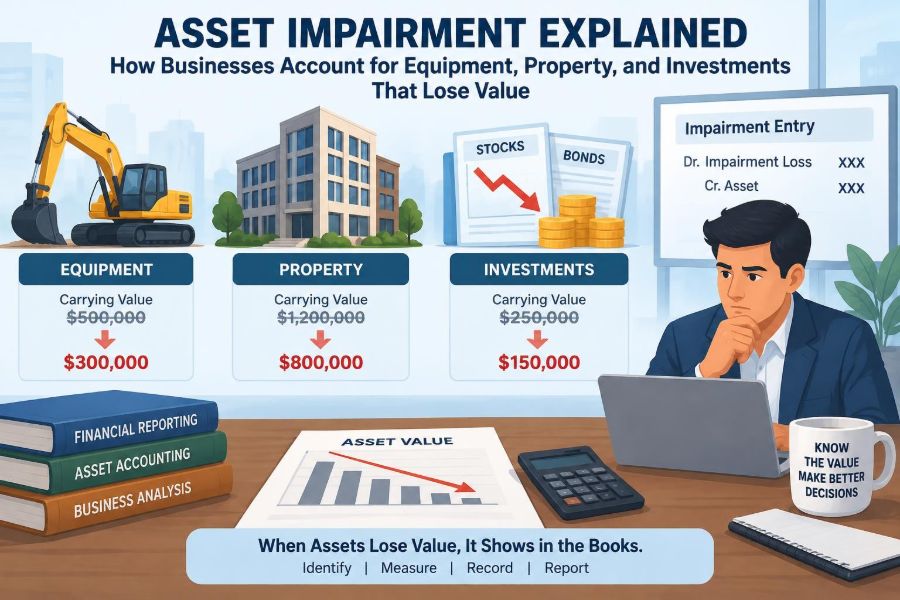

A manufacturer buys a specialized machine, expecting it to produce parts for ten years. Three years later, a new production method makes the machine slower and less useful. It still runs, but is it still worth the amount shown in the accounts?
Or consider a retailer that closes several underperforming stores. The buildings, fixtures, and leasehold improvements remain on the balance sheet, yet the cash those locations can generate has changed sharply.
These situations create an accounting question with real consequences: when an asset has lost economic value, a business may need to reduce its recorded amount. That process is called asset impairment.
Impairment accounting matters because financial statements should not carry long-lived assets or investments at amounts the business is no longer expected to recover. It connects operational reality—failed projects, damaged facilities, falling demand, obsolete technology—to reported profit and financial position.
🔎 What Asset Impairment Means
An asset is impaired when its carrying amount—the amount recorded on the balance sheet—is higher than the amount the entity can recover from it. Recovery may come from using the asset, selling it, or both.
An impairment loss reduces the asset’s carrying amount and is usually recognized as an expense in profit or loss. In plain terms, accounting catches up with a decline in value that depreciation, amortization, or normal market movements have not already captured.
🧱 The Assets Most Often Tested
Impairment can apply to many nonfinancial assets. Common examples include property, plant, and equipment; intangible assets such as patents and software; right-of-use assets from leases; goodwill; and investments accounted for under certain methods.
Financial instruments, such as trade receivables and many debt investments, follow separate expected-credit-loss or credit-loss models. Although people may casually call those declines “impairment,” the measurement rules differ from the long-lived asset rules discussed here.
📖 Carrying Amount: The Starting Point
The carrying amount is not necessarily the price an asset would fetch today. For a machine purchased for $500,000 with $150,000 of accumulated depreciation, its carrying amount is $350,000.
Before testing for impairment, the entity must ensure that depreciation or amortization is current. Otherwise, an apparent impairment may simply be missing routine expense recognition.
⏳ Depreciation Is Not Impairment
Depreciation systematically allocates an asset’s cost over its useful life. It assumes the asset will provide benefits over time and records that expected consumption gradually.
Impairment responds to evidence that expected benefits have fallen more sharply or fundamentally than originally assumed. A delivery van becoming one year older is depreciation; a van fleet damaged beyond profitable repair after a flood may require impairment.
| Feature | Depreciation or amortization | Impairment |
|---|---|---|
| Purpose | Allocate cost over useful life | Reflect an unexpected or significant value decline |
| Timing | Recognized regularly | Recognized when required by a test or indicator |
| Measurement | Based on useful life, residual value, and method | Based on recoverability or recoverable amount rules |
| Effect | Usually gradual | May create a large one-time loss |
🚨 Impairment Indicators: The Warning Signals
Most assets are not fully valued from scratch every reporting date. Instead, management watches for impairment indicators: events or changes in circumstances suggesting that an asset may not be recoverable.
Indicators do not automatically prove an impairment loss. They trigger analysis. The business must then apply the relevant accounting framework and measurement method.
🌍 External Indicators of Value Decline
External conditions can weaken an asset even when it remains physically sound. A sustained fall in market demand, a competitor’s new technology, unfavorable regulation, or a significant adverse change in interest rates can all affect expected value.
A decline in market capitalization below the carrying amount of a listed company can also be a warning signal, especially when it persists. It does not mechanically dictate the impairment amount, but it requires careful consideration.
🏭 Internal Indicators Inside the Business
Internal evidence is often more immediate. Physical damage, unexpected downtime, a decision to discontinue a product line, cost overruns on a development project, or operating losses from an asset group may indicate impairment.
For example, if a hotel’s renovation reveals serious structural problems and management expects fewer usable rooms, the building’s future cash-generating ability may be lower than assumed when it was acquired.
🧩 Why Assets Are Often Tested in Groups
Many assets do not generate largely independent cash inflows. A factory machine may only be useful alongside a building, workforce, production line, and distribution network.
Under IFRS, such assets are commonly tested within a cash-generating unit (CGU), the smallest group of assets generating cash inflows largely independent of other assets. US GAAP uses related concepts, including asset groups for long-lived assets held and used. Defining the group correctly is often one of the most judgmental parts of the process.
🧠 Goodwill Cannot Stand Alone
Goodwill arises when an acquirer pays more for a business than the fair value of identifiable net assets. It represents expected synergies, assembled workforce benefits, reputation, and other future economic benefits that cannot be separately identified.
Because goodwill does not generate independent cash flows, it is allocated to an appropriate reporting unit under US GAAP or CGU group under IFRS. Testing goodwill at a level that is too broad can hide poor performance in an acquired business behind stronger performance elsewhere.
📆 Assets That Require Annual Testing
Some assets must be tested annually, and also whenever an impairment indicator exists. Under IFRS, this generally includes goodwill, intangible assets with indefinite useful lives, and intangible assets not yet available for use.
Under US GAAP, goodwill and indefinite-lived intangible assets are also subject to annual testing, with detailed requirements depending on the asset and reporting framework. A business may choose its annual test date, but it should apply that choice consistently.
🌐 IFRS and US GAAP Share the Goal
Both IFRS and US GAAP aim to prevent assets from being carried above an economically supportable amount. Both require judgment about future cash flows, discount rates, useful lives, and market evidence.
Their mechanics differ in important ways, particularly for long-lived assets held and used, goodwill, and reversal of losses. Professionals should never transfer a calculation template from one framework to another without checking the applicable guidance.
🧮 IFRS: Recoverable Amount
Under IAS 36, an asset or CGU is impaired when its carrying amount exceeds its recoverable amount. Recoverable amount is the higher of two measures: fair value less costs of disposal and value in use.
This “higher of” rule matters. A business does not need to use an asset in the most profitable way if selling it would recover more value, and it does not need to assume a sale if continuing to use it produces more value.
🏷️ Fair Value Less Costs of Disposal
Fair value less costs of disposal estimates the amount obtainable from selling an asset in an orderly transaction between market participants, less incremental costs directly attributable to disposal.
Market prices, recent transactions for comparable assets, and valuation techniques may provide evidence. Costs of disposal can include legal fees, removal costs, and direct selling costs, but they are not simply every future operating cost associated with the asset.
💡 Value in Use and Discounted Cash Flows
Value in use is the present value of future cash flows expected from continuing to use an asset or CGU and ultimately disposing of it. “Present value” recognizes that cash received sooner is generally worth more than the same cash received later.
The calculation requires estimates of sales, operating costs, capital needs, useful life, and terminal proceeds. Cash flows and discount rates must be consistent: for example, a pre-tax cash-flow approach should use a rate that reflects the same basis.
🇺🇸 US GAAP: The Recoverability Screen
For many long-lived assets held and used under US GAAP, an impairment test begins with a recoverability test. The entity compares the carrying amount of the asset group with the sum of expected future undiscounted cash flows from its use and eventual disposition.
If undiscounted cash flows exceed the carrying amount, no impairment loss is recognized under that model, even if a discounted valuation would be lower. If the carrying amount is not recoverable, the loss is generally measured by comparing it with fair value.
🔁 The Key Difference in Measurement
IFRS uses discounted measures directly through recoverable amount. US GAAP’s two-step approach for many held-and-used long-lived assets uses undiscounted cash flows as a threshold, then fair value to measure a loss if the threshold is failed.
That difference can produce different timing and amounts for the same economic facts. Goodwill and indefinite-lived intangible assets have additional, framework-specific testing rules, so a simple “IFRS versus US GAAP” shortcut is rarely enough.
🛒 Assets Held for Sale Follow a Different Path
When management commits to a plan to sell an asset or disposal group and the applicable held-for-sale criteria are met, the accounting changes. The asset is generally measured at the lower of carrying amount and fair value less costs to sell.
Depreciation or amortization generally stops while the asset is classified as held for sale. This reflects the fact that the asset’s recovery is expected through sale rather than continued use.
📉 A Simple Equipment Example
Imagine a company owns a production line with a carrying amount of $900,000. A new competing material sharply reduces orders for products made on that line, creating an impairment indicator.
Suppose the company estimates that fair value less costs of disposal is $620,000 and value in use is $700,000. Under the IFRS recoverable-amount approach, the recoverable amount is $700,000, the higher measure. The hypothetical impairment loss would be $200,000.
The entry would generally debit impairment loss and credit accumulated impairment losses or reduce the asset directly, depending on the accounting system and presentation policy.
🏢 A Property Example Requires More Than a Price Guess
Assume a company owns an office building in a location affected by a long-term loss of major employers. A lower appraisal may be relevant, but management should consider the asset’s intended use, occupancy expectations, rental cash flows, selling costs, and applicable reporting rules.
Property values can be especially sensitive to assumptions about market rents, vacancy, lease incentives, maintenance spending, and discount rates. A valuation is not made more reliable merely because it has many spreadsheet tabs; each major assumption needs support.
📈 Investments and the Accounting Method Matter
“Investment impairment” is not one universal calculation. Equity-method investments, debt securities, equity securities, loans, and investments in subsidiaries can have different impairment or fair-value requirements.
For instance, an equity-method investment is generally assessed for an other-than-temporary or qualifying decline under the applicable framework, while many investments measured at fair value already reflect changes in value through earnings or other comprehensive income. First identify the investment’s classification before deciding which model applies.
🧾 Recording the Impairment Loss
An impairment loss usually reduces current-period profit. On the balance sheet, it lowers the carrying amount of the affected asset or asset group.
The accounting entry may look simple, but the surrounding work is not. The entity must document the triggering event, unit of account, calculations, assumptions, approvals, and disclosures. Auditors and reviewers often focus heavily on this evidence because impairment estimates can materially affect reported results.
🧭 Allocating a Loss Within a Cash-Generating Unit
When a CGU is impaired under IFRS, the loss is first allocated to reduce any goodwill assigned to that unit. Any remaining loss is allocated to other assets in the unit on a pro rata basis, subject to limits.
An individual asset should not be reduced below the highest of its fair value less costs of disposal, its value in use if determinable, and zero. This prevents one asset from absorbing an unrealistic share of a group-level loss.
📅 What Happens After the Write-Down
After impairment, future depreciation or amortization is recalculated using the asset’s new carrying amount, revised residual value where relevant, and remaining useful life. The impairment is not ignored after the date it is booked; it changes future expense patterns.
Management should also revisit operating plans. A write-down may signal the need to retire equipment, renegotiate leases, redesign a product, sell a site, or improve controls over capital spending.
↩️ Can an Impairment Loss Be Reversed?
Under IFRS, impairment losses for assets other than goodwill may be reversed if estimates change and the recoverable amount increases. The reversal is limited: the asset cannot be restored above the carrying amount that would have existed had no impairment been recognized, after normal depreciation or amortization.
Goodwill impairment is not reversed under IFRS. Under US GAAP, reversals of impairment losses for long-lived assets held and used are generally prohibited. This is a major practical difference and a reason to identify the reporting framework early.
🧪 Forecast Quality Drives the Answer
Most impairment work is less about arithmetic than about forecasts. Revenue assumptions should reflect realistic volumes, prices, customer retention, capacity, and competitive conditions—not simply a budget created before bad news emerged.
Useful controls include comparing prior forecasts with actual results, challenging unusually rapid recoveries, reconciling forecasts to board-approved plans, and documenting why key assumptions are reasonable. Sensitivity analysis can show how much headroom remains if sales fall or discount rates rise.
⚖️ Discount Rates Need Consistency
A discount rate should reflect the time value of money and risks not already included in projected cash flows. Double-counting risk is a common error: reducing cash flows for a risk and then adding the same risk again to the discount rate can understate value.
There is no universally correct rate for every asset. The appropriate rate depends on the currency, timing, risk profile, and cash-flow assumptions being valued. Finance teams often use market-based evidence and valuation specialists where the estimates are complex.
🧱 Common Mistakes That Distort Results
- Testing too late: waiting for a formal annual review despite clear interim warning signs.
- Choosing an oversized asset group: allowing profitable assets to mask losses elsewhere.
- Using stale budgets: relying on plans that no longer reflect current demand or costs.
- Confusing cash flow with profit: impairment models need carefully defined cash flows, not just an income-statement line.
- Ignoring disposal assumptions: overlooking closing costs, removal costs, or realistic sale timing.
- Forgetting disclosures: reporting a loss without explaining the events and assumptions behind it.
🗂️ Documentation Is Part of the Accounting
A defensible impairment file explains the story from trigger to conclusion. It should identify the relevant assets, explain the unit of account, state the accounting framework, show source data, and document review by appropriate personnel.
For material estimates, preserve valuation reports, budgets, market data, discount-rate support, sensitivity analyses, and management approvals. Clear documentation helps the organization repeat the assessment consistently and respond to questions long after the reporting date.
🗣️ Disclosures Help Readers Understand Judgment
Financial statement users need more than the total impairment expense. Depending on the standards and facts, disclosures may describe the affected asset or CGU, events causing the loss, measurement basis, key assumptions, discount rates, and sensitivity to reasonably possible changes.
Good disclosure does not eliminate uncertainty. It makes management’s judgment visible, allowing readers to evaluate whether reported asset values depend heavily on ambitious forecasts or volatile market inputs.
🛠️ A Practical Impairment Review Process
- Maintain an asset register linked to locations, projects, and responsible managers.
- At each reporting date, gather operational, market, legal, and financial indicators.
- Identify the correct asset, asset group, CGU, reporting unit, or investment classification.
- Update depreciation and amortization before testing.
- Build supportable cash-flow or fair-value estimates under the applicable framework.
- Review assumptions independently, calculate the loss if required, and prepare disclosures.
- Monitor the asset afterward and revise future depreciation, plans, and controls as needed.
🎯 The Core Principle: Report Recoverable Economic Value
Asset impairment is not a prediction that an asset has become useless. It is an accounting discipline that asks whether the amount on the balance sheet can still be supported by expected economic benefits.
The strongest assessments combine timely operational information with careful valuation work. They distinguish ordinary depreciation from a genuine decline, use the right unit of account, apply the correct reporting framework, and communicate uncertainty rather than hiding it.
When an asset can no longer support its recorded amount, recognizing the loss promptly makes the financial statements more faithful to the business’s economic reality. That principle applies whether the asset is a machine, a building, software, an acquired business, or a strategic investment. 💰📊