
A purchasing manager sees the price of a common component rise from $10 to $14 over several deliveries. The sales team keeps selling finished goods at roughly the same price. Nothing appears to have changed on the warehouse floor: the same shelves, the same products, and the same number of customer orders.
Yet the income statement can tell two different stories, depending on how the business assigns those purchase costs to the units it sells. Under one method, reported profit may look stronger. Under another, it may look more cautious. Neither result necessarily means the company sold more or less.
This is the quiet power of inventory valuation. It shapes cost of goods sold, ending inventory, gross profit, taxable income in some jurisdictions, performance measures, and the decisions managers make from financial reports.
FIFO and weighted average are not merely bookkeeping choices. They are systematic cost-flow assumptions that translate a stream of changing purchase prices into useful accounting information.
📦 Inventory Is an Asset Before It Becomes an Expense
Inventory includes goods held for resale, materials used in production, and items in the process of being made. When a retailer buys goods or a manufacturer buys raw materials, the cost is generally recorded as an asset rather than immediately as an expense.
That cost becomes an expense when the related goods are sold. The expense is called cost of goods sold, often shortened to COGS. Matching inventory cost with the revenue from the sale helps period-by-period profit reflect the activity that generated it.
🧮 The Basic Profit Connection
The starting relationship is simple:
Sales revenue − Cost of goods sold = Gross profit
Holding sales revenue constant, a higher COGS produces lower gross profit. A lower COGS produces higher gross profit. Inventory valuation determines which purchase costs move into COGS and which remain in ending inventory.
Operating expenses, interest, and taxes may still affect final net income. But for a business that buys or makes physical products, the inventory method can materially affect the first major layer of profitability.
🔄 Why Cost Flow Does Not Need to Mirror Physical Flow
A cost-flow assumption is not always a claim about which exact unit physically left the warehouse. A grocery store may rotate older stock first, while a hardware supplier may pick items based on location, order size, or handling efficiency.
Accounting asks a separate question: which recorded costs should be assigned to the units sold? FIFO and weighted average answer that question differently, provided the chosen method is permitted and applied appropriately under the reporting framework.
🚚 FIFO Means First In, First Out
FIFO stands for first in, first out. It assumes that the earliest costs incurred are the first costs assigned to goods sold. The most recent costs therefore tend to remain in ending inventory.
FIFO often resembles the physical movement of perishable goods or products subject to obsolescence. But its accounting use does not depend on literal physical rotation. It is principally a rule for assigning costs.
⚖️ Weighted Average Blends Available Costs
The weighted average method pools the cost of goods available for sale and divides it by the number of units available. Each unit sold and each unit remaining is assigned the same average unit cost for the period or reporting cycle.
It is “weighted” because larger purchases influence the average more than smaller purchases. A 1,000-unit delivery affects the cost pool far more than a 10-unit delivery at the same or a different price.
🧱 The Cost Layers Behind FIFO
FIFO works through identifiable cost layers. Each purchase creates a layer made up of a quantity and a unit cost. Sales consume the oldest remaining layer first for accounting purposes.
Suppose a business holds 100 units at $10, then buys 100 units at $14. If it sells 150 units, FIFO assigns 100 units at $10 and 50 units at $14 to COGS. The 50 units left in stock carry the newer $14 cost.
This layer-by-layer logic makes FIFO especially intuitive when purchase prices change frequently.
🧾 Calculating a Weighted Average Cost
Using the same hypothetical purchases, total goods available are 200 units costing $2,400. The weighted average unit cost is:
$2,400 total cost ÷ 200 units = $12 per unit
If 150 units are sold, COGS is $1,800. The 50 units remaining are valued at $600. Instead of preserving separate $10 and $14 layers in the result, weighted average spreads the $2 price difference across all available units.
📊 One Example, Two Profit Figures
Consider a hypothetical retailer that buys 100 units for $10 each and later buys 100 units for $14 each. It sells 150 units for $20 each, producing sales revenue of $3,000.
| Measure | FIFO | Weighted Average |
|---|---|---|
| COGS | $1,700 | $1,800 |
| Ending inventory | $700 | $600 |
| Gross profit | $1,300 | $1,200 |
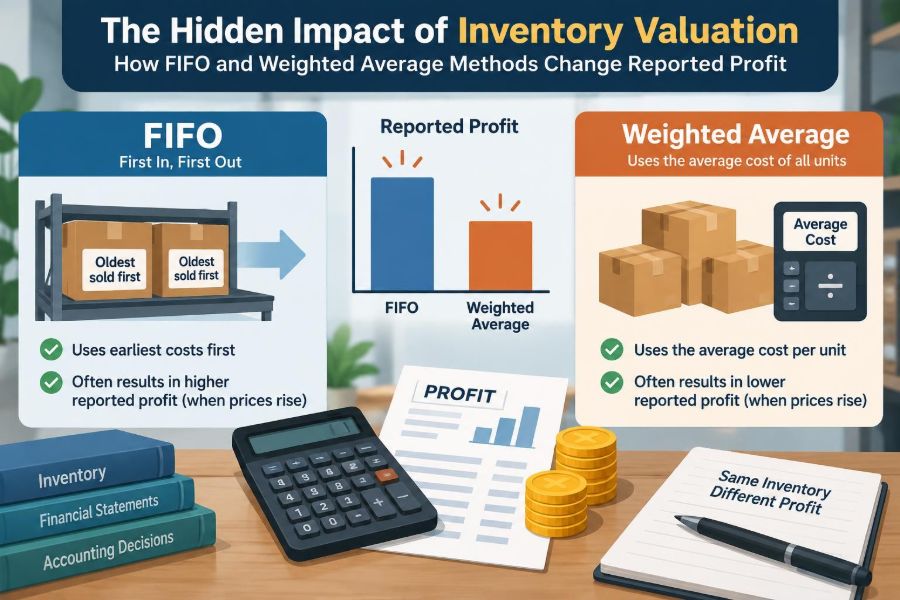
Under FIFO, older and cheaper costs reach COGS first, so gross profit is higher while prices are rising. Under weighted average, the newer higher cost is partly included in every unit sold, moderating that effect.
📈 Rising Prices Usually Favor FIFO Profit
When purchase prices are rising, FIFO usually assigns lower historical costs to COGS. As a result, it usually reports higher gross profit and a higher ending inventory value than weighted average.
“Usually” matters. The precise result depends on purchase timing, quantities, beginning inventory, sales volume, returns, write-downs, and the details of the company’s costing system. The directional pattern is useful, but it is not a substitute for calculation.
📉 Falling Prices Can Reverse the Pattern
When purchase prices fall, the older FIFO layers are generally more expensive than recent purchases. FIFO then tends to produce higher COGS and lower gross profit than weighted average.
This reversal explains why no method is permanently “better” for profit. The price environment, not a label attached to the method, drives much of the difference.
🌊 Stable Prices Reduce the Difference
If units are acquired at broadly similar costs, FIFO and weighted average will produce similar COGS and inventory values. There is little for either method to redistribute.
Differences become more visible when costs move sharply or when inventory remains on hand long enough for several purchase layers to accumulate. Businesses with stable input prices may find the choice less consequential numerically, though consistency and system fit still matter.
🏷️ Ending Inventory Carries a Different Story
Under FIFO during rising prices, ending inventory is often closer to current replacement costs because it contains more recent purchases. This can make the balance sheet inventory figure appear more current than a figure built from older costs.
Weighted average produces an intermediate amount. It does not aim to report replacement cost; it reports a blended historical cost. Financial statement users should avoid treating either amount as a direct estimate of what it would cost to replace every item today.
💵 Cash Does Not Change With the Accounting Method
A crucial distinction: choosing FIFO rather than weighted average does not change the cash paid to suppliers. It also does not change the cash collected from a customer for a given sale.
The method changes the timing and allocation of reported expense. Cash-flow consequences can arise indirectly through taxes where tax rules recognize the method, but the core purchase and sale transactions are the same. Reported profit is not the same thing as cash generated.
🧾 Taxes Depend on Local Rules
Higher accounting profit can lead to higher taxable income when tax reporting uses the same or a linked inventory method. In a rising-cost setting, FIFO’s tendency toward higher profit may therefore accelerate tax expense or tax payments.
However, tax law varies by country and may prescribe separate tax methods, adjustments, or elections. Financial reporting standards and tax reporting can also differ. Businesses should not infer a tax outcome from financial statements alone; qualified local tax advice is necessary for a specific decision.
📏 Gross Margin Can Move Without a Sales Change
Gross margin expresses gross profit as a percentage of sales. If sales prices stay fixed while FIFO produces lower COGS in a rising-price period, gross margin rises even though the business did not negotiate better customer prices.
This matters when comparing periods. A manager may attribute an improved margin to stronger purchasing, pricing, or production efficiency when part of the movement simply reflects older costs flowing through COGS.
🔍 Ratios Require Method Awareness
Inventory valuation influences more than the income statement. Ratios using inventory, COGS, gross profit, current assets, or equity can shift as well.
- Inventory turnover uses COGS relative to average inventory.
- Current ratio includes inventory within current assets.
- Return measures may change because both earnings and asset values can change.
- Gross margin changes directly when COGS changes.
Comparing two businesses without checking their inventory accounting can lead to misleading conclusions, especially in an inflationary or deflationary environment.
🏭 Manufacturers Need to Track More Than Purchases
For manufacturers, inventory includes raw materials, work in process, and finished goods. Costs may include direct materials, direct labor, and an appropriate allocation of production overhead under applicable accounting rules.
FIFO or weighted average can be applied to materials and finished-goods costs, but production adds complexity. Changes in overhead allocation, yield, spoilage, and production volume can affect inventory and COGS alongside the chosen cost-flow assumption.
🛒 Periodic and Perpetual Systems Affect Timing
In a periodic inventory system, COGS is commonly determined at the end of the period after a physical count or inventory determination. Weighted average may be calculated using all costs available during that period.
In a perpetual inventory system, inventory records update with each purchase and sale. A moving-average approach can recalculate the average cost after each purchase. That can produce a different answer from a single period-end weighted average when costs fluctuate.
🧠 Moving Average Is Not Always the Same Calculation
“Weighted average” is sometimes used loosely. Under a moving-average perpetual system, a new purchase changes the average cost available for subsequent sales, but it does not retroactively change the cost assigned to sales already recorded.
Under a periodic weighted-average approach, all purchases in the period may be pooled before the period’s sales are costed. Students and professionals should always ask which system is being used before comparing numbers.
🧰 Practical Systems Make Consistency Possible
Modern inventory software can maintain FIFO layers or average costs automatically, but automation does not eliminate accounting judgment. The chart of accounts, unit-of-measure controls, purchase receiving process, returns handling, and master-data quality all affect the output.
A sound setup establishes clear rules for landed costs, discounts, freight, transfers, assemblies, and adjustments. If those inputs are inconsistent, a perfectly configured valuation method will still produce unreliable results.
🚛 Landed Cost Should Not Be Ignored
The cost of inventory can extend beyond the supplier’s invoice price. Depending on the circumstances and applicable accounting requirements, it may include costs needed to bring goods to their present location and condition, such as freight-in, nonrecoverable duties, and directly attributable handling.
Leaving legitimate acquisition costs out of inventory understates inventory and may understate COGS later. The issue is separate from FIFO versus weighted average, but it changes the cost pool to which either method is applied.
🛑 Write-Downs Are a Separate Test
FIFO and weighted average establish a cost amount; they do not guarantee that inventory is recoverable at that amount. Damaged, expired, obsolete, slow-moving, or overpriced goods may require a write-down under the relevant accounting framework.
A business may therefore hold recently purchased inventory under FIFO but still need to reduce its carrying value if expected recovery from sale or use is lower. Cost flow and impairment-style inventory measurement tests solve different problems.
🔁 Returns, Discounts, and Corrections Need Clear Rules
Customer returns may restore inventory, supplier returns may remove it, and purchase discounts may alter its recorded cost. Each event needs a policy that fits the inventory system and preserves a reliable audit trail.
Manual corrections are particularly risky. An adjustment posted only to COGS, without understanding the physical and recorded inventory position, can distort both profit and the balance sheet. Reconcile quantities before treating a difference as purely a cost issue.
🧮 A Simple Reconciliation Catches Many Errors
For a periodic system, the inventory relationship provides a useful control:
Beginning inventory + Net purchases − Ending inventory = Cost of goods sold
“Net purchases” should reflect the organization’s policy for returns, allowances, freight, and other inventory costs. If the equation does not reconcile, investigate missing receipts, duplicate invoices, incorrect counts, unit conversions, or unrecorded shrinkage.
🔐 Physical Counts Still Matter
Cost assumptions cannot fix wrong quantities. Theft, damage, scanning errors, misplaced stock, unrecorded production usage, and counting mistakes all create differences between records and reality.
Cycle counts throughout the year, supported by independent review of significant adjustments, help keep inventory records credible. Strong quantity controls make the FIFO or weighted-average calculation meaningful rather than merely precise-looking.
⚠️ Common Mistakes in Classroom and Workplace Calculations
Many errors come from mixing methods or overlooking the order of transactions. A calculation may begin as FIFO and quietly switch to average cost when the remaining units are valued.
- Using sale price instead of purchase or production cost in COGS.
- Averaging unit prices without weighting them by quantities.
- Forgetting beginning inventory in the available-for-sale pool.
- Applying a period-end average to a perpetual moving-average exercise.
- Assuming a physical FIFO warehouse requires FIFO accounting in every case.
- Ignoring damaged or obsolete stock because it remains physically present.
Writing down quantities, dates, and cost layers before calculating is often faster than correcting a polished but flawed spreadsheet later.
🧭 Choosing a Method Is a Reporting Decision
The appropriate method depends on the reporting framework, industry practice, operational systems, management needs, tax considerations, and the desire for consistent information over time. A method should be selected because it provides a supportable representation of cost, not because it creates the most attractive single-period profit.
Accounting standards differ. For example, some frameworks permit FIFO and weighted average but do not permit certain other cost-flow assumptions, while local tax rules may add additional constraints. Policies should be documented and reviewed with accounting professionals familiar with the applicable requirements.
🔄 Consistency Improves Comparability
Once a company adopts an inventory costing policy, consistent application lets users compare results across periods. Frequent switching can obscure whether margin changes came from operations or from accounting choices.
A change may sometimes be justified, but it should be evaluated under the relevant standards and disclosed or accounted for as required. The goal is not rigidity for its own sake; it is financial information that remains understandable and comparable.
🗣️ Explain Margin Changes in Plain Language
Finance teams can improve decisions by separating operational performance from cost-flow effects. Instead of reporting only that gross margin rose, explain whether sales prices changed, purchase costs changed, product mix shifted, inventory write-downs occurred, or older cost layers moved through COGS.
This is especially helpful for nonfinancial managers. A plain-language explanation prevents a favorable FIFO effect during rising prices from being mistaken for a permanent improvement in the underlying economics.
🎓 A Repeatable Approach to Solving Inventory Questions
Whether you are studying an exam problem or reviewing a monthly close, use a disciplined sequence:
- List beginning inventory and every purchase by date, quantity, and unit cost.
- Confirm the number of units sold and units remaining.
- Identify whether the system is periodic or perpetual.
- Apply FIFO layers or calculate the appropriate weighted average.
- Check that units accounted for equal units available.
- Check that COGS plus ending inventory equals total cost available for sale.
- Interpret the effect on gross profit, inventory, and ratios in the current price environment.
The final interpretation matters as much as the arithmetic. A correct calculation becomes useful when it explains what readers should expect in the financial statements.
🏁 The Core Principle: Cost Timing Shapes Reported Profit
FIFO and weighted average generally do not change the total cost of all units eventually sold. They change when particular costs are recognized in COGS and where the remaining costs appear on the balance sheet.
In rising-price periods, FIFO commonly reports lower COGS, higher gross profit, and higher ending inventory than weighted average. In falling-price periods, the tendency commonly reverses. When prices are stable, the gap narrows.
The wise reader looks beyond a single profit figure. Ask which inventory method is used, how costs have moved, whether quantities are reliable, and whether write-downs or production factors are also affecting results.
Inventory valuation does not alter the economics of a purchase, but it can significantly alter the story financial statements tell about profit in a particular period. Understanding that distinction makes you a more careful preparer, manager, investor, and student of accounting. 📦📈