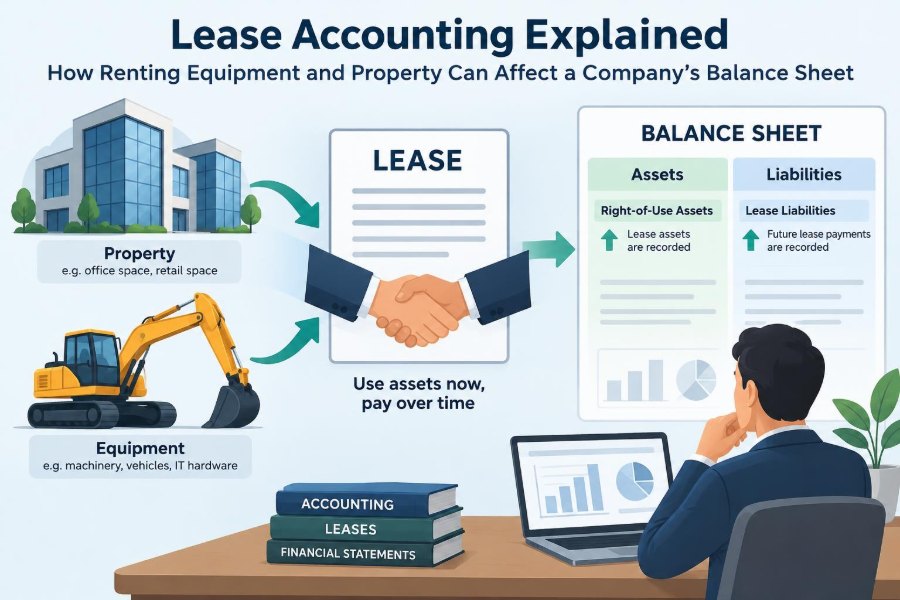

A manufacturer leases a production machine rather than paying the full purchase price upfront. A retailer signs a ten-year agreement for a storefront. A growing technology company rents office space and leases laptops for new employees.
Operationally, these choices feel like renting: make periodic payments, use the asset, and return it when the agreement ends. But accounting asks a second question: has the company taken on a long-term obligation and obtained control over an economic resource?
For many leases, the answer is yes. That conclusion can put both an asset and a liability on the balance sheet, changing debt measures, expense patterns, and the way lenders, investors, and managers interpret financial statements.
Lease accounting is therefore more than a compliance exercise. It is a practical translation of a contract into the economics of rights, obligations, cash flows, and risk.
📄 What Lease Accounting Is Designed to Show
Lease accounting is the process of recording agreements that give a company the right to use an identified asset for a period of time in exchange for consideration, usually payments. The asset may be a building, vehicle, aircraft, machine, server, or specialized equipment.
The central idea is straightforward: a long-term rental can create value and obligations much like financed ownership. Financial statements should show that substance rather than presenting every lease payment solely as a current operating cost.
🔑 The Basic Definition of a Lease
Under major accounting frameworks, including IFRS 16 and ASC 842, a contract contains a lease when it conveys the right to control the use of an identified asset for a period in exchange for consideration.
Control generally involves two features: the customer receives substantially all economic benefits from using the asset, and the customer directs how and for what purpose it is used. A contract can contain a lease even if it is titled “service agreement,” and a document called a lease may include non-lease services.
🏭 What Counts as an Identified Asset
An identified asset is explicitly named in a contract or implicitly available for the customer’s use. A lease for a specific forklift, a defined floor in a building, or a particular production line can meet this condition.
Substitution rights matter. If the supplier can practically and economically replace the asset whenever it chooses, the customer may not control an identified asset. A supplier’s right to substitute only when equipment breaks down does not usually defeat lease classification.
🧭 Control Is More Than Physical Possession
A company can use an asset without controlling its use. For example, a logistics provider may use its own trucks to deliver goods on routes and schedules it chooses. The customer receives a transportation service, not necessarily a truck lease.
By contrast, if a customer has exclusive use of named trucks and decides where, when, and for what cargo they operate, the arrangement is more likely to contain a lease. The contract’s practical decision-making rights are more revealing than its label.
🧩 Separating Lease and Service Components
Many arrangements combine a right-of-use asset with services. An office contract may include space, cleaning, security, utilities, and maintenance. An equipment agreement may include the machine plus an operator or repair plan.
Separating these components prevents a company from treating service costs as lease debt. Depending on the applicable framework and elections available, a lessee may account for components separately or use a practical expedient to combine them. The choice affects the recorded lease liability and should be applied consistently.
📚 The Two Major Frameworks: IFRS 16 and ASC 842
IFRS 16 governs lease accounting for entities reporting under International Financial Reporting Standards. ASC 842 is the U.S. GAAP guidance. Both brought most lessee leases onto the balance sheet, but their income-statement models differ in meaningful ways.
| Area | IFRS 16 lessee model | ASC 842 lessee model |
|---|---|---|
| Balance sheet | Right-of-use asset and lease liability for most leases | Right-of-use asset and lease liability for most leases |
| Expense pattern | Generally depreciation plus interest | Finance leases: depreciation plus interest; operating leases: generally one straight-line lease cost |
| Classification | Single lessee accounting model, subject to exemptions | Finance versus operating lease classification remains important |
The exact requirements, elections, disclosures, and exceptions require careful reference to the entity’s reporting framework. This overview explains the common mechanics rather than replacing professional advice.
🏢 Why Most Leases Now Appear on the Balance Sheet
Historically, many leases were treated as operating leases and remained largely off the balance sheet, although future commitments appeared in note disclosures. That presentation could make two companies with similar long-term rental commitments look very different from a debt perspective.
Modern standards emphasize recognition of the right obtained and the obligation incurred. A lessee usually records a right-of-use (ROU) asset and a lease liability when the lease begins.
🧾 Understanding the Right-of-Use Asset
The ROU asset represents the lessee’s right to use the underlying property or equipment during the lease term. It is not the same as owning the underlying building, vehicle, or machine outright.
At commencement, its initial amount commonly starts with the lease liability, then adjusts for items such as payments made at or before commencement, initial direct costs, and certain incentives received. That asset is subsequently reduced according to the applicable accounting model.
⚖️ Understanding the Lease Liability
The lease liability is the present value of unpaid lease payments the lessee is obligated to make. Present value converts future payments into their value at the commencement date, recognizing that a payment due years from now is not economically equivalent to the same amount due immediately.
Over time, payments reduce the liability, while interest accretes on the unpaid balance. The liability is generally split between current and noncurrent portions, helping users see what is due within the next year versus later periods.
🧮 How Present Value Drives the Opening Numbers
Suppose, hypothetically, a company agrees to pay $50,000 at each year-end for five years to use equipment. The opening liability is not simply $250,000. The company discounts those payments using the appropriate rate, producing a lower present-value amount.
The discount rate is often the rate implicit in the lease if readily determinable. Otherwise, the lessee commonly uses its incremental borrowing rate: the rate it would pay to borrow funds over a similar term, with similar security, in a similar economic environment.
📅 Determining the Lease Term
The lease term includes the noncancellable period plus renewal periods the lessee is reasonably certain to exercise, as well as periods covered by termination options the lessee is reasonably certain not to exercise.
This assessment requires judgment. A below-market renewal rate, costly relocation, specialized leasehold improvements, or an asset essential to operations can create an economic incentive to stay. A stated one-year contract may therefore have a longer accounting lease term if its options are reasonably certain to be used.
💳 Which Payments Belong in the Liability
The liability generally includes fixed payments, in-substance fixed payments, certain residual value guarantees, payments tied to an index or rate using the commencement-date index or rate, and amounts related to reasonably certain purchase options or termination penalties when applicable.
Purely variable payments based on usage or sales are often excluded from the initial liability and recognized in profit or loss when the triggering activity occurs. For example, a payment based solely on monthly machine output is treated differently from a fixed minimum payment.
🛠️ Initial Direct Costs, Incentives, and Restoration Duties
Lease measurement is rarely just “discount the rent.” Initial direct costs may affect the ROU asset. Lease incentives, such as a landlord payment or rent-free period, also change the accounting.
A lessee may have to restore a property at the end of the lease, remove equipment, or repair alterations. When a restoration obligation meets the requirements for a provision or asset retirement obligation, it can add to the initial ROU asset and create a separate liability. Contract review must capture these clauses early.
🚦 The Commencement Date Is the Accounting Starting Line
The commencement date is when the lessor makes the underlying asset available for use. It may differ from the date a contract is signed, and it is normally the date the lessee recognizes the ROU asset and lease liability.
Construction periods, landlord approvals, delayed delivery, and fit-out work can make this date less obvious than expected. Teams should document when control of use actually becomes available, because the date affects discounting, expense recognition, and disclosure.
📈 Finance Lease Expense Under U.S. GAAP
ASC 842 classifies a lease as a finance lease when it effectively transfers significant ownership-like benefits or risks. Indicators include transfer of ownership, a reasonably certain purchase option, a major part of the asset’s remaining economic life, or payments that represent substantially all of fair value.
For a finance lease, the lessee records interest expense on the liability and amortization expense on the ROU asset. Because interest is higher in early periods, total expense is usually front-loaded even when cash payments are level.
📉 Operating Lease Expense Under U.S. GAAP
For an operating lease under ASC 842, the lessee still records an ROU asset and lease liability. The key difference is subsequent expense presentation: the lessee generally recognizes a single, straight-line lease cost over the term.
The liability still uses an interest method internally. The ROU asset is reduced by the amount needed so that interest plus asset reduction equals the straight-line lease cost. This can look counterintuitive, but it preserves the intended income-statement pattern.
🌍 The IFRS 16 Expense Pattern
For lessees, IFRS 16 generally does not retain an operating-versus-finance classification for most leases. The ROU asset is depreciated, while interest is recognized on the lease liability.
That often produces higher total expense in earlier years and lower expense later, assuming level cash payments. It can also increase reported EBITDA because depreciation and interest are normally presented below EBITDA, whereas a traditional rent expense would often have reduced it.
🪶 Short-Term and Low-Value Lease Relief
Accounting standards offer limited practical relief for some leases. Under IFRS 16, a lessee may elect not to recognize ROU assets and liabilities for short-term leases and, subject to the standard’s conditions, leases of low-value underlying assets.
ASC 842 also permits a short-term lease accounting election, subject to its rules. “Short-term” generally refers to a lease term of 12 months or less without a purchase option the lessee is reasonably certain to exercise. These elections reduce administrative effort but should not be assumed automatically.
🚚 Equipment Leases: A Practical Example
Consider a construction business leasing a named excavator for four years. The business decides how it will be used and receives the economic benefit of that use. The supplier provides periodic maintenance but cannot freely swap the excavator for another unit.
The agreement likely contains a lease plus a maintenance service. The business identifies the lease payments, determines the term and discount rate, records the liability and ROU asset at commencement, and accounts for maintenance according to the applicable component policy.
🏬 Property Leases: Why Real Estate Is Often Complex
Property leases may contain stepped rents, tenant improvement allowances, common-area charges, rent-free periods, renewal options, index-linked payments, and restoration clauses. Each feature can affect measurement or classification.
A retail location also creates operational judgment. If a company has invested heavily in store-specific fixtures and the site is critical to its customer base, it may be reasonably certain to renew. That conclusion increases the lease term and can materially increase the recognized liability.
🖥️ Embedded Leases Hidden in Ordinary Contracts
Lease populations are not limited to contracts held by the real estate or procurement team. Embedded leases can appear in outsourcing, data-center, transportation, manufacturing, and supply agreements.
A contract for dedicated server capacity may contain a lease if a specific server is identified and the customer controls its use. Conversely, a promise to provide a computing outcome using the vendor’s interchangeable infrastructure may be a service. Reviewing only documents titled “lease” is a common control failure.
🔄 Modifications and Reassessments Change the Numbers
Lease accounting does not end at commencement. A lease may be modified when parties add space, extend the term, remove equipment, or renegotiate consideration. Depending on the facts and framework, the change may be accounted for as a separate lease or as a remeasurement of the existing arrangement.
Reassessment may also be required after certain changes in option exercise expectations, index-based payments, or other specified events. A documented change-management process is essential; otherwise, financial statements may continue reflecting terms that no longer exist.
📊 Effects on Financial Ratios and Performance Measures
Recognizing lease assets and liabilities can increase reported assets, total liabilities, and leverage measures. Ratios such as debt-to-equity, return on assets, current ratio, and debt covenant calculations may shift, although definitions in lending agreements vary.
Expense presentation can affect EBITDA, operating profit, interest coverage, and trend comparisons. A higher EBITDA does not mean a company has more cash simply because lease cost is now split into depreciation and interest. Analysts should connect reported metrics back to contractual payment obligations.
💵 Cash Flow Statements: Classification Versus Cash Reality
A lease standard can change cash flow classification without changing the total cash paid under the contract. Under U.S. GAAP, operating lease cash payments are generally operating cash outflows, while finance lease principal payments are generally financing outflows and interest follows applicable cash-flow guidance.
Under IFRS, classification can differ, particularly for interest, depending on the entity’s accounting policy and requirements. The practical lesson is simple: never infer cash generation from EBITDA or a single cash-flow category without understanding the lease classification and policy choices.
🗒️ Disclosures Explain What the Balance Sheet Cannot
Lease disclosures help readers understand lease costs, maturity of lease liabilities, discount rates, cash paid, weighted-average lease terms, and significant judgments. Exact disclosure requirements depend on the framework and entity circumstances.
Notes are especially useful when a company has material variable payments, renewal-option judgments, sale-and-leaseback transactions, or large commitments not yet commenced. The face of the balance sheet gives a snapshot; disclosures provide the contractual context behind it.
👥 The Lessor’s View Is Not the Mirror Image
This article emphasizes lessees because their accounting changed most visibly. Lessors still need to classify leases and account for income, underlying assets, residual interests, and collectibility under their applicable guidance.
A contract can therefore produce different accounting outcomes for the two parties without either side being wrong. The lessor’s retained risks, transfer of control, and classification rules matter. Companies that both rent assets and provide them should maintain separate processes for each role.
⚠️ Common Mistakes That Distort Lease Records
- Using the contract signature date instead of the date the asset is available for use.
- Ignoring renewal and termination options without documenting the “reasonably certain” assessment.
- Missing embedded leases in service and outsourcing contracts.
- Using an unsupported discount rate or applying one rate mechanically to very different lease populations.
- Forgetting modifications after business teams renegotiate space, volume, or lease length.
- Mixing service charges with lease payments without a defined component policy.
Most errors originate in contract intake and cross-functional communication, not in the journal entry itself.
🧰 A Practical Lease Accounting Workflow
A reliable process connects legal documents, operational data, accounting judgments, and reporting controls. It should not depend on one person remembering every renewal, amendment, and payment change.
- Collect new, amended, and terminated contracts from procurement, legal, treasury, and business teams.
- Screen contracts for identified assets and control of use.
- Extract payment schedules, options, incentives, services, and restoration clauses.
- Document term, discount-rate, component, and classification conclusions.
- Calculate entries and reconcile the lease subledger to the general ledger.
- Monitor changes and prepare disclosures from controlled data.
🧑💼 Decisions Managers Should Not Make From One Number
Lease liabilities are useful, but they are not identical to bank loans. They arise from a right to use assets, may have different remedies, and can include assumptions about options and variable payments. Comparing them blindly with conventional debt can mislead.
Likewise, leasing is not automatically better or worse than buying. Leasing can preserve flexibility, reduce upfront cash needs, and transfer some residual-value risk. Buying can provide control and long-term economic advantages in other circumstances. Accounting reports the arrangement; it does not determine the business decision.
🔍 Questions to Ask When Reading Lease Notes
Students, analysts, and managers can make lease disclosures more useful by asking targeted questions:
- What assets does the company depend on but not own?
- How much of the liability is due soon, and how much extends far into the future?
- Are major payments fixed, index-linked, or driven by usage?
- What assumptions support renewal terms and discount rates?
- Did lease modifications or new locations materially change the obligation?
- How do the company’s lease metrics compare with its business model and peers?
These questions turn a technical note into evidence about operating commitments and strategic flexibility.
🎓 The Core Takeaway: A Lease Is a Right and an Obligation
Lease accounting starts with economic substance. When a company controls the use of an identified asset for a period and must make payments, it commonly has both a resource—the right to use the asset—and an obligation—the lease liability.
The detailed calculations matter: lease term, payment structure, discount rate, components, options, and later changes all shape the reported figures. But the lasting principle is more accessible: financial statements should show the significant commitments created by using assets over time, not merely the cash paid this month.
Understanding lease accounting means seeing renting as a financial commitment with both operational benefits and balance-sheet consequences. That perspective makes contracts, ratios, and reported performance easier to interpret. 💼📊