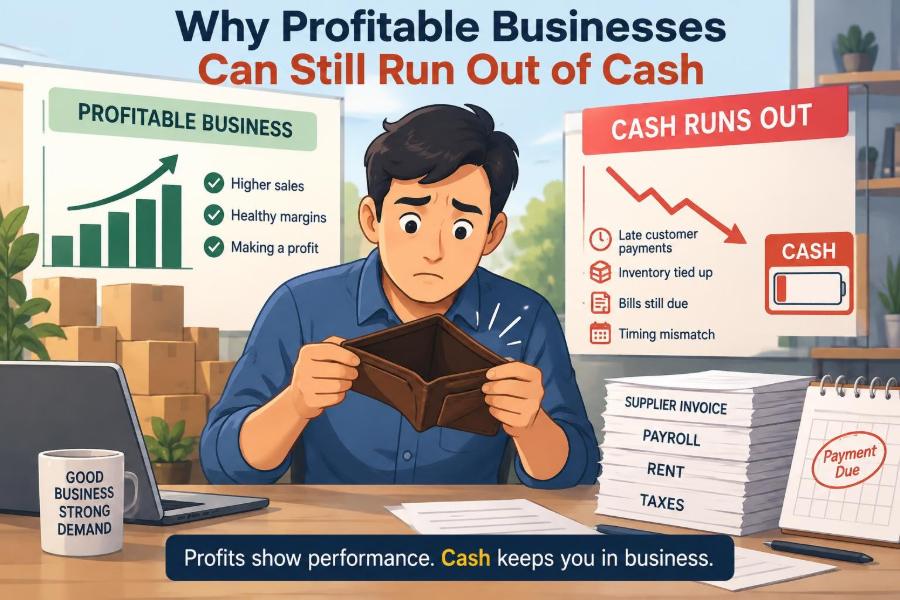

A café is busy every day. Its monthly sales are rising, its income statement shows a profit, and the owner feels that the business is finally working. Then payroll is due, a supplier demands payment, and the bank balance is not enough.
This situation is not a contradiction. It is one of the most common and consequential misunderstandings in business finance: profit is not the same thing as cash.
A company can create value, sell successfully, and report a positive net income while still lacking the money needed to pay its immediate obligations. For students, this distinction makes financial statements more meaningful. For managers and owners, it can determine whether a healthy-looking business survives a period of growth.
Understanding the gap between profit and cash means looking beyond the income statement and following when money actually enters and leaves the business.
🧭 The Central Paradox: Profit Without Cash
Profit is an accounting measure: revenue minus expenses for a period. Cash is the money available in bank accounts or on hand to pay bills. The two often move together over the long run, but they can diverge sharply in any given month, quarter, or year.
A business may record a sale today but receive the customer’s payment weeks later. It may record the cost of materials when it sells a product, yet have paid for those materials months earlier. Timing creates the gap.
📘 What the Income Statement Actually Measures
The income statement summarizes financial performance over a period. Under accrual accounting, it recognizes revenue when it is earned and expenses when they help generate that revenue, rather than simply when cash changes hands.
If a consulting firm completes a project in March and invoices the client for $20,000, March revenue may include $20,000 even if the client pays in May. The firm can be profitable in March without receiving any cash from that sale in March.
🏦 What Cash Flow Measures Instead
Cash flow tracks actual inflows and outflows of money. The statement of cash flows separates these movements into operating, investing, and financing activities.
For day-to-day survival, operating cash flow is especially revealing. It shows whether the core business is generating cash after considering working-capital movements such as customer receivables, inventory, and supplier payables.
🔄 Accrual Accounting Creates Useful Timing Differences
Accrual accounting is not a flaw. It gives a better picture of economic performance than a simple cash record would. A retailer that buys seasonal inventory in October and sells it in December should not appear deeply unprofitable in October merely because cash left before sales occurred.
But accrual accounting requires interpretation. Reported profit answers, “Did the business create economic value during this period?” Cash flow answers, “Did the business have money available during this period?” Both questions matter.
🧾 Credit Sales Can Produce Paper Profits
Many businesses sell on credit. They deliver goods or services now and allow customers to pay later, creating accounts receivable: amounts customers owe the company.
Suppose a wholesaler sells $100,000 of goods in June, at a profit, but offers customers 60-day payment terms. June’s income statement may look strong. Yet the cash needed for wages, freight, rent, and suppliers may not arrive until August.
- Revenue rises when the sale is earned.
- Receivables rise until customers pay.
- Cash rises only when payment is collected.
Fast sales growth can therefore increase a company’s funding needs before it improves its cash position.
⏳ Slow Collections Turn Revenue Into a Funding Need
A receivable is an asset, but it is not spendable cash. Until collection occurs, the business must finance the gap through existing reserves, supplier credit, a loan, or owner funding.
Late-paying customers make this problem worse. An invoice can be legitimate, collectible eventually, and still dangerous if payment arrives after the company’s own obligations fall due. Cash flow depends not only on whether customers pay, but on when they pay.
📦 Inventory Absorbs Cash Before It Produces Revenue
Inventory is another major reason profitable businesses become cash-constrained. A manufacturer pays for components, labor, storage, and transport before a finished item is sold. A retailer pays for stock before customers walk through the door.
That spending often does not immediately appear as an expense on the income statement. Inventory initially sits on the balance sheet as an asset. Its cost becomes cost of goods sold only when the inventory is sold.
Cash can leave today while the accounting expense appears much later. This is normal, but it must be planned.
📈 Growth Can Make the Cash Gap Wider
Growth is usually desirable, yet rapid growth can strain liquidity. More sales may require more raw materials, more stock, more staff, more delivery capacity, and higher receivables.
Imagine a small distributor receiving a large new order. The order may be profitable, but the distributor must purchase goods and ship them before receiving customer payment. If it cannot fund those upfront needs, a profitable opportunity can create a crisis.
This is sometimes called being overtrading: expanding activity faster than the business can finance its working-capital requirements.
🧮 Working Capital Explains Much of the Story
Working capital broadly refers to short-term operating assets and liabilities. A useful operating view focuses on receivables, inventory, and payables.
| Component | Cash-flow effect when it increases | Typical interpretation |
|---|---|---|
| Accounts receivable | Uses cash | More sales remain uncollected |
| Inventory | Uses cash | More cash is tied up in goods |
| Accounts payable | Provides temporary cash | Suppliers have not yet been paid |
A rise in receivables or inventory can reduce operating cash flow even while net income is positive. A rise in payables can preserve cash temporarily, although relying on delayed supplier payments has risks.
🚚 The Cash Conversion Cycle Shows the Timing
The cash conversion cycle follows cash through operations: paying suppliers, holding or producing inventory, selling to customers, and collecting payment. The longer this cycle, the more money the business must keep tied up in operations.
Companies commonly monitor three timing measures: days inventory outstanding, days sales outstanding, and days payable outstanding. Their calculation methods and interpretation can vary by business, but the principle is simple: shorter collection and inventory periods generally release cash, while sensible supplier terms defer outflows.
🏗️ Capital Spending Drains Cash Without Reducing Profit Immediately
Buying a vehicle, machine, computer system, or building can require a large upfront cash payment. Yet accounting usually records a long-lived item as an asset and spreads its cost over its useful life through depreciation or amortization.
For example, paying cash for equipment affects cash immediately. The income statement may recognize only one period’s depreciation expense. A profitable company can therefore report modest expense while experiencing a substantial cash outflow.
🪜 Debt Principal Payments Are Cash Outflows Too
Interest expense reduces profit, but repayment of loan principal usually does not. Principal repayment reduces a liability on the balance sheet rather than appearing as an operating expense.
This is a frequent source of confusion. A business may show a healthy profit after interest expense, then find that scheduled principal payments consume much of its available cash. Profitability analysis should be paired with a clear debt-service schedule.
💸 Owner Withdrawals and Dividends Can Empty the Account
When owners take drawings or a company pays dividends, cash leaves the business. These distributions are generally not operating expenses, so they may not reduce profit for the period.
An owner can unintentionally weaken a profitable company by treating all cash in the bank as personal surplus. Some of that balance may already be needed for tax payments, payroll, inventory, debt installments, or invoices arriving next month.
🧾 Taxes Follow Their Own Calendar
Taxes create another timing mismatch. A company may earn profit over many months, but its tax payment schedule may require a significant cash payment on specific dates. Sales taxes or similar transaction taxes can also pass through the business without being income.
Tax rules, payment dates, and liabilities vary by location and entity type. The practical lesson is universal: estimate obligations early and reserve cash rather than assuming the bank balance is fully available.
🧯 One-Time Cash Costs Can Be Real but Invisible in Comparisons
Cash can be consumed by deposits, legal settlements, system implementations, relocation, restructuring, or repairs. Some costs are expensed immediately; others are capitalized, prepaid, or classified differently from routine operations.
These items should not be ignored merely because they are unusual. A cash forecast should include known non-routine payments, especially when management is comparing current liquidity with an ordinary month’s profit.
📉 Depreciation Makes Profit Lower, Not Cash Lower
Depreciation is an accounting allocation of an asset’s cost over time. It reduces reported profit, but it does not normally require a new cash payment in the period it is recorded.
This explains why operating cash flow often starts with net income and adds back depreciation in an indirect cash-flow statement. The cash for the asset was generally paid when it was acquired, not each time depreciation is recognized.
That add-back does not mean equipment is free. It means the cash event and the accounting expense occur at different times.
⚖️ Profit Margins Do Not Guarantee Liquidity
A company can have high margins and still run short of cash if collections are slow, inventory is excessive, or debt payments are heavy. Conversely, a low-margin business may sustain cash flow if customers pay quickly, inventory turns rapidly, and suppliers offer workable terms.
Margin measures operating economics. Liquidity measures the ability to meet near-term obligations. A durable business needs both, but they answer different questions.
🧪 A Simple Hypothetical Example
Consider a growing furniture retailer. In one month, it sells $60,000 of furniture that cost $36,000. It pays staff and rent of $14,000. On an accrual basis, its monthly profit is $10,000.
But customers paid only $20,000 upfront; the remaining $40,000 is on approved financing and will be received later. The retailer also bought $45,000 of new inventory and paid $8,000 toward a loan principal. Cash flow for the month can be negative despite the $10,000 profit.
The business has not necessarily failed. It has a timing and financing challenge that must be managed until collections arrive.
🔍 Read the Balance Sheet Alongside Profit
The balance sheet explains where resources are tied up and what obligations are due. When profit rises but cash does not, look for changes in receivables, inventory, prepaid expenses, payables, short-term borrowings, and tax liabilities.
A rising receivables balance may be acceptable if it reflects creditworthy customers and a planned growth strategy. It becomes concerning when invoices age beyond agreed terms or when collection assumptions are overly optimistic.
📊 Use the Statement of Cash Flows as a Diagnostic Tool
The statement of cash flows reconciles a company’s opening and closing cash. It helps readers distinguish cash generated by operations from cash raised through borrowing or owners’ contributions.
A business can maintain its bank balance by borrowing even if operations consume cash. That may be an appropriate short-term strategy, but it is different from having self-funding operations. Ask where cash came from, not only how much cash exists.
🗓️ A Cash Forecast Is More Useful Than a Budget Alone
A budget estimates revenue and expenses. A cash forecast maps expected receipts and payments by week or month. Both are valuable, but only the cash forecast identifies whether the company can pay obligations on their actual due dates.
For a small business, a rolling 13-week forecast is often practical because it makes near-term commitments visible. Larger organizations may use more detailed treasury forecasts, but the logic remains the same.
- List expected customer receipts by realistic payment date.
- Schedule payroll, supplier payments, rent, taxes, debt service, and planned capital spending.
- Compare the projected balance with a minimum cash buffer.
- Update the forecast as collection dates and orders change.
🎯 Forecast Collections Realistically, Not Optimistically
A forecast is only as useful as its assumptions. Recording every invoice on its contractual due date can overstate near-term cash if customers often pay later.
Segmenting receivables helps. A long-standing customer with a reliable history may be forecast differently from a new customer, a disputed invoice, or an account already overdue. Finance teams should align forecasts with evidence, not hope.
🤝 Improve Customer Terms and Collection Discipline
Businesses can often improve cash conversion without increasing sales. Clear invoices, prompt billing, accurate purchase-order references, visible due dates, and a polite follow-up process reduce avoidable delays.
Payment terms should fit the market and customer relationship. Demanding immediate payment may damage competitiveness in some industries; offering long terms to every customer can create avoidable strain. The goal is a deliberate credit policy, not maximum strictness.
📦 Manage Inventory as Both an Asset and a Cash Commitment
Inventory protects sales and service levels, but every extra unit ties up cash and may become obsolete, damaged, or harder to sell. Inventory decisions should reflect demand patterns, supplier reliability, lead times, storage costs, and stockout risk.
Reducing inventory indiscriminately can create lost sales. Better management means identifying slow-moving items, improving purchase planning, and setting replenishment levels that match realistic demand.
🤲 Negotiate Supplier Terms Without Damaging Trust
Supplier credit can help align outflows with the cash received from customers. Negotiating payment terms before a growth period may be more constructive than asking for emergency extensions after invoices become overdue.
However, stretching payments beyond agreed terms can harm supplier relationships, reduce future flexibility, and interrupt supply. A payable is not free financing if it jeopardizes the operations that generate revenue.
🏦 Match Financing to the Need Being Funded
Short-term fluctuations in receivables and inventory are often financed with working-capital facilities, overdrafts, or revolving credit where appropriate and available. Long-lived assets may be better matched with longer-term financing, because the asset provides benefits over several years.
Using a short-term loan to fund a long-term investment can create refinancing pressure. Using long-term debt for a brief seasonal cash gap can be unnecessarily costly. Financing choices depend on risk, rates, covenants, security, and local conditions, so professional advice may be needed.
🚦 Know the Early Warning Signs
Cash problems are easier to address before a payment is missed. Watch for patterns rather than isolated incidents.
- Receivables growing faster than sales or becoming increasingly overdue.
- Inventory accumulating without a credible sales plan.
- Regular reliance on delayed supplier payments or emergency borrowing.
- A shrinking cash buffer despite reported profits.
- Large tax, debt, payroll, or capital payments approaching without funding plans.
These indicators do not prove failure. They signal that management should investigate timing, assumptions, and financing capacity.
🚫 Common Mistake: Treating the Bank Balance as Profit
A bank balance is a snapshot, not an income measure. It can include borrowed funds, customer deposits, tax amounts collected on behalf of authorities, or cash needed for bills already incurred.
Likewise, a positive profit figure is not permission to spend. A sound decision asks both: “Is this profitable?” and “Can we afford the cash timing?”
🚫 Common Mistake: Chasing Sales Without Funding the Cycle
Managers may celebrate a large contract without calculating the cash required to fulfill it. The correct analysis includes production or purchase costs, labor, shipping, customer payment timing, deposits, returns risk, and the capacity of existing credit facilities.
Sometimes a business should negotiate a deposit, stage billing, adjust volume, or decline an order that cannot be safely financed. Revenue quality includes collectibility and cash timing, not merely the headline amount.
👥 Different Teams Influence Cash Flow
Cash management is not solely the finance department’s job. Sales teams influence customer terms; operations teams influence inventory; procurement influences supplier arrangements; project managers influence billing milestones; executives approve investment and distributions.
Shared metrics can reduce conflict. For example, a sales incentive based only on booked revenue may encourage generous terms, while a measure that considers collection can better align commercial success with liquidity.
🧱 Build a Cash Buffer for Uncertainty
Forecasts cannot eliminate surprise. Customers may pay late, demand may fall, equipment may fail, or a supplier may require a faster payment. Maintaining a reasonable cash reserve or available credit capacity creates room to respond.
The appropriate buffer differs widely by volatility, seasonality, access to finance, fixed obligations, and industry. It should be based on the business’s risk profile rather than copied from another company.
🧠 The Core Principle: Profit Is Not a Payment Method
Profitability remains essential. Over time, a business that consistently loses money cannot usually sustain itself. But near-term survival depends on liquidity: having enough cash, or reliable access to cash, when obligations are due.
The disciplined approach is to connect the three core statements. Use the income statement to assess performance, the balance sheet to see resources and obligations, and the cash-flow statement plus forecast to understand timing.
When managers track receivables, inventory, payables, capital spending, debt service, taxes, and distributions together, the apparent paradox becomes manageable rather than mysterious.
A profitable business can run out of cash because accounting profit records value created, while cash management determines whether the business can pay its bills on time. Treat both as essential measures of financial health, and use forecasts to bridge the gap before it becomes an emergency. 💰📊🌱