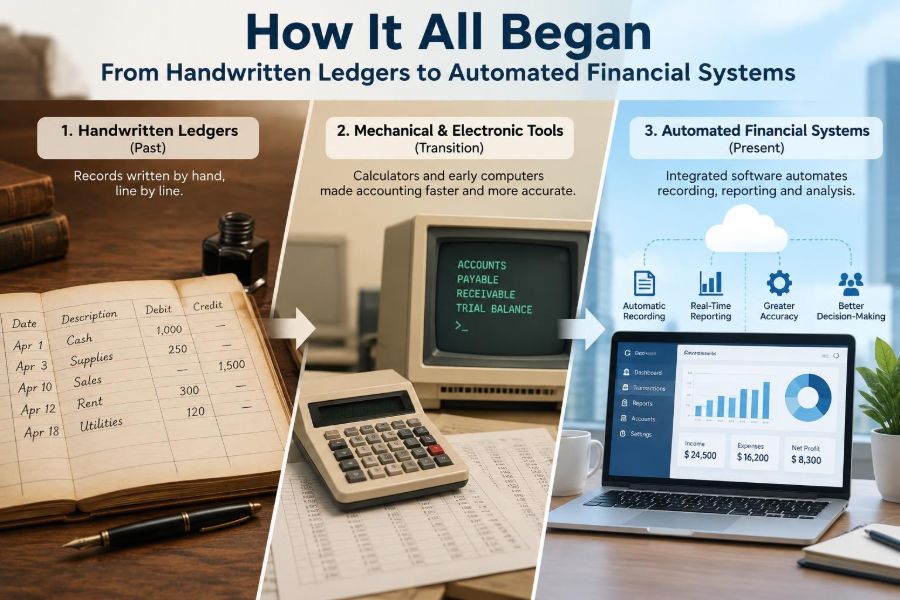

A café owner closes for the night, counts the cash drawer, checks card payments, and wonders whether the business actually made money that day. A century ago, the same question might have meant hours of writing figures into a bound book. Today, software can pull data from the point-of-sale system, match payments to invoices, and update reports almost immediately.
The tools have changed dramatically, but the underlying job has not: record what happened, organize the evidence, and turn transactions into information people can use. Whether the user is a shop owner, lender, investor, manager, tax authority, or employee, accounting provides a shared way to describe economic activity.
That continuity explains why accounting history matters to both students and working professionals. Modern automated systems may feel far removed from ink, paper, and wooden counting boards, yet many familiar ideas—accounts, balances, controls, reconciliation, and audit trails—were shaped by much older problems.
Following the path from handwritten ledgers to automated financial systems makes it easier to understand what software truly improves, what it cannot decide for us, and why sound accounting judgment remains essential.
🏺 Trade Created the Need for Records
Accounting emerged because memory is unreliable when trade becomes frequent, goods move over distance, and more than one person has a claim on the result. Early recordkeeping systems helped communities track crops, livestock, labor, debts, and goods held in storage.
Some of the earliest known administrative records were made on clay tablets in ancient Mesopotamia. They were not financial statements in the modern sense, but they served a familiar purpose: documenting who delivered, received, owed, or controlled resources.
🧾 The First Accounting Problem: Accountability
At its core, accounting addresses accountability: the ability to explain how resources were used and who is responsible for them. A storekeeper needed to show that grain received was the same grain distributed, sold, or remaining in storage.
This purpose still appears in modern organizations. A department manager explains spending against a budget; a nonprofit explains how restricted donations were used; a company explains its financial position to shareholders and creditors.
🔢 Counting Tools Came Before Accounting Systems
Marks, tokens, tally sticks, and counting boards made quantities easier to track. These tools were useful for counting, but counting alone does not create a full accounting system. Accounting also needs categories, timing, evidence, and a method for checking whether records make sense together.
An inventory count of 50 units answers “how many?” A useful record also asks: which item, owned by whom, acquired at what cost, stored where, and changed because of which transaction?
📜 Written Records Made Claims More Durable
Writing changed recordkeeping because it made obligations less dependent on personal recollection. A written record could outlast the people who made an agreement and could be reviewed by someone not present when a transaction occurred.
That durability mattered for trade conducted across cities and seasons. When a merchant sent goods with an agent, both parties needed a record of what was entrusted, what was sold, and what remained due.
🏛️ Governments Expanded the Scale of Recordkeeping
As governments collected taxes, paid workers, maintained stores, and funded public activity, their recordkeeping needs grew. Large administrations required records that could pass through several hands without losing meaning.
This increased the value of consistent procedures. Standardized units, dates, authorizations, and document formats reduced ambiguity. Modern public-sector accounting still reflects this challenge: systems must track large volumes while preserving transparency and control.
⛵ Commerce Made Simple Lists Insufficient
A simple list works when transactions are few. It becomes less reliable when a business buys on credit, sells through agents, borrows money, owns inventory in multiple places, and settles obligations at different times.
Consider a merchant who purchases cloth in one port and sells it months later in another. Cash paid at purchase and cash received at sale do not, by themselves, explain whether the venture produced a gain or loss. The records must connect related events.
📚 Ledgers Organized Transactions by Account
A ledger is a book or record that groups transactions by account, such as cash, inventory, rent expense, sales revenue, or amounts owed by customers. Grouping activity this way turns scattered events into a usable summary.
A daily record might show every sale. The cash account, however, shows the cumulative effect on available funds. The accounts receivable ledger shows what customers still owe. This structure remains central even when the “book” is a cloud database.
🗂️ Journals Preserved the Transaction Story
Historically, transactions were often first entered chronologically in a journal, then posted to the ledger. The journal preserved the narrative sequence: date, parties, description, and amounts.
This division remains useful. A transaction-level record answers, “What happened on March 12?” The account balance answers, “What is the total effect so far?” Good systems retain both views because each supports a different kind of question.
⚖️ Double-Entry Bookkeeping Added a Self-Check
Double-entry bookkeeping records each transaction with at least two effects. If a business buys equipment for cash, equipment increases and cash decreases. If it makes a credit sale, accounts receivable increases and revenue increases.
The approach became widely associated with Italian commercial practice during the late medieval and Renaissance periods, and Luca Pacioli’s 1494 work famously described bookkeeping methods used by merchants. He did not invent all the practices he documented, but his publication helped spread their principles.
➕ Debits and Credits Are Directions, Not Good and Bad
One common beginner mistake is treating debits as losses and credits as gains. In double-entry accounting, they are simply labels for the left and right sides of an account.
Whether a debit increases or decreases a balance depends on the account type. Assets and expenses generally increase with debits, while liabilities, equity, and revenue generally increase with credits. Learning the underlying logic is more durable than memorizing isolated rules.
🧮 The Accounting Equation Holds the System Together
The basic accounting equation is Assets = Liabilities + Equity. Assets are resources controlled by the entity; liabilities are obligations to others; equity is the residual interest after liabilities.
Every properly recorded transaction preserves this relationship. Borrowing cash raises both assets and liabilities. Earning revenue generally raises assets or receivables and, ultimately, equity. This equation gives double-entry records an internal structure rather than merely a balancing trick.
🔍 Trial Balances Revealed Some Errors
After posting entries, bookkeepers prepared a trial balance to check whether total debits equaled total credits. This was a valuable checkpoint before preparing financial reports.
But a balanced trial balance is not proof of perfection. It may not reveal a transaction omitted entirely, an entry recorded twice on both sides, or a correct amount assigned to the wrong account. Controls must therefore go beyond arithmetic agreement.
🕯️ Manual Books Required Discipline
Handwritten systems rewarded careful routines: date documents promptly, use consistent account names, cross-reference entries, total columns carefully, and preserve records. A smudged figure, skipped line, or posting error could take substantial time to trace.
The physical design of a ledger was itself a control. Ruled columns, page numbers, signatures, and sequential documents made changes easier to detect. Paper systems were slower, but their visible trail could be remarkably clear when maintained well.
📦 Inventory Brought Physical Reality Into the Books
Inventory accounting has always required comparing records with actual goods. A ledger might say 200 items remain, but damage, theft, spoilage, receiving errors, or counting mistakes can make that number inaccurate.
Physical counts and reconciliations bridge the gap between recorded information and reality. Automation can improve inventory visibility, but it cannot eliminate the need to verify that a system record corresponds to the item actually on the shelf.
🏭 Industrial Growth Increased Transaction Volume
Industrialization brought factories, payrolls, machinery, larger supply chains, and complex production costs. Owners needed more than a record of cash in and cash out; they needed to understand the cost of making products and operating at scale.
This encouraged the development and wider use of cost accounting methods. Managers began separating direct materials, direct labor, and indirect costs so they could estimate product costs, set prices, and identify inefficient processes.
🧑💼 Professional Accounting Developed Around Trust
As businesses grew and ownership became separated from day-to-day management, outside parties needed credible financial information. Lenders, investors, and owners could not personally observe every transaction.
This created demand for trained accountants, repeatable reporting practices, and independent review. Professional accounting is not merely paperwork; it supports trust where decision-makers must rely on information prepared by others.
🛡️ Audits Formalized Independent Examination
An audit is an independent examination designed to provide assurance about financial information, within the scope of the engagement. It does not mean that every individual transaction is checked or that all fraud is guaranteed to be found.
Auditors evaluate evidence, test selected items, assess controls, and consider whether the financial statements are presented according to the applicable reporting framework. The need for an audit trail—evidence linking a report back to source activity—has endured across every technology shift.
🧾 Source Documents Remain the Starting Point
Invoices, receipts, purchase orders, bank records, contracts, timesheets, and delivery confirmations are source documents. They substantiate what the accounting system records.
In an automated environment, these may be digital files, scanned documents, electronic approvals, or data exchanged between systems. The format changes, but the question does not: what evidence supports this recorded event?
⌨️ Mechanical and Electronic Machines Reduced Repetition
Adding machines, calculators, and early tabulating equipment reduced repetitive arithmetic and sorting work. They did not replace accounting principles, but they lowered the time needed to process growing volumes of data.
The practical shift was significant. When totals can be calculated faster, people can spend more time investigating exceptions, preparing analyses, and reviewing whether transactions were classified correctly.
💾 Mainframes Centralized Business Data
Early computerized accounting systems often ran on mainframes and were operated by specialized data-processing teams. Transactions were collected, processed in batches, and reported on scheduled cycles.
Batch processing was efficient for large volumes but could delay visibility. A manager might receive a report after the period had closed rather than seeing an up-to-date position during the day. This limitation shaped later demand for more immediate systems.
🖥️ Spreadsheets Put Modeling in More Hands
Spreadsheets made it much easier for finance professionals to build budgets, forecasts, reconciliations, and what-if analyses. Their flexibility remains valuable because business questions do not always fit a fixed report template.
That flexibility also creates risk. A formula can be overwritten, a link can break, or multiple versions can circulate with no clear owner. Spreadsheets work best when their purpose, inputs, review process, and version control are proportionate to the decision they support.
🔗 ERP Systems Connected Operational and Financial Data
An enterprise resource planning system, often called an ERP, links functions such as purchasing, inventory, sales, payroll, production, and general ledger accounting. Rather than re-entering data in separate systems, one approved event can update several connected records.
For example, receiving goods may update inventory records, create a liability for a supplier invoice, and provide data for later cost reporting. Integration can reduce duplicate entry, but only if master data, workflow design, and access permissions are well governed.
☁️ Cloud Platforms Changed Access and Collaboration
Cloud accounting platforms allow authorized users to access current records through the internet, often from different locations. This can support collaboration between internal teams, accountants, managers, and clients without exchanging files repeatedly.
Cloud delivery does not automatically make data secure or reliable. Organizations still need strong passwords, multi-factor authentication, defined user roles, backup practices, vendor due diligence, and procedures for reviewing system changes.
🤖 Automation Handles Rules, Not Responsibility
Modern tools can import bank transactions, recognize invoice fields, route approvals, calculate recurring entries, match records, and flag unusual items. These features can reduce manual effort and improve consistency for routine work.
Automation is strongest when the underlying process is stable and rules are explicit. It is weaker when documents are ambiguous, circumstances are unusual, or a transaction requires interpretation of a contract, policy, or reporting requirement. Fast processing is not the same as correct accounting.
🔄 Reconciliation Is Still the Essential Reality Check
A reconciliation compares two related sets of records and explains differences. The familiar bank reconciliation compares the company’s cash records with the bank statement, accounting for timing differences and errors.
Automated matching makes reconciliation faster, especially when data is structured and volumes are high. Yet unmatched items deserve attention rather than automatic dismissal. They may represent timing, duplicate entries, missing documents, fraud indicators, or a flawed system rule.
🔐 Internal Controls Must Evolve With Technology
Internal controls are processes designed to reduce risks such as error, unauthorized activity, and unreliable reporting. In a manual environment, a control might be a signed approval and locked filing cabinet. In a digital environment, it may include role-based access, approval workflows, change logs, and automated exception reports.
A key principle is segregation of duties: no single person should control every stage of a sensitive transaction where practical. For example, the person who creates a supplier should not also be able to approve payments to that supplier without independent review.
🧠 Data Quality Determines Report Quality
Financial reports are only as useful as the data and rules that produce them. Duplicate suppliers, inconsistent customer names, incorrect tax settings, poorly designed account codes, and missing dates can all create misleading outputs.
Good data governance gives ownership to important data fields, defines standards, restricts unnecessary changes, and establishes review routines. This may sound administrative, but it directly affects cash forecasting, compliance work, profitability analysis, and management decisions.
📊 Real-Time Reporting Requires Careful Interpretation
Dashboards can display sales, cash balances, receivables, inventory, and performance indicators quickly. Timely information can help managers act sooner, particularly when they understand what the measures include and exclude.
However, “real time” may mean that transactions are still unreviewed, estimates have not been updated, or period-end adjustments have not been recorded. A live dashboard is useful for operational awareness; it is not automatically equivalent to finalized financial statements.
🧭 The Accountant’s Role Has Shifted, Not Disappeared
When routine posting becomes automated, accountants can devote more attention to analysis, controls, process design, interpretation, and communication. They help translate system output into decisions: why margin changed, which customers are slow to pay, or whether a forecast rests on realistic assumptions.
That shift requires technical fluency as well as accounting knowledge. Professionals increasingly need to understand data flows, system permissions, automated rules, and the limits of the reports they present.
⚠️ Common Mistakes When Modernizing Finance Systems
Technology projects often struggle because organizations focus on software features before defining the accounting process. Moving a confusing chart of accounts or poorly controlled approval process into a new platform simply makes the old problem faster.
- Automating a broken workflow: map the current process and remove unnecessary steps first.
- Ignoring data migration: clean, classify, and test historical data before relying on it.
- Giving excessive access: apply the least privilege needed for each role.
- Skipping user training: explain both clicks and accounting consequences.
- Assuming reports are self-explanatory: define metrics, cutoffs, and ownership.
🛠️ A Practical Path to Better Automation
Useful automation begins with a specific problem. A business may want to shorten invoice approval time, reduce duplicate data entry, improve bank reconciliation, or produce a more reliable cash forecast. Each goal requires a different design.
- Document the transaction from source evidence to final report.
- Identify manual steps, decision points, risks, and recurring exceptions.
- Standardize account codes, master data, and approval rules.
- Test automation with realistic transactions, including unusual cases.
- Monitor exceptions and revise rules when business conditions change.
This approach treats technology as part of a controlled accounting process rather than as a shortcut around one.
🌉 The Enduring Bridge Between Books and Bots
Handwritten ledgers and automated platforms sit at opposite ends of a long technological journey, but they share the same foundation. Both must capture events faithfully, classify them consistently, retain evidence, preserve relationships between accounts, and allow someone to review the result.
The core principle is simple: accounting systems are trustworthy not because they are manual or automated, but because their records, controls, and human judgments work together. Software can accelerate the mechanics; people remain responsible for the meaning, integrity, and consequences of the numbers.
From a clay tablet to a cloud dashboard, accounting has always been the discipline of making economic activity understandable and accountable. Learning the history makes modern systems less mysterious—and makes us better prepared to use them wisely. 📚⚙️💰