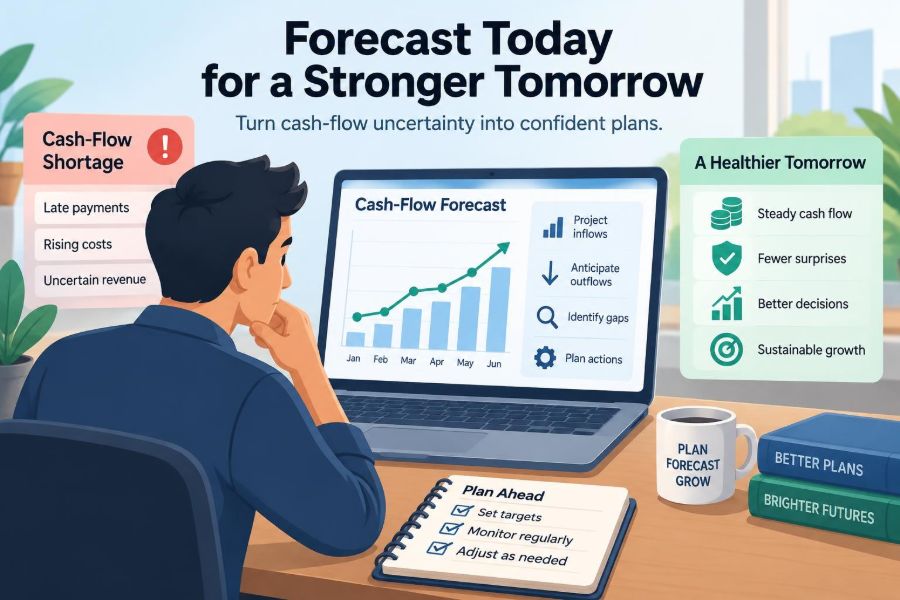

A business can look profitable on paper and still struggle to make payroll on Friday. A large customer may have placed an order, inventory may be moving, and the income statement may show a healthy margin. But if the customer will not pay for another 60 days, the cash needed this week may not exist.
This is the uncomfortable reality behind many cash-flow shortages. They often do not begin with a dramatic collapse in sales. They begin with a timing mismatch: money leaves the business before expected money arrives.
Owners and finance teams sometimes respond only when the bank balance becomes alarming. At that point, their choices may be limited to delaying payments, drawing on costly credit, or turning down an opportunity that requires upfront spending.
Cash forecasting changes the conversation from “How do we survive this week?” to “What is likely to happen next, and what can we do now?” It is not a crystal ball. It is a disciplined planning process that makes upcoming pressure visible while there is still time to respond.
💵 Cash Flow Is Not the Same as Profit
Profit measures whether revenue exceeds expenses over an accounting period. Cash flow tracks actual cash moving into and out of the bank account. Both matter, but they answer different questions.
For example, a consulting firm can invoice a client for completed work in March and record revenue then. If the client pays in May, the firm has earned profit but cannot use that invoice to pay April rent.
Accrual accounting is designed to match income and costs to the period in which they are earned or incurred. Cash forecasting complements it by focusing on when cash is expected to be available.
⏱️ Why Timing Creates Shortages
Most cash shortages are timing problems. A company may pay employees weekly, suppliers within 30 days, and tax obligations on fixed dates, while its customers pay invoices after 45, 60, or 90 days.
Seasonality can widen the gap. A retailer may need to buy stock months before a holiday sales period. A construction contractor may pay labor and materials long before reaching a billing milestone.
Growth can also consume cash. More sales may require more inventory, more staff, and more customer credit before collection catches up. That is why rising revenue is not, by itself, proof that liquidity is improving.
🔭 What a Cash Forecast Actually Does
A cash forecast estimates the opening cash balance, expected cash receipts, expected cash payments, and resulting closing balance for future periods. Those periods may be days, weeks, months, or a combination.
Its purpose is practical: to identify when available cash may fall below a safe level, when surplus cash may build, and which assumptions are driving the result. A forecast should support decisions, not merely produce a neat spreadsheet.
The basic relationship is straightforward:
Closing cash = Opening cash + Cash inflows − Cash outflows
The hard work lies in making each line realistic, keeping it current, and recognizing uncertainty before it becomes a crisis.
🧭 Choose the Right Forecast Horizon
A useful forecast usually works at more than one time horizon. Near-term detail helps manage immediate obligations; longer-term estimates support larger financial decisions.
| Horizon | Typical level of detail | Best used for |
|---|---|---|
| Daily or weekly | Known invoice dates, payroll, supplier due dates | Protecting short-term liquidity |
| Monthly | Expected collections, recurring costs, planned spending | Budget control and working-capital planning |
| Quarterly or longer | Broader sales and investment assumptions | Funding, hiring, and strategic choices |
A weekly 13-week forecast is common because it is long enough to reveal a developing gap and close enough to use specific operational information. The best horizon depends on the business cycle, not on a universal template.
🏦 Start With Verified Opening Cash
Every forecast begins with the cash actually available at the start of the period. This sounds simple, but errors occur when teams rely on an old bank balance, forget restricted cash, or treat an unused credit facility as cash.
Reconcile bank accounts regularly and identify funds that cannot be freely used. Cash held for payroll taxes, client money, debt-service reserves, or a specific project may not be available for general operating needs.
It is also useful to separate operating cash from borrowing capacity. A line of credit can be an important contingency, but forecasting should show clearly whether the business is using its own cash or additional financing.
📥 Forecast Customer Receipts by Payment Behavior
Sales forecasts are not cash receipt forecasts. To estimate inflows, begin with outstanding invoices and expected sales, then apply realistic collection timing.
Review customer payment patterns rather than relying only on stated invoice terms. A customer with “net 30” terms may consistently pay around day 45. Another may pay promptly but dispute certain types of invoices.
For each significant receivable, ask when payment is likely to clear, not when it is hoped for. For smaller, predictable accounts, a grouped assumption may be reasonable. The goal is evidence-based judgment, not false precision.
🧾 Treat Accounts Receivable as a Timing Risk
Accounts receivable are amounts customers owe. They can be a valuable business asset, but they are not cash until collected. A large receivables balance can therefore hide a liquidity problem.
Aging reports organize invoices by how long they have been outstanding. They help a finance team spot concentration, overdue balances, and customers whose behavior is worsening.
- Review large invoices individually.
- Confirm whether billing documents were accepted without dispute.
- Escalate overdue balances before they become severely late.
- Avoid assuming every invoice will arrive on its contractual due date.
Forecasting makes collection work more targeted because it connects one delayed payment to a specific future cash position.
📤 Map Every Material Cash Outflow
Outflows deserve the same discipline as inflows. Payroll, rent, supplier payments, loan installments, taxes, insurance, software subscriptions, and capital purchases can all create predictable pressure points.
Some costs are regular but not monthly. Annual insurance renewals, quarterly tax payments, bonuses, license fees, and maintenance contracts are easy to miss if a forecast is built from a single recent month.
Include payment timing, not just expense recognition. Depreciation, for example, reduces accounting profit but does not itself create a cash payment. Buying the asset, however, may create a large cash outflow when it occurs.
👥 Put Payroll and Tax Dates in Plain Sight
Payroll is usually one of the least flexible obligations in a business. Employees expect to be paid on time, and payroll taxes or withholdings often have formal remittance deadlines.
Forecast gross payroll, employer-related costs, benefits, commissions, and temporary labor where relevant. Do not estimate only the net amount employees receive if the business must also fund associated obligations.
Tax timing deserves separate attention. The applicable rules vary by jurisdiction and business type, so organizations should use their actual filing calendar and seek qualified advice where needed. A forecast cannot replace compliance planning, but it can ensure cash is set aside before the deadline approaches.
📦 See Inventory as Cash Waiting to Return
For product-based businesses, inventory is cash converted into goods. It returns to cash only after the goods are sold and the customer pays.
Buying more stock can protect service levels and support anticipated demand. Yet slow-moving or obsolete inventory ties up funds that may be needed for payroll, debt, or faster-selling products.
A cash forecast should connect purchase orders to supplier payment dates and expected sales cycles. This helps managers compare the benefit of ordering early with the liquidity cost of carrying more inventory.
🏗️ Separate Operating Costs From Capital Spending
Operating costs keep the business running: wages, utilities, supplies, and routine services. Capital expenditures acquire or significantly improve longer-lived assets, such as equipment, vehicles, or systems.
The distinction matters because capital spending is often large, discretionary, and irregular. A profitable business may be able to justify a new machine economically while still lacking enough cash to buy it now.
Forecast major purchases explicitly. Consider the cash effect of deposits, delivery milestones, financing arrangements, installation costs, and possible downtime—not merely the asset’s headline price.
🔁 Use a Rolling Forecast, Not a One-Time File
A forecast becomes less useful when it ends at the close of the month and is never refreshed. A rolling forecast is updated regularly while extending the end date forward.
For instance, when one week closes, actual cash movements replace estimates, and a new future week is added. This keeps the forecast focused on the same planning horizon rather than shrinking toward zero.
Regular updates also expose whether assumptions are reliable. If collections repeatedly arrive later than forecast, the answer is not to keep typing the same optimistic date. It is to revise the collection assumption and investigate the cause.
✅ Compare Forecasts With Actual Results
Forecasting improves through feedback. Compare the expected closing cash balance and major inflows or outflows with what actually happened, then explain significant differences.
A variance is not automatically a forecasting failure. A delayed customer payment, unexpected repair, early supplier discount, or stronger-than-expected sales may all cause variation. The valuable question is whether the cause was knowable, controllable, or likely to recur.
Keep a short record of recurring variances. Over time, this can improve the quality of assumptions and reveal operational issues that a bank balance alone would not show.
🎯 Build a Base Case Before Adding Scenarios
The base case is the most reasonable view of expected cash movements using current information. It should not be a best-case version of events, nor should it assume disaster.
Use confirmed orders, known payment schedules, normal collection patterns, approved spending, and credible sales expectations. Be clear about what is firm and what is estimated.
A believable base case gives decision-makers a common starting point. It also makes later scenario discussions more useful because everyone can see which assumption changed and why.
🌦️ Test Best, Base, and Downside Scenarios
Scenario planning shows how cash changes when key assumptions move. It is especially valuable when customer concentration, seasonal demand, commodity costs, or project milestones create uncertainty.
A simple set of scenarios might include:
- Base case: normal collections and planned spending.
- Upside case: faster collections or stronger sales conversion.
- Downside case: delayed receipts, lower sales, or an unplanned cost.
The downside case should be plausible, not theatrical. Its purpose is to identify decision points: when to accelerate collections, reduce spending, draw financing, or speak with a lender.
🚦 Set a Minimum Cash Buffer
A forecast should not treat a zero balance as success. Businesses need a minimum cash buffer to absorb normal timing variation, bank processing delays, errors, and minor surprises.
The appropriate buffer depends on the stability of collections, fixed obligations, access to credit, and the consequences of missing a payment. A business with concentrated customers and weekly payroll may need more protection than one with immediate card receipts and low fixed costs.
Set a clear threshold and flag any projected period below it. This turns the forecast into an early-warning system rather than a report that merely records a future problem.
🧮 Understand the Cash Conversion Cycle
The cash conversion cycle describes the time between paying for inventory or inputs and collecting cash from customers. It combines inventory holding time, customer collection time, and supplier payment time.
A shorter cycle generally releases cash more quickly, but shortening it should not damage customer relationships or disrupt supply. For example, demanding earlier payment may reduce overdue receivables, while excessively delaying suppliers may harm terms or reliability.
Forecasting makes the cycle visible in operational terms. Managers can see whether a purchasing decision, production delay, billing practice, or collections issue is extending the period cash remains tied up.
🤝 Coordinate Sales, Operations, and Finance
Cash forecasting cannot be owned by accounting alone. Sales teams know the status of deals and customer negotiations. Operations understands production schedules and purchasing needs. Finance brings payment data, controls, and a view of obligations.
Without coordination, a sales forecast may include a promising deal that has not yet been contracted, while operations may commit to inventory before finance sees the cash impact.
A short recurring review can improve accuracy. The objective is not to make every department a forecaster; it is to ensure that important changes reach the forecast quickly.
📞 Act Early When a Gap Appears
A projected shortage is a prompt for action, not a prediction that must come true. The earlier it is identified, the more options the business usually has.
Possible responses include accelerating invoicing, following up on receivables, adjusting purchase timing, negotiating supplier schedules, deferring nonessential spending, or arranging financing. Each option has costs and relationship consequences.
For example, asking a reliable customer to pay an undisputed invoice promptly may be reasonable. Pressuring a customer over a legitimate dispute is unlikely to improve long-term cash flow. Forecasting supports judgment; it does not make every response equally sensible.
💬 Manage Payables Without Damaging Trust
Accounts payable are amounts the business owes suppliers. Managing their timing is a legitimate cash-flow lever, but it should be handled deliberately and ethically.
Paying much earlier than required can reduce available cash unless an early-payment discount is worthwhile. Paying later than agreed may preserve cash temporarily but can trigger fees, reduce supply reliability, or strain important relationships.
Use the forecast to prioritize payments by due date, criticality, discounts, and contractual consequences. If a payment must be rescheduled, proactive communication is usually better than silence.
🧾 Improve Billing Before Chasing Collections
Many collection delays begin upstream. Invoices may contain incorrect purchase order numbers, unclear descriptions, missing supporting documents, or terms the customer never accepted.
Issue invoices promptly after delivery or a contractual milestone. Confirm billing contacts, submission portals, required documentation, and dispute procedures before the invoice is due.
Small process improvements can have a meaningful cash effect because they reduce avoidable waiting time. A forecast will reflect the result only if the team updates expected receipt dates based on actual process performance.
🏦 Plan Financing Before It Becomes Urgent
External financing can bridge a temporary cash gap, fund a seasonal build-up, or support a planned investment. It is usually easier to discuss when the business has time, accurate records, and a clear explanation of the need.
Options may include an overdraft, revolving credit facility, term loan, equipment finance, or invoice-based funding. Suitability depends on cost, repayment structure, security requirements, risk, and local legal and tax considerations.
Borrowing should not be used to ignore a persistent operating problem. If the forecast repeatedly shows a deficit, management needs to understand whether margins, collections, pricing, overhead, or the business model require a deeper fix.
🛠️ Select Tools That Match the Business
A small organization with a limited number of transactions may build an effective weekly forecast in a spreadsheet. A larger business may need accounting-system data, bank feeds, forecasting software, or dashboard reporting.
Technology can reduce manual work and improve visibility, but it cannot repair weak assumptions. An automated forecast that assumes every customer pays on time may be more polished than a spreadsheet, but not more reliable.
Whatever tool is used, protect access, document key formulas, reconcile source data, and make the model understandable to more than one person.
⚠️ Avoid Common Forecasting Mistakes
Several mistakes make cash forecasts misleading even when the arithmetic is correct. The most common problem is optimism: using sales targets as cash receipts or assuming late-paying customers will suddenly pay on time.
- Forgetting irregular obligations such as taxes, renewals, or annual payments.
- Double-counting receipts already included in the opening balance.
- Ignoring bank fees, debt payments, and payment-processing delays.
- Leaving old assumptions unchanged after business conditions shift.
- Mixing cash flow with profit-and-loss figures without adjusting for timing.
A practical forecast is allowed to be imperfect. It is not allowed to conceal its assumptions.
🧪 A Simple Hypothetical Example
Imagine a small manufacturer beginning April with $80,000 in available operating cash. It expects $120,000 of customer receipts during the month, but $50,000 is from a customer that often pays two weeks late.
April outflows include $70,000 in payroll and related costs, $60,000 to suppliers, $25,000 in rent and overhead, and a $35,000 equipment deposit. On a monthly total basis, the business might appear close to break-even.
A weekly forecast reveals the issue: payroll, supplier payments, and the deposit occur early, while the large customer receipt may arrive late. By moving the equipment deposit, accelerating invoice follow-up, or arranging a short-term facility in advance, the company can address a timing gap before payments are missed.
📊 Turn Forecasts Into Decisions, Not Reports
A forecast has value only when it changes or confirms a decision. Leadership meetings should focus on the periods where cash is tight, the assumptions with the greatest uncertainty, and the actions assigned to specific people.
Useful questions include: Which receipts are at risk? What spending can be deferred without harming operations? What is the trigger for using credit? Who will update the forecast after a major customer conversation?
Clear ownership matters. A file that nobody reviews is not a cash-management system, even if its formulas are correct.
🔐 Add Controls Without Slowing the Business
Forecasting works best alongside sound financial controls. Payment approval rules, bank reconciliations, separation of duties where practical, and documented changes reduce the risk of errors or unauthorized cash movements.
Controls should be proportionate. A very small business may not be able to separate every task, but it can still review bank activity, require approval for unusual payments, and retain supporting records.
Reliable controls improve forecast quality because the underlying cash data is more dependable. They also help ensure that a projected balance reflects genuine resources rather than unrecorded commitments or avoidable mistakes.
📈 Measure Improvement Over Time
The aim is not to produce a forecast that is perfectly accurate in every line. Business conditions change, and uncertain events cannot be eliminated. The aim is to improve visibility and reduce avoidable surprises.
Teams can monitor patterns such as forecast-versus-actual cash variance, overdue receivables, days taken to invoice after delivery, inventory build-up, and frequency of buffer breaches. Interpret these measures in context rather than chasing a single number.
If forecasting identifies shortages earlier, supports better collection conversations, and helps management make planned rather than reactive choices, it is doing its job.
🌱 Make Cash Awareness Part of Daily Operations
Strong cash management is not solely the responsibility of the finance department. Sales decisions about payment terms, procurement decisions about order quantities, and project decisions about billing milestones all affect liquidity.
Employees do not need access to every bank detail to understand the basics. They do need to recognize that a signed sale, a completed project, and cash collected are different stages of the commercial process.
Over time, this shared awareness can improve decisions at the source. It encourages teams to ask not only, “Will this generate revenue?” but also, “When will it require cash, and when will cash return?”
🧠 The Core Principle: See Cash Before You Need It
Cash-flow forecasting is a structured way to connect operational activity with financial timing. It brings together receipts, payments, working capital, planned investments, and uncertainty in one forward-looking view.
It cannot guarantee that customers will pay, costs will stay stable, or unexpected events will not occur. What it can do is reveal pressure early enough for a business to choose from more options.
The most effective approach is simple in principle: begin with accurate cash, use realistic dates, update frequently, test uncertainty, maintain a buffer, and act when the forecast signals a problem.
Businesses rarely eliminate every cash-flow shortage, but a dependable forecast turns many shortages from emergencies into manageable planning decisions. That shift creates room for better choices, steadier relationships, and more resilient growth. 💰📈