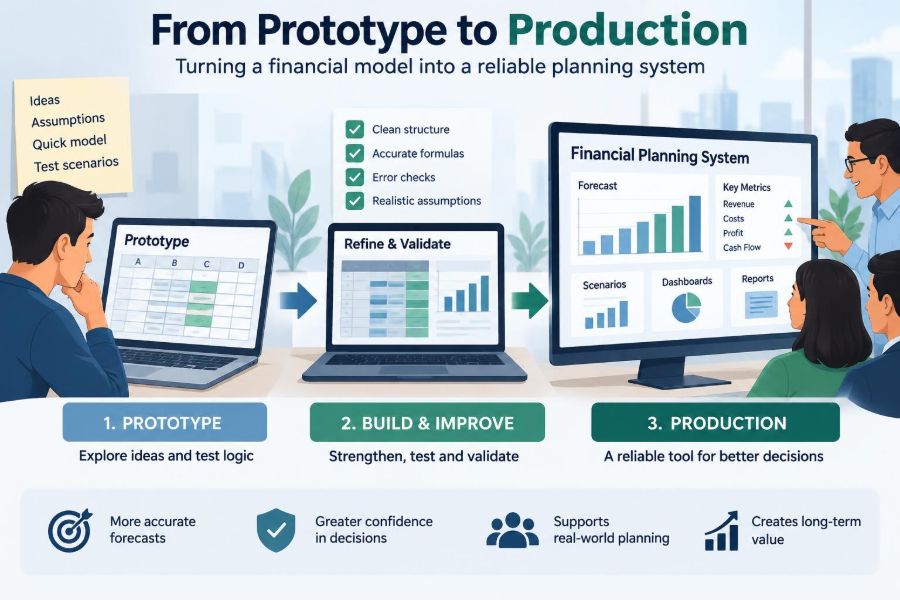

A finance team often starts with a useful spreadsheet: a revenue forecast built for a budget meeting, a cash-flow view prepared for a lender, or a hiring plan assembled before an executive review. It answers an urgent question, and it may do so remarkably well.
Then the workbook becomes popular. More people use it, new scenarios are added, actuals are pasted in each month, and leaders begin treating its outputs as the basis for decisions. What began as a prototype is now carrying the weight of a planning system.
That transition is where many avoidable problems begin. A model can contain sensible formulas and still be unreliable if its inputs are unclear, its logic cannot be tested, or its results change when one person leaves the team.
Moving from prototype to production does not mean removing judgment from planning. It means building a dependable process around that judgment: clear definitions, controlled data, repeatable calculations, reviewable assumptions, and outputs people can trust.
🧭 A Prototype and a Planning System Serve Different Jobs
A prototype is designed to learn quickly. It may be a single workbook, a rough set of assumptions, or a model maintained by the person who understands the business best.
A production planning system is designed to operate repeatedly. It must support planning cycles, scenario updates, actual-versus-plan analysis, handovers, review, and decision-making without depending on improvisation.
The difference is not whether the model uses Excel, code, or a planning platform. The difference is whether its process is repeatable and its results are explainable.
🎯 Start With the Decisions the System Must Support
Before redesigning formulas, identify the decisions the model is expected to inform. A board forecast, department budget, liquidity plan, and sales-capacity model can share data but require different levels of detail and different refresh schedules.
Ask practical questions: Who uses the output? What decision follows? How often is it updated? What happens if it is wrong or late? These answers establish the appropriate level of control.
- Investment decisions need traceable assumptions and clear downside cases.
- Weekly cash planning needs timely bank and payment information.
- Department planning needs accountable owners and workable input templates.
🗺️ Define the Model’s Boundary
A financial model becomes fragile when it quietly expands to answer every possible question. Define what is inside the system: entities, products, currencies, periods, statements, and planning horizons.
Also define what remains outside. For example, a corporate forecast may consume a separate sales pipeline forecast rather than attempting to recreate CRM logic inside the financial model.
A clear boundary prevents duplicated calculations and helps users know when an output is fit for purpose.
🧱 Turn Business Logic Into a Model Architecture
Reliable models separate major layers of work. A common architecture is inputs, transformations, calculations, outputs, and controls. This structure applies whether the system is spreadsheet-based or automated.
Inputs hold source data and assumptions. Transformations standardize mappings and timing. Calculations apply business rules. Outputs present plans and reports. Controls test whether the whole chain behaved as expected.
When these layers are mixed on one worksheet, a user can accidentally overwrite a formula while changing an assumption. Separation makes errors easier to find and changes safer to make.
📚 Build a Shared Financial Data Dictionary
Words that seem obvious often conceal different meanings. “Revenue” may mean invoiced sales, recognized revenue, bookings, gross revenue, or net revenue. “Headcount” may include employees but exclude contractors and open roles.
A data dictionary records each important measure, its definition, source, owner, granularity, and treatment of exceptions. It should also state the relevant time basis: transaction date, invoice date, service period, or cash date.
This is not administrative decoration. Consistent definitions stop teams from producing conflicting versions of the same metric.
🔗 Establish a Reliable Source-of-Truth Chain
A planning model should state where each input originates. Actual revenue might come from the general ledger, pipeline from a CRM system, payroll rates from HR, and foreign-exchange assumptions from a treasury process.
Source systems can disagree for legitimate reasons. The ledger is usually authoritative for booked actuals, while operational systems may provide richer detail for drivers. The solution is not to force identical numbers; it is to document which source governs each purpose.
Maintain a source register so refreshes do not depend on undocumented extracts or personal inbox files.
🧹 Standardize and Map Data Before Calculating
Raw data rarely arrives in model-ready form. Cost centers may be renamed, account codes may be added, and customer names may vary across systems. Map these differences before the core calculations begin.
Use controlled mapping tables for items such as chart-of-accounts rollups, legal entities, product groups, and departmental ownership. Avoid burying these mappings inside long formulas.
A visible mapping table lets reviewers identify whether a variance comes from business performance or from classification changes.
🕰️ Make Time Logic Explicit
Financial planning is fundamentally about timing. A sale can be booked in one month, recognized over several months, billed on another schedule, and collected later still.
Every major schedule should make its timing rules visible: monthly versus quarterly periods, fiscal calendar, working days, lag assumptions, and treatment of partial periods. Hard-coded date labels are a common source of silent errors when a new year begins.
Where possible, use a central calendar table so all schedules refer to the same periods.
🔄 Connect Operational Drivers to Financial Outputs
The strongest forecasts explain financial outcomes through operational drivers. Instead of typing a revenue growth percentage with no context, a subscription business might model customers, acquisition, churn, pricing, and usage.
Likewise, staffing costs may flow from approved roles, start dates, salaries, benefits, and payroll taxes. Inventory needs may flow from demand, lead times, and target stock levels.
Driver-based planning is not always more accurate, especially when drivers are uncertain. Its advantage is that assumptions become discussable: leaders can challenge churn or hiring timing rather than only debating a final revenue number.
🧮 Design Calculations for Auditability
Auditability means a reviewer can trace an output back through the logic and identify the inputs that produced it. It does not require a formal audit; it requires understandable lineage.
Prefer simple, modular schedules over a single formula that performs many unrelated tasks. For example, calculate deferred revenue in a schedule, then link the result into the income statement and balance sheet.
Use meaningful labels and avoid unexplained constants such as *1.08. A named “annual price increase” assumption is far easier to review and update.
🧾 Preserve the Financial Statement Relationships
A complete plan usually connects the income statement, balance sheet, and cash-flow statement. Planning only profit can hide a serious cash requirement; planning only cash can hide accruals and working-capital movements.
The relationships should reconcile. Profit affects retained earnings, depreciation affects profit but not operating cash in the same way, and changes in receivables affect cash timing. These relationships are useful control points as well as accounting concepts.
For smaller organizations, a simplified integrated model may be sufficient. The key is to be explicit about what has been simplified and what risk that creates.
💧 Treat Cash Flow as Its Own Planning Problem
Cash planning needs assumptions that differ from the income statement. Payment terms, collection behavior, payroll dates, tax payments, capital expenditure, debt service, and timing of supplier payments all matter.
A company can meet its annual profit target and still face a short-term liquidity gap. A monthly cash forecast may therefore need weekly detail for the near term, while later months can remain more aggregated.
Do not assume a revenue forecast automatically produces a usable cash forecast. The collection and payment mechanics need to be modeled separately.
⚖️ Separate Assumptions From Calculated Results
An assumption is an informed input: a hiring date, price change, conversion rate, or payment term. A calculated result is what the model derives from those inputs. Mixing them makes review difficult.
Place assumptions in identifiable areas and record their owner, effective date, and rationale. A short note such as “renewal pricing held flat pending contract review” can be more valuable than a polished but unexplained number.
This separation also prevents users from “fixing” an undesirable output by overwriting a formula.
🌦️ Build Scenarios Around Real Uncertainty
A scenario is not merely a different percentage applied everywhere. It is a coherent set of assumptions describing a plausible operating condition, such as a slower sales cycle, delayed hiring, foreign-exchange movement, or supply constraint.
Keep the base case distinct from upside and downside cases. Each should show which assumptions changed and why. If every scenario uses hidden manual overrides, comparisons lose meaning.
Scenario planning is most useful when it prepares choices: which spending can move, what financing may be needed, or which performance indicators should trigger action.
🎛️ Use Sensitivity Analysis for Key Drivers
Sensitivity analysis changes one or two uncertain variables while holding other assumptions constant. It answers focused questions, such as how a change in gross margin or collection days affects cash.
This differs from a full scenario. Sensitivities isolate relationships; scenarios combine related changes. Both are valuable, but presenting a sensitivity table as if it were a fully realistic forecast can mislead decision-makers.
| Technique | Best use | Main caution |
|---|---|---|
| Sensitivity analysis | Understand exposure to one driver | May ignore linked operational changes |
| Scenario analysis | Compare plausible business conditions | Can become vague if assumptions are not documented |
| Forecast update | Reflect the latest expected outcome | Should not quietly rewrite the approved plan |
✅ Create Controls That Test the Model Automatically
Controls turn review from visual inspection into repeatable checking. They should appear prominently and return a clear pass, fail, or exception result.
- Balance sheet balances to zero difference.
- Opening balances equal the prior period’s closing balances.
- Entity totals equal consolidated totals after eliminations.
- Actuals loaded reconcile to approved source totals.
- Key rates remain within expected logical ranges.
A control should identify the nature of the issue, not merely signal that something is wrong.
🧪 Test Logic With Known Cases
Model testing is easier when a small, known case has an obvious answer. For example, test a new employee starting mid-month, a customer contract recognized over several periods, or an invoice collected after its stated terms.
Use boundary cases too: zero volume, a year-end rollover, a negative adjustment, or a contract ending on the first day of a month. These cases often reveal timing and sign errors.
Whenever a major rule changes, rerun the relevant test cases. This is the planning equivalent of checking a calculation before relying on it.
🔒 Protect Inputs, Logic, and Access
Protection is not only about passwords. It includes deciding who can change assumptions, who can alter logic, who can refresh source data, and who can approve a published forecast.
Use role-based access where the tool supports it, and protect formula areas in shared workbooks. However, technical restrictions should not replace good operating practice. A restricted file can still contain a poorly governed assumption.
For sensitive plans, access decisions should reflect confidentiality as well as editing risk.
🧾 Introduce Version Control and a Change Log
When people ask which forecast is current, the system has already lost some reliability. Establish a naming convention, an approval status, and a publication location for each planning cycle.
A change log should capture material changes to assumptions, logic, mappings, and source data. It need not describe every formatting edit. Its purpose is to explain why a result changed.
For code-based models, version-control tools can record changes precisely. For spreadsheet models, disciplined file management and protected release copies provide a practical equivalent.
👥 Assign Ownership Without Creating Bottlenecks
A planning system needs named accountability. Finance may own model integrity and consolidation, while sales owns pipeline assumptions, HR owns workforce data, and operational leaders own their cost drivers.
Ownership does not mean every owner edits the central model. Often, it means they review and approve a prepared input set. This reduces accidental structural changes and keeps responsibility close to the underlying business decision.
Document a backup owner for critical tasks. A system that works only when one analyst is available is not yet production-ready.
🗓️ Design a Repeatable Planning Calendar
Reliability depends on cadence. Define when actuals close, when data is refreshed, when assumptions are submitted, when finance reviews variances, and when leadership receives a forecast.
Allow time for exceptions. Late payroll files, revised revenue recognition, or incomplete operational data will occur. A calendar should state how these are treated: estimate, defer, flag, or reopen.
A predictable timetable improves behavior because contributors know when their inputs are needed and what “final” means.
📊 Make Outputs Decision-Ready
Decision-makers need fewer outputs than model builders often create. A useful management pack typically combines headline performance, key drivers, cash outlook, risks, and actions required.
Every chart and table should answer a question. A revenue bridge may explain change from plan; a cash runway view may show timing of funding needs; a headcount schedule may reveal capacity constraints.
Retain detailed schedules for analysis, but do not ask executives to navigate calculation tabs to understand the forecast.
🔍 Explain Variances Rather Than Just Displaying Them
A variance is the difference between actual, budget, prior forecast, or prior period. It becomes useful only when its driver is understood.
Separate volume, price, mix, timing, foreign exchange, and accounting classification where relevant. For example, revenue below plan may reflect delayed contract signatures rather than lost demand; the appropriate response differs.
Good variance commentary links three things: what changed, why it changed, and what the organization will do next.
🚧 Recognize Common Prototype Failure Modes
Most prototype failures are ordinary, not dramatic. A hard-coded assumption is forgotten, a lookup silently omits a new department, or an actuals paste shifts one column to the right.
Watch for warning signs:
- Multiple files claim to be the latest forecast.
- Users cannot explain a key output without asking the model creator.
- Manual adjustments grow every month.
- Inputs, formulas, and reports occupy the same working area.
- Reconciliation happens only when a senior reviewer notices a problem.
These issues indicate process debt: shortcuts that were reasonable at first but now need deliberate redesign.
🛠️ Improve the System Iteratively
Production readiness is not a one-time conversion project. Start with the highest-risk areas: key assumptions, source-data reconciliation, cash logic, and critical controls.
Then improve usability, automation, documentation, and reporting through each planning cycle. A large rebuild can be justified when the current model is fundamentally unmaintainable, but incremental improvements often preserve valuable business knowledge.
Measure success by reduced rework, clearer explanations, faster review, and greater confidence in decisions—not simply by a more sophisticated tool.
🤖 Automate Carefully, Not Blindly
Automation can reduce repetitive copying, refresh reports, enforce mappings, and run controls consistently. It can also amplify a flawed rule across every output much faster than a manual process.
Automate stable, well-understood steps first. Keep review checkpoints around judgment-heavy inputs, unusual transactions, and exceptions. A scheduled data load still needs reconciliation to confirm that it loaded the intended data.
The best question is not “Can this be automated?” but “Is the logic clear enough to automate safely?”
📖 Document the System for Its Next User
Documentation should help a capable colleague operate the model without rediscovering its design. Include purpose, scope, source systems, refresh steps, assumption owners, key calculations, controls, output definitions, and release process.
Keep documentation close to the work. A short operating guide updated with each structural change is more useful than a long document written once and forgotten.
Explain known limitations honestly. For example, a forecast may exclude small entities, use estimated allocations, or treat certain timing items at a high level.
🏁 The Core Principle: Trust Is Designed
A reliable planning system is not defined by the number of tabs, dashboards, or automated workflows it contains. It is defined by whether people can use it repeatedly to make decisions with a clear understanding of inputs, logic, uncertainty, and limits.
The journey from prototype to production therefore combines accounting discipline with engineering discipline. Define the job, structure the data, expose assumptions, test calculations, control changes, and build a routine that survives turnover and changing business conditions.
When those foundations are in place, the model becomes more than a spreadsheet or report. It becomes a shared planning mechanism that connects operational choices to financial consequences.
A financial model earns trust when its numbers are traceable, its uncertainty is visible, and its process works reliably beyond the person who first built it. 💰📊🔧