
It is the third week of the month, and the finance team is preparing for close. Sales look normal. Cash in the bank has not triggered concern. Then the first draft of the monthly report reveals a surprise: gross margin has fallen, overdue receivables have increased, and a large expense was coded to the wrong department.
None of these problems necessarily started at month-end. The signals may have existed for days or weeks in orders, invoices, payment activity, purchasing approvals, or operational systems. They were simply scattered across places that nobody was watching together.
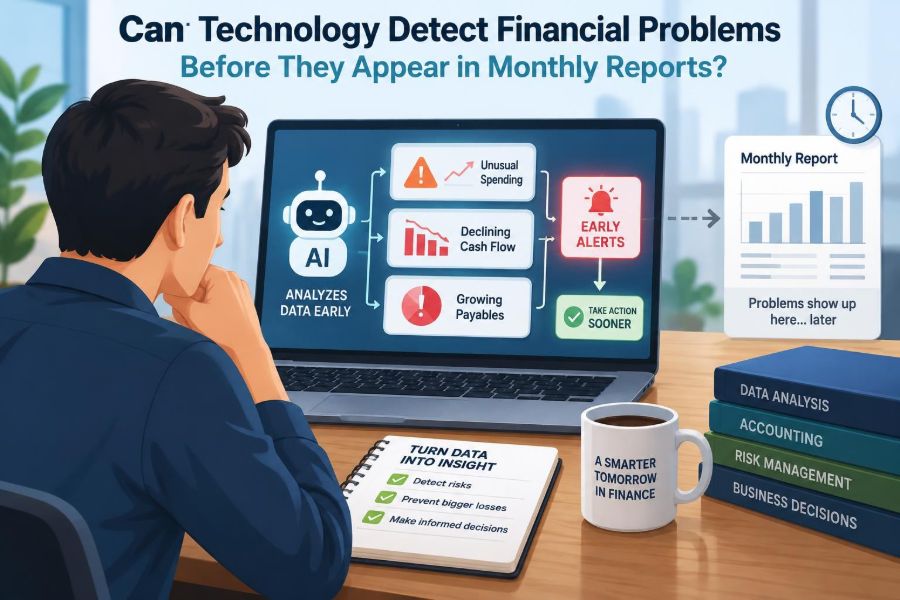
That gap is where financial technology can help. Rather than replacing monthly reporting, modern data tools can create an earlier warning system: one that highlights unusual movement, breaks in expected processes, and emerging risks while there is still time to investigate.
The key word is highlight, not predict with certainty. Technology can identify patterns that deserve attention, but people still need to interpret the business context and decide what action is appropriate.
🔎 What “Before the Monthly Report” Really Means
Monthly reports are usually backward-looking. They summarize transactions that have already occurred, often after reconciliations, accruals, adjustments, and review. They are essential for reliable financial statements, but their timing can limit management’s ability to intervene.
Earlier detection means using available data during the month to spot conditions that could later affect revenue, costs, cash flow, controls, or reporting accuracy. An alert might appear when a customer’s payment pattern changes, when discounts rise unexpectedly, or when a purchase order is exceeded.
This is not the same as producing a premature set of accounts. It is a process for identifying financial signals before they become confirmed monthly outcomes.
📊 Why Monthly Reports Can Arrive Too Late
Month-end close has a necessary sequence. Teams collect data, complete reconciliations, investigate variances, record adjusting entries, and review results. The care involved is valuable, yet it means the clearest picture may arrive after decisions have already been made.
Consider a retailer that is offering larger discounts to maintain sales volume. Revenue may look healthy in daily sales reports, while margin erosion is less visible until costs and discount data are matched during close. An earlier margin dashboard could surface that pressure sooner.
The issue is not that monthly reporting fails. It is that a monthly cadence cannot be the only monitoring rhythm for a fast-moving business.
🧭 The Difference Between a Signal and a Problem
An unusual number is not automatically a financial problem. A spike in travel expense may reflect a planned sales conference. A delayed customer payment may follow an agreed billing dispute. Good systems treat anomalies as prompts for review rather than accusations.
A signal is evidence that something differs from an expected pattern. A problem is a validated condition requiring correction, escalation, or a management decision. Keeping these concepts separate prevents alert systems from creating unnecessary alarm.
The most useful question is often: “What changed, and is there a reasonable business explanation?”
🗂️ The Data That Creates Early Visibility
Financial early-warning systems draw from more than the general ledger. The ledger is central, but it often contains summarized or delayed information. Operational data explains what may be driving financial movement.
- Sales orders, shipments, returns, and discounts can reveal revenue and margin pressure.
- Invoices, credit notes, and payment dates can reveal collection risk.
- Purchase orders, goods receipts, and supplier invoices can reveal cost commitments.
- Payroll, time records, and staffing schedules can reveal labor-cost movement.
- Bank feeds and treasury data can reveal near-term liquidity changes.
Connecting these sources does not mean collecting every possible data point. It means selecting information that supports a specific decision or control.
🔗 Why Data Integration Matters
A finance system may show an expense, while a procurement system shows the purchase order and an operations system shows whether goods were received. Viewed separately, each record can appear ordinary. Viewed together, they may reveal duplicate billing, an unapproved commitment, or a timing issue.
Integration creates a common view across systems. It can be as simple as regularly combining exports in a controlled model, or as advanced as automated data pipelines feeding a governed reporting platform.
However, integration also exposes inconsistent customer names, account codes, dates, and definitions. A dashboard built on mismatched data can create confident-looking but misleading conclusions.
⏱️ Near-Real-Time Does Not Always Mean Better
Some financial processes benefit from frequent monitoring. Cash positions, fraud indicators, payment failures, and order cancellations may require attention daily or even intraday. Other measures, such as depreciation or long-term allocations, usually do not.
Data freshness should match the decision. If a manager can act only once each week, a continuously refreshing dashboard may add noise without creating value. If a payment approval is time-sensitive, a weekly report is clearly too slow.
Useful timeliness is the right speed for the risk and decision, not the fastest possible update.
📉 Variance Analysis as an Early Warning Tool
Variance analysis compares actual results with a baseline, such as budget, forecast, prior period, or expected operational activity. Traditionally it is performed after close. With current-period data, it can identify deviations before they become final.
For example, a manufacturer may compare material purchases with production volume. If purchasing rises while production remains flat, the difference could reflect price increases, excess inventory, incorrect coding, or a legitimate planned purchase.
The baseline matters. Comparing December sales with November sales may be unhelpful in a seasonal business. A better comparison may be against the same trading period last year, adjusted for known changes.
📈 Trend Monitoring Finds Slow-Moving Risks
Some problems do not appear as dramatic single-day exceptions. They develop gradually: invoices take slightly longer to collect, customer returns increase, or small spending overruns occur across many cost centers.
Trend monitoring looks at direction and persistence. A one-off late payment might not be concerning. A steady rise in days outstanding across a customer group deserves investigation, even if no invoice is yet severely overdue.
This is particularly valuable because gradual deterioration can be easy to normalize. A chart showing a consistent slope makes the change harder to overlook.
🚨 Exception Rules Catch Clear Breaks in Process
Rules-based monitoring checks whether a transaction violates a defined condition. Examples include an invoice above an approval threshold, a payment made outside normal banking details, or a journal entry posted to an unusual account late in the period.
These rules are transparent. Finance staff can see exactly why an item was flagged, which makes them useful for controls and audit trails.
Rules do have limits. A threshold can miss a series of smaller transactions, and a rigid rule may flag legitimate exceptions. They work best when regularly reviewed as business processes and risk levels change.
🤖 What Machine Learning Adds
Machine learning can identify unusual combinations or patterns without relying entirely on fixed thresholds. For example, it may notice that a supplier invoice differs from that supplier’s normal timing, amount, description, and approval route at the same time.
In practical finance terms, this is often called anomaly detection. The model learns characteristics of past activity and assigns attention to transactions that appear less typical.
Machine learning is not a magic fraud detector. It can learn from poor-quality history, reflect past process weaknesses, and produce alerts that lack a clear explanation. Its output should support review, not replace it.
🧠 Forecasting Turns Current Activity Into a Forward View
Forecasting estimates what may happen next using recent activity, known commitments, historical patterns, and management assumptions. A rolling cash forecast, for instance, can combine expected customer receipts, payroll dates, supplier obligations, and financing arrangements.
Forecasts are especially useful when they include scenarios. A team might examine expected cash flow, then test what happens if a major customer pays later than planned or if sales fall below the current run rate.
A forecast is not a promise. Its value lies in making assumptions visible and giving decision-makers time to prepare for plausible outcomes.
💵 Cash Flow Often Provides the Earliest Clue
Profit and cash are connected but not identical. A business can record revenue while waiting to collect cash, or it can pay suppliers before related revenue is recognized. That is why daily or weekly cash monitoring can reveal stress that an income statement has not yet shown.
Useful indicators include changes in expected receipts, concentration of payments from a few customers, unplanned disbursements, and upcoming obligations with no identified funding source.
Cash monitoring should also distinguish timing from solvency. A short-term delay may be manageable; a recurring mismatch between inflows and obligations may require a larger response.
🧾 Receivables Signals Can Protect Revenue Quality
Accounts receivable data offers more than a list of overdue invoices. It can reveal disputed charges, repeated partial payments, unusually frequent credit notes, and customers whose payment behavior is changing.
Imagine a hypothetical software company whose largest customer begins paying only undisputed portions of invoices. The total outstanding balance may not look alarming at first, but the pattern could signal a contract issue or collection risk.
Finance teams can combine aging reports with customer-service notes, billing disputes, and sales information to understand whether an issue is administrative, commercial, or credit-related.
🛒 Procurement Data Can Reveal Cost Pressure Early
Purchase orders represent commitments before supplier invoices reach accounts payable. Monitoring purchase-order values, price changes, and unapproved requests can therefore give finance an earlier view of likely spending.
A budget owner may believe costs are under control because invoices booked this month remain low. Yet open purchase orders could indicate that future invoices will exceed the remaining budget.
Commitment reporting is most reliable when purchasing teams use the approved process consistently. Off-system buying creates a blind spot that technology alone cannot solve.
🏷️ Margin Monitoring Needs Operational Detail
Revenue growth can hide weaker unit economics. To monitor margin early, organizations often need to connect sales prices, discounts, returns, shipping costs, labor, materials, or service-delivery costs.
A simple example is a distributor with growing sales but increasing expedited freight. If freight is reviewed only as a monthly total, management may miss that a particular product line or customer arrangement is driving the deterioration.
Early margin reporting should focus on decision-relevant dimensions, such as product, channel, customer segment, or region. Too many dimensions can make the result difficult to interpret.
🧮 Continuous Reconciliation Reduces Month-End Surprises
Reconciliation compares two sources of information that should agree, such as bank transactions and cash records, subledgers and the general ledger, or inventory records and physical counts. Waiting until close concentrates unresolved issues into a stressful period.
Continuous reconciliation uses automation to match routine items during the month and create a queue for exceptions. This does not eliminate review; it allows people to focus on unmatched or unusual entries.
The result can be a cleaner close, but only if matching rules are controlled. An overly broad matching rule may incorrectly clear transactions that should remain under investigation.
🔐 Controls Are Part of Detection, Not an Obstacle to It
Some teams see controls as a separate compliance exercise. In reality, a well-designed control can generate valuable early signals. A failed approval, a vendor bank-detail change, or a manual override may indicate either a valid urgent need or a process risk.
Technology can record who performed an action, when it occurred, and whether it followed the expected workflow. This creates evidence for review and helps organizations identify recurring process breaks.
Monitoring must be proportionate. Not every deviation needs an escalation, and employees should understand how their activity is being monitored and why.
🕵️ Fraud Detection Requires Careful Judgment
Unusual transactions can be associated with fraud, but unusual does not mean fraudulent. A new supplier, emergency purchase, or executive travel booking may all be legitimate while falling outside normal patterns.
Effective monitoring may look for combinations such as changed supplier details, unusual payment timing, split invoices near approval limits, or payments without expected supporting records. Each signal should lead to an appropriate review process.
Organizations should avoid designing alerts that publicly label people or transactions as suspicious without evidence. Fair investigation procedures, access controls, and confidentiality remain essential.
🧹 Data Quality Determines Whether Alerts Can Be Trusted
An alert is only as reliable as the records behind it. Duplicate suppliers, missing invoice dates, inconsistent product codes, or incorrect cost-center assignments can generate false exceptions and hide genuine issues.
Data quality work is not glamorous, but it is foundational. It includes clear data definitions, ownership of key fields, validation at entry, controlled changes to master data, and regular review of known errors.
If users repeatedly find that alerts are wrong, they will stop trusting the system. That is a governance failure, not a user failure.
🎯 Start With a Specific Financial Question
Many analytics projects begin with a broad ambition to “use AI in finance.” A stronger starting point is a narrow, measurable question: Which supplier invoices should be reviewed before payment? Which customers are most likely to miss expected payment dates? Which purchase commitments could exceed a budget?
A focused question identifies the relevant data, users, action, and measure of usefulness. It also makes it easier to test whether the tool improves a real process.
Start where earlier visibility can change a decision, not merely create a more attractive dashboard.
🧪 Pilot Before Scaling Across Finance
A pilot allows a team to test data availability, alert quality, workflow, and user behavior in a limited setting. For example, a finance department might begin by monitoring duplicate-payment risks for one business unit.
During the pilot, track practical outcomes: Were alerts reviewed promptly? How many were useful? Did the process reduce rework or prevent an error? Did it create a new bottleneck?
A pilot should also document limitations. A model that works well for high-volume routine invoices may be unsuitable for infrequent complex contracts.
👥 People Need Clear Ownership of Every Alert
An alert with no owner is simply information. For each type of exception, organizations should define who reviews it, how quickly they respond, what evidence they check, and when they escalate.
A simple workflow may assign initial review to an analyst, commercial context to a manager, and control concerns to a finance leader or compliance function. The exact structure depends on the organization.
Ownership also includes closing the feedback loop. If an alert was valid, the team should consider whether a process change is needed. If it was not useful, the rule or model may need refinement.
📋 Build an Alert Process That People Can Use
The most sophisticated detection engine fails if users receive hundreds of unprioritized notifications. Alerts should provide enough context to support a quick first assessment: the transaction, the reason it was flagged, comparison information, and the recommended next step.
- Prioritize by potential financial impact and control risk.
- Group related alerts rather than sending separate notices for one underlying issue.
- Set realistic response targets based on urgency.
- Record outcomes so rules and models can improve.
Good alert design respects attention as a limited resource.
⚖️ Balance False Positives and Missed Risks
A false positive is an alert that does not identify a meaningful issue. A missed risk, sometimes called a false negative, is a real issue that the system fails to flag. Reducing one can increase the other.
For a high-risk payment-control process, a team may accept more false positives to avoid missing serious irregularities. For low-value expense monitoring, too many alerts may cost more staff time than they save.
There is no universal threshold. The appropriate balance depends on financial materiality, process volume, regulatory obligations, and the cost of investigation.
🧑💼 Finance Professionals Remain Essential
Technology can compare thousands of transactions faster than a person can. It cannot reliably understand a customer relationship, evaluate a strategic exception, or decide whether a temporary variance reflects a sensible business choice.
Accountants and finance professionals bring accounting knowledge, professional skepticism, ethical judgment, and an understanding of how operational activity reaches the financial statements. Those skills become more valuable when routine checking is automated.
The role shifts from manually finding every number toward asking better questions about the numbers that matter.
📚 Skills That Make Early Detection Work
Finance teams do not all need to become data scientists. But many benefit from stronger data literacy: understanding data sources, testing assumptions, reading trends, recognizing poor data quality, and explaining findings clearly.
Useful technical skills may include spreadsheet modeling, business-intelligence tools, SQL for querying data, and basic knowledge of automation or statistical concepts. Equally important are process knowledge and communication.
The goal is a team that can challenge an output constructively rather than treating a dashboard or model as unquestionable.
🛡️ Privacy, Security, and Access Cannot Be Added Later
Financial monitoring often uses sensitive data, including pay information, customer details, bank records, and employee expenses. Access should follow the principle of least privilege: people receive only the information needed for their role.
Organizations also need clear retention practices, secure system connections, audit logs, and procedures for responding to data incidents. Requirements vary by jurisdiction and industry, so local legal and policy advice may be needed.
Trust in financial technology depends not only on accuracy, but also on responsible handling of the data it uses.
🏢 Smaller Organizations Can Begin Without Complex AI
Early detection is not reserved for large enterprises with extensive technology budgets. A small business can begin with bank-feed categorization, weekly cash forecasts, invoice-aging reviews, budget-versus-actual checks, and approval workflows.
The best first improvement may be a consistent process for reviewing exceptions rather than a new software platform. For instance, a controller could maintain a weekly list of overdue receivables, unapproved commitments, and material cost changes.
Complexity should be earned. Automate only after the underlying process and data are sufficiently stable.
🚧 Common Implementation Mistakes
Several mistakes repeatedly weaken financial monitoring initiatives:
- Building dashboards before agreeing on definitions of revenue, margin, overdue, or forecast.
- Automating a poorly designed process instead of fixing it first.
- Using historical data without checking whether it reflects current business conditions.
- Sending alerts without assigning reviewers and escalation paths.
- Measuring success by the number of alerts rather than better decisions or reduced risk.
These are manageable problems, but they require finance, operations, technology, and control teams to work together from the start.
🗓️ A Practical 90-Day Starting Approach
In the first month, select one decision area, map the existing process, identify available data, and define what counts as a useful alert. Keep the scope narrow enough that people can validate the results manually.
In the second month, create a simple report, rule set, or forecast and run it alongside the current process. Review false positives, missing data, and whether users can act on the output.
In the third month, formalize ownership, refine thresholds, document controls, and decide whether to expand. This staged approach produces learning before major investment.
🌱 The Core Principle: Earlier Insight Needs Better Decisions
Technology can detect financial problems before monthly reports by connecting operational and financial data, monitoring change, and directing attention to exceptions. It is most effective when it supports a clearly defined action: collect sooner, investigate a cost, stop a payment, revise a forecast, or correct a process.
The objective is not to eliminate month-end close or turn every transaction into an emergency. It is to reduce avoidable surprises and give finance more time for analysis, judgment, and constructive intervention.
Strong early-warning systems combine reliable data, sensible controls, explainable alerts, and accountable people. Remove any one of those elements, and the system becomes less trustworthy.
Technology is most valuable when it helps finance see meaningful change early enough to make a better decision. Monthly reports remain the disciplined record of what happened; earlier signals help shape what happens next. 💰📊🔍