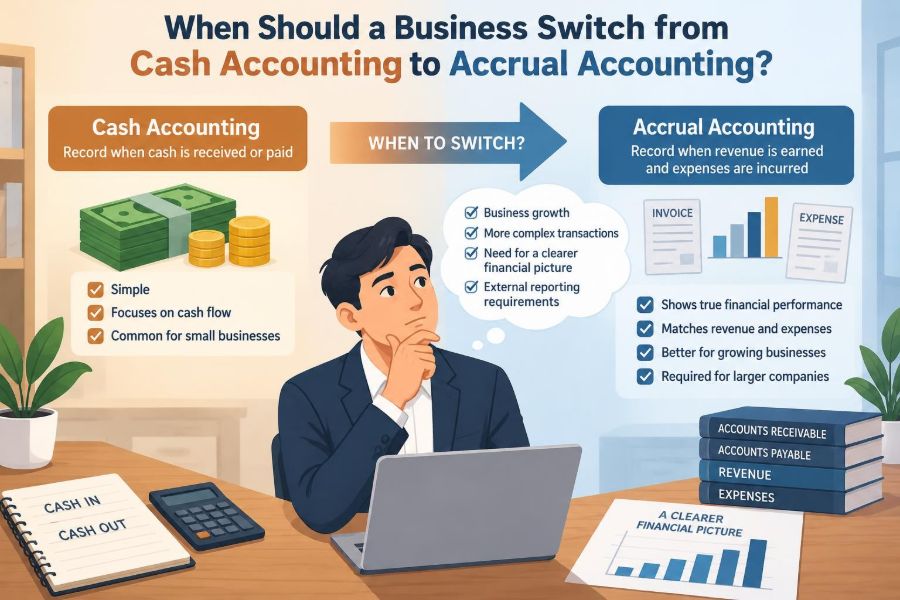

A freelance designer finishes a large project in December but does not receive payment until January. Under cash accounting, the income appears in January—along with the bank deposit. Yet the work, costs, and business effort belonged to December.
Now imagine the same pattern across a growing company: customer invoices outstanding, supplier bills arriving after month-end, annual subscriptions paid in advance, and inventory bought months before it is sold. The bank balance is still useful, but it no longer tells the whole operating story.
This is where the choice between cash and accrual accounting becomes more than a bookkeeping preference. It affects profit reports, pricing decisions, tax planning, borrowing conversations, and an owner’s confidence in the numbers.
A switch to accrual accounting is not automatically a sign of success, and it is not always required immediately. The right time depends on how the business earns, spends, finances, and needs to understand its money.
🧾 Start with the two accounting methods
Cash accounting records revenue when cash is received and expenses when cash is paid. If a customer pays an invoice in February, February shows the revenue, even if the work was completed in January.
Accrual accounting records revenue when it is earned and expenses when they are incurred. In simple terms, it tries to match economic activity to the period in which it happened, rather than the date money moved through the bank.
Neither method changes how much cash a business has. They change the timing and structure of what its financial statements say about performance.
💵 Why cash accounting is appealing at first
For a small business with immediate payment and simple expenses, cash accounting is intuitive. The bookkeeping question is straightforward: did money enter or leave the account?
It can also make day-to-day cash monitoring easier because recorded income and expenses closely resemble transactions on a bank statement. A sole proprietor paid at the time of service may not need much more to understand basic operations.
The simplicity has limits. Bank activity answers “what cash moved?” but not always “what did the business earn or consume this month?”
📚 What accrual accounting adds
Accrual accounting introduces accounts that represent amounts outside the current bank balance. Accounts receivable tracks money customers owe. Accounts payable tracks bills the business owes to suppliers.
It also recognizes assets and liabilities created by timing. A prepaid insurance payment can be recorded as an asset and expensed over the covered period. A loan payment can be separated into interest expense and repayment of loan principal.
This additional structure makes records more demanding, but it creates a more complete picture of financial position and operating performance.
🧩 The matching principle in plain language
The central logic of accrual accounting is often called the matching principle: record related revenue and costs in the same reporting period where practical.
Suppose a retailer buys inventory in April and sells it in June. Under accrual accounting, the inventory cost becomes an expense in June as cost of goods sold, when the related sales revenue is recognized. Recording the full purchase as an April expense could make April look weak and June look unusually profitable.
Matching is not about making results look better. It is about making each period more representative of what actually occurred.
📈 Revenue is becoming less immediate
A strong signal to consider accrual accounting is a widening gap between doing the work and collecting payment. This often happens when a business begins invoicing customers with payment terms rather than requiring payment at checkout.
For example, a consultant may finish $12,000 of work in March, invoice then, and receive payment in April. Cash accounting reports no March revenue from that project. Accrual accounting recognizes March revenue and records the unpaid amount as receivable.
As receivables grow, management needs to distinguish a healthy sales month from a month when cash simply arrived from older sales.
⏳ Customer payment terms change the picture
Offering terms such as payment within 15, 30, or 60 days can help win commercial customers. It also creates credit risk: revenue may be recorded before payment is certain.
Accrual records make that risk visible. An aging report can group receivables by how long they have been outstanding, helping staff follow up before a late invoice becomes a bad debt.
Cash accounting does not eliminate the risk of nonpayment. It merely delays recognizing revenue until collection, which can hide the size of unpaid customer balances from routine profit reports.
📦 Inventory usually raises the stakes
Businesses that buy, hold, make, or resell inventory often benefit substantially from accrual accounting. Inventory is not simply a cash outflow; it is generally an asset that will provide value through future sales.
Without a reliable inventory record, gross profit can be distorted. Buying a seasonal shipment in one month and selling it over several months creates uneven expenses under a pure cash view.
Inventory also requires operational discipline: counts, valuation methods, damaged-stock reviews, and attention to shrinkage. Switching methods will not fix weak stock records, but it can reveal why they need attention.
🏗️ Large upfront costs need better timing
Some expenses support operations over many months or years. Examples include annual software subscriptions, business insurance, major equipment, and deposits for future services.
Under accrual accounting, costs are allocated according to their nature. A one-year insurance policy is usually recognized over its coverage period. Equipment may be capitalized as an asset and depreciated over its useful life, subject to applicable accounting rules.
This prevents a single payment date from dominating a month’s reported profit when the economic benefit extends well beyond that month.
🔁 Recurring revenue calls for period-based records
Subscription, membership, maintenance, retainer, and prepaid service models create a timing question: when has the business earned the customer’s payment?
If a customer pays in advance for six months of service, receiving the cash does not necessarily mean all six months have been earned. The unearned portion is commonly recorded as a liability, often called deferred or unearned revenue.
That distinction matters because an advance payment creates an obligation to deliver service. Accrual accounting makes both the cash and the remaining obligation visible.
🧑🤝🧑 Payroll and contractor costs may cross month-end
Paydays do not always align with calendar months. Employees may work during the final week of a month but receive pay in the following month.
Accrual accounting can record the earned but unpaid wages as an accrued expense. The same idea can apply to contractor work completed before an invoice arrives.
For a growing team, this helps managers compare labor cost to the revenue and output generated during the same period rather than treating payroll dates as performance dates.
🔌 Supplier bills reveal obligations before payment
A business may receive utilities, raw materials, advertising, freight, or professional services before it pays for them. Cash accounting recognizes the cost only when the payment is made.
Accrual accounting records the expense when the business receives the benefit and records a payable or accrued liability until settlement. This provides a clearer view of what the business already owes.
That visibility is particularly valuable when payment schedules are tight. A bank balance can look comfortable while several significant bills are waiting to be processed.
📊 Monthly reporting needs a dependable profit measure
Owners often switch because they want meaningful monthly financial statements. A monthly profit and loss statement is most useful when it reflects that month’s sales, labor, inventory use, and operating costs.
Cash reports can swing sharply because customers pay late, annual bills are paid at once, or suppliers are settled early. These are real cash events, but they may not represent a change in underlying profitability.
Accrual accounting does not eliminate judgment or forecasting uncertainty. It gives management a stronger base for comparing one period with another.
🧭 Cash flow and profit are different questions
One of the most common misunderstandings is treating profit as cash, or cash as profit. They influence each other, but they are not interchangeable.
A profitable business can run short of cash when customers pay slowly, inventory builds up, or loan repayments are due. Conversely, a business can have strong cash inflow after collecting old invoices even if current operations are weak.
Accrual accounting makes this difference more apparent. It should be paired with active cash forecasting—not used as a substitute for it.
🏦 Lenders and investors may expect accrual statements
External parties often want financial statements that show receivables, payables, inventory, debt, and earned revenue in a consistent way. Lenders may use these records to assess repayment capacity, working capital, and trends.
Investors and potential buyers also need to understand recurring earnings rather than simply review deposits and withdrawals. Accrual-based records usually provide a better starting point for that analysis.
Requirements vary by lender, investor, jurisdiction, and transaction. Before making a financing decision, ask what statements, reporting basis, and supporting schedules will be expected.
⚖️ Tax rules and financial reporting are not always identical
The accounting method used for internal reports may not be the same method required or permitted for tax filings. Tax law can contain eligibility rules, elections, thresholds, and special treatment for inventory, prepaid expenses, and long-term contracts.
A business should not assume that a switch in bookkeeping automatically determines its tax position. Likewise, choosing a tax method does not prevent management from maintaining accrual-style internal reports where useful.
Because the consequences depend on location and business facts, discuss a planned change with a qualified tax professional or accountant before filing returns or revising prior records.
🌍 Reporting frameworks can make accrual unavoidable
Businesses preparing statements under formal accounting frameworks often use accrual accounting because those frameworks focus on economic events, assets, liabilities, income, and expenses—not only bank movements.
Audited financial statements, acquisition due diligence, grant reporting, regulated activities, and contracts with detailed financial covenants may all increase the need for a robust accrual process.
The standard required depends on the entity and jurisdiction. The broader principle is simple: once outsiders rely heavily on the statements, consistency and documentation become more important.
🧮 Compare the methods with one simple example
Assume a hypothetical agency completes a client campaign in December for $10,000, pays freelancers $3,000 in December, and collects from the client in January. It also pays $1,200 for a January-to-December insurance policy in December.
| December item | Cash accounting view | Accrual accounting view |
|---|---|---|
| Client campaign | No revenue until January collection | $10,000 revenue and a receivable |
| Freelancer work | $3,000 expense when paid | $3,000 December expense |
| Annual insurance | $1,200 December expense when paid | Prepaid asset; one month of expense recognized for December if coverage begins then |
Neither presentation is “fake.” They answer different questions. The accrual view better describes December’s campaign performance; the cash view better describes December’s bank movements.
🚦Signs that the switch is timely
No single trigger applies to every business. A change becomes more compelling when several operational signs appear together.
- Customers regularly pay after the work or goods are delivered.
- Unpaid supplier bills are material to cash planning.
- Inventory, deposits, prepayments, or work in progress are growing.
- Management needs reliable month-by-month margins.
- The business is pursuing financing, investment, a sale, or formal reporting.
- Several people need to rely on the books rather than the owner’s memory.
These signals indicate that timing differences are no longer minor bookkeeping details.
🛑 Situations where a switch may be premature
Accrual accounting adds workload, review needs, and opportunities for error. A very small cash-based service business with immediate payment, little debt, no inventory, and minimal prepayments may gain limited practical value from a full accrual system.
It can also be premature when bank reconciliation is not reliable. Adding receivables, payables, and adjusting entries on top of incomplete basic records usually creates confusion rather than insight.
Start with dependable transaction capture and reconciliations. Complexity should solve a decision-making problem, not merely make reports look more sophisticated.
🧰 Choose systems that support the process
Software alone does not create accrual accounting, but the right system reduces manual work. Useful functions may include invoicing, bill tracking, bank feeds, inventory controls, recurring entries, approval workflows, and financial reporting.
Before changing platforms, map the actual workflow: who sends invoices, approves bills, receives goods, tracks time, counts inventory, and reviews reports. A sophisticated system cannot compensate for unclear ownership.
Keep the chart of accounts understandable. Too few accounts hide useful information; too many create inconsistent coding and unreadable reports.
🗂️ Build a clean opening balance sheet
The conversion point requires an opening balance sheet: a dated list of assets, liabilities, and owner or shareholder equity. This is the foundation of accrual records.
Typical items include bank balances, customer receivables, inventory, prepaid expenses, equipment, supplier payables, payroll liabilities, loans, taxes payable, and deferred revenue. Each balance should be supported by documents or schedules.
This step deserves care. If opening receivables or liabilities are missing, later profit can be misstated even when the new monthly bookkeeping is accurate.
🧾 Establish a month-end close routine
Accrual accounting works best as a repeatable month-end close, not a frantic annual cleanup. The aim is to complete and review records soon after each reporting period ends.
- Reconcile bank, card, loan, and payment accounts.
- Review unpaid customer invoices and supplier bills.
- Record payroll, interest, and other needed accruals.
- Update inventory and cost of goods sold where applicable.
- Post prepayment amortization, depreciation, and deferred revenue entries.
- Review the financial statements for unusual changes and errors.
The exact routine should fit the business, but consistency matters more than elaborate journal entries.
🧠 Understand the key adjusting entries
An adjusting entry updates records at period-end when the cash transaction occurred earlier or later than the underlying activity. It is the practical mechanism that turns transaction records into accrual-based statements.
Common adjustments include earned but unbilled revenue, wages incurred but unpaid, insurance used from a prepaid balance, depreciation on equipment, and revenue earned from customer advances.
Adjustments should be documented with a calculation, source record, and explanation. That discipline helps future reviewers understand why a number changed and prevents recurring entries from continuing after circumstances change.
🔍 Keep internal controls in proportion
As accounting grows more complex, errors and misuse can become harder to spot. Basic internal controls reduce this risk without requiring a large finance department.
- Separate approval of payments from reconciliation where practical.
- Require support for material journal entries and write-offs.
- Review aged receivables and payables regularly.
- Limit access rights based on each person’s role.
- Have an owner or manager review unusual margins, balances, and trends.
For a small team, one person may need several roles. In that case, independent review by an owner, external bookkeeper, or accountant becomes more valuable.
📉 Watch for common conversion mistakes
A frequent mistake is recording every unpaid invoice as fully collectible without considering disputes, customer financial trouble, or likely credits. Receivables should be reviewed realistically, and expected uncollectible amounts may need recognition under the applicable reporting approach.
Another error is treating loan principal as an expense. Repaying principal reduces a liability; interest is generally the financing cost. Similarly, an equipment purchase is not always an immediate operating expense.
Businesses also sometimes duplicate transactions during migration by recording an old cash-basis payment and an accrual payable without clearing one side. Reconciliation and a clear cutover date help prevent this.
🗣️ Train people beyond the bookkeeping team
Sales staff need to understand that signed work, invoicing accuracy, credits, and customer acceptance can affect revenue records. Operations staff may need procedures for confirming inventory receipts or work completed before an invoice arrives.
Managers should learn to read both profit reports and cash forecasts. Otherwise, they may celebrate revenue that has not been collected or cut a useful expense simply because its payment landed in the current month.
Accrual accounting is a business process, not just an accounting department task.
🔄 Consider a phased transition
A full conversion does not always need to happen overnight. Many businesses begin by maintaining cash records while adding a receivables list, payables list, inventory schedule, and monthly management adjustments.
A parallel period can expose gaps before accrual statements become the primary reporting tool. For example, a company might prepare internal accrual reports for several months while its adviser confirms the tax and system implications.
Set a defined cutover date rather than allowing two incomplete methods to run indefinitely. The goal is a controlled transition, not permanent duplication.
🤝 Know when professional help is worth it
An experienced bookkeeper, accountant, controller, or tax adviser can be especially helpful when inventory, multiple entities, foreign currency, construction-style contracts, payroll complexity, financing, or formal reporting requirements are involved.
Professional support is also useful for opening balances, accounting policies, tax-method questions, and designing a close process. Ask for explanations and schedules, not just finished reports; the business still needs to understand what its numbers mean.
The right level of help depends on risk and complexity. A short implementation project may be enough for one business, while another needs ongoing review.
🎯 The decision is about better decisions
The purpose of accrual accounting is not to satisfy an abstract preference for complexity. Its value is that it connects revenue, costs, obligations, and resources to the periods in which they matter.
Switch when cash timing is materially obscuring performance, financial position, or future commitments—and when the business has the records and discipline to maintain the method well. Keep cash reporting alongside it, because payroll, rent, debt payments, and supplier obligations are still paid with cash.
The best accounting method is the one that gives decision-makers a reliable view of both what the business has earned and what it can actually pay.
Cash accounting is often a practical starting point, but accrual accounting becomes valuable when a business’s promises, payments, and performance no longer happen at the same time. A thoughtful transition turns bookkeeping into a clearer operating tool rather than a year-end chore. 💰📊🧭