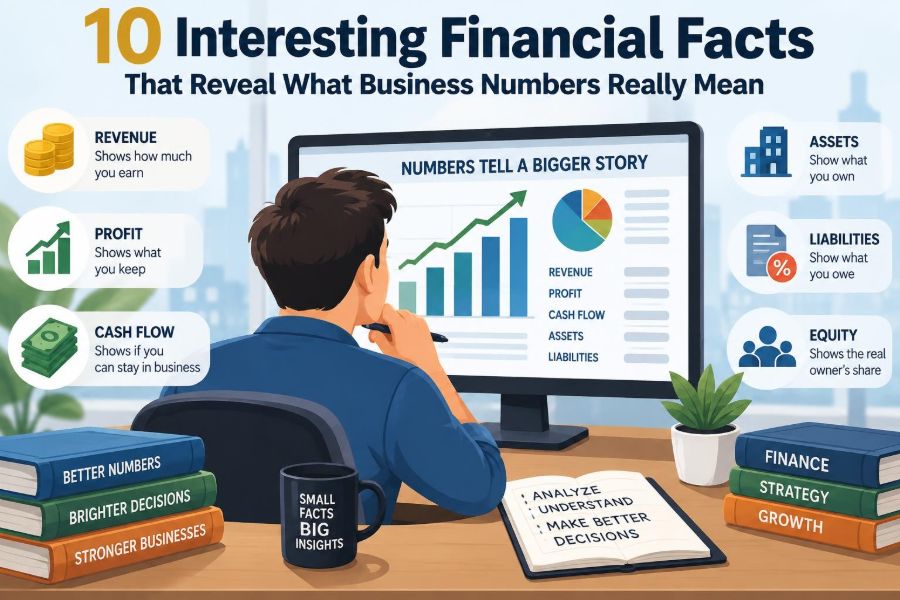

A business can report a healthy profit and still struggle to pay suppliers on Friday. Another can show a loss while building a product, customer base, or factory that may support future growth. At first glance, those statements seem contradictory.
They are not. Financial statements are designed to answer different questions, at different points in time, using accounting rules that sometimes differ from everyday intuition.
That is why a headline number—revenue, profit, cash, debt, or valuation—rarely tells the whole story. Learning to read the relationships between numbers is more useful than memorizing isolated ratios.
These ten financial facts, and the practical ideas behind them, help reveal what business numbers actually say about operations, risk, and decision-making.
🔍 Financial Numbers Are a Model, Not the Business Itself
Financial statements are a structured model of economic activity. They translate thousands of events—sales, payroll, inventory movements, borrowing, and investment—into standardized categories.
A model is useful precisely because it simplifies. But simplification means context can disappear. A revenue figure does not show whether customers are delighted, whether sales are repeatable, or whether payments will arrive on time.
Use reported numbers as a starting point for questions, not as a complete description of reality.
📚 The Three Statements Tell One Connected Story
The income statement shows performance over a period. The balance sheet shows what a business owns and owes at a specific date. The cash flow statement explains how cash changed during the period.
| Statement | Primary question | Common misunderstanding |
|---|---|---|
| Income statement | Did the business earn a profit? | Profit equals cash received |
| Balance sheet | What resources and obligations exist now? | Assets are automatically valuable or liquid |
| Cash flow statement | Where did cash come from and go? | More cash always means stronger operations |
Reading only one statement can produce a misleading conclusion. A profitable company may be collecting cash slowly; a cash-rich company may have raised debt rather than generated cash from customers.
💵 Fact 1: Revenue Is Not Cash
Revenue is usually recognized when a business has earned it, not necessarily when it has been paid. If a consultant completes a project in March and invoices the client for payment in April, March revenue may include the work even though cash has not arrived.
The unpaid amount becomes accounts receivable, an asset representing a claim on customers. This approach, called accrual accounting, better matches sales with the work that generated them.
It also creates risk. Revenue is less useful for paying wages than collected cash. When receivables rise much faster than sales, investigate whether customers are taking longer to pay or whether sales terms have changed.
🧾 Accounts Receivable Can Make Growth Feel Expensive
Imagine a wholesaler that doubles sales to creditworthy retailers. It may look successful on the income statement, yet need more cash to fund the larger unpaid invoice balance.
Growth consumes working capital when cash leaves before it returns. The company buys goods, stores them, sells them, invoices the customer, and waits for collection. Each step can tie up funds.
- Shorter collection periods can improve liquidity.
- Early-payment discounts may speed cash but reduce margin.
- Strict credit checks may reduce bad debts but can limit sales.
There is no universal best policy. The sensible approach depends on customer quality, bargaining power, financing cost, and competitive conditions.
📈 Fact 2: Profit Depends on Timing Rules
Profit equals revenue minus expenses for a period, but recognizing an expense is not always the same as making a payment. A business may pay annual insurance upfront and record the cost gradually as coverage is used.
This is the matching principle in action: costs are recorded in the period they help generate revenue. Without it, a single large payment could distort one month and make later months look artificially strong.
Timing rules do not make profit imaginary. They make it more informative, provided readers understand the assumptions and estimates involved.
🧮 Depreciation Spreads Cost Rather Than Measuring Cash
When a manufacturer buys equipment, the cash may leave immediately. Accounting generally records the equipment as an asset first, then recognizes depreciation expense over its expected useful life.
Depreciation is therefore a non-cash expense in the current period, although the original purchase required cash. It recognizes that the machine contributes to production over several years.
A useful caution: depreciation is an estimate. Useful life, residual value, maintenance needs, and technological change can make the estimate imperfect. Cash flow analysis should consider both depreciation and the future capital spending needed to replace assets.
🏭 Fact 3: Inventory Is Cash Wearing a Different Costume
Inventory is usually recorded as an asset because it is expected to be sold or used in production. But it is not as flexible as cash. Until goods sell and customers pay, money remains tied up in stock.
Excess inventory can create storage costs, markdowns, damage, spoilage, or obsolescence. This is especially relevant in fashion, consumer electronics, food, and businesses with fast-changing product lines.
Too little inventory has a different cost: stockouts, lost sales, disrupted production, and disappointed customers. Healthy inventory management balances availability against the cost and risk of holding goods.
🔄 Working Capital Explains Many Cash Surprises
Working capital broadly compares short-term operating assets and short-term operating obligations. Analysts often focus on receivables, inventory, payables, and accrued expenses because these accounts show how the operating cycle is being financed.
If inventory and receivables increase, cash is commonly absorbed. If payables increase, the business may temporarily retain cash by paying suppliers later. Neither movement is automatically good or bad.
For example, higher payables may reflect negotiated supplier terms—or a company under pressure that cannot pay promptly. The surrounding evidence matters.
🏦 Fact 4: Cash Flow From Operations Is Not the Same as Free Cash Flow
Cash flow from operations measures cash generated or used by normal operations after adjustments for non-cash items and changes in working capital. It is a valuable test of whether reported earnings translate into operating cash over time.
Free cash flow is not defined identically in every report. A common approach begins with operating cash flow and subtracts capital expenditures, the spending required to buy or maintain long-lived assets.
That distinction matters. A business can generate operating cash but still need heavy investment in stores, equipment, software infrastructure, or facilities. Always check how a company defines any nonstandard measure.
🛠️ Capital Expenditure Can Signal Both Strength and Strain
Capital expenditure, often called capex, funds assets expected to help beyond the current period. A logistics company may buy vehicles; a retailer may open stores; a manufacturer may expand capacity.
High capex can support growth and productivity. It can also be risky if expected demand fails to appear or if maintenance needs are consistently underestimated.
Readers should ask whether spending is mainly for expansion, replacement, regulatory compliance, or repairs deferred in earlier years. The same total amount can tell very different stories.
📉 Fact 5: A Loss Does Not Always Mean the Business Is Failing
A reported loss means expenses exceeded revenue for that period. It does not, by itself, establish why. A young company may be investing heavily in product development, staff, market entry, or customer acquisition.
Those investments can be rational, but they still require funding. The central questions are whether the business has a credible path to sustainable economics and sufficient cash to reach it.
Conversely, a mature firm reporting losses because prices no longer cover operating costs faces a different problem. Losses need interpretation through business model, life stage, and cash resources.
🎯 Gross Margin Shows What Is Left After Direct Costs
Gross profit is revenue less the direct cost of producing or acquiring the goods or services sold. Gross margin expresses that amount as a share of revenue.
A bakery’s direct costs may include ingredients and production labor. A software business may have relatively low costs for each additional customer, but still face significant support, hosting, sales, and development costs.
Strong gross margins can provide room to cover overhead and invest. They do not guarantee overall profitability, because rent, administration, marketing, interest, and taxes still matter.
🧱 Fact 6: High Revenue Can Hide Weak Unit Economics
Unit economics asks whether an individual product, order, subscriber, or customer relationship contributes enough to justify the costs associated with it. Revenue growth is less valuable if every additional sale adds to losses before fixed costs are even considered.
Consider a hypothetical delivery service offering deep discounts. Orders may rise quickly, but if the discounted price does not cover food preparation, payment fees, delivery, refunds, and support, volume alone will not solve the issue.
Unit economics must be calculated carefully. Allocation choices can vary, but the analysis should include the meaningful incremental costs that growth creates.
⚖️ Fixed Costs Create Operating Leverage
Fixed costs do not move much with short-term sales volume: lease payments, core software, salaries for permanent staff, or factory overhead are common examples. Variable costs rise more directly with each sale.
When a business has high fixed costs, additional revenue can improve profit quickly once those costs are covered. This is called operating leverage.
The reverse is equally true. A modest sales decline can hurt profit sharply when fixed commitments remain. Operating leverage is neither good nor bad; it raises both opportunity and sensitivity.
🧷 Break-Even Is a Decision Tool, Not a Forecast
Break-even analysis estimates the sales volume needed for contribution—the amount left after variable costs—to cover fixed costs. It can help managers evaluate prices, staffing, capacity, and promotion plans.
Its limitation is simplicity. Real businesses have changing prices, multiple products, stepped costs, returns, seasonality, and capacity constraints. A break-even point is best treated as a scenario, not a promise.
Testing several assumptions is more useful than relying on one precise-looking answer.
🏷️ Fact 7: Price Increases Do Not Automatically Increase Profit
A higher price can improve margin per unit, but customers may buy less, switch products, negotiate harder, or change their purchasing behavior. The result depends on demand sensitivity, often called price elasticity.
Costs may also rise at the same time. A restaurant increasing menu prices while food, labor, and rent costs climb may simply be protecting an existing margin rather than expanding it.
Track volume, mix, discounts, returns, and competitor response alongside average selling price. Price is one lever within a broader economic system.
🧺 Product Mix Can Change Results Without Changing Total Sales
Two businesses can report the same revenue but very different profitability because they sell different mixes of products. A retailer may sell more premium items with higher margins, or more low-margin products that attract traffic but contribute little profit.
Mix also affects inventory risk, warranty exposure, service requirements, and cash conversion. Looking at revenue by category, channel, geography, or customer type can reveal changes hidden in a total.
Managers should avoid celebrating sales growth until they understand what, exactly, grew.
🧾 Fact 8: Debt Is Not Automatically Dangerous
Debt can finance equipment, property, acquisitions, or temporary working-capital needs. Used appropriately, it can allow a company to invest without issuing additional ownership interests.
Risk comes from the obligation to repay principal and interest regardless of operating performance. Borrowing is more fragile when cash flows are unpredictable, rates can reset upward, or major repayments are due soon.
Debt should be assessed against cash generation, asset quality, covenant terms, maturity dates, and access to refinancing—not by the debt balance alone.
🗓️ The Due Date Matters as Much as the Debt Total
A company with a large amount of long-term debt may have manageable annual payments. Another with a smaller balance due within months may face a more urgent liquidity challenge.
This is why balance sheets separate current liabilities, generally due within the next operating cycle or year, from longer-term obligations. Notes to financial statements often provide a repayment schedule.
Liquidity is about timing. A sound-looking asset base does not help if assets cannot be sold or converted to cash before obligations fall due.
🧯 Fact 9: Liquidity and Solvency Are Different Risks
Liquidity is the ability to meet near-term obligations. Solvency concerns whether a business can sustain its obligations over the longer term.
A profitable company can have a liquidity problem if customers pay slowly and payroll is due now. A company may also have enough cash for the next quarter while carrying a long-term debt burden that its future earnings cannot support.
Useful analysis considers both the immediate cash runway and the durability of the capital structure.
🏛️ Equity Is Not a Pile of Cash
Equity is the residual interest in assets after liabilities: in simple terms, what remains for owners if all recorded obligations are subtracted from recorded assets. It includes items such as contributed capital and retained earnings.
Positive equity does not mean cash is available for distribution. The underlying assets may be inventory, property, receivables, or intangible assets, and some may be difficult to convert to cash.
Negative equity can signal accumulated losses, but its implications vary. A business with stable cash flows may operate differently from one with continuing losses and looming debt maturities.
🧠 Fact 10: Valuation Is Not the Same as Accounting Value
Book value is based on accounting records and reporting rules. Market value reflects what investors or buyers may be willing to pay, based on expected future cash flows, risk, growth prospects, and alternatives.
A valuable brand, talented workforce, customer relationships, or internally developed process may not appear on the balance sheet at an amount resembling perceived economic value. Accounting has recognition rules designed to support reliability and consistency.
For the same reason, a high market valuation is not proof that current accounting profit is high. It is a forward-looking judgment that can change quickly.
🧪 Estimates Are Built Into Many Reported Numbers
Financial reporting is not merely arithmetic. Useful estimates may be required for bad debts, inventory write-downs, warranty obligations, asset lives, pension commitments, and tax-related amounts.
Reasonable people can reach different estimates when future outcomes are uncertain. That does not automatically imply manipulation, but it does mean readers should notice assumptions and changes in assumptions.
A large adjustment may be appropriate after new information emerges. It may also show that earlier expectations were overly optimistic. The explanation and pattern over time are important.
🚩 One-Off Items Deserve a Second Look
Restructuring charges, asset sales, litigation settlements, impairments, and acquisition-related costs can materially affect a period’s results. Some are genuinely unusual; others recur often enough to be part of operating reality.
Do not automatically exclude an item simply because it is labeled “non-recurring.” Ask whether similar costs have appeared repeatedly and whether management’s strategy makes future occurrences likely.
Likewise, a gain from selling property can boost profit without improving the core business’s ability to sell products or services.
🧭 Ratios Are Clues, Not Verdicts
Margins, current ratios, debt measures, return metrics, and turnover ratios summarize relationships efficiently. Their strength is comparison: across time, against plans, and with businesses that have similar economics.
Their weakness is that a single ratio strips away detail. A current ratio can look comfortable while much of the current asset balance is slow-moving inventory. A high return measure can be influenced by low equity or heavy borrowing.
Use ratios to identify where to investigate, then return to the underlying statements and operating facts.
🔎 Compare Like With Like Before Drawing Conclusions
A grocery chain, a software subscription company, and a construction contractor can have radically different margins, working-capital cycles, and capital needs. Comparing their ratios without context produces little insight.
Even within one industry, accounting policies, business mix, geographic exposure, and growth stage can differ. Historical comparisons also need adjustment for acquisitions, disposals, and major changes in strategy.
The best benchmark is rarely “the highest number.” It is a sustainable result consistent with the business model and risk profile.
🧾 Read the Notes, Not Just the Headline Statements
The primary statements summarize. Notes explain accounting policies, debt terms, revenue composition, commitments, contingencies, related-party transactions, share-based compensation, and significant estimates.
For students, notes may initially feel dense. For professionals, they are often where the most decision-relevant details live. A debt total becomes more meaningful once you know the interest rate, maturity, security, and covenants.
Start with the notes connected to the largest balances and the areas that changed most from the prior period.
🛡️ Use a Simple Financial Reading Routine
A repeatable process prevents attention from being captured by the most dramatic headline. Before forming an opinion, move from performance to cash, then to financial position and disclosures.
- Identify how revenue and profit changed, and why.
- Check whether operating cash flow broadly supports the earnings story.
- Examine receivables, inventory, payables, and capital expenditure.
- Review cash, debt, repayment timing, and other major obligations.
- Read notes for estimates, unusual items, commitments, and definitions of adjusted measures.
- Compare several periods to distinguish a temporary movement from a trend.
This routine will not eliminate judgment, but it makes judgment more disciplined.
🌟 The Core Lesson: Relationships Matter More Than Isolated Numbers
The most revealing financial facts are often connections: profit compared with operating cash flow, revenue compared with receivables, debt compared with maturity dates, and growth compared with the capital required to fund it.
Business numbers become meaningful when they are connected to operations. What does the company sell? When does it get paid? Which costs rise with volume? What must it spend to keep operating? What promises must it meet?
Financial literacy is the ability to turn reported figures into informed questions about cash, risk, economics, and the future.
Numbers are not a crystal ball, but read together and in context, they provide a remarkably practical map of how a business works—and where that map may contain warning signs or opportunity. 💰📊🔍