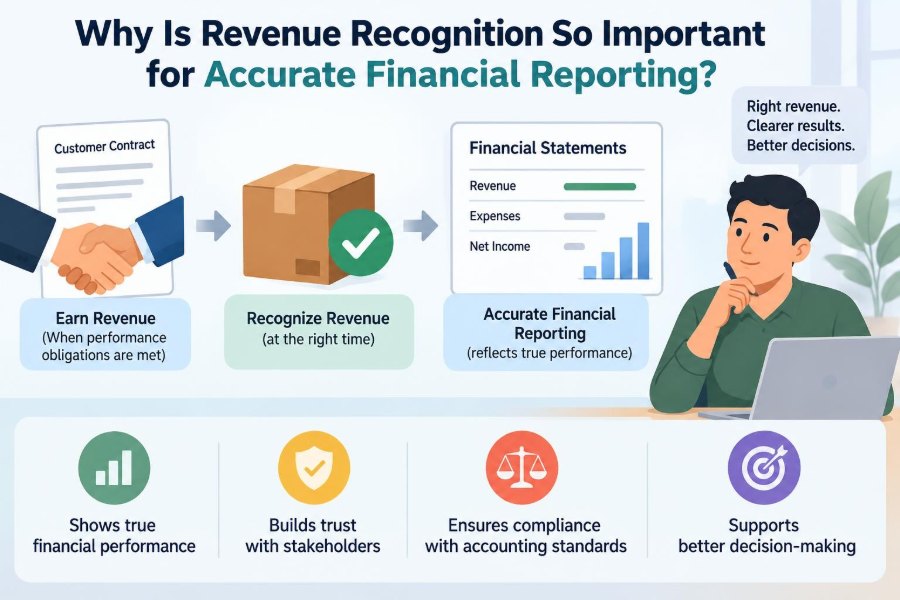

A software company signs a large customer contract in December. Cash will arrive over the next year, and the company will provide access to its platform month by month. Should it report the entire contract value as December revenue?
A builder may receive a deposit before breaking ground. A retailer may sell a gift card that will not be redeemed for months. A consulting firm may finish a project in March but send its invoice in April. In each case, cash, invoices, and completed work occur at different times.
That timing difference is why revenue recognition is one of the most consequential areas of financial reporting. Revenue often shapes how people judge growth, profitability, performance, and future prospects.
Recognizing revenue in the right period does not merely satisfy an accounting rule. It gives users of financial statements a more faithful view of what a business has actually earned and what it still owes customers.
🧭 Revenue Recognition in Plain Language
Revenue recognition is the process of recording revenue when a business has earned it by providing promised goods or services, rather than simply when it receives cash or sends an invoice.
The underlying question is practical: what did the company deliver to the customer during this reporting period? The answer determines whether an amount belongs in current revenue, a future period, or an asset or liability account.
💵 Cash Received Is Not Always Revenue
Cash is easy to see, which makes it tempting to treat every customer payment as income. But an advance payment may create an obligation to perform later.
If a gym receives an annual membership fee upfront, it has cash immediately but still owes access to the facilities over the membership term. Recording all of that amount as current revenue would overstate current performance and understate the service still owed.
🧾 Invoices and Revenue Have Different Jobs
An invoice is a request for payment under agreed billing terms. It is an important business document, but its date does not automatically control the timing of revenue.
A consulting firm can earn revenue before invoicing if it has completed work and has a right to consideration. Conversely, it can invoice before earning revenue if the contract permits advance billing. Accounting must reflect performance, not just paperwork.
📊 Why Timing Changes the Financial Story
Recognizing revenue too early makes a period look stronger than the underlying delivery supports. Recognizing it too late can hide performance that actually occurred during the period.
Both errors distort trends. A reader comparing quarterly sales, operating margins, or growth rates may draw the wrong conclusion if revenue shifts from one period to another without a real change in customer activity.
🎯 The Matching of Performance and Reporting Periods
Financial statements divide continuous business activity into reporting periods, such as months, quarters, and years. Revenue recognition assigns the effects of a contract to the periods in which performance occurs.
This produces a more meaningful comparison with expenses. If a company delivers a service throughout a year, recognizing its associated revenue across that year helps readers assess whether the costs incurred to provide that service were economically worthwhile.
🪜 The Core Principle: Earned Through Performance
Under widely used revenue accounting frameworks, revenue is generally recognized as a company satisfies its performance obligations—its promises to transfer distinct goods or services to a customer.
The exact application differs by contract and accounting framework. Still, the central discipline is consistent: identify what was promised, determine when control or benefit transfers, and recognize the related amount at that point or over that period.
🤝 A Customer Contract Creates the Starting Point
Revenue accounting begins with an enforceable arrangement with a customer. The arrangement may be written, oral, or implied by customary business practice, depending on the facts and applicable requirements.
Accountants consider whether each party’s rights and payment terms can be identified, whether the arrangement has commercial substance, and whether collection is probable or otherwise sufficiently expected under the applicable framework. A signed document alone is not always the end of the analysis.
🧩 Identifying Separate Promises to Customers
One contract can contain several promises. A technology vendor might sell equipment, installation, training, and ongoing support in a single arrangement.
The accounting question is whether those items are distinct performance obligations. If customers can benefit from an item on its own or with readily available resources, and the promise is separately identifiable, it may need its own timing of revenue recognition.
🏷️ Determining the Transaction Price
The transaction price is the consideration a business expects to receive in exchange for its promised goods or services. It may be straightforward in a fixed-price sale, but many arrangements include complexity.
Discounts, rebates, refunds, bonuses, penalties, credits, returns, and usage-based charges can affect the amount. Estimates should reflect the contract’s terms and available evidence, while avoiding amounts that may later require a significant reversal.
⚖️ Allocating One Price Across Several Promises
When a contract has multiple performance obligations, the total transaction price often must be allocated among them. This prevents a company from placing too much value on an item delivered early and too little on services delivered later.
Allocation commonly relies on relative stand-alone selling prices: the prices at which the company would sell each item separately. This is a measurement exercise, not simply a billing decision.
📦 Recognizing Revenue at a Point in Time
Some promises are satisfied at a specific moment. A retailer normally recognizes revenue when a customer obtains control of purchased goods, often at checkout or delivery depending on the arrangement.
Control involves more than physical possession. Relevant indicators can include a present right to payment, legal title, physical possession, significant risks and rewards, and customer acceptance. No single indicator resolves every case.
⏳ Recognizing Revenue Over Time
Other promises are fulfilled continuously. Monthly cloud hosting, routine maintenance, and many subscription services provide customers with benefits as time passes.
For such arrangements, revenue is recognized over time using a measure of progress that faithfully depicts performance. Time elapsed may be appropriate for an even service, while units delivered, milestones, labor hours, or costs incurred may better reflect other contracts.
🏗️ A Construction Example Shows the Judgment Involved
Consider a hypothetical contractor hired to build a specialized asset on a customer’s site. If the customer controls the work as it is created, or the asset has no practical alternative use and the contractor has an enforceable right to payment for work performed, revenue may be recognized over time.
Progress must still be measured carefully. Costs incurred can be useful evidence, but they may not always represent progress—for example, if unusually costly materials are purchased early but not yet incorporated into the work.
🔁 Returns, Refunds, and Variable Outcomes
A retailer that expects some merchandise returns should not assume every dollar billed will remain revenue. Expected refunds and the right to recover returned inventory can require separate accounting.
The same principle applies to performance bonuses and volume rebates. Revenue should represent the amount the company expects to be entitled to after considering the uncertainty built into the contract, not the most optimistic possible result.
🎁 Gift Cards and Customer Prepayments
When a customer buys a gift card, the seller generally has not yet transferred the promised goods or services. The initial amount is usually a contract liability, sometimes called deferred or unearned revenue.
Revenue arises when the card is redeemed, or in some cases when the entity expects it will not be redeemed and is entitled to the amount under applicable rules. The treatment depends on contractual rights and relevant unclaimed-property requirements, which can vary by jurisdiction.
📅 Subscriptions Make Deferral Visible
Subscriptions illustrate why cash timing cannot be the rule. If a magazine, streaming provider, or software company collects an annual fee on day one, it has received financing from the customer for a year of promised access.
As each month of access is provided, part of the contract liability becomes revenue. This pattern tells readers both how much has been earned and how much service remains to be delivered.
🧮 Contract Assets and Receivables Are Not Identical
A receivable exists when the company has an unconditional right to payment; only the passage of time is required before payment is due. A contract asset exists when the company has recognized revenue but its right to payment still depends on something else, such as completing another milestone.
The distinction matters because it explains where a company stands in the path from performance to collection. It also helps users evaluate billing practices and potential credit risk.
🧱 Contract Liabilities Reveal Future Work
A contract liability is the opposite side of early customer payment: the company has collected consideration, or has a right to it, before transferring the related goods or services.
A rising contract liability is not automatically good or bad. It may reflect healthy advance sales, longer contracts, delayed delivery, or a change in billing terms. Readers need the surrounding business context before treating it as a performance signal.
📈 Reliable Revenue Supports Better Analysis
Investors and lenders use revenue to assess demand, pricing, scale, and the ability to cover fixed costs. Managers use it to set targets, allocate resources, and evaluate product lines. Employees may see it affect bonuses or job security.
When recognition follows actual delivery, these decisions rest on more comparable information. Revenue becomes more than a headline number; it becomes evidence of what the organization has accomplished during the period.
🧠 Revenue Quality Matters Alongside Revenue Growth
Two companies can report the same revenue growth while having very different underlying economics. One may have recurring customers receiving services evenly over time; another may depend on a small number of long, customized contracts with significant estimates.
Users should consider the nature of the revenue, payment terms, returns, concentration of customers, changes in contract balances, and management’s significant judgments. Strong growth does not remove the need to understand how the number was produced.
🔍 Disclosures Explain the Number Behind the Number
Revenue notes can explain accounting policies, categories of revenue, opening and closing contract balances, remaining performance obligations, and key judgments about timing and measurement.
These disclosures matter because the income statement is condensed. A single revenue line can combine products, services, regions, delivery patterns, and contractual risks that have very different implications for future results.
🚨 Early Recognition Creates Serious Risks
Premature recognition can inflate revenue, profit, assets, and performance-based compensation. It may also cause a company to miss warning signs, such as weak customer acceptance, high cancellation risk, or obligations that remain unfulfilled.
Even an honest mistake can lead to corrections, lost credibility, audit issues, and poor decisions. Intentional acceleration is more serious: it can mislead users of financial statements and may breach legal, regulatory, or contractual obligations.
🧯 Late Recognition Has Costs Too
Conservatism is not a license to delay earned revenue without reason. Unnecessary deferral can make current performance look weak, obscure trends, and push legitimate results into a later period.
Accurate reporting requires neutrality. The goal is neither the earliest defensible revenue nor the latest possible revenue; it is the amount and timing that faithfully represent the transfer of promised goods or services.
📝 Common Mistakes in Everyday Accounting
- Recording a deposit as revenue without checking what remains to be delivered.
- Using invoice dates as the sole trigger for revenue.
- Ignoring side agreements, renewal rights, rebates, or acceptance clauses.
- Combining distinct products and services into one revenue stream without analysis.
- Using outdated estimates for returns, refunds, or variable consideration.
- Failing to reconcile contract assets and liabilities at period end.
These errors often begin with a process gap rather than a complex technical issue. Clear contract review and timely communication between sales, operations, billing, and accounting can prevent many of them.
🛠️ Build a Repeatable Revenue Process
A practical control framework turns contract terms into consistent accounting. The process should be proportionate: a simple cash-sale business needs less complexity than a company selling bundled, multi-year arrangements.
- Capture the approved contract and relevant amendments.
- Identify promised goods or services and the delivery evidence for each.
- Document the transaction price, including estimates and constraints.
- Set the recognition pattern and account mapping before or when billing begins.
- Review exceptions, contract balances, and estimates at each close.
- Retain support for judgments, approvals, and changes.
👥 Sales, Operations, and Finance Must Share Information
Sales teams may negotiate discounts, free implementation, acceptance rights, or flexible cancellation terms. Operations teams know whether delivery occurred. Finance teams translate those facts into financial reporting.
If information stays in separate systems or inboxes, accounting may rely on incomplete assumptions. A short contract-review workflow for unusual terms is often more effective than trying to repair the records after the reporting period ends.
⚙️ Automation Helps, but It Cannot Read Intent Alone
Revenue systems can automate schedules, allocate consideration, produce entries, and flag contract modifications. They reduce manual work and make recurring processes more consistent.
But automation depends on sound inputs. A system cannot reliably decide whether a promised implementation service is distinct, whether a customer has accepted a deliverable, or whether a rebate estimate is reasonable without accurate contract data and human judgment.
🔄 Contract Changes Need Fresh Analysis
Customers often add products, extend terms, change scope, or renegotiate price. A modification may be accounted for as a separate contract, a termination and replacement, or an adjustment to the existing arrangement, depending on what changes and whether the added goods or services are distinct.
Treating every amendment as a simple administrative update can create material timing errors. The original contract analysis should be revisited whenever commercial terms change.
🌍 Accounting Frameworks Share a Direction, Not Every Detail
Many organizations apply IFRS or U.S. GAAP revenue guidance built around a similar core model for customer contracts. Their broad objective is to portray the transfer of promised goods or services in an amount reflecting expected consideration.
Specific requirements, industry practices, tax rules, legal enforceability, and disclosure obligations can differ. Businesses should apply the framework that governs their reporting and seek qualified advice for unusual, high-value, or judgment-heavy arrangements.
🧪 Questions to Ask Before Closing the Books
A disciplined month-end review does not need to be mysterious. It should focus attention on the facts that could move revenue between periods.
- What did we promise, and what did we actually deliver this period?
- Did any customer accept, reject, return, cancel, or modify an arrangement?
- Did estimates for rebates, refunds, bonuses, or collectibility change?
- Do invoices, cash receipts, receivables, and contract balances reconcile to contract terms?
- Are there unusual transactions near period end that require added evidence?
🎓 What Students and Professionals Should Remember
Revenue recognition combines principles with evidence. Memorizing that revenue is “earned” is a useful start, but professional work requires identifying the promise, examining the contract, observing delivery, estimating uncertainty, and documenting conclusions.
For students, practice by mapping familiar transactions—concert tickets, prepaid phone plans, online orders, gift cards—to the timing of performance. For working professionals, focus on the handoffs between commercial terms, operational delivery, and the general ledger.
🔑 The Core Principle Behind Accurate Reporting
Revenue is important because it is one of the clearest measures of a company’s activity, yet it can be misunderstood when cash, billing, and performance occur at different times. Sound recognition makes those differences visible rather than hiding them.
The core principle is simple: report revenue when the business transfers the promised goods or services, in the amount it expects to be entitled to, and support that conclusion with clear evidence. Applying that principle consistently makes financial statements more useful to everyone relying on them.
Accurate revenue recognition turns customer promises and completed work into a financial story that readers can trust. That trust supports better analysis, better management, and more credible reporting over time. 💰📊✅