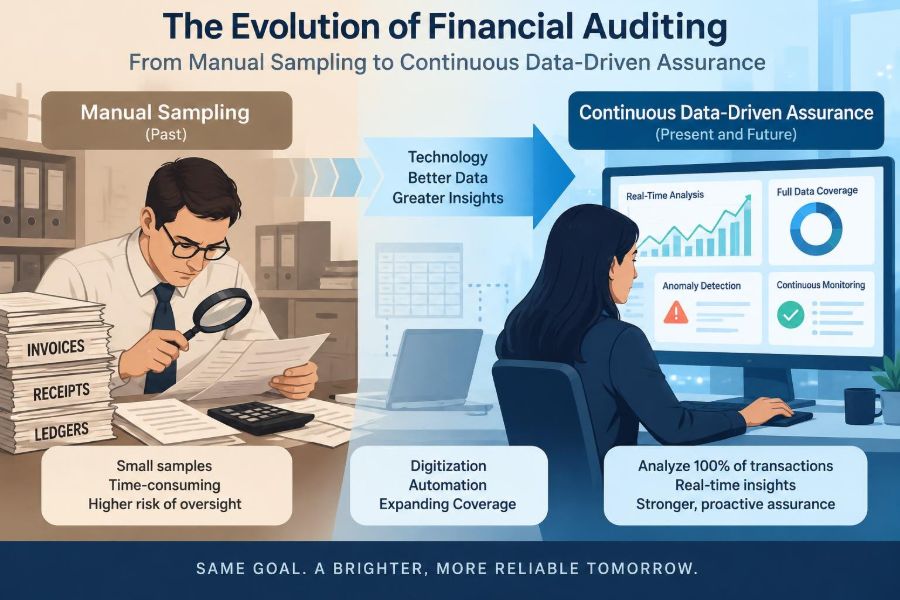

A finance team closes the month, reconciles key accounts, and sends a large folder of invoices, contracts, and spreadsheets to the audit team. Days later, a request arrives for 40 transactions selected from thousands. Someone retrieves files, explains an exception, and hopes the sample represents the wider population.
That familiar scene captures the traditional rhythm of financial auditing: periodic, document-heavy, and necessarily selective. It has supported trust in financial reporting for generations, but it was designed around paper records and limited computing power.
Businesses now create transactions continuously through enterprise systems, payment platforms, e-commerce sites, payroll tools, and cloud applications. Risks can emerge and spread long before a year-end audit begins. A duplicated vendor bank account, unusual revenue entry, or failed approval workflow may be visible in data almost immediately.
This shift is changing the question auditors ask. Rather than only asking whether a sample of past transactions was properly recorded, audit teams can increasingly ask whether the whole population is behaving as expected—and whether exceptions are being identified while management can still act.
📜 What Financial Auditing Is Designed to Do
A financial statement audit provides reasonable assurance that financial statements are free from material misstatement, whether caused by error or fraud. Reasonable assurance is a high level of assurance, not a guarantee that every error will be found.
Auditors form an opinion by understanding the entity, assessing risks, evaluating controls, and performing procedures on account balances, transactions, and disclosures. Their work is guided by professional standards, evidence requirements, and professional judgment.
Auditing is therefore not simply an exercise in checking arithmetic. It is a disciplined process for deciding whether the evidence supports confidence in reported financial information.
🗂️ The Paper-Based Roots of Audit Work
Early auditing was shaped by ledgers, vouchers, physical inventory counts, bank statements, and signed approvals. When records were largely manual, an auditor’s work often involved tracing entries from a ledger back to source documents or vouching a payment to an invoice and authorization.
Physical evidence had practical advantages: a signed purchase order or cancelled check could be inspected directly. But collecting, organizing, and reviewing this evidence took substantial time, especially for organizations with large transaction volumes.
The physical environment also influenced audit timing. Work was commonly concentrated around the reporting date because records and people had to be available in one place.
🎯 Why Sampling Became Essential
Reviewing every transaction is rarely practical. Even a modest organization may process thousands of sales, purchases, payroll entries, and journal entries in a year. Sampling lets auditors obtain evidence efficiently from less than the entire population.
A sample can be statistical, using principles of random selection and measurement of sampling risk, or nonstatistical, based on professional judgment. In either case, the auditor must define the population, choose a method, determine sample size, and evaluate the results.
Sampling is not a shortcut for careless work. It is a structured response to limited time and the fact that audit evidence has a cost to obtain and evaluate.
🎲 Understanding Sampling Risk
Sampling risk is the possibility that a conclusion based on a sample differs from the conclusion that would have been reached by examining the entire population. For example, a sample of expense claims may contain no unsupported items even though a broader review would have found a recurring problem.
Auditors manage this risk through sound sample design, appropriate sample sizes, population analysis, and follow-up of exceptions. They also combine sampling with other forms of evidence, such as analytical procedures and control testing.
Still, sampling is strongest when the population is relatively stable and the selected items are genuinely representative. It is less reassuring when unusual transactions are concentrated in a small, difficult-to-identify subset.
🔎 Vouching, Tracing, and the Direction of Testing
Two classic audit techniques sound similar but answer different questions. Vouching starts with an accounting record and moves back to supporting evidence. It is often used to test whether recorded transactions occurred and were valid.
Tracing starts with source evidence and follows it into the accounting records. It is often used to test completeness: whether transactions that should have been recorded actually were.
Imagine goods received at a warehouse. Tracing from receiving reports to accounts payable helps test whether liabilities are complete. Vouching from recorded purchases back to invoices and receiving reports helps test validity.
📅 The Limits of Periodic Audit Cycles
A traditional annual audit is inevitably retrospective. By the time fieldwork occurs, many business decisions based on the reported period have already been made. The audit remains valuable for external reporting, but it may be less useful as an early-warning mechanism.
Interim testing can move some work earlier, and internal audit functions may operate throughout the year. Yet a periodic approach can still leave lengthy intervals between identifying a condition and responding to it.
This timing gap matters most in fast-moving processes such as online sales, automated payments, inventory movement, and privileged system access.
🖥️ The Move from Ledgers to Enterprise Systems
Enterprise resource planning systems, or ERPs, brought finance, procurement, inventory, production, and payroll into connected digital records. Instead of examining only printed reports, auditors could obtain system extracts and test larger volumes electronically.
Digital systems also create new evidence: user IDs, timestamps, workflow histories, configuration settings, and system logs. These records can reveal not only what was posted, but who initiated it, who approved it, and whether a control step occurred.
However, system-generated evidence is only as reliable as the systems and controls that produce it. Auditors must understand data flows and relevant information technology controls before relying heavily on reports.
📊 Audit Data Analytics Changes the Scale of Inquiry
Audit data analytics uses data to plan audit procedures, identify risks, test controls, examine transactions, or evaluate evidence. Analytics may support a sample, target a high-risk subset, or in some cases test an entire population against defined criteria.
The key change is scale. Rather than manually scanning a small selection of journal entries, an auditor can search all entries for postings outside normal hours, unusual descriptions, unexpected users, or amounts just below an approval threshold.
Analytics does not make every exception an error. It makes the population more visible and directs human attention to items that deserve explanation.
🧮 Full-Population Testing Has a Precise Meaning
Testing 100% of a data extract does not automatically mean testing 100% of an audit assertion. A script may inspect every invoice number for duplicates, but it does not prove every invoice represents a valid delivery or that all terms were correctly applied.
The distinction is crucial. Full-population testing is powerful when the test criterion maps closely to a risk, such as identifying every payment made to a supplier before the supplier was approved.
Auditors still need to assess data completeness, accuracy, and relevance. If a report excludes a transaction type or omits a subsidiary, a perfectly executed analysis can produce an incomplete conclusion.
🔁 What Continuous Auditing Means
Continuous auditing describes audit activities that are performed frequently or on an ongoing basis using timely data and automated procedures. It does not necessarily mean an external auditor watches every transaction in real time.
In practice, continuous approaches may run daily, weekly, or monthly tests that flag exceptions for review. The frequency should reflect the speed and risk of the underlying process rather than a vague preference for “real time.”
A daily review of duplicate payments may be sensible. A yearly review of a low-volume, stable policy disclosure may be entirely appropriate.
🛡️ Continuous Assurance Is Broader Than Detection
Continuous assurance is the broader goal of providing more timely confidence about information, controls, or risk conditions. It can include continuous auditing, but it may also involve management monitoring, internal audit work, and automated control evidence.
For example, a dashboard showing whether bank reconciliations were completed on time is a monitoring tool. An audit procedure that independently tests whether reconciliations were completed and reviewed may contribute to assurance.
Keeping these roles distinct preserves accountability. Management owns controls; auditors evaluate and report on them.
⚙️ Continuous Controls Monitoring Belongs to Management
Continuous controls monitoring, often called CCM, is usually a management activity. Rules are embedded in or connected to business systems to identify control failures, policy breaches, or unusual conditions.
A procurement rule might flag a purchase order approved after the related invoice date. A payroll rule might identify employees whose bank details were changed and whose pay was processed shortly afterward.
When designed well, CCM helps management correct issues promptly. Audit can then assess the design, operation, governance, and reliability of that monitoring instead of becoming responsible for running the business process.
🧱 Reliable Data Is the First Control
Data-driven assurance begins with a basic question: can the team rely on the data set? This requires attention to data lineage—the path from original transaction through system processing, interfaces, transformations, and the final report or audit file.
Common data problems include duplicate extracts, inconsistent date formats, missing fields, overridden master-data values, and reports that do not include all relevant entities. These issues can change analytical results without producing an obvious error message.
Useful validation steps include reconciling record counts and totals to trusted reports, checking period coverage, inspecting key fields, and documenting extraction logic. Data preparation is audit work, not merely technical housekeeping.
🔐 IT General Controls Support Trust in Systems
IT general controls, often abbreviated as ITGCs, are foundational controls over the environment in which applications operate. They commonly cover user access, program changes, system operations, backups, and incident management.
Suppose a revenue report is accurate under normal conditions, but users can obtain inappropriate access or alter its underlying logic without review. The report may not be reliable audit evidence, even if its numbers appear plausible.
Application controls and ITGCs work together. An automated three-way match is more dependable when access and change controls help protect the configuration behind it.
🧾 Journal Entry Testing Illustrates the New Approach
Journal entries are a frequent focus because manual adjustments can affect many financial statement areas. In a traditional approach, auditors may select entries based on size, timing, account, or preparer.
With analytics, they can screen the full journal population for patterns such as entries posted late in the period, unusual combinations of accounts, round numbers, entries by infrequent users, or descriptions containing atypical terms.
These are risk indicators, not proof of misconduct. A large late entry may be a legitimate accrual. The value of the analysis is that it supports a focused inquiry into the business rationale, approval, and underlying documentation.
🛒 Procure-to-Pay Offers High-Value Use Cases
The procure-to-pay process moves from vendor setup and purchasing through receipt of goods or services, invoicing, approval, and payment. It creates rich data that can be tested across systems.
- Identify duplicate invoices using combinations of vendor, invoice number, date, and amount.
- Find payments made before a required approval or before receipt of goods.
- Compare vendor bank accounts to employee or other vendor details where governance permits.
- Flag split purchases that may avoid established approval thresholds.
Each test needs context. Similar invoice amounts may reflect recurring services, and a shared bank account can have a legitimate explanation. Exception workflows must allow knowledgeable reviewers to distinguish anomalies from actual issues.
💳 Revenue Analytics Must Respect Business Reality
Revenue is often high risk because it can be affected by timing, returns, contract terms, rebates, shipping conditions, and manual adjustments. Analytics can compare sales trends by product, customer, channel, geography, or period and highlight unexpected movements.
A hypothetical example: a spike in sales during the final days of a reporting period could be consistent with a genuine seasonal promotion. It could also justify testing whether shipment, acceptance, return rights, and cut-off were treated correctly.
Analytics helps frame questions; it does not replace understanding the contract and the applicable accounting requirements.
📦 Inventory Connects Digital Records to Physical Reality
Inventory testing shows why automated analysis cannot entirely replace observation and judgment. System data can identify negative quantities, slow-moving items, unusual adjustments, count differences, or locations with recurring discrepancies.
But physical existence and condition often require observation, inspection, or other persuasive evidence. A warehouse record can say 500 units exist; it cannot by itself establish that the goods are present, saleable, and owned by the entity.
The strongest approach combines digital population analysis with targeted physical procedures based on risk.
🧠 Machine Learning Can Prioritize, Not Decide Alone
Machine learning models can identify patterns, cluster similar transactions, or assign anomaly scores. They may help review teams prioritize large populations where rule-based tests would create too many alerts.
Yet model outputs can be difficult to explain, can reflect biased historical data, and can change in performance as business processes evolve. A model that learned from past review decisions may replicate weak judgment rather than improve it.
For audit use, teams need understandable objectives, controlled data, validation, documented governance, and human review. An anomaly score is not audit evidence by itself.
🧩 Rules and Models Solve Different Problems
Rule-based analytics are transparent: “Flag every payment over a stated threshold approved by the same user who created the vendor.” They work well for known control requirements and clearly defined conditions.
Models are more useful when patterns are complex or unknown, such as finding transactions that differ meaningfully from similar historical activity. Their results require more careful interpretation.
| Approach | Best suited to | Main caution |
|---|---|---|
| Rule-based test | Known policies and control breaches | Can miss novel patterns |
| Statistical analysis | Trends, relationships, and outliers | Requires sound assumptions |
| Machine learning | Complex prioritization across large data sets | May be hard to explain or validate |
Many mature programs use a combination rather than treating one technique as universally superior.
🚨 Alerts Need Triage and Ownership
An exception report has little value if nobody reviews it promptly. Continuous assurance programs need a clear workflow: who receives alerts, how they investigate, what evidence they retain, how they classify outcomes, and when they escalate issues.
Too many low-quality alerts create alert fatigue. Reviewers start ignoring notifications, and genuinely significant items may be missed. Thresholds should be calibrated using actual outcomes, not chosen only because they are easy to code.
Good triage separates routine explanations from suspected control failures, accounting errors, and matters that require broader investigation.
📈 Better Evidence Does Not Eliminate Judgment
Auditors apply professional skepticism: a questioning mindset and critical assessment of evidence. More data can sharpen skepticism, but it cannot automate it.
For example, a dashboard may show that approvals occurred before payment. An auditor must still consider whether the approver had appropriate authority, whether the approval was meaningful, and whether related controls were circumvented.
Professional judgment also determines materiality, the significance of exceptions, the sufficiency of evidence, and the implications for the audit opinion.
⚖️ Independence and Role Boundaries Matter
Technology can blur roles. If an external audit team designs and operates a client’s controls-monitoring system, questions may arise about independence and management responsibility. The precise boundaries depend on applicable professional rules and the nature of the engagement.
Organizations should clearly document who owns the process, who resolves exceptions, who changes rules, and who provides independent assurance. Internal audit teams also need safeguards that preserve their objectivity when advising on system design.
A useful principle is simple: management manages risks and controls; assurance functions evaluate them.
🧭 Implementation Should Start with a Focused Risk
Organizations do not need to automate every audit procedure at once. A practical starting point is a high-volume, repeatable process with accessible data and a clear risk, such as duplicate payments, privileged-access review, or untimely reconciliations.
- Define the business risk and audit objective.
- Map the process, systems, data sources, and control points.
- Validate the data against reliable totals and records.
- Design a transparent test and exception criteria.
- Assign investigation ownership and escalation steps.
- Measure results, refine the test, and document evidence.
This sequence keeps technology connected to an assurance purpose rather than becoming an attractive but poorly governed dashboard.
👥 Skills Are Shifting, Not Disappearing
Modern audit teams benefit from accounting knowledge, control thinking, data literacy, process understanding, and communication skills. Some members may use SQL, Python, visualization tools, or audit analytics platforms, while others focus on interpreting results and obtaining corroborating evidence.
Accountants do not need to become full-time software engineers to contribute. They do need enough data fluency to ask sensible questions: Where did this field originate? What does a blank value mean? Does this extract include reversals? Could the rule create false positives?
Likewise, technical specialists need to understand audit objectives. A technically elegant query is not useful if it does not address a relevant assertion or control risk.
🧪 Testing the Test Is a Core Discipline
Automated procedures need quality assurance just as financial systems do. A single incorrect join, filter, date condition, or assumption can omit important records or generate misleading exceptions.
Teams should test code and rules with known cases, independently review significant logic, retain version histories, and document changes. When a process changes—such as a new payment platform or revised approval matrix—the related analytics should be reassessed.
Reproducibility matters. Another qualified reviewer should be able to understand what the test did, which data it used, and how the conclusion was reached.
🧯 Common Mistakes in Data-Driven Assurance
The most common failures are not always advanced technical failures. They are often failures of design and governance.
- Assuming a complete data set without reconciling it to a trusted source.
- Treating every anomaly as an error or fraud indicator.
- Automating a weak or poorly understood manual process.
- Building dashboards without assigning action owners.
- Using black-box outputs where explanation and evidence are required.
- Ignoring privacy, security, retention, and access requirements for sensitive data.
These mistakes can create false confidence—the opposite of what assurance is intended to provide.
🌐 Cloud Systems Expand Both Opportunity and Complexity
Cloud applications can make data more accessible and enable faster integration across business functions. They can also create fragmented data environments when finance, sales, HR, and operations use separate platforms with different definitions and controls.
Interfaces deserve close attention. A transaction may be approved correctly in one system but transferred incompletely or incorrectly into another. Audit teams need to understand system boundaries, automated handoffs, and reconciliation controls.
Data access should follow least-privilege principles. Broad access may simplify analysis but can expose confidential payroll, customer, or employee information unnecessarily.
🔮 The Future Is Hybrid, Not Fully Automated
Financial auditing is unlikely to become a fully autonomous exercise. Complex estimates, unusual transactions, management intent, legal terms, and physical conditions require context that data alone may not capture.
What is changing is the allocation of effort. Repetitive searching, matching, and population screening can increasingly be automated, allowing professionals to spend more time on judgment, challenge, investigation, and communication.
The future audit is best understood as a hybrid model: automated evidence gathering and monitoring combined with accountable human evaluation.
🏁 The Core Principle: Timely Data, Credible Evidence, Human Accountability
The evolution from manual sampling to continuous data-driven assurance is not a story of old methods becoming worthless. Sampling, inspection, observation, confirmations, and professional skepticism remain essential tools when used for the right risks.
The opportunity is to use digital records more intelligently: examine broader populations, identify exceptions sooner, test controls more consistently, and direct human effort toward the matters that most need interpretation.
But speed and volume do not create assurance by themselves. Reliable data, sound controls, transparent methods, clear ownership, and professional judgment are what turn analytics into credible audit evidence.
The strongest audit approach combines the reach of technology with the discipline and accountability of informed human judgment. That combination helps assurance become not only more efficient, but more relevant to how modern organizations actually operate. 💰📊🛡️