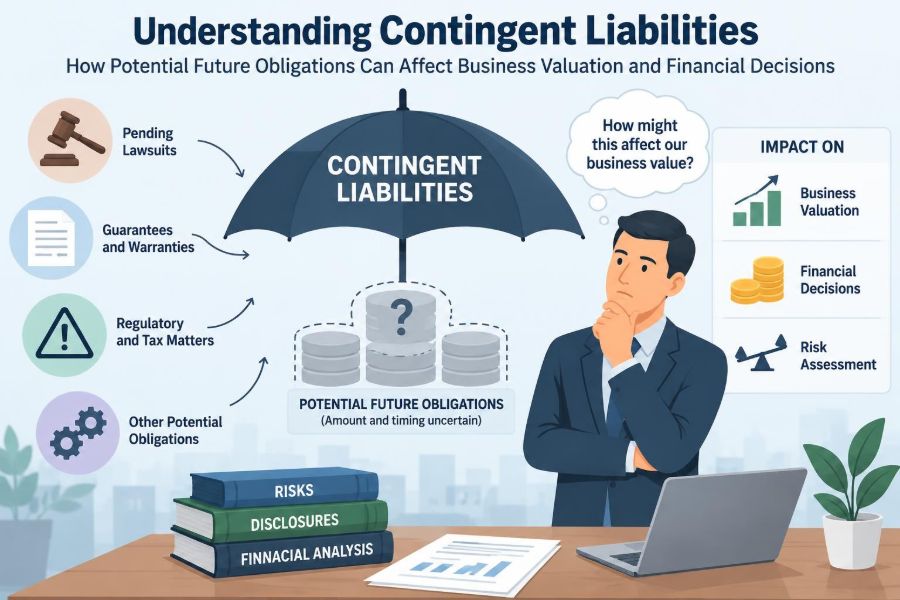

A company can look profitable, hold cash, and report manageable debt—yet still face a lawsuit, warranty problem, tax dispute, or loan guarantee that could become expensive later. That possibility may not appear as an ordinary payable on the balance sheet.
Imagine comparing two manufacturers with similar sales and earnings. One has routine obligations. The other has guaranteed a supplier’s bank loan and is defending a product-liability claim. Their current income statements may look alike, but their future risk is not alike.
That gap is where contingent liabilities matter. They force accountants, managers, lenders, and investors to look beyond amounts that are already certain and ask what may happen if uncertain events unfold.
Understanding these potential obligations is not about predicting every bad outcome. It is about identifying material risks, judging the available evidence carefully, and communicating uncertainty in a way that supports sound financial decisions.
🧾 What a Contingent Liability Is
A contingent liability is a possible obligation arising from a past event. Whether the company must pay, provide services, or transfer other resources depends on the outcome of an uncertain future event that is not entirely within the company’s control.
For example, a customer may sue a retailer after an injury allegedly caused by a defective product. The sale and alleged injury happened already, but the retailer’s obligation depends on settlement negotiations, a court ruling, insurance coverage, and other uncertain facts.
🔍 The Three Elements Behind the Definition
Most contingent-liability analysis starts with three questions. First, did a past event create a possible obligation? Second, is there uncertainty about whether an outflow will occur? Third, can the financial effect be estimated reliably enough for reporting?
The order matters. A vague concern about future competition is a business risk, not a contingent liability. A claim based on an event that already occurred may be a contingent liability even before cash is paid.
⚖️ Why “Contingent” Does Not Mean “Unreal”
The word contingent can sound hypothetical or remote. In accounting, however, it often refers to a real exposure whose final outcome remains uncertain.
A pending legal claim can consume management time, restrict financing options, and affect a buyer’s willingness to acquire the business before a court determines the final amount. Uncertainty changes measurement; it does not automatically eliminate economic significance.
📚 The Core Reporting Logic
Accounting frameworks differ in terminology and detailed thresholds, but the broad logic is similar. Management assesses both the likelihood of an outflow and the ability to estimate the amount.
When loss is sufficiently likely and can be reasonably estimated, the company generally recognizes an expense and a liability. When an obligation is possible but does not meet the recognition threshold, disclosure in the notes may be required. Remote exposures generally receive less reporting attention, unless a specific rule requires otherwise.
🧭 Recognition, Disclosure, or No Reporting?
| Assessment | Typical financial reporting response | Illustrative situation |
|---|---|---|
| Loss is sufficiently likely and estimable | Recognize an expense and liability | A warranty pattern supports a reasonable expected-cost estimate |
| Loss is possible or estimate is not reliable | Disclose the nature and potential effect, when material | A lawsuit is underway but outcomes remain highly uncertain |
| Chance of loss is remote | Often no disclosure under general rules | A weak claim with little factual or legal support |
This table is a conceptual guide, not a substitute for the applicable accounting standard or professional advice. The exact language, threshold, and disclosure requirements can vary by reporting framework and jurisdiction.
🧮 Why Estimation Changes Everything
Accounting does not require certainty before recognizing every obligation. Ordinary warranty costs, returns, and environmental cleanup estimates would otherwise be ignored until each invoice arrived.
Instead, the question is whether available evidence supports a reasonable estimate. Relevant evidence can include claim histories, contract terms, expert assessments, engineering reports, legal counsel’s evaluation, settlement discussions, and changes in facts after the reporting date.
🛠️ Product Warranties as a Familiar Example
A manufacturer that promises to repair or replace products has created an obligation through past sales. Although the identity of each future claimant is unknown, experience may allow the company to estimate the overall cost.
If 10,000 units are sold with a warranty, management might use expected defect patterns, repair labor, shipping, and parts costs to estimate the obligation. The resulting expense is matched to the revenue-generating sales period rather than delayed until repairs occur.
🏛️ Litigation and Legal Claims
Lawsuits are among the most visible contingent liabilities because their financial outcome can vary widely. A claim’s stated damages are not automatically the expected loss; the claim may be dismissed, settled for a different amount, or limited by law, contract, or insurance.
Management should work with legal counsel, but accounting judgments remain management’s responsibility. Financial reporting should reflect the best supportable assessment at the reporting date, not optimism, fear, or an attempt to influence negotiations.
🛡️ Insurance Does Not Erase the Exposure
Insurance can reduce a company’s net economic loss, but it does not always remove the underlying obligation. Coverage may have deductibles, exclusions, limits, disputed terms, or insurer-credit risk.
In many cases, the potential liability and expected recovery are assessed separately. Reporting only the hoped-for insurance proceeds can make the exposure appear smaller or more certain than it actually is.
🤝 Guarantees Create Risk for Someone Else’s Debt
A guarantee occurs when one party promises to pay or perform if another party fails. A parent company may guarantee a subsidiary’s borrowing, or a business owner may guarantee a company loan personally.
The guarantor may never pay. But if the borrower becomes distressed, the guarantee can quickly turn into a direct obligation. Investors and lenders therefore examine guarantees to understand leverage that may not be obvious from recorded borrowings alone.
🏗️ Environmental and Remediation Obligations
Industrial operations, property ownership, waste disposal, and resource extraction can create future cleanup duties. The timing and amount may depend on contamination findings, regulatory requirements, remediation methods, and the allocation of responsibility among parties.
These cases often require engineering, legal, and environmental input. A useful estimate may be a range rather than one precise number, which makes transparent explanation of assumptions especially valuable.
🧾 Tax Positions and Government Disputes
A company may take a tax position that a revenue authority later challenges. Potential interest, penalties, and additional tax can create uncertainty, particularly when rules are complex or facts are open to interpretation.
Tax contingencies should not be confused with routine taxes payable. The accounting issue is the uncertain portion: the amount that may become due if an interpretation, audit, appeal, or settlement goes against the company.
👥 Employee Claims and Benefit Commitments
Employment disputes can involve alleged wrongful dismissal, discrimination, unpaid wages, workplace injuries, or benefit obligations. A single case may be manageable, while a pattern of similar claims can indicate a larger exposure.
For benefit promises, the obligation may also depend on employee service, actuarial assumptions, or future eligibility. That makes careful classification essential: some obligations are standard accrued liabilities, while others include significant contingencies.
📦 Contracts Can Hide Costly Obligations
Contracts may contain indemnities, performance penalties, service-level credits, price adjustments, or obligations to compensate another party for specified losses. These clauses are easy to overlook when accounting teams focus only on the contract’s revenue terms.
A strong review process identifies nonstandard clauses before signature and reassesses them as projects progress. The legal document may contain the earliest warning that a future liability is developing.
⏳ Timing Matters at the Reporting Date
Financial statements report conditions that existed at a particular date. Events occurring after that date may provide evidence about an existing condition or may create a new condition entirely.
For instance, a settlement reached shortly after year-end could provide evidence about a lawsuit already pending at year-end. By contrast, a new accident after year-end generally concerns a later event, although it may still require disclosure if material under applicable rules.
📈 The Income Statement Effect
When a contingent loss is recognized, the company records expense in the appropriate period. This reduces reported profit even though payment may occur later.
That timing is not a penalty for uncertainty. It is an attempt to prevent current results from being overstated when current operations or past events have already created a probable, estimable obligation.
🏦 The Balance Sheet Effect
A recognized contingency appears as a liability, often classified as current or noncurrent depending on expected timing. It can affect working capital, debt ratios, and the apparent cushion available to absorb setbacks.
Disclosed but unrecognized contingencies do not increase reported liabilities directly. Still, analysts may adjust their view of debt, liquidity, or enterprise value after reading the notes.
💵 Cash Flow Is Not Always Immediate
An expense and cash payment often occur in different periods. Recording an estimated warranty liability today may reduce profit now, while repair payments occur over coming months.
This distinction helps explain why a company can report a large contingency expense without an identical current-period operating cash outflow. Cash-flow forecasting must still incorporate the expected payment schedule.
🔎 Financial Statement Notes Are Essential Reading
The balance sheet gives a compressed snapshot. The notes often explain the nature of major claims, the stage of proceedings, ranges of possible loss, insurance considerations, and why an amount was or was not recognized.
Readers should watch for qualitative language that signals uncertainty: inability to estimate, multiple possible outcomes, unresolved legal questions, or dependence on regulatory decisions. Such wording does not prove a severe loss, but it identifies an area requiring judgment.
📊 How Analysts Adjust Business Valuation
Valuation is forward-looking, so investors do not rely only on the recorded liability. They ask whether expected future cash flows already reflect the risk and whether the market price adequately compensates for uncertainty.
A buyer evaluating an acquisition may reduce the purchase price, request an escrow, negotiate an indemnity, or model several outcomes. A relatively small recorded amount can matter greatly if it signals a broader product, compliance, or governance problem.
🎯 Expected Value Is Helpful—but Incomplete
An analyst may think in expected-value terms: possible outcomes weighted by their perceived likelihood. This can be useful for building scenarios, especially when a contingency has a range of losses.
But expected value should not create false precision. A low-probability, high-severity outcome may affect financing access or survival even if its mathematical average looks moderate. Decision-makers should consider downside concentration, timing, and available liquidity as well.
🏛️ Effects on Loans and Debt Covenants
Lenders assess whether a borrower can repay under stressed conditions. Recognized liabilities can weaken leverage, current-ratio, and net-worth measures used in loan agreements.
Even unrecorded contingencies can matter if they trigger disclosure requirements, represent a material adverse change, or cause lenders to demand more information. Borrowers should review covenant definitions closely rather than assuming accounting presentation determines every contractual consequence.
🧠 Management Decisions Influenced by Contingencies
Potential obligations influence more than reporting. They can change pricing, reserve policies, product design, supplier selection, litigation strategy, capital spending, and whether a business enters a new market.
For example, rising returns may lead a manufacturer to investigate quality controls before the issue becomes a large warranty reserve. The best response is often operational: reduce the source of the risk rather than merely improve its accounting estimate.
🧩 The Role of Internal Controls
Contingencies are frequently missed because information is scattered across legal, sales, operations, tax, procurement, and executive teams. A formal quarterly questionnaire alone may not capture rapidly changing claims or contract exposures.
Useful controls include a central claims register, legal-department reporting, contract review checkpoints, warranty data monitoring, documented estimates, and review by finance leadership. Controls should create an evidence trail showing how management reached its conclusion.
🚩 Common Warning Signs for Readers
No single sign confirms a major problem, but several patterns deserve closer investigation:
- Repeated references to unresolved litigation or regulatory inquiries.
- Rapid growth in warranty expense, returns, or customer credits.
- Large guarantees involving financially weak counterparties.
- Broad wording about losses that cannot be estimated.
- A mismatch between management’s optimistic narrative and cautious note disclosures.
The aim is not to assume the worst. It is to identify questions that may materially affect cash flows, risk, and valuation.
❌ Mistake: Treating Every Claim as a Recorded Debt
Not every complaint, demand letter, or threatened lawsuit should become a balance-sheet liability. Doing so would overstate obligations and obscure the difference between a possible exposure and a probable, measurable loss.
Good accounting requires evidence-based classification. The presence of uncertainty calls for judgment, not automatic recognition.
❌ Mistake: Ignoring What Is Outside the Balance Sheet
The opposite error is to treat recorded debt as the complete picture of financial risk. Guarantees, litigation, environmental matters, and contractual indemnities can be economically meaningful before they are recognized as liabilities.
Students learning ratio analysis should therefore pair the face of the statements with the notes. Working professionals should make that practice routine in credit reviews, budgeting, due diligence, and investment analysis.
📝 A Practical Review Process
A disciplined review can be organized into a repeatable sequence:
- Identify past events that could create obligations.
- Gather contracts, correspondence, claim data, legal input, and operational evidence.
- Assess likelihood using the applicable reporting framework.
- Estimate the amount or range using supportable assumptions.
- Decide whether to recognize, disclose, or take no reporting action.
- Document the rationale and update it when facts change.
Documentation is crucial because a conclusion that is reasonable today may need revision next quarter as litigation advances or new defect data emerges.
🔄 Reassessment Is Part of the Job
Contingent liabilities are not set-and-forget estimates. A case can move from remote to possible, from possible to probable, or in the other direction after new evidence appears.
Management should reassess material exposures at every reporting date and whenever a significant event occurs. Updating an estimate is not an admission that the earlier estimate was wrong; it reflects better information.
🤔 Questions to Ask Before Making a Decision
Whether you are evaluating an employer, company, project, or investment, ask practical questions: What event caused the exposure? What outcome must occur before payment is required? Who is responsible? What evidence supports the estimate? How soon could cash be needed?
Also ask what is not known. A disclosed range, an inability to estimate, or reliance on a counterparty can be more decision-relevant than a single number presented without context.
✅ The Core Principle: Measure Risk Honestly
Contingent liabilities sit at the boundary between known obligations and uncertain future outcomes. Sound accounting neither hides uncertainty nor converts every possibility into a definite debt.
The core discipline is to connect past events, current evidence, likelihood, measurement, disclosure, and decision-making. For valuation and financial planning, the question is not simply “What is recorded?” but “What could reasonably require resources, and can the business absorb it?”
Contingent liabilities matter because financial strength depends not only on obligations already due, but also on credible future obligations that may emerge from the past. Reading the evidence behind those possibilities leads to clearer analysis and better decisions. 💰📊⚖️