
It is the last week of the month, and a finance team is waiting on a bank export, chasing a department head for an explanation, and comparing two spreadsheets that should match but do not. A small timing difference, a duplicated payment, or a missing invoice can turn a routine close into an evening of detective work.
That pressure is familiar because finance depends on trust. Leaders need numbers they can use to decide whether to hire, invest, conserve cash, or revise a plan. Auditors need a clear trail from a reported balance back to the underlying evidence.
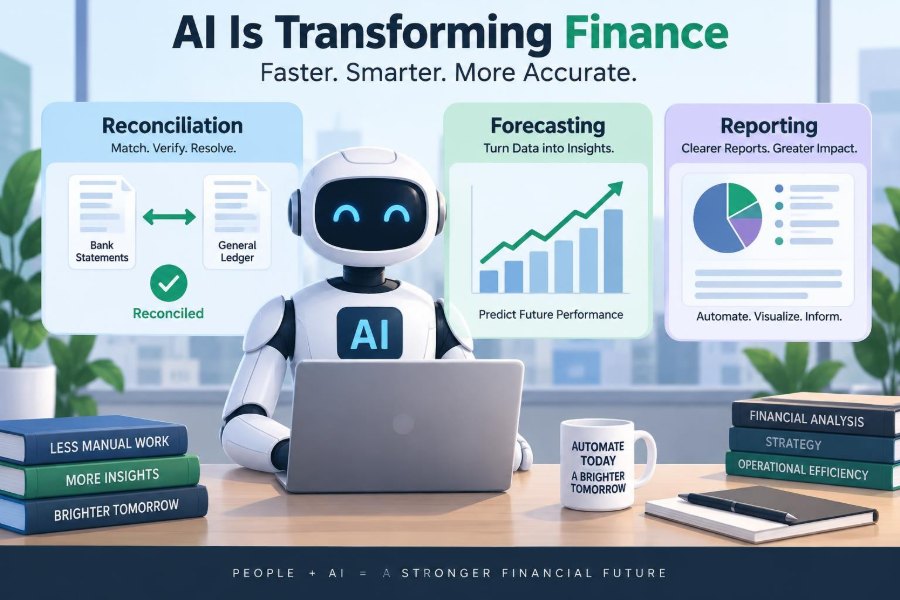
Artificial intelligence is entering this work not as a replacement for accounting judgment, but as a way to sort, connect, summarize, and flag information at a scale that manual processes struggle to sustain. Its most practical effects are appearing in reconciliation, forecasting, and reporting.
The real breakthrough is not that software can produce an answer quickly. It is that well-designed financial automation can help people focus their attention on the exceptions, assumptions, and decisions that actually require professional judgment.
🧭 Financial Automation Has Moved Beyond Simple Rules
Traditional automation follows explicit instructions: if an invoice number matches a payment reference, mark the item as matched. Those rules remain valuable because they are predictable and easy to test.
AI adds pattern recognition and language capabilities. It can assess several clues at once, such as vendor name variations, dates, amounts, memo text, and past behavior, then suggest a likely relationship or explain a variance in plain language.
That distinction matters. A rule answers a known, structured problem. An AI-enabled workflow can help with messy, incomplete, or unusually large sets of information, although its output still needs appropriate controls.
🔍 What “AI” Means in a Finance Workflow
AI is a broad label. In accounting operations, it commonly includes machine learning, natural language processing, document extraction, anomaly detection, and generative AI.
Machine learning identifies patterns from examples. Natural language processing helps systems read unstructured text, such as invoice descriptions or management commentary. Generative AI can draft a narrative explanation, but it should not be confused with an authoritative accounting conclusion.
A useful mental model is that AI can act as a very fast analyst: it can prepare, classify, compare, and propose. It cannot assume responsibility for policy choices, materiality judgments, or the truthfulness of source records.
🏗️ Start With the Accounting Data Foundation
Automation quality is constrained by data quality. If the chart of accounts is inconsistent, supplier records are duplicated, or transaction descriptions are vague, an AI tool will inherit those weaknesses.
Finance teams should establish reliable identifiers, consistent account mappings, documented data ownership, and clear definitions for key measures. For example, “revenue” may mean booked revenue, recognized revenue, billed revenue, or cash collected depending on the report.
Clean data does not mean perfect data. It means the organization understands its fields, can trace them to a source, and has a process for correcting recurring issues.
🔗 Why Reconciliation Is a Natural First Use Case
Reconciliation compares two or more records to confirm that they agree or to explain why they do not. Bank reconciliation, accounts receivable matching, intercompany reconciliation, and subledger-to-general-ledger reconciliation all involve repeated comparison work.
These processes often contain high volumes of routine matches plus a smaller set of unusual items. That makes them well suited to automation: let software handle straightforward cases and direct staff to the exceptions.
The goal is not merely a faster match rate. A sound reconciliation process should leave an understandable record of what was matched, what remains open, who reviewed it, and why any adjustment was made.
🧩 How Intelligent Matching Works
A basic matching engine may require an exact amount and reference number. An intelligent system can consider multiple attributes at once, assigning a confidence level to a proposed match.
For instance, a payment of $9,950 might relate to a $10,000 invoice after a documented early-payment discount. The system could recognize the vendor, timing, and common discount pattern, then route the item for review rather than leaving it unmatched.
Confidence scores are not proof. They are a prioritization tool. Organizations should determine which score ranges can be auto-cleared and which must be reviewed by a person.
🏦 Bank Reconciliation: From Search to Investigation
Bank feeds provide transaction-level detail, but descriptions can be abbreviated or inconsistent. AI-assisted classification can suggest whether an item relates to a known customer receipt, recurring fee, payroll disbursement, or unusual cash movement.
Consider a hypothetical retailer with daily card settlements. The deposit may represent many sales less processing fees and refunds. Automation can group related entries and identify the expected net deposit, while an accountant examines settlement delays or unexplained differences.
This shifts effort from locating transactions to investigating meaningful cash exceptions. It also makes daily or weekly reconciliation more achievable, rather than treating cash visibility as a month-end event.
🧾 Document Extraction Reduces Re-Keying
Invoices, receipts, contracts, and remittance advice often arrive as documents rather than clean data. Document extraction tools can capture fields such as supplier, invoice number, date, tax amount, line items, and payment terms.
The useful workflow is not “extract and post without checking.” It is “extract, validate, compare against master data and purchase information, then route uncertain items.” A supplier name that does not match an approved vendor record deserves attention.
Extraction also supports auditability when the original document remains attached to the transaction record and users can see which fields were system-captured or manually changed.
🚨 Anomaly Detection Finds What Rules Miss
An anomaly is an item that differs meaningfully from an expected pattern. It may be legitimate, such as a one-time legal settlement, or it may indicate an error, control failure, or possible fraud.
AI-based detection can assess several dimensions together: an amount unusual for a vendor, a payment outside normal timing, a new bank account, repeated rounded amounts, or entries posted to an uncommon account combination.
Flags should begin an investigation, not pronounce a verdict. A strong review queue shows the underlying evidence and the reason for the alert, allowing finance professionals to decide whether the item is explainable.
🧠 Reconciliation Still Requires Accounting Judgment
Some differences are mechanical; others reflect accounting substance. A system can identify a mismatch between a subledger and the general ledger, but it cannot independently decide whether the cause requires an accrual, a reclassification, a correction of an error, or disclosure.
Judgment is especially important when transactions cross reporting periods, involve related parties, depend on contract interpretation, or could be material to users of the financial statements.
Automation can reduce the search effort, but it should not bypass the review of accounting conclusions.
📈 Forecasting Is About Assumptions, Not Fortune-Telling
A forecast is a structured estimate based on available information and stated assumptions. It is not a promise about the future, even when sophisticated models are involved.
AI can analyze historical patterns, current pipeline information, operational drivers, and external inputs provided by the organization. It may identify trends that a static spreadsheet misses, such as changes in collection timing by customer segment.
However, a model trained on the past can struggle when the business changes abruptly. A new pricing model, acquisition, supply disruption, or policy change can make older patterns less relevant.
📊 The Difference Between Budgets, Forecasts, and Scenarios
These tools serve different purposes. A budget usually sets an approved plan. A forecast updates the expected outcome. A scenario explores what could happen under a defined set of assumptions.
| Tool | Primary question | Typical use |
|---|---|---|
| Budget | What plan has been authorized? | Targets, accountability, resource allocation |
| Forecast | What is currently expected? | Updated outlook and performance management |
| Scenario | What if an assumption changes? | Risk assessment and decision support |
AI can support all three, but the inputs and governance should be explicit. A scenario is only as useful as the assumptions it makes visible.
💵 Cash Forecasting Benefits From Timely Signals
Cash forecasting is often more operational than income-statement forecasting. Collection dates, payment runs, payroll timing, taxes, inventory commitments, and borrowing terms can matter as much as annual revenue assumptions.
Automation can combine open receivables, payment history, purchase orders, scheduled obligations, and bank activity to produce a rolling view of expected inflows and outflows. It can also segment customers by observed payment behavior rather than relying only on stated payment terms.
A late-paying customer may be a predictable working-capital risk even if the eventual credit loss is low. Seeing that pattern early gives treasury and collections teams more time to act.
📦 Driver-Based Forecasts Make Models More Explainable
Driver-based forecasting links financial results to operational causes. A service business might connect revenue to headcount, utilization, billing rates, and project backlog. A manufacturer might connect cost to production volume, material prices, and yields.
AI can help surface relationships, but finance should preserve an explainable model structure. If projected revenue rises, a manager should be able to ask whether the change comes from volume, price, timing, conversion, or an assumption in the pipeline.
Explainability helps leaders challenge a forecast constructively instead of treating it as an opaque system output.
🌦️ Use Ranges When Uncertainty Is Real
A single forecast number can create false confidence. Where outcomes depend on uncertain inputs, a range or set of scenarios often communicates risk more honestly.
For example, a forecast might distinguish a base case, a slower-collections case, and a delayed-project-start case. Each should specify the assumptions that changed and the financial effects that follow.
AI can generate many plausible simulations, but the business still needs to decide which uncertainties are relevant. More model output is not automatically better decision support.
🧮 Reporting Automation Changes the Close Process
Financial reporting has historically involved exporting data, adjusting spreadsheets, updating charts, writing commentary, and checking that every version agrees. Automation can reduce repetitive assembly work by connecting controlled data sources to standardized report templates.
When a report is refreshed from governed data, teams spend less time copying numbers and more time validating movements. This can support a more continuous close, where issues are resolved through the period instead of accumulating at the end.
Standardization matters here. A beautifully automated report is still unreliable if different teams use different definitions for the same metric.
🗣️ Generative AI Can Draft Narrative, Not Evidence
Management reporting requires interpretation: why did margin change, what drove spending, and what actions are proposed? Generative AI can draft a first-pass variance narrative from approved figures and structured prompts.
It may turn “travel expense increased due to three regional launches and delayed reimbursement processing” into a concise management comment. That saves time, particularly when many cost centers need similar reporting.
But generated text can sound confident even when it is incomplete or wrong. Reviewers must confirm every factual claim against the underlying data and ensure the narrative does not omit a material counterpoint.
🧷 Preserve Lineage From Report Back to Source
Data lineage is the ability to trace a reported number back through calculations, transformations, journals, and source transactions. It is essential for both internal confidence and audit support.
A useful reporting environment documents where each metric came from, when it was refreshed, which rules were applied, and who approved changes. For a gross-margin dashboard, users should be able to identify the source of revenue and cost data, not just see a polished chart.
AI features should fit inside this lineage rather than creating a separate, untraceable layer of analysis.
🔐 Financial Data Needs Deliberate Security Controls
Finance information may include payroll, bank details, customer data, pricing, and nonpublic performance results. Feeding that information into an AI service without understanding its data handling can create confidentiality and compliance risks.
Organizations should assess access permissions, retention practices, encryption, vendor terms, geographic processing requirements, and whether customer data is used to train shared models. The correct requirements vary by organization and jurisdiction.
At a practical level, users should be trained not to paste sensitive data into unapproved tools. Convenience is not a substitute for an approved data environment.
🛡️ Segregation of Duties Must Survive Automation
Segregation of duties prevents one person from controlling every part of a sensitive transaction. For example, the ability to create a vendor, approve an invoice, and release a payment should not sit with one unchecked role.
Automation can strengthen controls by applying consistent routing and retaining logs. It can also weaken controls if a workflow silently grants broad access or automatically posts exceptions without review.
Design approval thresholds, role permissions, and escalation paths before deployment. Then test whether those controls still work when records are incomplete, duplicated, or unusually urgent.
🧾 Auditability Is a Design Requirement
An auditor, controller, or future reviewer needs to understand how a result was produced. For automated workflows, that means retaining source records, matching logic, model version information where relevant, review evidence, and adjustment history.
“The system recommended it” is not sufficient documentation for a material accounting entry. The business rationale, supporting evidence, approval, and applicable policy remain necessary.
Teams should agree on documentation standards early. Retrofitting an audit trail after an automated process has been operating is difficult and costly.
⚖️ Bias and Error Can Appear in Financial Models
Models reflect their training data and design choices. If historical payment patterns were influenced by inconsistent collections practices, a model may learn those patterns rather than an idealized view of customer behavior.
Classification errors can also create operational problems. A system that repeatedly assigns a new expense type to the wrong account may make reports look consistent while gradually distorting analysis.
Monitoring should include accuracy checks across transaction types, entities, customer groups, and changing business conditions. Performance that appears strong overall can still be weak in a high-risk subset.
👥 Human-in-the-Loop Means More Than a Click
A meaningful human review requires enough context to challenge the system. Asking a reviewer to approve hundreds of recommendations without evidence simply transfers automation risk into an approval queue.
Good review screens show the proposed action, confidence level, relevant source data, comparable past items, and the reason the item was flagged or matched. Reviewers should be able to accept, reject, correct, or escalate the recommendation.
The feedback from those decisions can improve future automation, provided the organization checks that corrections are valid and not merely convenient.
🪜 Choose the Right Level of Automation
Not every task should be fully automated. The appropriate level depends on transaction volume, risk, data quality, and the cost of a mistake.
- Assist: suggest classifications, matches, or explanations for a person to review.
- Automate with thresholds: process low-risk, high-confidence items and route others for review.
- Fully automate: reserve for stable, well-controlled processes with low consequences if an exception occurs.
Starting with assistance is often sensible. It allows a team to measure performance and improve controls before relying on automatic posting or reporting.
🧪 Pilot a Narrow Problem Before Scaling
A useful pilot has a specific objective, a defined data set, and a clear owner. “Use AI in finance” is too broad; “reduce the manual review required for recurring bank-fee classifications while preserving review evidence” is testable.
Establish a baseline for the current process, such as time spent, exception volume, rework, and error types. Then compare the pilot against that baseline, including the effort required to supervise the new workflow.
A pilot should also reveal edge cases. The most valuable lesson may be that a source system needs cleanup before advanced automation will deliver dependable results.
📏 Measure Quality, Not Just Speed
Time saved matters, but speed alone can hide risk. A rapid close is not a better close if unsupported entries, unexplained variances, or reporting errors surface later.
Balanced measures may include match quality, exception resolution time, number of manual corrections, forecast error against actual results, reviewer override rates, and completeness of supporting documentation.
Metrics should be interpreted in context. A rising exception rate may signal a failing model, but it may also reveal a genuine change in business activity that deserves investigation.
🧯 Common Implementation Mistakes
One mistake is automating a broken process. If a reconciliation lacks clear ownership or routinely contains unexplained old items, adding AI will not solve the underlying discipline problem.
Another is accepting a vendor demonstration as evidence that a tool will work with local data, policies, and controls. Demonstrations often use clean examples; production data is more complicated.
- Skipping data definitions and master-data cleanup.
- Allowing generated narrative to publish without factual review.
- Using unclear confidence thresholds for automatic actions.
- Failing to plan for staff training and changed responsibilities.
- Ignoring model drift as transactions and operations evolve.
🔄 Monitor Models After Go-Live
Model drift occurs when the relationship between past data and current reality changes. A supplier merger, new payment platform, revised chart of accounts, or altered sales process can reduce a model’s usefulness.
Ongoing monitoring should compare recommendations with reviewer outcomes, track overrides, and investigate unexpected changes in confidence or accuracy. Some models need retraining; others need revised rules, new reference data, or tighter scope.
Change management also matters. When processes, policies, or source systems change, finance should assess the effect on automated controls before relying on them again.
🎓 The Finance Professional’s Role Is Evolving
As routine preparation becomes more automated, the value of finance work shifts toward interpretation, control design, communication, and decision support. Accountants will still need technical standards knowledge, but they will increasingly need to ask good questions of data and systems.
Useful skills include data literacy, process mapping, internal controls, model-risk awareness, and the ability to explain a financial story to non-finance colleagues. These are extensions of professional judgment, not replacements for it.
Students can practice by learning how transactions flow through systems, not just how to record journal entries. Working professionals can begin by improving one recurring process and documenting what evidence supports each decision.
🤝 Collaboration Between Finance, IT, and Operations
Successful financial automation is rarely owned by finance alone. Finance defines accounting outcomes and control needs; IT supports architecture, security, and integration; operations explains how underlying activity actually occurs.
Regular collaboration prevents a common failure: building a technically elegant system that does not reflect the business process. It also helps finance avoid creating shadow tools that are convenient but poorly governed.
A shared vocabulary is valuable. Teams should agree on what counts as a source of record, an approved adjustment, a forecast driver, and an exception requiring escalation.
🗺️ A Practical Adoption Roadmap
Begin with a process inventory. Identify repetitive tasks, high-volume transactions, recurring delays, and controls that consume significant manual effort. Then rank opportunities by feasibility, risk, data readiness, and potential decision value.
- Map the current process and its pain points.
- Clean key data fields and define ownership.
- Select a narrow, measurable use case.
- Design approvals, audit evidence, and exception handling.
- Test using representative historical and current data.
- Train users, monitor outcomes, and expand carefully.
This sequence may feel less dramatic than buying a new tool first, but it makes automation more durable and easier to defend.
🌟 The Core Principle: Augment Judgment, Protect Trust
AI can make reconciliation more targeted, forecasting more responsive, and reporting less manual. Its strongest contribution is often not the final answer; it is the ability to bring the right item, pattern, or question to a professional’s attention sooner.
Reliable financial automation combines clean data, explicit accounting policies, security, controls, traceability, and accountable review. Remove any of those elements, and a faster workflow can become a faster way to spread errors.
The best design treats technology as part of the finance operating model, not as a shortcut around it. That approach gives teams more capacity for analysis while preserving the confidence that financial information must earn.
AI delivers lasting value in finance when it automates routine evidence work while people retain responsibility for judgment, controls, and trust. 💰📊🤝